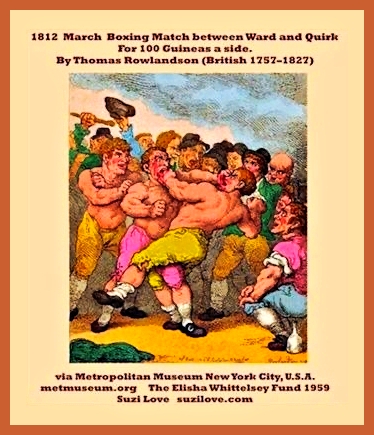
1812 March 1st Boxing Match between Ward and Quirk for 100 Guineas a side. By Thomas Rowlandson, British. via The Metropolitan Museum, New York City, U.S.A. metmuseum.org



I'm an Australian author of contemporary and historical romances, plus history non-fiction. My books range from sexy to erotic, late 1700s to the mid 1800s, and with a dash of Australia thrown into the mix. My heroes and heroines challenge tradition and my stories often expose the seamier levels of life. I now live in a sunny part of Australia after spending many years in developing countries in the South Pacific. My greatest loves are traveling, anywhere and everywhere, meeting crazy characters, and visiting the Australian outback. I hope my books bring history alive and you have fun adventuring with my roguish heroes and feisty heroines.
1812 March 1st Boxing Match between Ward and Quirk for 100 Guineas a side. By Thomas Rowlandson, British. via The Metropolitan Museum, New York City, U.S.A. metmuseum.org
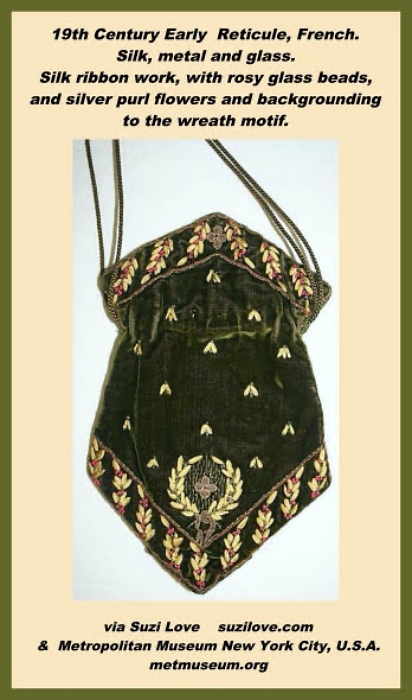
19th cent. Early. Reticule, or Bag, of silk, metal and glass, French, as carried in Jane Austen’s times. Silk ribbon work, with rosy glass beads, and silver purl flowers and backgrounding to the wreath motif. via Metropolitan Museum, N.Y.C., U.S.A. metmuseum.org
Definition Reticule: Bag or purse, often with a drawstring to pull closed and usually made of cloth or covered cardboard and often decorated with beading or embroidery. A reticule, or purse, or handbag, was usually carried by a woman during the Regency period to carry all their daily necessities. Earlier, women used pockets that tied at the waistline and were hidden in the folds of their skirts. Empire style, or early 1800s, high-waisted dresses made it impossible to either sewn in a pocket or to tie on a pocket. So women began carrying small, decorated bags called Reticules, or ridicules, which generally pulled close at the top with a drawstring.

1800 ca. Tan Corduroy Breeches. Drop down front flap, or ‘fall’, with two buttons, three silver metal buttons at the waistband, watch pocket, corner pockets with buttons, pieced back with waist tie, saggy back with extra fabric to allow for easier movement when riding or sitting, four buttons and silk ties at knee. via Whitaker Auction whitakerauction.smugmug.com. https://books2read.com/SuziLoveFashionMen1800-1819.
Typical of a gentleman’s breeches worn during the early 1800s, or the Regency Era, or Jane Austen’s times. They have a front flap, or fall, which unbuttons and drops down and a back waist tie to adjust the waist size and there are buttons and ties to secure the breeches below the knee.


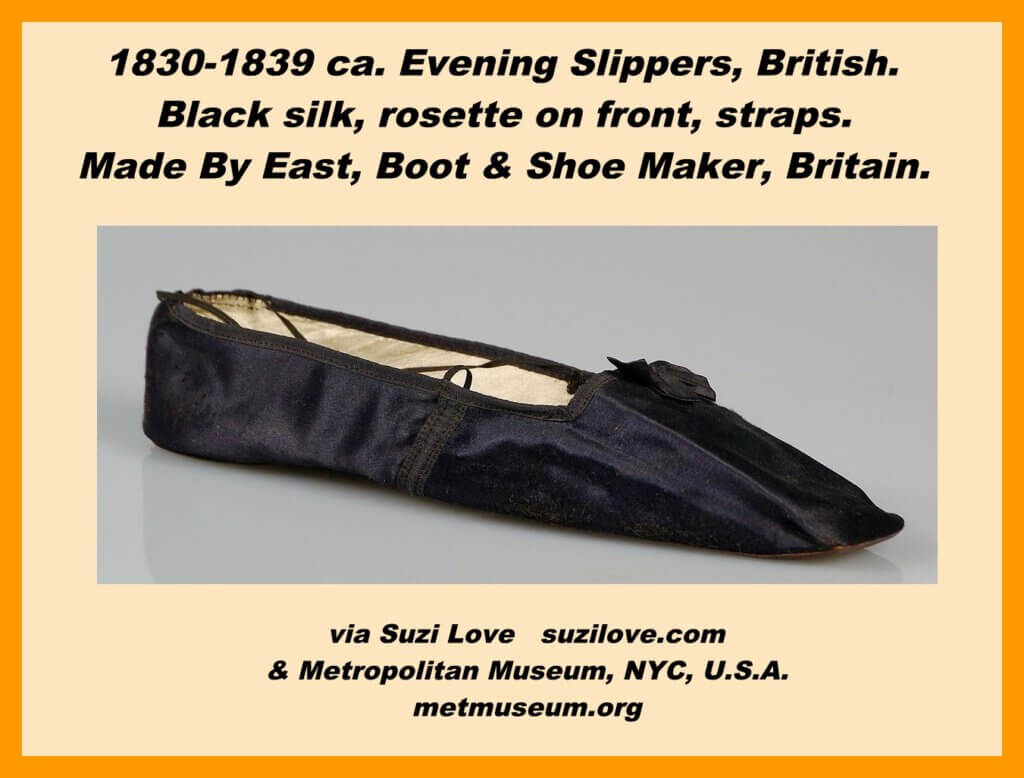
1830-1839 ca. Black Evening Slippers, British. Black silk, rosette on front, straps. Made By East, Boot & Shoe Maker, Britain. via Metropolitan Museum, NYC, U.S.A.
1830s Shoes: Producing different shoes for right and left feet started around 1830 in France. In these first attempts, little paper labels on the insoles of the shoes indicated left and right. However, the shoes were still made on straight lasts with no differentiation between the left and right foot. By the end of the 19th century, producing left and right shoes had become common as shoemakers then worked with combinations of sole and vamp cuts tailored to fit either the right or the left foot. The first steps towards the mechanisation of shoemaking were taken during the Napoleonic Wars. In 1810, engineer Marc Brunel developed a machinery that could mass-produce nailed boots for the soldiers of the British Army. But after the end of the war in 1815, manual labour became cheap, and the demand for military shoes declined. The industrialization of shoemaking began around 1830.

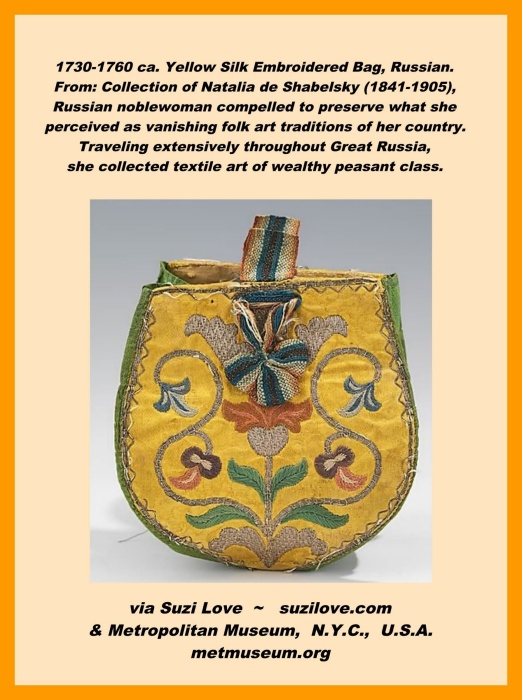
1730-1760 ca. Yellow Silk Embroidered Bag, Russian. From: Collection of Natalia de Shabelsky (1841-1905), Russian noblewoman preserving vanishing folk art traditions of her country. Traveling extensively throughout Great Russia, she collected textile art of wealthy peasant class. via Metropolitan Museum, NYC.
18th Century bags, or purses, were usually designed to hang from the waist or wrist to carry essential daily items on the person rather than making the long walk back through a castle or grand house to fetch things like coins, personal seals, toiletries or medicines.

1815 French Couple. Lady in evening dress with scooped neckline on low-cut pink bodice, floral headpiece and long white gloves. Gentleman in brown tailcoat and stirrup trousers, vest, and casual necktie. Fashion Plate via Journal des Dames et des Modes, or Costume Parisien.
The sort of fashionable outfits and items worn or carried by Jane Austen and her contemporaries when out in public. Ladies outfits for evening were accessorized with gloves, headdresses and jewelry and often dresses were of this shorter length for dancing. Gentlemen were always heavily accessorized as well with the essential of gloves, coats, waistcoats and neatly tied cravats. For more about the fashions of 1815, take a look at History Notes Books 23 and 28 men’s and women’s regency Era fashions.
Fashion Women 1815-1819 History Notes Book 28 What did Jane Austen wear? What was fashionable for women at the end of the Regency Era in Britain and the reconstruction in Europe after the wars. Book 28 for 1815-1819 in History Notes Includes fashions for mourning, riding, dresses, hats, shoes, reticules or bags, underclothing, accessories.
Fashion Men 1800-1819 History Notes Book 23 What was fashionable for men in early 1800s, or Jane Austen’s time, or Regency Era? Suits, hats, shoes, underclothing, fashion accessories, military and bedroom fashions. French fashions and Georgian and Regency Era fashions from Great Britain were copied around the world.


1805 Regency Group of Ladies and Gentlemen dressed as Jan Austen and her family and friends would have dressed. Ladies in dresses, bonnets, shawls, gloves, and carrying a reticule, or bag, and a parasol. Gentlemen in tailcoats, overcoats, trousers, vests, cravats, hats, boots and shoes and carrying walking sticks. via Men And Women In Costumes, 1804-1829.
The Miriam and Ira D. Wallach Division, The New York Public Library, U.S.A.

1816 August Walking Costume, or Pelisse, or Coat, English. Round dress, composed of cambric and trimmed with lace. The body is let in with a profusion of lace. Plain long sleeves, very full, except at the wrist where the fulness is confined by small plaits, sleeve finished by double frill of lace. Over the dress is a Pelisse of blue and white shot sarcenet, lined with white sarcenet and trimmed with white satin. Pelisse sleeve is very full and finished at the wrist by a cuff and bows of ribbon. Pelisse is made half high and finished at neck with a triple fall of rich lace but the neck is bare. White satin hat is turned up in front and ornamented with flowers. Kid gloves, blue kid shoes and a parasol. We are indebted for this tasteful dress to Mrs. Gill of Cork Street, Burlington Garden, London. Fashion Plate via Rudolph Ackermann’s ‘The Repository of Arts’.
Definition: Pelisse Or Redingote: Woman’s long, fitted coat often worn open in front to show off the dress underneath. Sometimes cut away in front. Originally made with several capes and trimmed with large buttons. French word developed from English words, riding coat. reefer. Single- or double-breasted, fitted, tailored, over-all coat usually made from sturdy fabric. Jane Austen and her contemporaries wore long coats like these to keep warm when out and about, visiting, shopping etc. The thin muslin dresses worn in the early 1800s were little protection against European winters. #Regency #Fashion #History

1807 Healthful Dipping. Lady in her white linen chemise, or shift, preparing to take a dip in the spa waters. Scenes of Spa life. By F. Eginton, New Bath Guide. ‘How the ladies did giggle and set up their clacks, All the while an old lady was rubbing their backs.’ From Anstey’s ‘The New Bath Guide’. In Jane Austen’s novels, the resorts of Brighton, Scarborough, Cromer, Lyme and the fictional Sandy ton or Sanditon all get mentions. Women bathed in the sea, via bathing machines pulled down to the water’s edge, or promenaded along beautiful walkways, such as in Cheltenham, near Bat in Britain. Visiting seaside resorts became very popular during the Regency years. Le Beau Monde, or fashionable society, went to spa and beach towns to ‘take the waters’ or to holiday in a fashionable town. To see and be seen. Ladies dressed in light muslin gowns but added colorful accessories to make outfits more interesting.
Chemise Or Shift: Sleeveless, mid-calf length garment of white cotton or muslin was worn next to the skin under stays or corset. Called ‘Shift’ from early Georgian (1700-1750) until Late Georgian (1750-1790) to replace ‘Smock’. By 1800, name replaced by ‘Chemise’.


1800 Elegant Young French Gentleman. Pulling on his top coat over a long tan coat. Tan gloves, brown hat, brown boots, cane. Fashion Plate via suzilove.com and Journal des Dames et des Modes, or Costume Parisien.
Overcoats: Called many names: Greatcoat, or Carrick, or Garrick, or Coachman’s, or Driving. Or Box Coat. Overcoats were voluminous and covered the other clothing. Usually with many capes, or collars, or pelerines covering the shoulders and with buttons down the front. Popular in the 19th century for riding, driving and travel as they kept the wearer warm and snow and rain off the body. Greatcoat: Overcoat with capes around the shoulders for men. Carrick or Garrick Coat: Other names for a gentleman’s inclement weather coat and worn for driving or travel.
