↓
 

Suzi Love

Making history fun, one year at a time.

Header_
  • Home
  • Newsletter
  • Pre order form
  • Shop
    • Cart
    • Checkout
    • My account
    • Refund and Returns Policy
  • Blog
  • BOOKS
    • History Events
    • Kelly’s Justice
    • Outback Arrival
    • Irresistible Aristocrats
    • History Notes
    • Scandalous Siblings
    • Love After Waterloo
    • Regency Life Series
  • Privacy Policy
  • EVENTS
Home » guitar

Tag Archives: guitar

Do you love music, Jane Austen and the Bridgerton family? Treat yourself to a nonfiction book on music history from the 17th, 18th, and 19th Centuries. #Bridgerton #Music #JaneAusten

Suzi Love Posted on September 12, 2026 by Suzi LoveSeptember 11, 2026

Music history from the 17th, 18th, and 19th Centuries. Pianos, pianofortes, harps, viols, violins played during Jane Austen’s times. Musical Instruments were so important in most of the more affluent households in history that large industries grew all around the world to manufacture instruments, musical accessories, and to print sheet music. Musical instruction and encouragement could be found everywhere and both young ladies and gentlemen were encouraged to have musical appreciation. And of course, playing music was on the list of social requirements for all young ladies desirous of becoming a wife and homemaker.

London became Europe’s leading centre for the manufacture of scientific instruments and this led to the manufacture of more musical instruments as well as factories developed and rail transport helped the faster distribution of goods to regional areas. One of the first places that music was used to tell stories and to share enjoyment was in Christmas music. Because music was such an integral part of households, music was always a feature in Magazines. There were advertisements everywhere for musical instruments for sale, for sheet music, and for music lessons.  And of course, of most interest to the ladies were the hundreds of fashion plates included in magazines where people were depicted with their musical instruments.

books2read.com/suziloveMusicGeneral

books2read.com/suziloveMusicPiano

books2read.com/suziloveMusicViolins

HN_6-7-8 Music General History Notes
HN_7 D2D Retailer Buy Link Music Piano History Notes
books2read.com/suziloveMusicPiano
HN_7 D2D Retailer Buy Link Music Piano History Notes

Posted in 1700s, 1800s, 1900s, Australia, Canada, Edwardian Era, England, Europe, furniture, Georgian Era, History, History Notes, household, Music, Pastimes, Quotations, Regency Era, Romantic Era, Suzi Love Books, Suzi Love Images, U.S.A, Victorian Era | Tagged Bridgerton, British history, furniture, Georgian era, guitar, History Notes, HN_6-7-8, household, Jane Austen, music, pastimes, piano, Regency Era, Romantic Era, Suzi Love Books, Victorian Era, violin
guitar_1780 ca. English Guitar, Lisbon, Portugal. Made by Jaco Vieira da Silva Pine back, sides and soundboards, with pine and wood purfling (bordering); brass openwork rose, framed with mother-of-pearl. The English guitar was a fashionable instrument from about 1750, considered easy to play and tuned in C major, although the player would use a capo, much like a modern folk-guitarist, in order to change the key. The tuning pegs were often small metallic pins that could be turned with a watch-key, to keep the strings in tune longer. This instrument was made in Portugal, a country with strong trading links with England, and its peg box is decorated with a paper ‘cameo’ in imitation of a jasper ware medallion, a motif made popular by Josiah Wedgwood (1730-1795) from about 1770. Victoria and Albert Museum, London, U.K.

1780 ca. English Guitar, Lisbon Made by Jaco Vieira da Silva. #Music #Guitar #Portugal #GeorgianEra

Suzi Love Posted on August 27, 2026 by Suzi LoveAugust 22, 2026

1780 ca. English Guitar, Lisbon Made by Jaco Vieira da Silva. Pine back, sides and soundboards, with pine and wood purfling or bordering, brass openwork rose, framed with mother-of-pearl. The English guitar was a fashionable instrument from about 1750, considered easy to play and tuned in C major, although the player would use a capo, much like a modern folk-guitarist, in order to change the key. The tuning pegs were often small metallic pins that could be turned with a watch-key, to keep the strings in tune longer. This instrument was made in Portugal, a country with strong trading links with England, and its peg box is decorated with a paper ‘cameo’ in imitation of a jasper ware medallion, a motif made popular by Josiah Wedgwood (1730-1795) from about 1770. Victoria and Albert Museum, London, U.K.  History Notes Book 6 Music General https://www.suzilove.com/wp-admin/books2read.com/suziloveMusicGeneral \

1780 ca. English Guitar, Lisbon, Portugal. Made by Jaco Vieira da Silva Pine back, sides and soundboards, with pine and wood purfling (bordering); brass openwork rose, framed with mother-of-pearl. The English guitar was a fashionable instrument from about 1750, considered easy to play and tuned in C major, although the player would use a capo, much like a modern folk-guitarist, in order to change the key. The tuning pegs were often small metallic pins that could be turned with a watch-key, to keep the strings in tune longer. This instrument was made in Portugal, a country with strong trading links with England, and its peg box is decorated with a paper ‘cameo’ in imitation of a jasper ware medallion, a motif made popular by Josiah Wedgwood (1730-1795) from about 1770. Victoria and Albert Museum, London, U.K.
.
1780 ca. English Guitar, Lisbon, Portugal. Made by Jaco Vieira da Silva Pine back, sides and soundboards, with pine and wood purfling (bordering); brass openwork rose, framed with mother-of-pearl. The English guitar was a fashionable instrument from about 1750, considered easy to play and tuned in C major, although the player would use a capo, much like a modern folk-guitarist, in order to change the key. The tuning pegs were often small metallic pins that could be turned with a watch-key, to keep the strings in tune longer. This instrument was made in Portugal, a country with strong trading links with England, and its peg box is decorated with a paper ‘cameo’ in imitation of a jasper ware medallion, a motif made popular by Josiah Wedgwood (1730-1795) from about 1770. Victoria and Albert Museum, London, U.K.
HN_6_D2D_Music General_ books2read.com/suziloveMusicGeneral

Posted in 1700s, Decorative Item, Europe, Georgian Era, History, Music, Pastimes, Suzi Love Images | Tagged 1700s Or Georgian Era, europe, Georgian era, guitar, music, Victoria and Albert Museum

1800 Highly Decorated Six String Guitar, Probably Italian, as used in Jane Austen’s lifetimes. #RegencyEra #JaneAusten #Music #Guitar

Suzi Love Posted on August 27, 2025 by Suzi LoveAugust 21, 2025

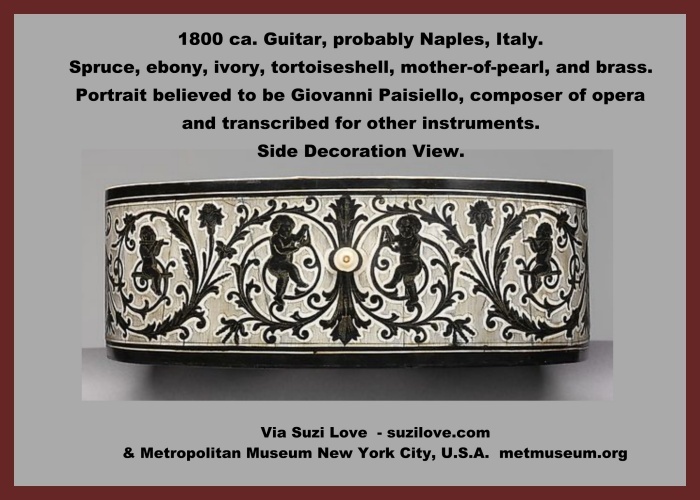
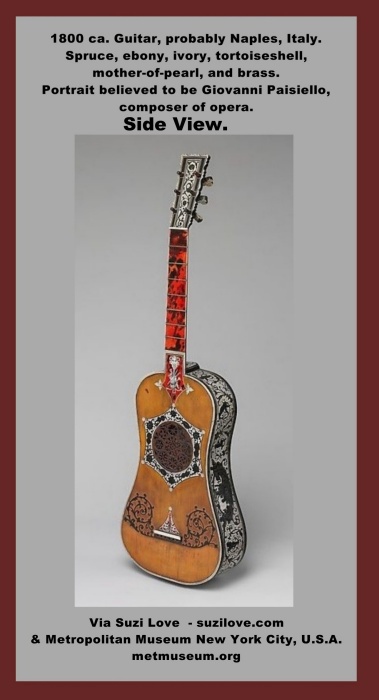
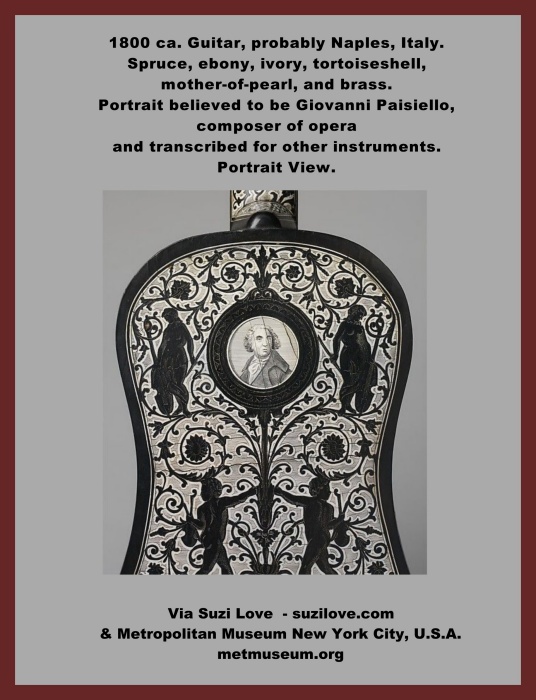
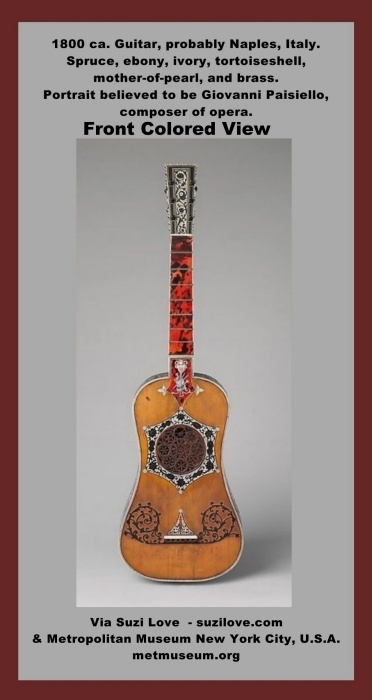
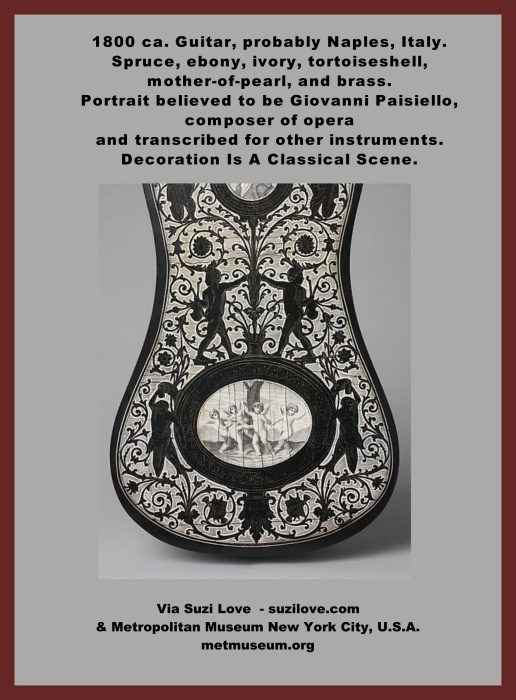
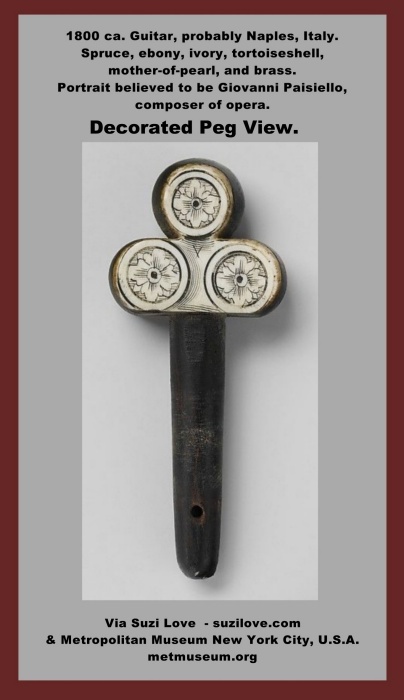
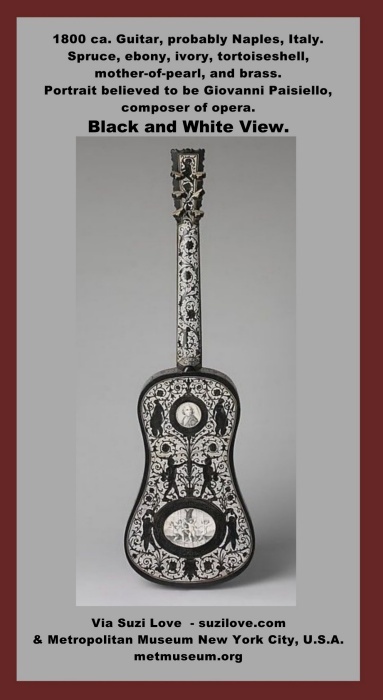
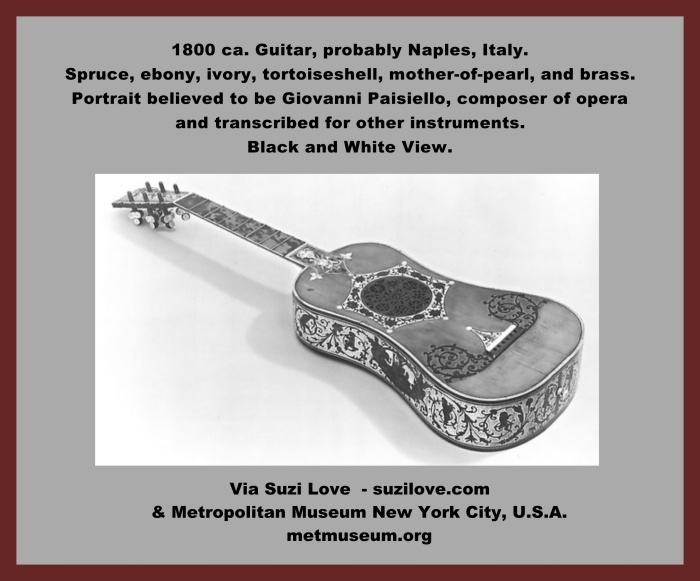
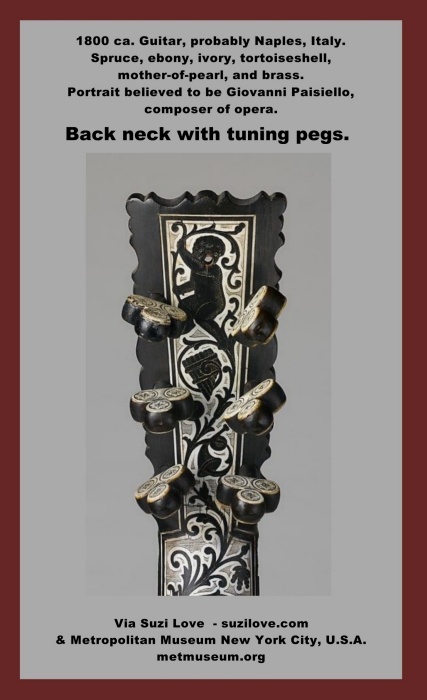
1800 Guitar, Probably Naples, Italy. The sort of guitar people in Jane austen’s era would have played in their homes. Spruce, ebony, ivory, tortoiseshell, mother-of-pearl, and brass. This highly decorated guitar is an early example of a six-string, single-course guitar. The elaborate decoration features classical figures, musical instruments, and floral motifs made from ebony and fit into an ivory ground covering the back, sides, neck, and headstock of the guitar.

A second guitar at the Yale Collection of Musical Instruments features the same decoration, only in reverse, indicating that the decoration was made at the same time by cutting through thin layers of stacked ebony and ivory. A portrait in the center of the upper back is believed to be of Giovanni Paisiello based on his 1791 portrait. Paisiello was a composer of opera and many of his works were transcribed for use on other instruments and his pieces were a favorite of guitarists.

The fingerboard is covered with tortoiseshell over read paint with an ivory satyr inlaid where the neck meets the body.  A carved wooden rosette may be a replacement and is surrounded by an ivory hexagon with ebony inlaid instruments and flowers matching the back. The decorative style is evocative of so-called Baroque guitars of the seventeenth century.  The six-string, single-course guitar became popular in Naples at the end of the eighteenth century and then spread throughout the rest of Europe replacing the earlier five and six double-course guitars. via  Metropolitan Museum New York City, U.S.A. books2read.com/suziloveMusicGeneral

guitar_1800 ca. Guitar, probably Naples, Italy. Spruce, ebony, ivory, tortoiseshell, mother-of-pearl, and brass. Portrait believed to be Giovanni Paisiello, composer of opera and transcribed for use in other instruments. Elaborate decoration features classical figures, musical instruments, and floral motifs of ebony in ivory background on the back, sides, neck and headstock. Via Metropolitan Museum New York City, U.S.A. metmuseum.org
HN_7 D2D Retailer Buy Link Music Piano History Notes
books2read.com/suziloveMusicPiano
HN_7 D2D Retailer Buy Link Music Piano History Notes
Posted in 1800s, Decorative Item, Europe, Jane Austen, Music, Regency Era | Tagged europe, guitar, Italy, Jane Austen, music, Regency Era

SUBSCRIBE TO SUZI LOVE'S NEWSLETTER.

Recent Posts

  • 1817 November White Walking Dress and Brown Spencer As Worn In Bridgerton and Jane Austen Times. #Bridgerton #RegencyFashion #JaneAusten
  • Jane Austen fan? Women’s dress styles around 1800. History Notes Book 12. #RegencyFashion #JaneAusten #nonfiction
  • 1815 June Lady Reading Book Wearing Jane Austen Style White Carriage Dress. #RegencyFashion #JaneAusten #HistoricalFashion
  • 1825 The Quadrant, London, in Jane Austen and Bridgerton years. #JaneAusten #Bridgerton #London #BritishHistory
  • 1809 Women’s Fashions in Jane Austen Times: Dresses, Shawls, Hats and Jewelry. #RegencyFashion #JaneAusten #HistoricalFashion

Recent Comments

  1. Suzi Love on Book Hooks: Petunia and the Pearl Diver. Petunia was too well spoken for a brothel worker. #Regencyromance #historicalromance #London #mfrw
  2. Bianca White on Book Hooks: Petunia and the Pearl Diver. Petunia was too well spoken for a brothel worker. #Regencyromance #historicalromance #London #mfrw
  3. Suzi Love on Book Hooks: Petunia and the Pearl Diver. Petunia was too well spoken for a brothel worker. #Regencyromance #historicalromance #London #mfrw
  4. Suzi Love on Book Hooks: Petunia and the Pearl Diver. Petunia was too well spoken for a brothel worker. #Regencyromance #historicalromance #London #mfrw
  5. Suzi Love on Book Hooks: Petunia and the Pearl Diver. Petunia was too well spoken for a brothel worker. #Regencyromance #historicalromance #London #mfrw

Login

  • Log in

Archives

  • October 2026
  • September 2026
  • August 2026
  • July 2026
  • June 2026
  • May 2026
  • April 2026
  • March 2026
  • February 2026
  • January 2026
  • December 2025
  • November 2025
  • October 2025
  • September 2025
  • August 2025
  • July 2025
  • June 2025
  • May 2025
  • April 2025
  • March 2025
  • February 2025
  • January 2025
  • December 2024
  • November 2024
  • October 2024
  • September 2024
  • August 2024
  • July 2024
  • June 2024
  • May 2024
  • April 2024
  • March 2024
  • February 2024
  • January 2024
  • November 2023
  • October 2023
  • September 2023
  • August 2023
  • June 2022
  • April 2022

Categories

  • 1700s
  • 1700s Mens fashion
  • 1700s Womens Fashion
  • 1800s
  • 1800s Mens Fashions
  • 1800s women's fashion
  • 1900s
  • art
  • Australia
  • Bath
  • bedroom fashion
  • Book Hooks
  • Box Or Container
  • Bridgerton
  • Bus Trips
  • Canada
  • Carriage
  • cartoon
  • Celebrity
  • Chatelaine
  • children
  • Children
  • Christmas
  • Coat or Pelisse Or Redingote
  • Contemporary
  • Corset
  • Couple
  • Customs & Manners
  • dancing
  • December Scandal
  • Decorative Item
  • Dress Or Robe
  • Easter
  • Edwardian Era
  • Embracing Scandal
  • England
  • Ester In Images
  • Europe
  • Events
  • Fashion
  • fashion accessories
  • Food and Drink
  • Four Times A Virgin
  • France
  • furniture
  • Georgian Era
  • Georgian Fashion
  • Google Books
  • Grand Tour
  • Group
  • hats
  • History
  • History Events
  • History Notes
  • History Of Christmases Past
  • household
  • Hygiene
  • Irresistible Aristocrats
  • Jane Austen
  • Keanu Reeves
  • Kellys Justice
  • Legal
  • London
  • Love After Waterloo
  • Loving Lady Katharine
  • medical
  • military
  • money
  • mourning
  • Music
  • Outback Arrival
  • pants
  • Pastimes
  • peerage
  • People
  • Petunia and Pearl Diver
  • Places
  • Pleasure House Ball
  • postal
  • Queensland
  • Quotations
  • Regency Era
  • Regency Fashion
  • Regency Life Series
  • Reticule or Bag
  • riding
  • Romantic Era
  • Royalty
  • Russia
  • Scandalous Siblings Series
  • Scenting Scandal
  • Self Publishing
  • sewing
  • Shirt
  • shoes
  • Shopping
  • South Pacific
  • Spencer
  • sports
  • Suit
  • Sunday Snippet
  • Suzi Love
  • Suzi Love Books
  • Suzi Love Images
  • Suzi Love Writing
  • THe Viscount's Pleasure House
  • travel
  • U.S.A
  • underclothing
  • Vest or Waistcoat
  • Victorian Era
  • Victorian Fashion
  • weapons
  • weddings
  • Writing Tools

1800s men fashion 1800s women's fashion antiques Bridgerton British history Cartoons Corset cravat decorative Dress Or Gown England europe fashion accessories Fashion Plate France Georgian era Georgian Fashion gloves google books Hats And Hair historical romance History Notes household Jane Austen jewelry Journal des Dames et des Modes London Metropolitan Museum NYC pants Redingote Or Pelisse Or Coat Regency Era Regency Fashion Regency London reticule or bag riding Romantic Era sewing shawls Shoes Suzi Love Books Suzi Love Images Tailcoat The Repository Of Arts underclothing Vest or Waistcoat

©2026 - Suzi Love - Weaver Xtreme Theme Privacy Policy
↑