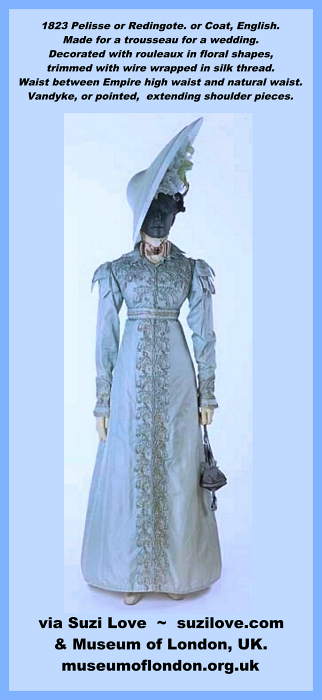
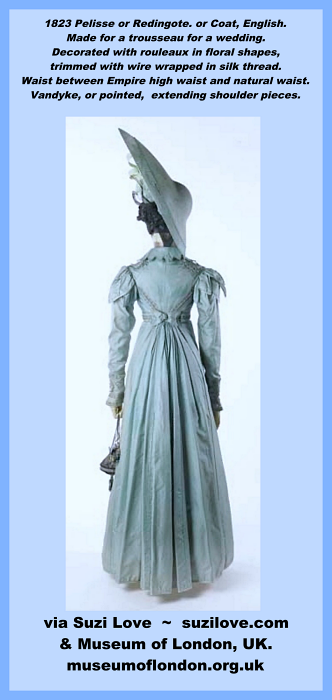
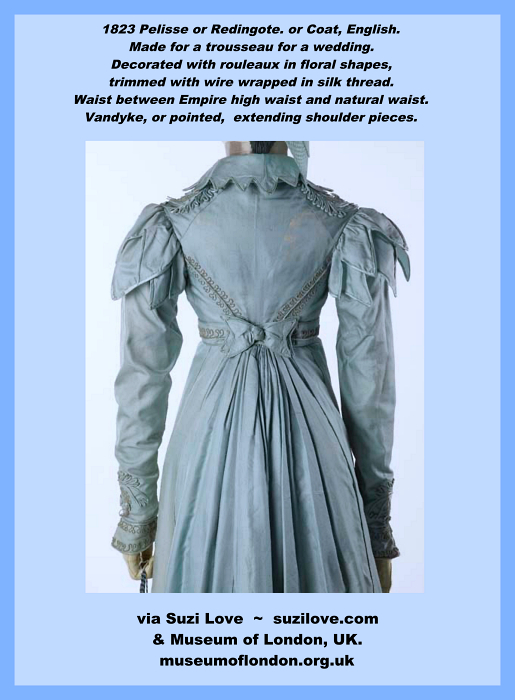
1823 Pelisse or Redingote or Walking dress, or Coat, English. Made for a wedding trousseau in 1823. Intricate decoration from rouleaux applied in floral shapes, and trimmed with wire wrapped in silk thread which stands out from the garment in loops at the ends. ‘Vandyke’ style of pointed shoulder pieces were fashionable at the time. Via Museum Of London, UK.
Definition Redingote Or Pelisse Or Walking Dress Or Coat: French word developed from English words, riding coat. Long fitted outdoor coat worn over other garments for warmth. Often left open at the front to show off the dress underneath. Sometimes cut away in front. Originally made with several capes and trimmed with large buttons. French fashion plates call these coats Redingotes and they are designed for women, men and children. English fashion plates call them a Pelisse, a walking dress, Promenade dress, or Carriage dress. books2read.com/suzilovePelisse
Definition Vandyke: Edging of v-shaped points, the name coming from the Flemish painter, Sir Anthony Vandyke, who was known for his short pointed beard.
1823 Blue Pelisse Or Redingote, British. Made for a trousseau for a wedding. via Museum of London.1823 Blue Pelisse Or Redingote, British. Made for a trousseau for a wedding. via Museum of London.1823 Blue Pelisse Or Redingote, British. Made for a trousseau for a wedding. via Museum of London.1823 Blue Pelisse Or Redingote, British. Made for a trousseau for a wedding. via Museum of London.1823 Blue Pelisse Or Redingote, British. Made for a trousseau for a wedding. via Museum of London.1823 Blue Pelisse Or Redingote, British. Made for a trousseau for a wedding. via Museum of London.1823 Blue Pelisse Or Redingote, British. Made for a trousseau for a wedding. via Museum of London.1823 Blue Pelisse Or Redingote, British. Made for a trousseau for a wedding. via Museum of London.1823 Blue Pelisse Or Redingote, British. Made for a trousseau for a wedding. via Museum of London.
1823 Blue Silk Pelisse, or Coat, Decorated With Rouleaux and Vandyke Points. #RegencyFashion #Pelisse #RomanticEra books2read.com/suzilovePelisse
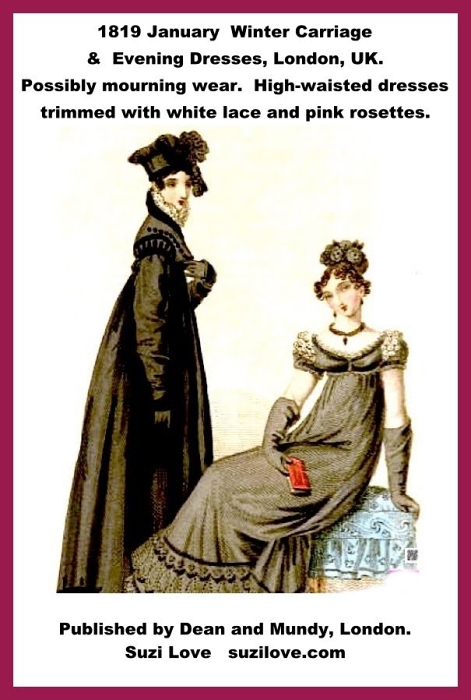
1819 January Two Fashion Plates By Dean and Mundy For Mourning: Winter Carriage and Evening Dresses. High-waisted carriage dress, cuffs edged with white lace and trimmed with gray frog closures, matching plumed hat and shawl. Empire style evening dress with short sleeves and wide neckline trimmed with scallops of white lace, skirt trimmed with white rosettes, evening upswept hairstyle. Fashion Plates Published by Dean and Munday, 1819, London.
Mourning wear was worn in Britain during the regency Era, firstly for Princess Charlotte who died in England on November 6th, 1817, or then for Queen Charlotte, wife of King George III and grandmother of Princess Charlotte, who died on November 17th, 1818. All the fashion magazines featured numerous outfits in black suitable for mourning, followed by many for half mourning in colors of grey, black with touches of white, and later mauve or lavender.
Black was worn for full mourning with various other colors were worn during the months of half mourning, including grey and mauve. However, as black dresses, black tunics, and black lace shawls were popular throughout the Regency years, it is often hard to decide what was definitely made for mourning and what was simply fashionable wear.
After the death of H.R. H. Princess Charlotte on November 7th, 1817, official court mourning was ordered. ‘The ladies to wear black bombazines, plain muslin or long lawn crape hoods, shamoy shoes and gloves, and crape fans. The gentlemen to wear black cloth without buttons on the sleeves or pockets, plain muslin or long lawn cravats and weepers, shamoy shoes and gloves, crape hat bands, and black swords and buckles.’ Two months later, a change of mourning attire was ordered.
1819 January. Winter Carriage and Evening Dresses. High-waisted carriage dress, cuffs edged with white lace and trimmed with gray frog closures, matching plumed hat and shawl. Empire style evening dress with short sleeves and wide neckline trimmed with scallops of white lace, skirt trimmed with white rosettes, evening upswept hairstyle. Mourning wear for Princess Charlotte who died in England in 1817 or for another member of the Royal family. Fashion Plate Published by Dean and Munday, London. 1819 January. Winter Carriage and Evening Dresses, London, U.K. High-waisted carriage dress, trimmed with front closures, matching plumed hat. Empire style evening dress with tiny sleeves and wide neckline trimmed with white lace on sleeves, skirt trimmed with rows of frills. Fashion Plate Published by Dean and Munday, 1819, London.
1819 January Mourning Winter Carriage and Evening Dresses in Bridgerton years. #Bridgerton #RegencyFashion #Mourning #HistoricalFashion https://books2read.com/SuziLoveFashionWomen1815-1819
1818 Long Green Redingote Or Coat With Velvet Collar, French. White shirt with high collar, cravat, white trousers, black boots and a cane. Fashion Plate via Journal des Dames et des Modes, or Costume Parisien.
Definition Redingote Or Pelisse Or Walking Dress Or Coat: French word developed from English words, riding coat. Long fitted outdoor coat worn over other garments for warmth. Originally made with several capes and trimmed with large buttons. For women, the coat was often cut away in the front or left open to show off the dress underneath. French fashion plates call these coats Redingotes and they were worn by men, women, and children. English fashion plates call the coats a Pelisse, a walking dress, Promenade dress, or Carriage dress.
1818 Gentleman’s Long Green Redingote Or Coat as Worn By the Bridgerton Men. #Bridgerton #RegencyFashion #France https://books2read.com/SuziLoveFashionMen1800-1819
1811 White Dress, French. Worn under a white spotted tunic with yellow over dress with long sleeves. White gloves, shoes and hat with plume, or feathers, or aigrette. Fashion Plate via Journal des Dames et des Modes, or Costume Parisien. Even though this is a French fashion plate, Jane Austen and her contemporaries would have worn long coats like these to keep warm when out and about, visiting, shopping etc. The thin muslin dresses worn in the early 1800s were little protection against European winters so warmth and color was added by tunics and coats in a huge variety of styles.
Definition Aigret, aigrette, egret: Plume of feathers or jeweled ornament in shape of feathers worn on head or hats. During the early 19th century., or Jane Austen’s lifetime, the favorite feathers were osprey and heron.
1811 White Dress, French. Worn under a white spotted tunic with yellow over skirt. White gloves, shoes and hat. Fashion Plate via Journal des Dames et des Modes, or Costume Parisien.
Suzi Love Author avatar link
Suzi Love Author
1811 Jane Austen Style White Dress With Spotted Tunic And Yellow Overdress. #JaneAusten #RegencyFashion #19thcenturydress https://books2read.com/SuziLoveFashion1810-1814
Love the Bridgerton Series? Fan of Jane Austen? What did men wear in the early 1800s? Suits, hats, shoes, underclothing, military and bedroom fashions. #Bridgerton #RegencyFashion #JaneAusten #BritishHistory
A Regency Era, or early 1800s, gentleman was outfitted in more practical fabrics, such as wool, cotton and buckskin rather than the fussy brocades and silks of the late 1700s. French fashions and Georgian and Regency Era fashions from Great Britain were copied around the world. Take a look at the outfits worn by gentlemen in the Bridgerton series and in Jane Austen’s lifetime. https://books2read.com/SuziLoveFashionMen1800-1819
The British Regency was the period from 1811-1820. King George III was deemed mad and unfit to rule so his son became his proxy, the Prince Regent, or Prinny to his close friends. This was the situation when Jane Austen was alive. The Regency Era was famous for its beautiful clothing as well as the magnificent buildings erected and furnished in the ‘Regency Style’ under orders from the extravagant Prince Regent.
Fashion Men 1800-1819 History Notes Book 23 What was fashionable for men in early 1800s, or Jane Austen’s time, or Regency Era? Suits, hats, shoes, underclothing, fashion accessories, military and bedroom fashions. French fashions and Georgian and Regency Era fashions from Great Britain were copied around the world. https://books2read.com/SuziLoveFashionMen1800-1819
Love the Bridgerton Series? Fan of Jane Austen? What did men wear in the early 1800s? Suits, underclothing, military, bedroom fashions. #Bridgerton #RegencyFashion #JaneAusten #BritishHistory https://books2read.com/SuziLoveFashionMen1800-1819
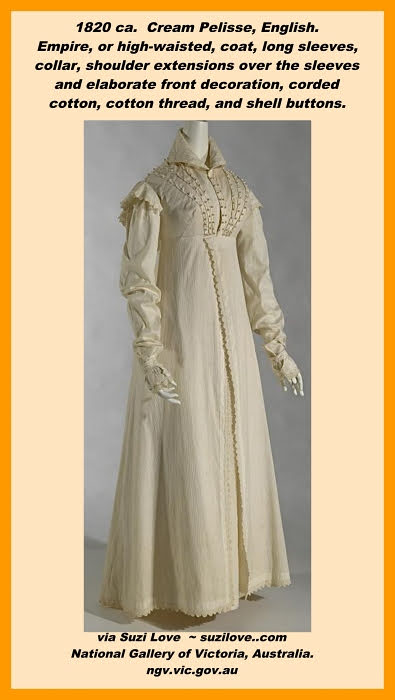
1820 ca. Cream Pelisse, English. Empire, or high-waisted, coat, long sleeves, collar, shoulder extensions over the sleeves and elaborate front decoration, corded cotton, cotton thread, and shell buttons. via National Gallery of Victoria, Australia. ngv.vic.gov.au books2read.com/suzilovePelisse
Definition Redingote Or Pelisse Or Walking Dress Or Coat: French word developed from English words, riding coat. Long fitted outdoor coat worn over other garments for warmth. Often left open at the front to show off the dress underneath. Sometimes cut away in front. Originally made with several capes and trimmed with large buttons. French fashion plates call these coats Redingotes and they are designed for women, men and children. English fashion plates call them a Pelisse, a walking dress, Promenade dress, or Carriage dress.
1820 ca. High-Waisted Cream Pelisse, Or Coat, as fashionable in Bridgerton times. #Bridgerton #RegencyFashion #Pelisse #Coat books2read.com/suzilovePelisse
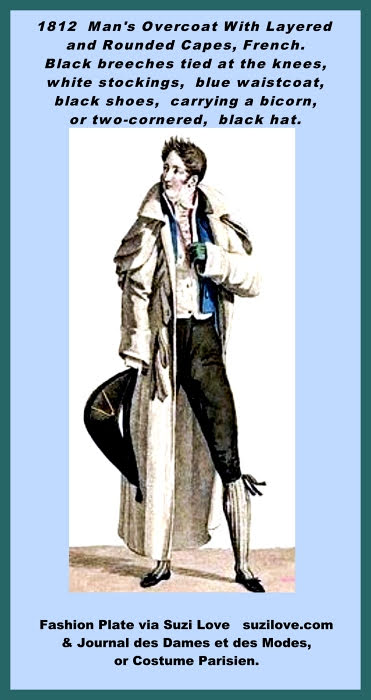
1812 Man’s Overcoat With Layered and Rounded Capes, French. Black breeches tied at the knees, white stockings, blue waistcoat, black shoes and carrying a bicorn, or two-cornered black hat. Fashion Plate via Journal des Dames et des Modes, Costume Parisien.
In the early 1800s, men no longer wore complicated styles and extravagant fabrics. Men’s fashion simplified and became more conservative. A well cut tailcoat, vest, pantaloons and an immaculate cravat of beautiful white linen in the style of George Bryan, or Beau, Brummell. Clothes were a status symbol and indicated a man’s social position. These clothing items were the sort worn by Jane Austen’s male family and friends.
1819 Pale Blue Redingote, Pelisse or Walking Dress, French. Blue redingote with pink bow showing off gorgeous neck frills and bonnet of castor decorated with tassels. The type of outfit young Regency Era ladies would have worn if they were out shopping on Bond Street, walking in a park, or taking a carriage ride through Hyde Park. Fashion Plate via Journal des Dames et des Modes, or Costume Parisien.
Definition Redingote Or Pelisse Or Walking Dress Or Coat: French word developed from English words, riding coat. Long fitted outdoor coat worn over other garments for warmth. Often left open at the front to show off the dress underneath. Sometimes cut away in front. Originally made with several capes and trimmed with large buttons. French fashion plates call these coats Redingotes and they are designed for women, men and children. English fashion plates call them a Pelisse, a walking dress, Promenade dress, or Carriage dress.
1821 December Green Promenade Dress, English. High waisted coat over white dress with ruffled collar, vertical front bows, short puffed sleeves over long straight sleeves, matching ruffled bonnet and yellow gloves. Fashion Plate via Rudolph Ackermann’s ‘The Repository of Arts’, London, U.K.
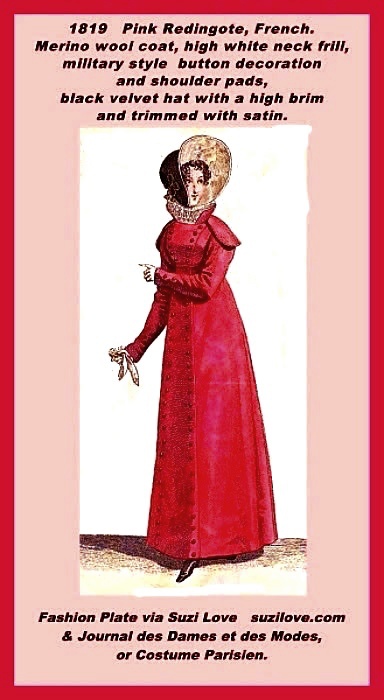
1819 Pink Merino Wool Redingote, French. Merino wool coat over a white dress with a high lace collar, military style buttons decoration and shoulder pads, matched with a black velour, or velvet, hat with a high front brim and lined with white satin. Military style shoulder pads and front buttons. It was fashionable at the time to wear military inspired clothing to show support of all the fighting men involved in the Napoleonic and other wars. The type of outfit young Regency Era ladies would have worn if they were out shopping on Bond Street, walking in a park, or taking a carriage ride through Hyde Park. Fashion Plate via Journal des Dames et des Modes, or Costume Parisien. Fashion Plate via Journal des Dames et des Modes, or Costume Parisien.
Definition Redingote Or Pelisse Or Walking Dress Or Coat: French word developed from English words, riding coat. Long fitted outdoor coat worn over other garments, especially light-weight muslin dresses, for warmth. Often left open at the front to show off the dress underneath. Sometimes cut away in front. Originally made with several capes and trimmed with large buttons. French fashion plates call these coats Redingotes and they are designed for women, men and children. English fashion plates call them a Pelisse, a walking dress, Promenade dress, or Carriage dress.
1819 January Red Redingote, French. Also called a Pelisse or Walking Dress in England. Merino wool coat over a white dress with a high lace collar, matched with a black velour, or velvet, hat lined with white satin. Fashion Plate via suzilove.com and Journal des Dames et des Modes, or Costume Parisien.
1819 Bridgerton or Jane Austen Style Pink Merino Wool Redingote, Or Coat, With Military Styling. #Bridgerton #JaneAusten #RegencyFashion #FashionPlate #French https://books2read.com/SuziLoveFashionWomen1815-1819