What did ladies do and wear in Jane Austen’s time, or early 1800s? #Regency #History #nonfiction Books 4 and 5 Regency Life Series. Young Lady’s Day and Older Lady’s Day in Books 4 and 5 in the Regency Life Series. These books depict the often-frivolous life and fashions of ladies in the early 1800’s, or during the lifetime of Jane Austen, but also gives a glimpse into the more serious occupations ladies may undertake. Through historic images, historical information, and funny anecdotes, they show how a lady fills her day, where she is permitted to go, and who she spends time with. These light-hearted looks at the longer Regency years are an easy to read overview of what people did and wore, and where they worked and played. There is plenty of information to interest history buffs, and lots of pictures to help readers and writers of historical fiction visualize the people and places from the last years of the 18th Century until Queen Victoria took the throne. Young Lady’s Day ~ Older Lady’s Day
1826 House Of Lords In High Debate. From A Regency Gentleman’s Life. From The English Spy By Robert Cruikshank.
Light-hearted look at a young man’s day in the early 1800s. Depicts the ups and downs of a young gentleman’s day in the Regency Era, or Jane Austen’s years. Through historic images, historical information, and funny anecdotes, it shows how a young man about town fills his day, where he goes, and who he spends time with. This light-hearted look at the longer Regency years is an easy to read overview of what people did and wore, and where they worked and played. There is plenty of information to interest history buffs, and lots of pictures to help readers and writers of historical fiction visualize the people and places from the last years of the 18th Century until Queen Victoria took the throne. Regency Life Series Book 3 Young Gentleman’s Day.com/suziloveYGD
1826 An Affair Of Honor Decided With Pistols In Hyde Park London, U.K. A Regency Gentleman’s Life. From The English Spy By Robert Cruikshank. By the Regency Era, dueling was outlawed, yet duels still happened because the courts were made up of peers who were reluctant to charge another peer with murder as a result of a duel. Gentlemen considered a duel a matter of honor and death was preferable to being labeled a coward.
Duels had a code of honor and were fought not so much to kill the opponent as to gain satisfaction and restore honor by demonstrating a willingness to risk your life. Originally dueling was only for the male members of nobility but then extended to all members of the upper classes. At first, duels were fought with swords but by the Regency Era, duels with pistols were more common. Some duels were also fought between women.
Favorite dueling grounds near London included Hampstead Heath, Chalk Farm and the common land that extended south of the Thames over modern Battersea, Putney and Wimbledon. The windmill there was a popular landmark beneath which duelists often agreed to meet. These locations were convenient for their proximity to the city, yet also sufficiently remote to avoid interruption and in the event of a fatality, attractively close to potential getaway routes on the roads out of London.
1826 An Affair Of Honor Decided With Pistols In Hyde Park London, U.K. A Regency Gentleman’s Life. From The English Spy By Robert Cruikshank.
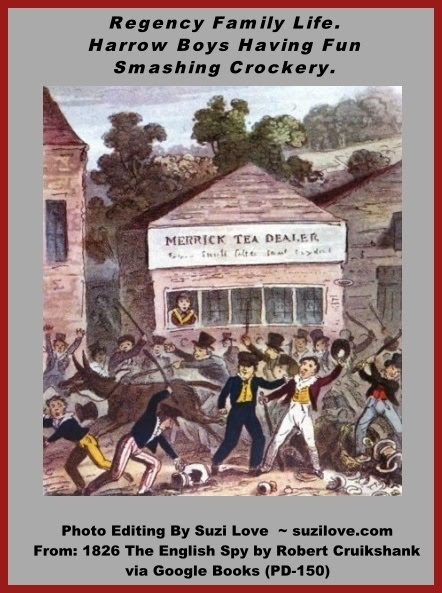
1826 Harrow Boys Having Fun Smashing Crockery. Regency Family Life. Photo Editing By Suzi Love. From: 1826 The English Spy By Robert Cruikshank via Google Books (PD-150)
1826 A Regency Gentleman’s Life In Jane Austen’s Times. #JaneAusten #RegencyEra #Cartoon #England. via 1826 The English Spy By Robert Cruikshank via Google Books (PD-150)
The young man’s friends may help him decide what activities they would engage in. Perhaps they would decide to watch a dogfight or a cockfight. Or perhaps go and see a mill, where two burly boxers would pummel each other’s faces until one was declared winner and bets could be settled. Later that night, the rowdy group would head to whatever gambling hell was in vogue where they would pass several hours drinking and playing cards. Dark and sordid rooms, smoky interiors, loud and drunken men, and losing your quarter’s allowance from your father were all willingly suffered if a young man had enticed a buxom wench to sit on his lap and make him forget his woes. And how angry his father would be when he learned his son had gambled away yet another three months of his allowance.
Having filled in their morning, the men wander into Town to meet their cronies for luncheon. Thank goodness it’s time for a few bottles of claret!! Just the thing for fixing a hang-over, plus, a great place to discuss how to eke out their never-enough allowances until the young men could beg their long-suffering fathers for a little more spending money.
Price Egan’s ‘Life In London in 1823 described a young man’s entertainment choices. ‘ …bit of a stroll,’ in order to get rid of an hour or two. A turn or two in Bond Street, a stroll through Piccadilly, a look in at Tattersall’s, a ramble through Pall Mall, and a strut on the Corinthian path, fully occupied the time until the hour for dinner arrived, when a few glasses of rich wine put them on the path for vice.’ A group of young men would then head to Vauxhall. ‘‘…if enjoyment is your motto, you may make the most of an evening at Vauxhall, more than at any other place in the metropolis. It is all free-and-easy. Stay as long as you like, and depart when you think proper.’
1804 Dandies In Morning and Evening Dress. By Isaac Robert Cruikshank. ‘Dandies In A Morning Dress’. Man in morning suit with hat and umbrella, woman with large hat and shawl. ‘Dandies In A Evening Dress’. Man in short evening jacket with handkerchief, woman with large feather headpiece. Via British Museum, London, UK. britishmuseum.org (PD-Art)
1817 April Ladies’ Voucher for all the Wednesday balls at Almack’s Assembly Rooms, London, U.K. in April 1817. The voucher is for the Marchioness of Buckingham to attend the balls at Almack’s “on the Wednesdays in April 1817.” There are initials in the lower right hand corner marked, “MD”. These initials might be for Mary Marchioness of Downshire who may briefly have been a patroness ca. 1816-1817. The red wax seal is also intact on the front. “Pall Mall” is written on the back of the card.Via Huntington Museum, California, U.S.A. https://hdl.huntington.org/digital/collection/p15150coll7/id/10672/
Subscribers to Almack’s were allowed to bring a guest to a Ball, if they were approved first. They called at the Rooms in person and were either granted a Strangers Ticket of admission or were banned. Rooms were open for supper, gaming dancing lasting the night. At eleven o’clock, doors were closed and no one, not even celebrities were admitted. Once a young lady making her debut during the London Season had been granted a ticket to Almack’s, her social standing was assured. The Patronesses introduced the debutante to people of importance and selected her dance partners.
Writing Regency Era Fiction Or Nonfiction? Need more information on Older Gentleman’s Day in early 1800s, or the Bridgerton family or Jane Austen’s Regency Era. A lighthearted overview of an older gentleman’s clothing, social life, and responsibilities in the early 1800s. Take a look at where an older man went, what he wore, and how he managed the family’s finances and his estates. Older Gentleman’s Day Regency Life Series Book 3 books2read.com/suziloveOGD