1804-1810 ca. Empire style, or high-waisted, French Court Dress called ‘Joséphine’, Attributed to embroiderer Jean-François Bony, Lyon, France. Silk tulle, silk, chenille, and cotton. via Musée des Tissus et musée des Arts décoratifs, Lyon. via Musée des Tissus et musée des Arts décoratifs, Lyon.
Definition Empire Style: Named after the First Empire in France, by 1800 Empire dresses had a very low décolleté, or neckline and a short narrow backed bodice attached to a separate skirt. Skirts started directly under the bust and flowed into the classical relaxed wide styles of Greece and Rome. This style of dress is associated with Jane Austen and her contemporaries as a simple cotton high-waisted dress was worn most days and accessorized according to the importance of the occasion.
1809 The King Of Great Britain. From: 1809 A Book Explaining The Ranks and Dignities Of British Society. via Google Books. (PD-180) BRITISH RANKS, The King Of Great Britain and His Or Her Powers during Jane Austen’s lifetime.
BRITISH RANKS, THE KING .
The supreme executive power of these kingdoms is vested by our laws in a single person, the King or Queen, for it matters not to which sex the crown descends, but the person entitled to it, whether male or female, is immediately invested with all the ensigns, rights, and prerogatives of sovereign power .
In the earliest periods of our his tory the crown appears to have been elective. But hereditary succession has now been long established , and has proved a good preservative against that periodical bloodshed and misery, which both history and experience have long shewn are the consequences of elective kingdoms. The crown descends lineally to the issue of the reigning monarch , and not till the failure of the male issue is it allowed to be taken by the female.
Lawyers say the King of England is a mixed person, a priest as well as a prince and at his coronation he is anointed with oil, as the priests and kings of Israel were, to intimate that his person is sacred. The principal duty of the king is to govern his people according to law and these are the terms of the oath administered usually by the Archbishop of
Canterbury at his coronation, in the presence of the people, who on their parts do reciprocally take the oath of allegiance to the crown :
“ The archbishop, or bishop, shall say, Will you solemnly promise and swear to govern the people of this kingdom of England , and the dominions thereto belonging,
according to the statutes in parliament agreed on and the laws and customs of the
same?
The king or queen shall say , I solemnly promise so to do .
Archbishop , or bishop .– Will you to your power cause law and jus tice , in mercy , to be executed in all your judgments?
King or queen, I will,
Archbishop , or bishop – Will you to the utmost of your power maintain the laws of God , the true profession of the gospel and the protestant reformed religion
established by the law? And will you preserve unto the bishops and clergy of this realm, and to the churches com mitted to their charge, all such rights and privileges as by law do or shall appertain unto them or any of them ?
King or queen, All this I promise to do .
After this , the king or queen , laying his or her hand upon the holy gospels , shall say , The things which I have here before promised , I will perform and keep : so help me God . And then shall kiss the book .
One of the principal bulwarks of our liberty is the certain and definite limitation of the king’s prerogative, the extent and
restrictions of which are marked out with the greatest clearness. But in the exertion
of those powers which the LAW has given him , the king is irresistible and absolute. He is considered by the laws of England as the head and supreme governor of the national church and, in virtue of this authority, he convenes , prorogues
rogues , restrains , regulates , and dis solves all ecclesiastical synods or
convocations. He has the supreme right of patronage over all ecclesiastical benefices and if they are not presented to within the time prescribed , their lapse becomes the
advantage of the crown. In regard to foreign concerns, the king is the delegate or
representative of his people. He has power, by his prerogative, with out any act of
parliament, to make war or peace, conclude treaties, grant safe conducts, give
commissions for raising and regulating fleets and armies, as well as for erecting,
manning, and governing forts, and other places of strength. He can prohibit the
exportation of arms and ammunition out of the kingdom, can dispose of magazines, castles, ships, public moneys, etc. and all that is done in
regard to foreign powers by the royal authority, is the act of the whole nation. He has the sole power of sending ambassadors to foreign states, and receiving ambassadors at home. He convokes, adjourns, prorogues, and dissolves parliaments and may
refuse his assent to any bill passed by both houses, without giving his reason for it .
He may increase the number of members of either house at plea sure, by creating
new peers and bestowing privileges on other towns for sending burgesses to
Parliament, but the last has by late kings been given up.
The sole power of conferring dignities and honors is entrusted to him so that all
degrees of nobility and knighthood, and other titles, are received by immediate grant from the crown. And the king has also the prerogative of conferring privileges upon private persons such as granting place or precedence to any of his subjects such is also the power to enfranchise an alien and make him a denizen, and the prerogative of
erecting corporations. The coining of money too, as well as the settling the
denomination or value for which it shall pass current, is the act of the sovereign
power.
But to take all the characters into view in which the king is considered in domestic
affairs would be almost endless for from thence an abundant number of prerogatives arise. All lands re covered from the sea , gold and silver mines, royal fishes etc.
be long to him. He can unite, separate, enlarge, or contract the limits of ecclastical
benefices and, by his letters, erect new bishoprics, colleges etc. He can dispense with the rigor of ecclesiastical laws except those which have been con firmed by act of
parliament, or declared by the bill of rights. He has also power to moderate the
rigor of the law to pardon a man condemned by law except in appeals of murder,
and in case of impeachment by the house of commons, and to interpret by his
judges in statutes and cases which are not defined by law.
But though he be entrusted with the whole executive power of the law, yet he cannot sit in judgment in any court for justice must be administered according to the powers committed and distributed to the several courts.
As the king is declared to be the supreme head in matters both civil and ecclesiastical so no suit can be brought against him even in civil matters because no court can
have jurisdiction over him. The law also ascribes to the king in his political capacity absolute perfection. The king can do no wrong, by which ancient and fundamental maxim we are not to understand that every transaction of government is of course just and lawful but that whatever is exceptionable in the conduct of public affairs is not to be
imputed to the king nor is he answerable for it personally to his people and farther that the prerogative of the crown extends not to do any injury. It is
created for the benefit of the people and therefore cannot be exerted to their
prejudice. In the king there can be no negligence and therefore no delay will bar his
right. In the king also there can be no infamy, stain, or corruption of blood. And the
law ascribes a kind of perpetuity, or immortality to him. His death is termed his
demise , because the crown is thereby demised to another. He is not in law liable to
Death, being a corporation of him self that lives for ever. There is no interregnum but the
moment one king dies, his heir is king, fully and absolutely, without any coronation , ceremony etc. To these it may be added that by the law the king is said in a manner
to be every where in all courts of judicature , which he alone has the right of erecting and therefore cannot be nonsuited.
The power of issuing proclamations is vested in the king alone, considered as the fountain of justice. The laws make it high treason barely to imagine or intend the death of the king, and because the destruction of the king may ensue
that of his great counsellors or officers, it is felony in any of the king’s subjects to
conspire even that. Some things the king cannot do.
He cannot divest himself or successor of any part of the regal prerogative or
authority and there are two things which he cannot do without the consent of
Parliament: the making of new laws and the raising of new taxes.
The king cannot dispense with the laws nor do any thing contrary to law. In England the law is as much superior to the king , as to any of his subjects and the obedience
of the king of England to the laws is his greatest glory while it is the security of the
rights and liberties of his people who are the greatest as well as the freest people on the face of the earth , merely because their sovereigns are obliged to live in
subjection to the written laws of the land.
The title of grace was first given to our kings about the time of Henry IV and that of majesty first to Henry VIII. The title of his present Majesty is , GEORGE the Third , King of the United Kingdom of Great Britain and Ireland, Defender of the Faith,
Sovereign of the Orders of the Garter, Thistle, Bath and St. Patrick, Duke and Elector of Brunswick Lunenburg, Bishop of Osnaburg and Arch Treasurer of the Holy Roman Empire.
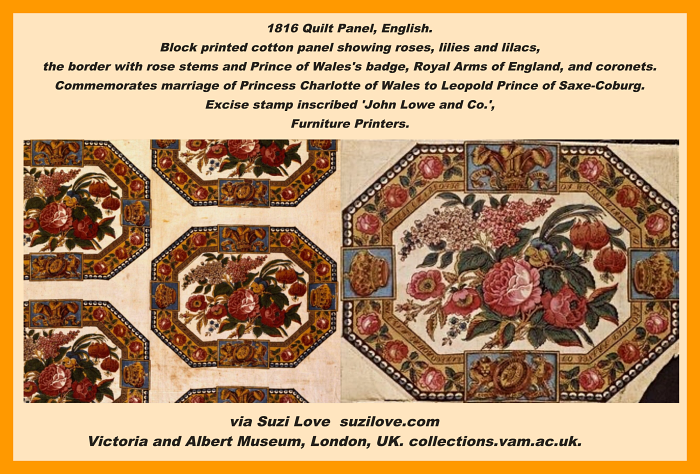
1816 Block Printed Quilt Panel made to celebrate the Marriage of Princess Charlotte to Prince Leopold of Saxe-Coburg.
Textile of block-printed white cotton in madder colours with pencilled blue. The cotton is printed with 9.5 octagonal panels intended to be cut out and applied to patchwork quilts. Each panels contains a bunch of flowers. Around the inner border is an inscription of Princess Charlotte of Wales married to Leopold Prince of Saxe-Coburg May 2, 1816. In the borders are three Prince of Wales feathers, the Royal Arms, and a crown on each side. At the end of the textile is printed a rectangular panel containing the manufacturers name and in a corner is the name ‘G. Swindels’.
This quilt has an excise stamp for 1816 and is inscribed ‘John Lowe and Co. Furniture Printers, Shepley Hall’, providing the name of the only identifiable manufacturer of these panels, although there are likely to have been others. John Lowe was a well-known firm of calico printers with large cotton factories and extensive bleaching grounds close to the River Tame near Ashton-under-Lyne in Lancashire.
Hand-quilting is done on a frame using needles called ‘betweens’. The stitches are executed with one hand; the other hand is kept underneath the quilt to feel for the needle. Small, uniform stitches (usually a ‘running stitch’) are taken through the three layers to form a decorative design. In ‘piecing’ or ‘patchwork’, small pieces of fabric are sewn together to produce a decorative design. The most enduring method in Britain is done by hand, and is known as ‘piecing over paper’. The pattern is first drawn onto paper and then accurately cut. Small pieces of fabric are tacked round each of the shapes, and then joined together from the back using overstitch. Most of the quilt top visible here has been pieced over paper, but in some areas the fabrics have been applied directly on to the earlier quilt that forms the wadding.
11811 Half-Mourning Dress, French. Black dress, high white neck ruffle, black hat with white trim and white shoes.
In November, 1810, Princess Amelia, youngest daughter of George III, died. At the end of 1810 full mourning of complete black would have been worn but by the beginning of 1811, half mourning would still have been to respect the loss of a royal family member. Half-mourning allowed touches of silver, grey, mauve and white to be added to a mostly black outfit and would be worn after the period of full mourning was ended, times depending on the relationship to the deceased person. Garments and accessories could either be trimmed with black, jet jewelry worn, black ribbons added, or a layer of black net or gauze added to a dress or hat.
Jane Austen and her family would have worn this type of outfit when mourning a relative or friend. However, as black dresses, black tunics, and black lace shawls were popular throughout the Regency years, it is often hard to decide what was definitely made for mourning and what was simply fashionable wear. Fashion Plate via Journal des Dames et des Modes, or Costume Parisien. https://books2read.com/SuziLoveFashion1810-1814
Definition Half or Slight Mourning: Allowed touches of grey and white to be added to full, or deep, mourning ensembles. Some lustre, or shine, was allowed in fabrics and accessories. After a time, mauve or deep purple could also be worn.
What was fashionable for women in Jane Austen’s times? Mourning, riding, daytime, evening clothing, plus underclothing, corsets and accessories. Wars were being fought so women adopted military looks in support of soldiers. https://books2read.com/SuziLoveFashion1810-1814 History Notes Book 27 Women’s Fashions 1810-1814.
These are the types of outfits worn by Jane Austen and contemporaries in English magazines, where French fashions were obsessively copied despite the two countries being at war for many years. In Jane Austen’s years, she and her contemporaries spent a lot of time walking outdoors. People were encouraged to partake in outdoor pursuits to maintain good health. Fragile slippers were worn for balls and evening events but for walking sturdier shoes were needed, In the early 1800s, these were typically made of leather, had a very small heel, slightly rounded toes and were laced up on the top.
Somerset House, London, UK. London’s Best Places to Visit. Home to Royal Academy and The Great Institutions.
Demolition of the old house, between the Strand and the River Thames, began in 1775 and continued in stages as the new Somerset House was constructed around it. When the new building rose from the rubble, the Royal Academy, which had been one of the last occupants of the old Somerset House, became one of the first occupants of the apartments which fronted the Strand, providing tangible continuity between the old and the new.
Timeline
1547 Edward Seymour, Lord Protector and Duke of Somerset, starts building a palace for himself on the banks of the Thames
1552 Seymour is executed at the Tower of London; ownership of his palace, nearly complete, passes to the Crown
1553 Aged 20, Princess Elizabeth moves to Somerset House; she lives there until 1558, when she’s crowned Queen Elizabeth I
1603 Anne of Denmark, wife of James I of England (James VI of Scotland), moves to Somerset House, which is renamed Denmark House in her honour
1604 The Treaty of London, ending the 19-year Anglo-Spanish War, is negotiated and signed at Denmark House
1609 Anne of Denmark invites Inigo Jones and other architects to redesign and rebuild parts of the palace; work continues until her death in 1619
1625 Charles I is crowned king; his wife, Henrietta Maria of France, commissions Jones and others to undertake more construction and renovation work, including a lavish new Roman Catholic chapel completed in in 1636
1642 The English Civil War begins; soon afterwards, General Thomas Fairfax takes over the palace as the headquarters for the Parliamentary Army
1649 The Civil War ends and Charles I is executed; Parliament tries and fails to sell Denmark House, but successfully sells its contents for the then-huge sum of £118,000
1652 Inigo Jones dies at Denmark House
1660 After Charles II, her son, is crowned king at the start of the Restoration, Henrietta Maria returns to Denmark House; more new construction follows
1665 The Plague sweeps London; Henrietta Maria moves back to France, where she dies in 1669
1666 The Great Fire of London destroys much of the City of London, but stops just short of Denmark House
1685 Charles II dies and his wife, Catherine of Braganza, moves into Denmark House; Sir Christopher Wren oversees yet more construction and renovation work
1693 Catherine of Braganza leaves Denmark House, the last royal to live in the palace
early 1700s Denmark House is used as grace-and-favour apartments, offices, storage and stables
c.1750 Canaletto paints two views from the terrace
1775 After decades of neglect, the original Somerset House is demolished; architect William Chambers immediately starts work on its replacement
1779 The Royal Academy of Arts becomes the first resident of new Somerset House in what’s now known as the North Wing
1780 The Royal Society and the Society of Antiquaries take up residence in the North Wing; Somerset House hosts the first Royal Academy Exhibition
1786 The Embankment Building, known today as the South Wing, is completed; the East and West Wings are completed two years later
1789 The Navy Board completes its move to Somerset House and eventually occupies one-third of the site; the Stamp Office, responsible for taxing newspapers and other documents, joins the board in the South Wing
1795 William Chambers, then aged 72, retires; James Wyatt replaces him as the building’s architect
1801 The new Somerset House is deemed complete, its construction having cost a mammoth £462,323
1829 Sir Robert Smirke starts work on King’s College, which opens in 1831 and is finally completed in 1835
1836 The General Register Office, responsible for births, deaths and marriages, is established here
1837 One year after the final Royal Academy Exhibition at Somerset House, the academy moves to Burlington House on Piccadilly
1849 Having merged in 1834, the Stamp Office and the Board of Taxes join with the Board of Excise to form the Inland Revenue, which remains in residence for more than 150 years
1856 Seven years after James Pennethorne started work on its design, the New Wing is completed
1857 The Royal Society moves out of Somerset House to join the Royal Academy of Arts at Burlington House; the Society of Antiquaries follows 17 years later
1864 Work begins on the Victoria Embankment, designed by Sir Joseph Bazalgette; the embankment is completed in 1870
1873 The Admiralty leaves Somerset House; its offices are taken over by the Inland Revenue
1940s Near the start of World War II, the Inland Revenue temporarily moves out of Somerset House; the Ministry of Supply takes its place
1950 Sir Alfred Richardson starts a two-year project to rebuild the Navy Staircase, known today as the Nelson Stair, which had suffered terrible bomb damage in 1940
1970 After 134 years at Somerset House, the General Register Office moves out
1989 The Courtauld Institute of Art moves into the North Wing
1997 The Somerset House Trust is established to preserve and develop Somerset House for public use
2000 The River Terrace opens to the public for the first time in more than a century; the Hermitage Rooms and the Gilbert Collection both open; then, in December, Somerset House installs a temporary ice rink for the first time
2001 American band Lambchop plays the first gig in the Edmond J. Safra Fountain Court; a full programme of shows follows in 2002 and continues today as the Summer Series
2009 London Fashion Week takes place at Somerset House for the first time
2011 The HMRC (formerly the Inland Revenue) closes its offices at Somerset House
The Royal Academy of Arts
George III, described as an “enthusiastic if undiscriminating collector and patron of the arts”, provided invaluable patronage for the three learned societies. When old Somerset House was relinquished by the Crown, the King reserved to himself the right to appropriate sufficient space in the new building for the Royal Academy of Arts, the Royal Society, and the Society of Antiquaries.
The Great Exhibition Room
1808 The Exhibition Room at Somerset House.
The most important part of the building for the Royal Academy was its Exhibition Room. Situated at the top of the steep, winding staircase, it was roughly 53 x 43 feet and 32 feet high including the lantern, and was described by Joseph Baretti as, “undoubtedly at that date the finest gallery for displaying pictures so far built.” It was here that George III was given a preview of the first Royal Academy Exhibition held at his command in 1780.
Year by year, the exhibits increased. There were 547 in 1781, 1,037 in 1801, and 1,165 in 1821, so that the pictures had to be hung almost from floor to ceiling and with the frames touching one another. From 1832 onwards there was talk of the Royal Academy moving to more spacious rooms in what is now the National Gallery, which was being built at the north end of Trafalgar Square. Accordingly, the last exhibition at Somerset House was held in 1836.
When the Academy moved, the most valuable decorations were taken down and reused in their new quarters. Later they were moved to Burlington House, the Royal Academy’s present home, where the ceiling paintings by Benjamin West and Angelica Kauffmann can now be seen in the entrance hall. The Academy’s old rooms at Somerset House were occupied by the Department of Practical Art, or Government School of Design.
The Royal Society
In 1776, they discovered they were to share the building to the east of the Strand entrance with the Society of Antiquaries, and complained to William Chambers that the accommodation would be inadequate; that the library would be too small and that there would be no room for the Society’s museum.
One of the first discoveries announced to the Society in its new quarters was that of a new planet, first observed by William Herschel in 1781. He wished to call the new planet Georgium Sidus in honour of the King, but other astronomers disagreed and today we know the planet as Uranus. Fellows of the Royal Society were keen to prevent war and politics interfering with the advancement of scientific discovery.
During the Napoleonic Wars of 1796-1815, the President of the Royal Society, Sir Joseph Banks, used his influence both in England and France to ensure that explorers of the two nations were not obstructed by the conflicting armed forces, and that French scientists should continue to be elected Fellows of the Society. When Sir Humphry Davy became president in 1820, the Society became oriented more towards pure scientific enquiry, to which ends, George IV founded two Gold Medals.
After the Royal Academy left Somerset House in 1837, the Royal Society remained there until 1857 when it joined the Academy at Burlington House.
The Society of Antiquaries
In 1776, the Antiquaries heard about the proposed new building at Somerset House, they decided to apply to George III, their Patron, for rooms there. After some intense lobbying by the President, the Reverend Dr Milles, the Society’s request for accommodation was favourably considered, and the King was, “most graciously pleased to order that the Society be accommodated with apartments in the new buildings at Somerset House.”
The resident Secretary of the Society was accommodated in the attic with three rooms “with deal dadoes, and Sienna marble and Sicilian jasper chimney-pieces”. The basement was hotly contested between the Royal Society and the Antiquaries, who were eventually allowed a kitchen, cellar, two vaults, and a privy. However, the lobby, originally intended for the footman in waiting, had to accommodate the Antiquaries’ porter as the Royal Society had taken possession of the Porter’s Lodge!
In the 1850s there was a proposal to move the Royal Society and the Antiquaries from Somerset House but, when the Royal Society moved out in 1857, the Antiquaries decided to remain, taking the opportunity to secure sole use of the disputed rooms, until they joined the other two learned societies at Burlington House in 1874.
The Navy Board
When the Admiralty moved into new premises in Whitehall in 1725, it was decided that the Navy Board, over whom the Admiralty had responsibility, should move to a site much closer; from Seething Lane behind the Tower of London to new offices at Somerset House. Chambers proposed to house the Navy Board on the west side of the south wing of the new building, in the part facing the river, with the Seamen’s Waiting Hall in the centre of the building providing an imposing entrance.
The related Sick and Hurt, Navy Pay, and Victualling Offices were to occupy the range of buildings on the west side of the courtyard. By 1789 the move was completed and, for nearly a century, more than a third of Somerset House was home to the various branches of the Navy Board.
General Register Office
In 1836 the General Register Office was created to set up a comprehensive system for the registration of Births, Marriages and Deaths and appoint the first Registrar General based at Somerset House. It was not until 1970, after slightly less than a century and a half at Somerset House, that the General Register Office moved out.
Principal Probate Registry
The Inland Revenue Stamp duty on documents, including newspapers, was only one of many revenue-raising methods administered by the Stamp Office, one of the government departments which moved to the new Somerset House in 1789. In 1834 the Stamp Office united with the Affairs of Taxes and in 1849 Stamps and Taxes joined the Excise to form a new Board of Inland Revenue. The Board of Inland Revenue today still occupies the east and west wings of Somerset House.
To read more of the history of Somerset House, visit their fascinating site.