Regency Life Series Book 2 Young Gentleman’s Day. This book depicts the ups and downs of a young gentleman’s day in the early 1800’s. Through historic images, historical information, and funny anecdotes, it shows how he fills his day, where he goes, and who he spends time with. These light-hearted looks at the longer Regency years are an easy to read overview of what people did and wore, and where they worked and played. There is plenty of information to interest history buffs, and lots of pictures to help readers and writers of historical fiction visualize the people and places from the last years of the 18th Century until Queen Victoria took the throne.
1806 Young French Gentleman. Brown Castorine Coat Over Blue Tailcoat, French. White cashmere breeches, white stockings, yellow gloves, black hat and a cane. Fashion Plate via Journal des Dames et des Modes, or Costume Parisien.
French fashions and Georgian and Regency Era fashions from Great Britain were copied around the world. This is the normal daily outfit for a gentleman in the early 1800s, or in the times of Jane Austen, for daily city and country life.
Le Beau Monde magazine made suggestions for men’s fashion in November 1806.
“The neckcloth should, by no means, be too greatly puffed out; but should be neatly united in front with a large unspread bow. Dark bottle green coats will be as generally worn this season, as those of brown colours were last winter.
“For morning dress frock coats will be prevalent: those of an olive hue, with a black velvet collar, will be the most universal. Fancied waistcoats of all manufactures may be worn with this kind of coat; but fashion ordains the invariable use of dark blue or light-coloured kerseymere pantaloons, and half-boots. The boots must rise somewhat higher in the leg than has recently been the custom, and the toes of them should be formed into a perfect semi-cirlce.
“Full dress coats will likewise be made of dark green cloth, double-breasted, and will possess the similar ornament of a black velvet collar. Single-breasted white waistcoats, and light-coloured kerseymere breeches will be in much estimation. Either flesh-coloured or now-white silk stockings fashion now considered as elegant.
“The hair, for morning dress, should be cut à la Titus; for full dress, it should be powdered. Buckles for the shoes are employed in full dress; but ribbands are allowed in afternoon or dinner dress.”
1800 Elegant Young French Gentleman. Pulling on his top coat over a long tan coat. Tan gloves, brown hat, brown boots, cane. Fashion Plate via Journal des Dames et des Modes, or Costume Parisien.
Overcoats: Called many names: Greatcoat, or Carrick, or Garrick, or Coachman’s, or Driving. Or Box Coat. Overcoats were voluminous and covered the other clothing. Usually with many capes, or collars, or pelerines covering the shoulders and with buttons down the front. Popular in the 19th century for riding, driving and travel as they kept the wearer warm and snow and rain off the body. Greatcoat: Overcoat with capes around the shoulders for men. Carrick or Garrick Coat: Other names for a gentleman’s inclement weather coat and worn for driving or travel.
1800 Elegant Young French Gentleman. Pulling on his top coat over a long tan coat. Tan gloves, brown hat, brown boots, cane. Fashion Plate via suzilove.com and Journal des Dames et des Modes, or Costume Parisien. https://books2read.com/SuziLoveFashionMen1800-1819
1815 The First Quadrille at Almack’s Assembly Rooms, London. Left to Right: Marquis of Worcester, Lady Jersey, Clanronald MacDonald and Lady Worcester. “It was not until 1815 that Lady Jersey introduced from Paris the favourite quadrille, which has so long remained popular. I recollect the persons who formed the very first quadrille that was ever danced at Almack’s: they were Lady Jersey, Lady Harriett Butler, Lady Susan Ryde, and Miss Montgomery; the men being the Count St Aldegonde, Mr Montgomery, Mr Montague, and Charles Standish.” From The Reminiscences of Captain Gronow 1810-1860.
The patronesses of Almack’s controlled a lot of a young lady’s acceptance into English society in Jane Austen’s times. To be given a voucher and admitted to an assembly, there was an introduction into London’s polite society.
I love Pinterest for keeping thousands of historical images in some sort of order.And I love using Pinterest Boards as inspiration for my romance books.What about you? Do you use Pinterest for planning something, or just for fun?Need more hints for what to do with your boards and pins? Take a look at these fascinating articles on Pinterest. if you want even more Pinterest information and tips for becoming a power user, check out my Suzi Love Pinterest Boards
LLove the Bridgerton Series? Fan of Jane Austen? What did men wear in the early 1800s? Suits, hats, shoes, underclothing, military and bedroom fashions. #Bridgerton #RegencyFashion #JaneAusten #BritishHistory
A Regency Era, or early 1800s, gentleman was outfitted in more practical fabrics, such as wool, cotton and buckskin rather than the fussy brocades and silks of the late 1700s. French fashions and Georgian and Regency Era fashions from Great Britain were copied around the world. Take a look at the outfits worn by gentlemen in the Bridgerton series and in Jane Austen’s lifetime.
The British Regency was the period from 1811-1820. King George III was deemed mad and unfit to rule so his son became his proxy, the Prince Regent, or Prinny to his close friends. This was the situation when Jane Austen was alive. The Regency Era was famous for its beautiful clothing as well as the magnificent buildings erected and furnished in the ‘Regency Style’ under orders from the extravagant Prince Regent.The Regency Era saw a wide variety of acceptable pants for men. Breeches were worn as part of a man’s daily outfit during the early 1800s and were necessary for formal occasions, such as court appearances, during the entire Regency Era. However, younger gentlemen moved away from breeches for daytime wear around 1807 and adopted a variety of long pants called trousers, pantaloons, buckskins or inexpressables. Knee-length breeches, worn with stockings, continued to be worn by older gentlemen through the entire Regency Era.
Around 1807, upper class gentlemen wore trousers held up by suspenders or pantaloons, which were closely fitted and worn with tall boots. Buckskins, made from deerskin, were comfortable to wear for riding. Inexpressibles were very tight leggings that left little to the imagination of young ladies. Every Regency man’s outfit included a hat, gloves, shoes or boots, and a selection of added accessories from a walking stick, watch on a chain, fobs, coin purse and a handkerchief.
1805 ca. Leather Breeches, French. Buttoned and adjustable waist and narrow drop down front flap, back waist gusset for ease of movement, fitted cuffs on legs with many buttons to fasten and hold in place. via Metropolitan Museum New York City, U.S.A. metmuseum.org The style of men’s breeches worn by men at the end of the 1700s and early 1800s, or in Jane Austen’ lifetime.
1805 ca. Front Leather Breeches, French. Buttoned and adjustable waist, back waist gusset for ease of movement, front fall flap, two tone fitted cuffs on legs with many buttons to fasten and hold in place on the legs. via Metropolitan Museum New York City, U.S.A. metmuseum.org 1805 ca. Back Leather Breeches, French. Buttoned and adjustable waist, back waist gusset for ease of movement, front fall flap, two tone fitted cuffs on legs with many buttons to fasten and hold in place on the legs. via Metropolitan Museum New York City, U.S.A. metmuseum.org 1805 ca. Waist Fastening Leather Breeches, French. Buttoned and adjustable waist, back waist gusset for ease of movement, front fall flap, two tone fitted cuffs on legs with many buttons to fasten and hold in place on the legs. via Metropolitan Museum New York City, U.S.A. metmuseum.org 1805 ca. Front and Back Leather Breeches, French. Buttoned and adjustable waist, back waist gusset for ease of movement, front fall flap, two tone fitted cuffs on legs with many buttons to fasten and hold in place on the legs. via Metropolitan Museum New York City, U.S.A. metmuseum.org 1805 ca. Cuff Leather Breeches, French. Buttoned and adjustable waist, back waist gusset for ease of movement, front fall flap, two tone fitted cuffs on legs with many buttons to fasten and hold in place on the legs. via Metropolitan Museum New York City, U.S.A. metmuseum.org https://books2read.com/SuziLoveFashionMen1800-1819
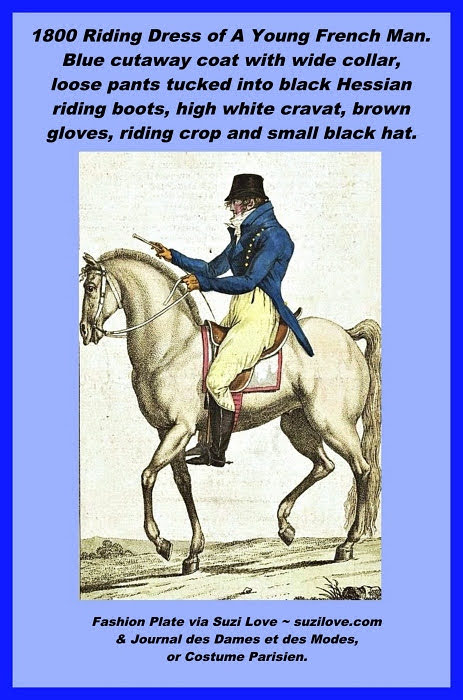
1800 Riding Dress of A Young French Man. Blue cutaway coat with wide collar, loose pants tucked into high black riding boots, high white cravat, brown gloves, riding crop and a very small black hat. Fashion Plate via Journal des Dames et des Modes, or Costume Parisien.
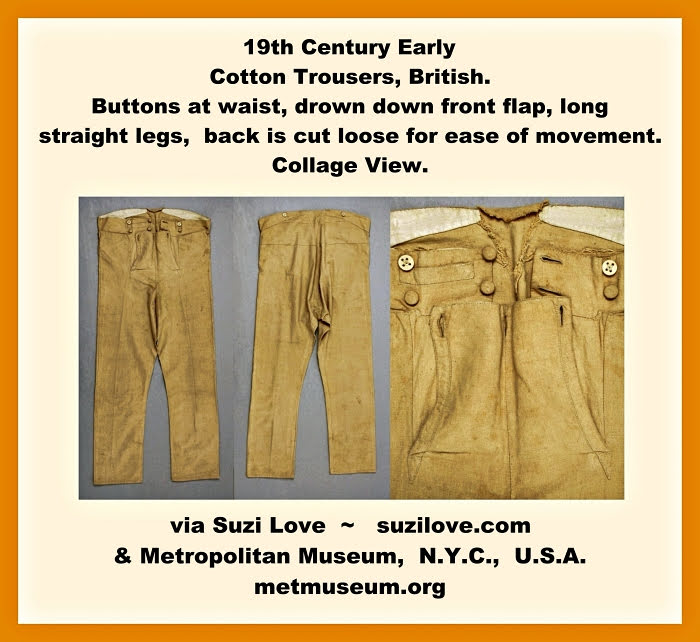
19th Century Early Cotton Trousers, British. Buttons at waist, drop down front flap with buttons and cut with excess material to allow easy movement. via Metropolitan Museum New York City, U.S.A. metmuseum.org.
Trousers: In the early 19th century, trousers were sewn with a flap in front called a fall front and was held in place by two or three buttons. Trousers were held up by tight-fitting waists which were adjusted by gusset ties in back of the waist. Seats were baggy to allow a man to rise comfortably from a sitting position.
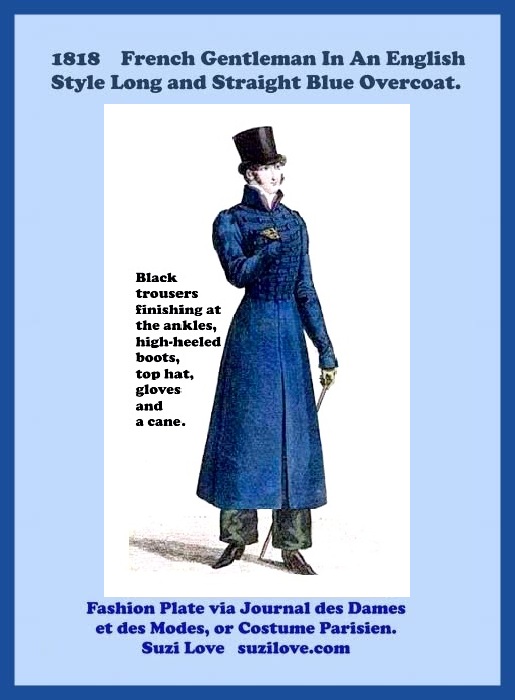
1818 French Gentleman In An English Style Long Blue Coat, Or Redingote. Black top hat, cane, black boots, black pants ending at his ankles, and gloves. Fashion Plate via Journal des Dames et des Modes, or Costume Parisien.
Definition Redingote Or Pelisse Or Walking Dress Or Coat: French word developed from English words, riding coat. Long fitted outdoor coat worn over other garments for warmth. Often left open at the front to show off the dress underneath. Sometimes cut away in front. Originally made with several capes and trimmed with large buttons. French fashion plates call these coats Redingotes and they are designed for women, men and children. English fashion plates call them a Pelisse, a walking dress, Promenade dress, or Carriage dress.
1818 Long Blue Coat, French. Gentleman In An English Style Long Blue Coat, Or Redingote. Black top hat, cane, black boots, black pants ending at his ankles, and gloves. Fashion Plate via Journal des Dames et des Modes, or Costume Parisien. https://books2read.com/SuziLoveFashionMen1800-1819