1815 French Couple. Lady in evening dress with scooped neckline on low-cut pink bodice, floral headpiece and long white gloves. Gentleman in brown tailcoat and stirrup trousers, vest, and casual necktie. Fashion Plate via Journal des Dames et des Modes, or Costume Parisien.
The sort of fashionable outfits and items worn or carried by Jane Austen and her contemporaries when out in public. Ladies outfits for evening were accessorized with gloves, headdresses and jewelry and often dresses were of this shorter length for dancing. Gentlemen were always heavily accessorized as well with the essential of gloves, coats, waistcoats and neatly tied cravats. For more about the fashions of 1815, take a look at History Notes Books 23 and 28 men’s and women’s regency Era fashions.
Fashion Women 1815-1819 History Notes Book 28 What did Jane Austen wear? What was fashionable for women at the end of the Regency Era in Britain and the reconstruction in Europe after the wars. Book 28 for 1815-1819 in History Notes Includes fashions for mourning, riding, dresses, hats, shoes, reticules or bags, underclothing, accessories.
Fashion Men 1800-1819 History Notes Book 23 What was fashionable for men in early 1800s, or Jane Austen’s time, or Regency Era? Suits, hats, shoes, underclothing, fashion accessories, military and bedroom fashions. French fashions and Georgian and Regency Era fashions from Great Britain were copied around the world.
. Fashion Women 1815-1819 History Notes Book 28 https://books2read.com/SuziLoveFashionWomen1815-1819
What did the Bridgerton ladies and Jane Austen use to carry her personal items? Ridicule, Reticule, Or Handbag? Call them what you like: purses, bags, handbags, reticules, ridicules, clutches, or pocket replacements. They all did the same job and they changed greatly with the prevailing fashions of time. books2read.com/suziloveReticules
Definition Of A Reticule; Bag or purse, often with a drawstring to pull closed and usually made of cloth or covered cardboard and often decorated with beading or embroidery. A reticule, or purse, or handbag, was usually carried by a woman during the Regency period to carry all their daily necessities. Earlier, women used pockets that tied at the waistline and were hidden in the folds of their skirts. Empire style, or early 1800s, high-waisted dresses made it impossible to either sewn in a pocket or to tie on a pocket, so women began carrying small, decorated bags called Reticules, or ridicules, which generally pulled close at the top with a drawstring. These Reticules, or bags, were the forerunners of our modern day purses.
The term ‘ridicule’ derived from the Latin ‘ridiculum’ and first used in France during the 17th century and meant subjecting something or someone to mockery. As women’s tiny bags were mocked, or ridiculed, for being a useless fashion accessory carried outside when they were first used in the late 1700s, it’s likely this is how the name ‘ridicule’ started. The later term ‘reticule’ derived from the Latin reticulum, meaning ‘netted bag’ and was applied when bags became larger and often made from netting. In the late 1700s and early 1800s, they were also known as indispensables as they carried all the personal items a lady needed upon her person every day. They were easily made by ladies, easy to carry and became an indispensable fashion accessory.
In the early nineteenth century, reticules started to look like future handbags as they were often made from rigid card or molded mâché or card into a variety of shapes. Early bags were circular and with a drawstring but as women wanted their reticules to look individual they could be made with two halves and a hinged metal closure or with concertina sides. Materials varied from silk, cotton and string and shapes were round, hexagonal or lozenge shapes with shell shaped bags becoming very popular during the Regency and Romantic Eras.
1800s magazines were written for well bred women who could read, so they gave plenty of ideas for how ladies could make and embellish reticules for their own use and as pretty gifts. Needlework was highly encouraged as a pastime for a lady so bags were frequently embroidered or decorated with beading. By the 1820s, reticules became more like our modern handbags using soft leather gathered at the top or hard leather with a rigid fastener and metal chain for carrying.
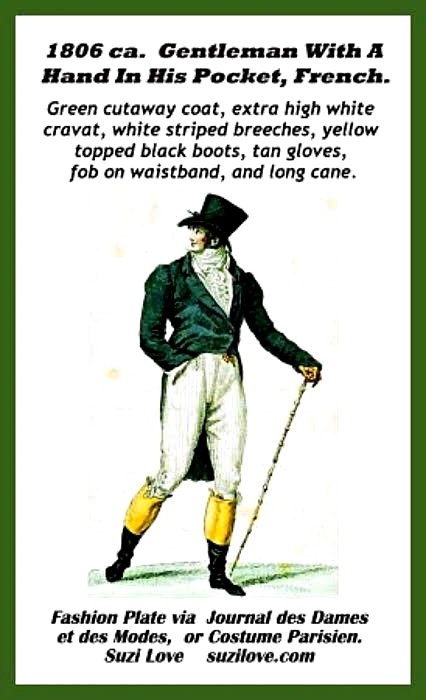
1806 Gentleman With A Hand In His Pocket, French. Green cutaway coat, extra high white cravat, white striped breeches, yellow topped black boots, tan gloves, fob on the waistband, and long cane. Typical Gentleman’s outfit as worn by men to daytime activities, such as escorting his female family members to the shops in Bond Street,London,or for walking in the park in Jane Austen’s times. Fashion Plate via Journal des Dames et des Modes, or Costume Parisien.
Do you know what was fashionable for men’s clothing in the years of the Bridgertons and Jane Austen? Fashion Men 1800-1819 History Notes Book 23. https://books2read.com/SuziLoveFashionMen1800-1819 Suits, hats, shoes, underclothing, fashion accessories, military and bedroom fashions. French fashions and Georgian and Regency Era fashions from Great Britain were copied around the world.
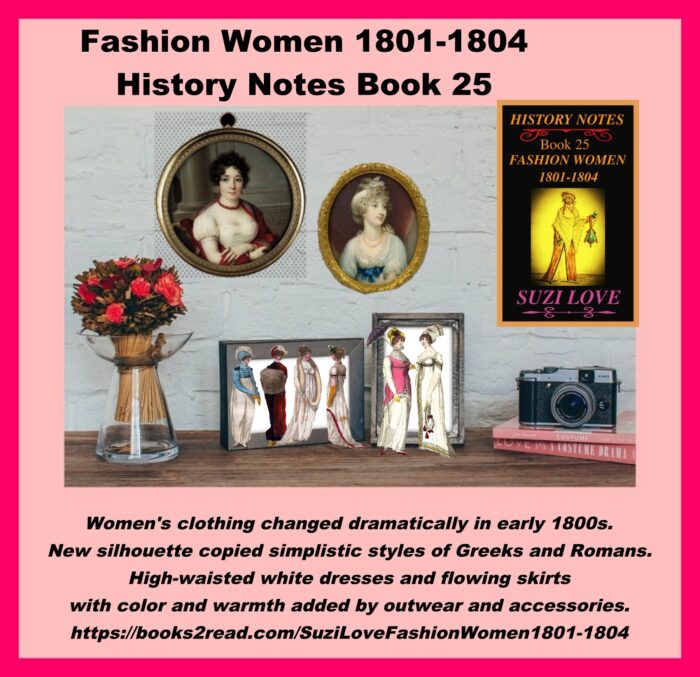
Writer Or Reader Of Regency Era?What did Jane Austen and friends wear? Women’s clothing changed dramatically in early 1800s. New silhouette copied simplistic styles of Greeks and Romans. High-waisted white dresses and flowing skirts with color and warmth added by outerwear and accessories. Fashion Women 1801-1804 History Notes Book 25 https://books2read.com/SuziLoveFashionWomen1801-1804
Definition Empire Style Dress: High-waisted white gowns defined women’s fashion during the Regency Era. ‘Empire’ is the name given to the period when Napoleon Bonaparte built his French Empire. High-waisted, loose gowns were adopted by the aristocracy as a symbol of turning away from the elaborate clothing worn in the 1700s. This sort of high-waisted dress would have been worn by Jane Austen and her contemporaries in England.
Definition Shawls: The shawl started off in India as a fine wool garment for men that could be worn as a scarf, turban or as a mantle: the word comes from the Persian shäl. Originally imported from the East, European Kashmir shawls were made first in Norwich and Edinburgh in Britain in the late 18th century. Shawls were an essential item in the early 1800s to cover the thin gowns women wore. They were made of muslin, gauze, silk, wool, and velvet, though cashmere shawls were the softest and most prized.
Fashion Women 1801-1804 History Notes Book 25 This book looks at the changes to women’s clothing in the early 1800s and the move away from complicated styles and heavy fabrics. The new silhouette copied the simplistic styles of the Greeks and Romans. White dresses were high-waisted and skirts were flowing, with color and warmth added by outwear and accessories. https://books2read.com/SuziLoveFashionWomen1801-1804
19th Century Early Brown Trousers, American. Button waist, drop down front flap, or fall, and extra fabric in the back for easy movement. via Metropolitan Museum New York City, U.S.A. metmuseum.org https://books2read.com/SuziLoveFashionMen1800-1819.
Do you know what was fashionable for men’s clothing in the years of the Bridgertons and Jane Austen? Fashion Men 1800-1819 History Notes Book 23. Suits, hats, shoes, underclothing, fashion accessories, military and bedroom fashions. French fashions and Georgian and Regency Era fashions from Great Britain were copied around the world.
19th Century Early Brown Trousers With Drop Down Front flap, or ‘Fall’. #Regency #Men #Fashion19th Century Early Brown Trousers With Drop Down Front flap, or ‘Fall’. #Regency #Men #Fashion19th Century Early Brown Trousers With Drop Down Front flap, or ‘Fall’. #Regency #Men #Fashion https://books2read.com/SuziLoveFashionMen1800-1819
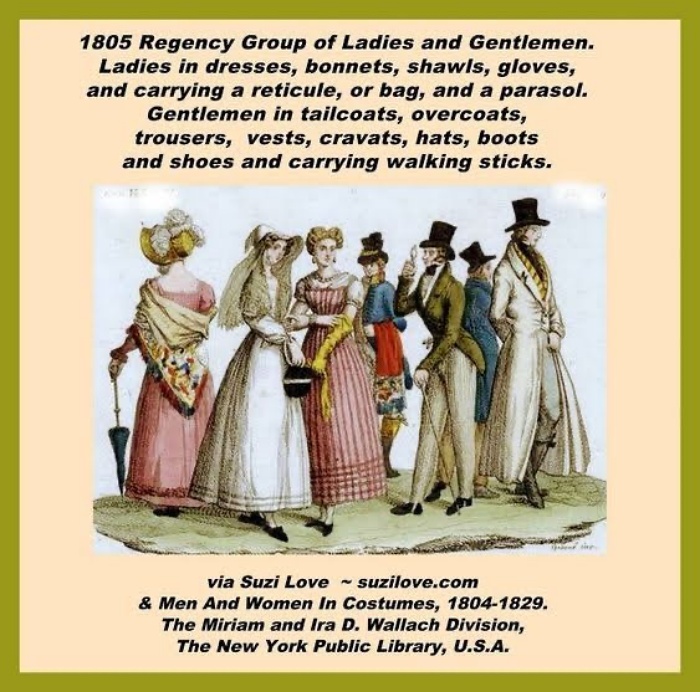
1805 Regency Group of Ladies and Gentlemen dressed as Jan Austen and her family and friends would have dressed. Ladies in dresses, bonnets, shawls, gloves, and carrying a reticule, or bag, and a parasol. Gentlemen in tailcoats, overcoats, trousers, vests, cravats, hats, boots and shoes and carrying walking sticks. via Men And Women In Costumes, 1804-1829. The Miriam and Ira D. Wallach Division, The New York Public Library, U.S.A.
Description: Early 1800s Women’s Fashion: Typical outfits worn for daytime activities included an Empire style, or high-waisted, white cotton dress worn under a Spencer or short jacket, a Redingote, or coat, for warmth and with pretty hats, shawls and shoes. Reticules, or bags, were carried as these light dresses no longer had pockets.
Description: Cashmere Shawls: Beautiful and very expensive shawls originating from Kashmir in Europe, but spelled by Englishmen Cashmere. Fine, soft, and delicate wool provided by goats is woven in a long and complicated process.
Description: Early 1800s Men’s Fashion: By the early 19th century, men’s fashions had radically changed. Coats finished in long tails at the back and cut higher in front. Waist-length square-cut waistcoat showed beneath coats. Shoulders and upper chest of the coat was sometimes quilted to improve the fit and some dandies wore boned corsets to give them a small waist. Gradually, men adopted long trousers which were worn for day and informal dress but breeches were still worn at places like court and Almack’s Assembly Rooms.
1805 Red Velvet Redingote, French. Shoulder cape with satin piping on the coat, white dress underneath, black hat with flowers to trim and white gloves. Fashion Plate via Journal des Dames et des Modes, or Costume Parisien. This is the type of outdoor walking dress, or pelisse, worn by Jane Austen and contemporaries in England as French fashion plates were obsessively copied despite the two countries being at war for many years. English fashion magazines frequently published plates copied from French fashion magazines.
This is the type of outdoor walking dress, or pelisse, worn by Jane Austen and contemporaries in England as French fashion plates were obsessively copied despite the two countries being at war for many years. English fashion magazines frequently published plates copied from French fashion magazines.
Definition Redingote, Pelisse, Walking Dress: The term, Redingote, was used more in France and other parts of Europe and Pelisse or Walking Dress was used more in England. While the terms Redingote and Pelisse are often used interchangeably, the Redingote usually features a close fitted top and flares out at the hemline with a more tailored or military look than a Pelisse.
Fashion Women 1805-1809 History Notes Book 26
What did Jane Austen and friends wear? This book looks at early 1800s fashions, which were elegant and pretty with high waists and fabrics that were almost transparent. These Empire style gowns, named after Napoleon’s first Empress, became popular throughout Europe, and were then copied around the world. Colorful outwear was added to make an ensemble more attractive and warmer.
https://books2read.com/SuziLoveFashionWomen1805-1809
1809 March. White walking dress as Jane Austen. would have worn in England. Pale blue tunic worn over a white dress and with an unusual blue hat trimmed in yellow to match the tunic. Carrying a matching blue reticule and wearing blue slippers and yellow gloves. Description on Fashion Plate, “A Polish cap, and pelisse of silver grey cloth, trimmed with gold or silver, buttoned down the front with small round buttons, a high collar, with a lace ruff ; boots of same colour as the pelisse, and both embroidered with gold or silver. York tan gloves. This dress was transmitted to a lady of high rank from Warsaw, and would alone evince the taste and elegance of the ladies of that country, were they not already sufficiently known. Engraved Plate via Rudolph Ackermann’s ‘The Repository’ of Arts.
Definition Reticule Or Ridicule Or Bag or Purse: Often with a drawstring to pull closed and usually made of cloth or covered cardboard and often decorated with beading or embroidery. A reticule, or purse, or handbag, was usually carried by a woman during the Regency period to carry all their daily necessities. Earlier, women used pockets that tied at the waistline and were hidden in the folds of their skirts. Empire style, or early 1800s, high-waisted dresses made it impossible to either sewn in a pocket or to tie on a pocket. So women began carrying small, decorated bags called Reticules, or ridicules, which generally pulled close at the top with a drawstring.
Fashion Women 1805-1809 History Notes Book 26 What did Jane Austen and friends wear? This book looks at early 1800s fashions, which were elegant and pretty with high waists and fabrics that were almost transparent. These Empire style gowns, named after Napoleon’s first Empress, became popular throughout Europe, and were then copied around the world. Colorful outwear was added to make an ensemble more attractive and warmer. https://books2read.com/SuziLoveFashionWomen1805-1809
Fashion Women 1805-1809 History Notes Book 26
What did Jane Austen and friends wear? This book looks at early 1800s fashions, which were elegant and pretty with high waists and fabrics that were almost transparent. These Empire style gowns, named after Napoleon’s first Empress, became popular throughout Europe, and were then copied around the world. Colorful outwear was added to make an ensemble more attractive and warmer.
https://books2read.com/SuziLoveFashionWomen1805-1809
1817 November Evening Mourning Dress, English. Black short length dress, layers of feathers on the skirt, long lace headdress falling from an upswept hairstyle and black shoes. Fashion Plate via John Belle’s La Belle Assemblée or, Bell’s Court and Fashionable Magazine, London.
Mourning – Full Or Deep Mourning: Entire ensemble and accessories must be black. Shiny fabrics were not allowed so bombazine became the fabric of choice for many. Hats had veils added and jet was the preferred jewelry.
Mourning – Half or Slight Mourning: allowed touches of grey and white to be added to full, or deep, mourning ensembles. Some lustre, or shine, was allowed in fabrics and accessories. After a time, mauve or deep purple could also be worn.
1800-1830 ca. Reticule, or Bag, American. Bottom of bag shaped like basket and made of stiff deep cream colored mohair with minute blue figure, two panels of light blue painted silk moiré, upper part of bag of deep cream colored figured silk, blue silk ribbon, drawstring and bows trimming lower part of bag. via Museum of Fine Arts, Boston, U.S.A. mfa.org
Definition Reticule Or Ridicule Or Bag or Purse: Often with a drawstring to pull closed and usually made of cloth or covered cardboard and often decorated with beading or embroidery. A reticule, or purse, or handbag, was usually carried by a woman during the Regency period to carry all their daily necessities. Earlier, women used pockets that tied at the waistline and were hidden in the folds of their skirts. Empire style, or early 1800s, high-waisted dresses made it impossible to either sewn in a pocket or to tie on a pocket. So women began carrying small, decorated bags called Reticules, or ridicules, which generally pulled close at the top with a drawstring.