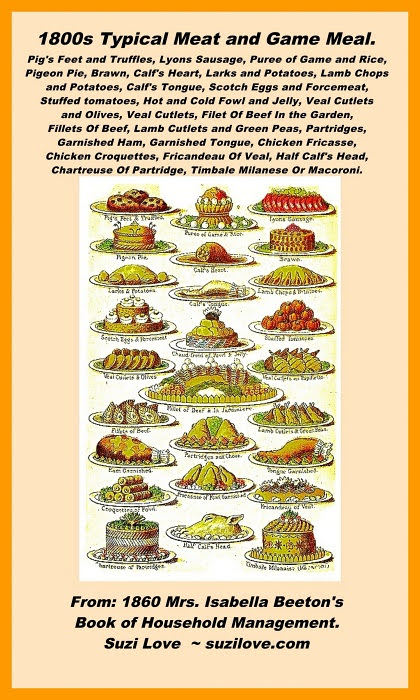
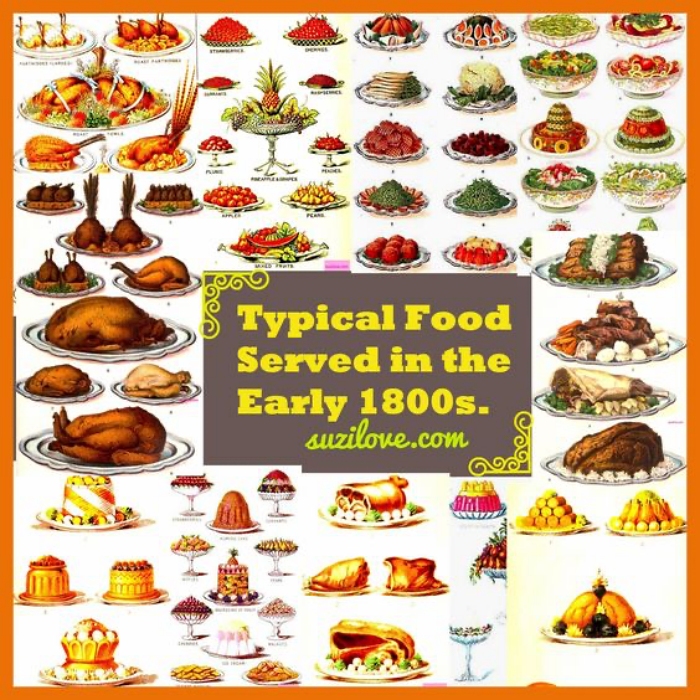
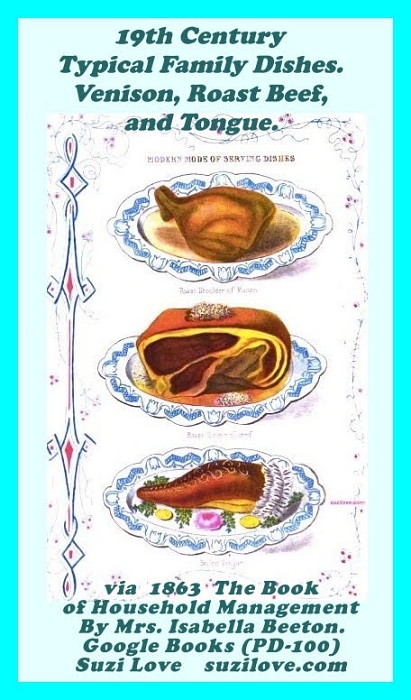
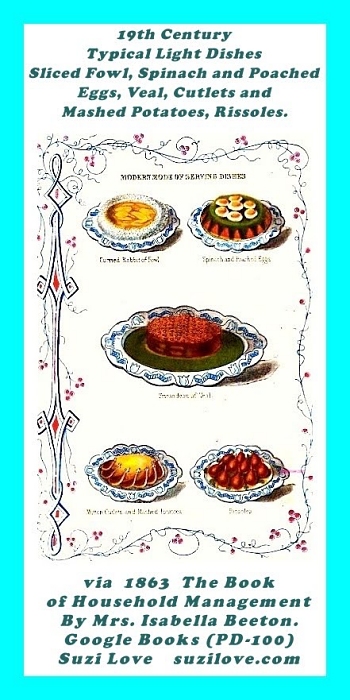
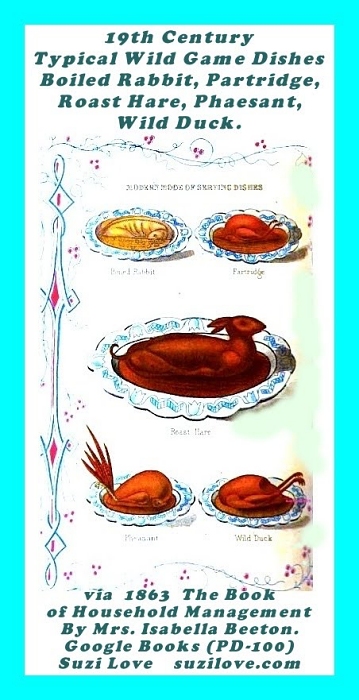
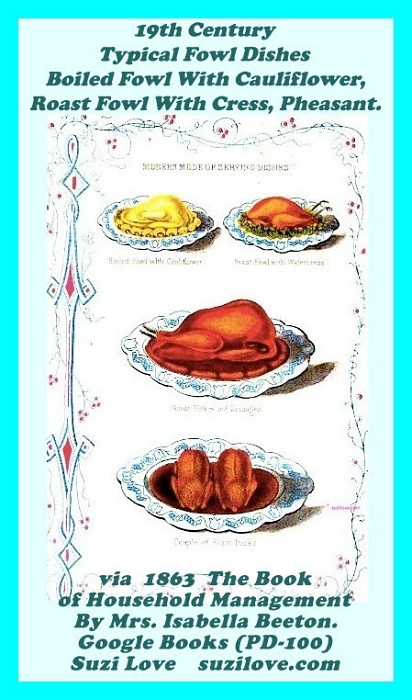
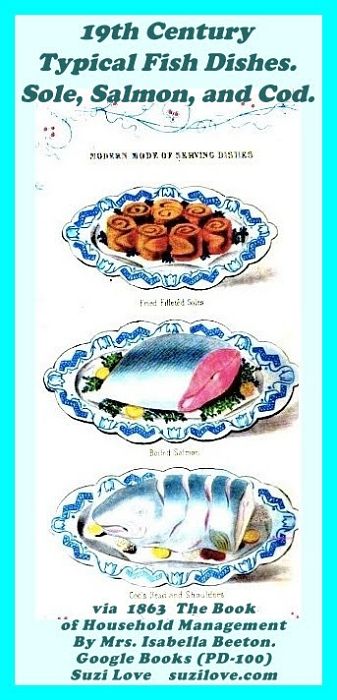
1800s Typical Meat and Game Meals served during the 1800s. These are the sort of dishes Jane Austen’s family and the Bridgertons would have eaten on a regular basis.
Pig’s Feet and Truffles, Lyons Sausage, Puree of Game and Rice, Pigeon Pie, Brawn, Calf’s Heart, Larks and Potatoes, Lamb Chops and Potatoes, Calf’s Tongue, Scotch Eggs and Forcemeat, Stuffed tomatoes, Hot and Cold Fowl and Jelly, Veal Cutlets and Olives, Veal Cutlets, Filet Of Beef In the Garden, Fillets Of Beef, Lamb Cutlets and Green Peas, Partridges, Garnished Ham, Garnished Tongue, Chicken Fricassée, Chicken Croquettes, Fricandeau Of Veal, Half Calf’s Head, Chartreuse Of Partridge, Timbale Milanese Or Macoroni.
From: 1860s Mrs. Beeton’s Book of Household Management. via Google Books (PD-150)
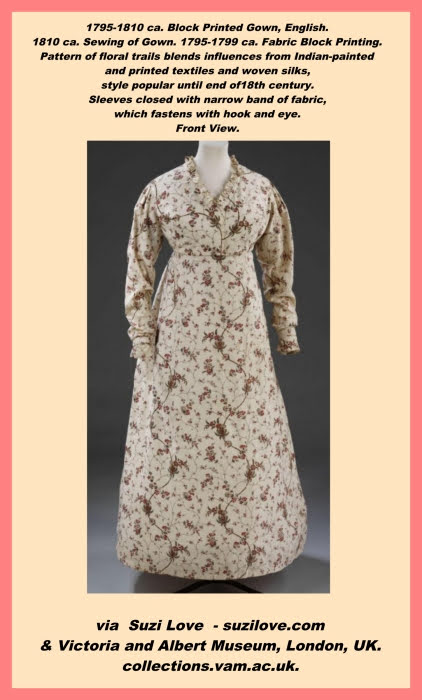
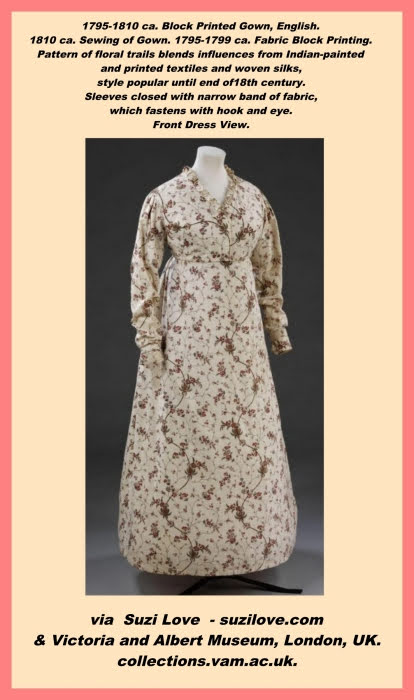
1795-1810 ca. Roller Printed Dress, English. Empire style, high-waisted, roller printed dress with skirt gathered at the back to create a full skirt and with simple V-necked bodice and long sleeves. Sleeves are closed with a narrow band of fabric which fastens with a hook and eye. via Victoria and Albert Museum, London, UK. 1810 ca. Sewing of Gown. 1795-1799 ca. Fabric Block Printing. Pattern of floral trails blends influences from Indian-painted and printed textiles, and woven silks, a style which remained popular until the end of18th century.
The pattern of floral trails seen on the printed fabric of this gown exhibits a blend of influences from Indian-painted and printed textiles, and woven silks, a style which remained popular until the end of the 18th century. The sleeves of this gown are closed with a narrow band of fabric, which fastens with a hook and eye.
The dress is styled with a high-waisted , fitted bodice, which fastens centrally. The neck, which is trimmed with a 1″ frill of matching material, is rounded a the back and V-shaped at the front. The bodice is lined with white cotton which extends 1/3 of the way down the full length tapered sleeves. A trimming decorations is attached to the wrist of the right sleeve (made from the same material and lined with white cotton), which fastens with a metal hook and eye at the hip. The skirt has an ‘apron’ style front with fastening tapes attached to either side, in addition to this there are vertical pocket slits situated at either side of the skirt measuring 11″. The front and rear sides of the skirt are constructed from one width of fabric – 39.5″ wide. The waistline at the back of the skirt is gathered a the centre and is constructed from two pieces of material measuring 46″ wide.
The cotton has blue threads in the selvedges denoting English origin, and is block printed in a polychrome palette with pencilled blue on a white ground. The design consists of an all-over pattern of delicate floral trails of carnations, pinks an other stylised flowers interspersed by vertical arborescent meanders bearing exotic fruits and stylised flowers. The pattern repeat measures 10.5″ by 10″.
1815 ca. Tailcoat, Probably British. Black wool, silk cotton and wood. Double-breasted, cutaway at the front waist, notched collar, straight sleeves, pleat falling from the back waist. via Metropolitan Museum, N.Y.C., U.S.A. As Worn By the Men in the Families of Jane Austen and the Bridgertons. #Regency #JaneAusten #Fashion #BritishHistory
Tailcoat: A Regency Era, or early 1800s, gentleman was outfitted in more practical fabrics, such as wool, cotton and buckskin rather than the fussy brocades and silks of the late 1700s. The men in Jane Austen’s life would have worn a black tailcoat like this for everyday wear. https://books2read.com/SuziLoveFashionMen1800-1819
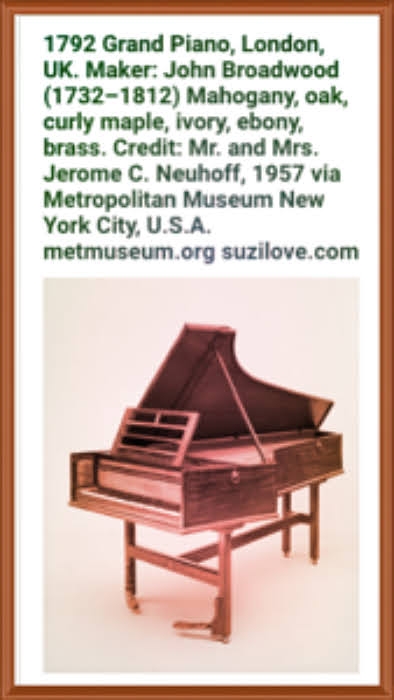
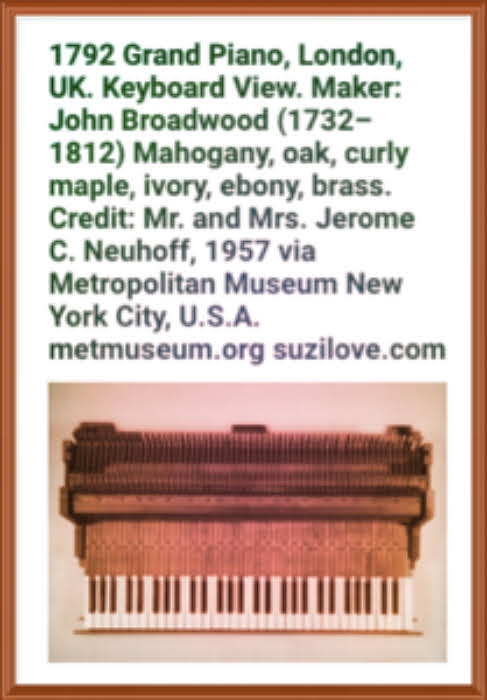
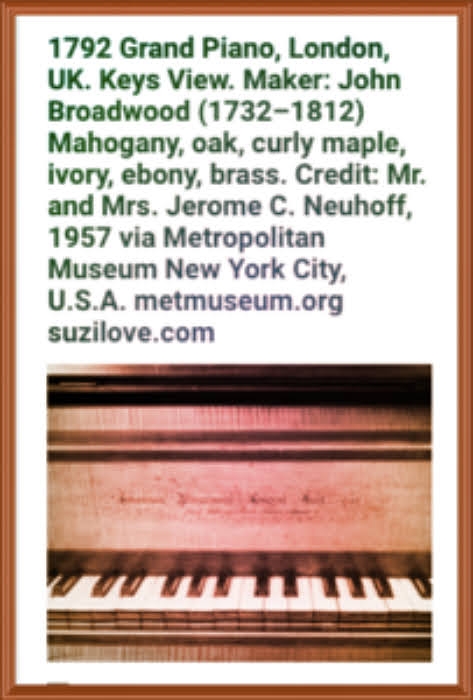
1792 Grand Piano, London, UK. Maker John Broadwood (1732–1812) Mahogany, oak, curly maple, ivory, ebony, brass. Credit: Mr. and Mrs. Jerome C. Neuhoff, 1957 via Metropolitan Museum New York City, U.S.A. metmuseum.org books2read.com/suziloveMusicPiano
HN_7 D2D Retailer Buy Link Music Piano History Notes
Excerpt: Lady Laura Jamison had turned to run, when an intractable force grasped her bodily and threw her off her feet, hurling them both sideways. Winchester, or to be precise, his muscled arms, had circled her body, heavy, protective, and immovable. Women screamed on the street below. Footsteps pounded across the stone steps.
Laura and Richard hit the ground a few feet from where they’d been standing and he rolled, his arms wrapped around her. The cocoon of his body stopped her from slamming onto the harsh stone, and he kept her lifted free of the blistering gravel on the pavement. After a series of rolls and tumbles, they pulled up in a tangled heap, a foot short of the tree-lined fence that separated church land from a row of buildings.
Not out of danger but, thank God, no longer sitting ducks. A large palm spread across the back of her head and gripped, as the Earl thrust her head into the concave shell of his chest. Her rib cage hurt as she struggled to open her lungs. She sucked in noisy streams of air, bobbed her head skyward and fought for normal breaths. His hand brushed her hair.
“Shush. Just breathe. Slowly.”
His mouth nuzzled, soothed, and hot breath lifted her curls. Under his guidance, she managed to slow her breathing to ease the ache in her chest and calm herself. She turned her head to listen, before peering out from under his arm. Sweat dripped off her brow and splashed onto the gravel below her chin, while drops fell from Winchester’s face onto her.
From beyond the high-piled vegetable cart, which provided a little protection, came chaotic noises—the terrified whinny of horses and high-pitched shrieks from humans. By the mix of lower-class voices calling to each other along the pavement, the crowd was confused about what had happened. Though not Laura.
She’d been stunned for a few seconds, but hadn’t needed any announcements to know a bullet had been fired. Not after several other incidents in recent months. They’d been physically threatened, and Becca had witnessed the murder of their friend who did the book-keeping at the Women’s Betterment Society.
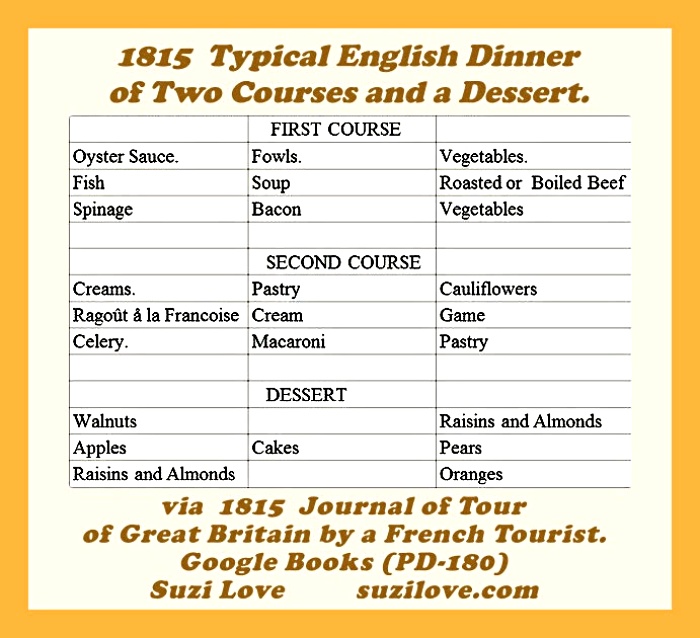
1815 Typical English Dinner In Jane Austen and Bridgerton Times. Two Courses and a Desert. From- 1815 Journal of Tour of Great Britain by a French Tourist via Google Books (PD-180)
Typical food served during the early 1800s, or Regency Era. ‘Removes‘ were the dishes removed from the table during a meal, usually the soup and fish, and then replaced by other dishes. After all diners have had a chance to eat all the dishes on the table, the table is cleared and another set of dishes put on the table. This is the second course.
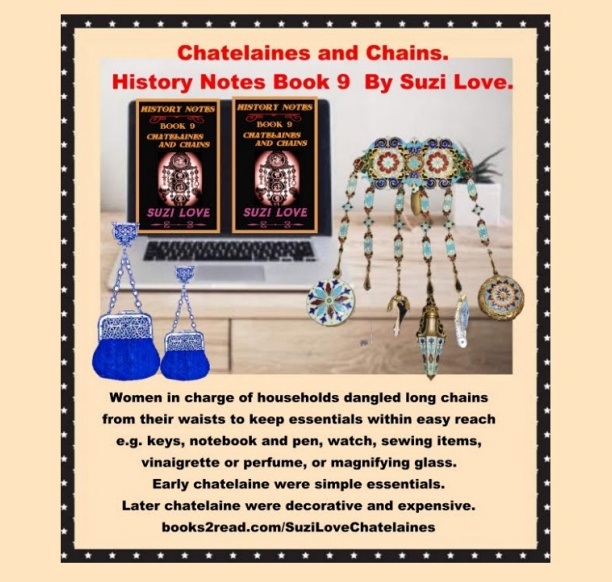
Jane Austen’s and the Bridgerton ladies personal necessities, keys, or chatelaines was a set of useful items hung from waist by decorative chain. Chatelaines and Chains. History Notes Book 9 By Suzi Love. Women in charge of households dangled long chains from their waists to keep essentials within easy reach e.g. keys, notebook and pen, watch, sewing items, vinaigrette or perfume, or magnifying glass. Early chatelaine were simple essentials. Later chatelaine were decorative and expensive. http://books2read.com/SuziLoveChatelaines
Definition Chatelaine: The word Chatelaine is French and means the keeper of the keys. Chatelaine” derives from the Latin word for castle. In Medieval times, the chatelaine was in charge of the day-to-day running of the castle. Women in charge of households dangled long chains from their waists to keep essentials within easy reach e.g. keys, notebook and pen, watch, sewing items, vinaigrette or perfume, or magnifying glass. Early chatelaine were simple essentials. Later chatelaine were decorative and expensive.books2read.com/SuziLoveChatelaines
What did a chatelaine do? Most important task was keeper of the keys. Also ordered supplies, did bookkeeping, supervised servants, taught castle children, and organized guests.
19th Century Food For The Upper Classes In Bridgerton and Jane Austen Times.
Typical Meals Served for the upper classes in the Georgian and Regency Eras. For the Upper classes in the 18th and through to the end of the 19th century, meals were elaborate affairs. and served by well-trained staff anticipated their every need. Women prided themselves on hosting dinners for 50-60 people which often consisted of numerous courses, and all served with the best wines and followed, for the men at least, by expensive port.
An older lady usually controlled the servants and the serving of meals. For more about this, take a look at Older Lady’s Day Regency Life Series Book 5 by Suzi Love. Overview of what an older lady did, wore, and how she lived in the early 19th Century. Information for history buffs and pictures for readers and writers of historical fiction. books2read.com/suziloveOLD
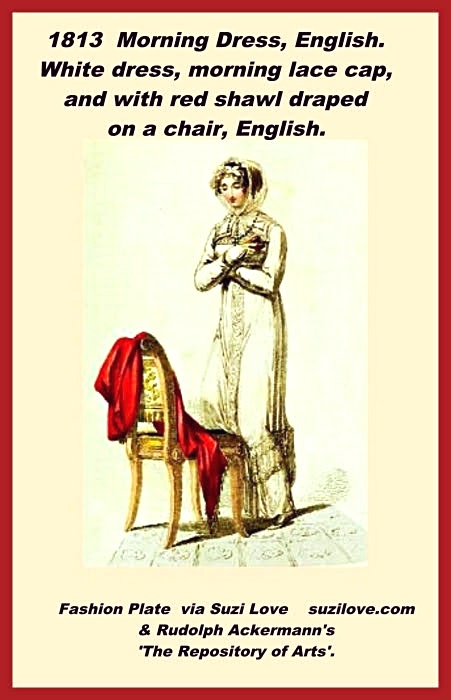
1813 October Morning Dress, English. Jane Austen and her family and friends would have worn this style of relaxed dress and cap. White At-Home dress with morning lace cap and a red shawl. Plain cambric underdress, three-quartered muslin or Chinese silk robe trimmed round the bottom and up the front with Indian border, or needle-work, and finished with a deep flounce of lace. Convent hood and pelerine of white net lace, confined under the chin with a silk cord and tassel. Hair in irregular curls with a fancy flower in the front. Short rosary and cross, plus bracelets, of coquilla beads. Buff or lemon kid slippers and pale tan gloves. Fashion Plate via Rudolph Ackermann’s ‘The Repository of Arts’.
This is a typical outfit worn at home in the morning in the house, to be seen only by family or close friends. A lady might wear this while writing having breakfast, writing letters, or reading. Called by the various names of Undress, to At-Home dress, or Morning dress, it is the most relaxed ensemble a lady will wear all day. The sort of outfit Jane Austen would have worn when writing her books.
1812 Red Dress, French. High-waisted red Merino wool dress with short puffed sleeves, high Chako hat with a plume long white gloves and white shoes. Fashion Plate via Journal des Dames et des Modes, or Costume Parisien.HN_27_D2D_fashwomen1810-1814
https://books2read.com/SuziLoveFashion1810-1814
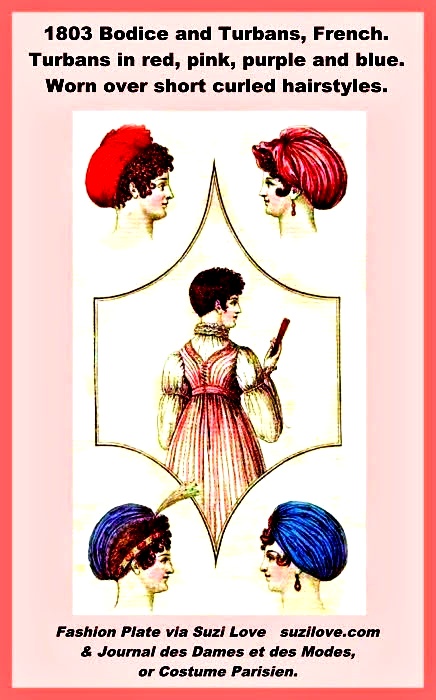
1803 Bodice and Turbans, French. Turbans in red pink purple and blue. Worn over short curled hairstyles. Fashion Plate via Journal des Dames et des Modes, or Costume Parisien.) https://books2read.com/SuziLoveFashionWomen1801-1804
Definition Turban: Early 19th-century etiquette required a lady’s head to be covered at all times, even with evening dress. In Jane’s Austen’s world, a lady wore some sort of hat or bonnet during the day when out and about, a cap during the night to keep her hair in place and for relaxed morning dress e.g. for breakfast, and for evenings either a small hat or turban. From 1800 to 1820, hats came in every shape, color, and size. Turbans, jockey caps, and straw bonnets were decorated with flowers, ribbons, lace, and feathers. Turbans, especially decorated with feathers were popular.