1809 January Walking Dress, English. Polish bonnet, mantle of gold velvet with an invisible hood trimmed with ermine, antique collar fastened with a gold ornament in form of a shell. Morning dress, white muslin Brussels spot, with worked stomacher, trimmed down the front and at the bottom, worked along hanging sleeves, twisted and fastened at the wristband with small gold ornament to match mantle and cincture of the dress, gold sandals laced with brown cords and tassels and York tan gloves. Plate via Rudolph Ackermann’s ‘The Repository’ of Arts.
1811 January Evening Full Dress, English. Round dress of white satin, small train with pink velvet, vandyke edges, dotted with black chenille, turban cap of white satin with pearls, necklace, earrings, bracelets of gold and pearls, white kid shoes and gloves, fan of white crape and gold. Fashion Plate via John Belle’s La Belle Assemblée or, Bell’s Court and Fashionable Magazine, London.
Definition Van Dyke Points: V-shaped lace and trims named after a 17th Century Flemish painter, Sir Anthony Van Dyck, known for painting V-shaped lace collars and scalloped edges on sitters.
Definition Velvet or Velour: Silk with short, dense and smooth pile produced by pile warp raised in loops above ground weave through introduction of rods during the weaving.
An overview of women’s fashions in the first twenty years of the 19th century. What was fashionable for women in Jane Austen’s times, or the early 1800s. Wars were being fought around the globe so women’s fashion adopted a military look in support of soldiers. In Britain, the Prince Regent ruled instead of his father, King George III, so fashions, like the lifestyle, became more extravagant and accessories went from pretty to opulent. This set includes books 12, 25, 26, 27 and 28.
What was fashionable for women in Jane Austen’s times, or 1800s, or Regency Era. High-waisted dresses were extravagantly accessorized and hats, shoes, parasols and bags were added. Set includes History Notes Books 12, 25, 26, 27 and 28.
In Jane Austen’s times craftsmen created boxes and containers of precious metals, leather, silks, and decorated them with jewels. Boxes, Cases, Etui, Necessaire and everything else that was used to carry essential items for travel, sewing, medicine, writing, and toiletries. Containers were engraved to make exquisite and expensive items as well as practical carrying cases. books2read.com/suziloveBoxesCases
1809 June Evening Full Dress, English. Lemon dress with white underskirt, short sleeves, braid decorated bodice, zig-zag hem, long white gloves, plumed headdress, full Parure of necklace, bracelet and earrings, evening slippers and a fan. Fashion Plate via John Belle’s La Belle Assemblée or, Bell’s Court and Fashionable Magazine, London.
Definition Full Evening Dress – Ball, dinner, evening and opera gowns but with every possible accessory added to make the most impressive display possible, such as adding a Grand Parure, or full jewelry set and including headpieces as with the feathered headdress above.
Lover of Jane Austen and the Regency Era fashions? History Notes Book 25. #JaneAusten #RegencyFashion #HistoricalFashion books2read.com/SuziLoveFashionWomen1801-1804
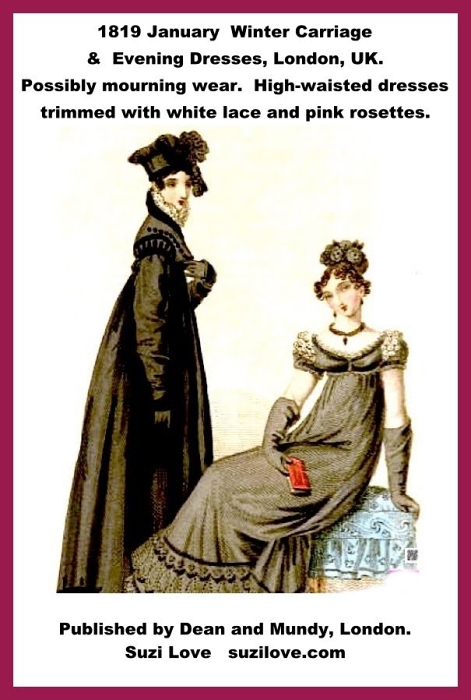
1815 Arundel Fete Dress and Baronial Helmet, English. White dress with purple bodice and hem with matching shawl and plumed headdress. Skirt of white crape over white satin, a double row of novel and elegant trimmings on the bottom, two falls of the crape, set on full, are edged with silk. Body comes high on each side of the bosom and is shaped so as to display the neck and shoulders, and both body and sleeves are formed and trimmed in the most exquisitely tasteful manner. A superb cord and tassels confines the waist and ties in front. The Baronial Helmet is striking and made of white sarsnet or satin and white lace and superbly ornamented with feathers. Jewelry set, or Grand Parure, of necklace, bracelets. ear-rings, and small French locket of pearl. White kid slippers and gloves. Full Dress for evening would most likely be a dress of silk or satin, perhaps with a transparent overlay of netting, tulle etc., embellished with taffeta, ruffles and ribbons, and with a full range of accessories including a Grand Parure of tiara and other matching jewelry. https://books2read.com/SuziLoveFashionWomen1815-1819
La Belle Assemblee: Fashion Plate via John Belle’s La Belle Assemblée or, Bell’s Court and Fashionable Magazine, London. Many of the fashion plates seen in La Belle Assemblée and The Repository of Arts were designed by Mrs. Bell who had her dressmaking showroom in Bedford Square, London, and was related to John Bell who published La Belle Assemblée. It seems that she designed for at least two fashion magazines and so there is a cross-over of designs in different magazines.
Grand Parure: A Parure is a matched set of jewelry, including a necklace, bracelet, earrings, pin etc. and a Grand Parure often includes a tiara or other headdress.
Writer Or Reader Of Regency Era?What did Jane Austen and friends wear? Women’s clothing changed dramatically in early 1800s. New silhouette copied simplistic styles of Greeks and Romans. High-waisted white dresses and flowing skirts with color and warmth added by outerwear and accessories. Fashion Women 1801-1804 History Notes Book 25 https://books2read.com/SuziLoveFashionWomen1801-1804
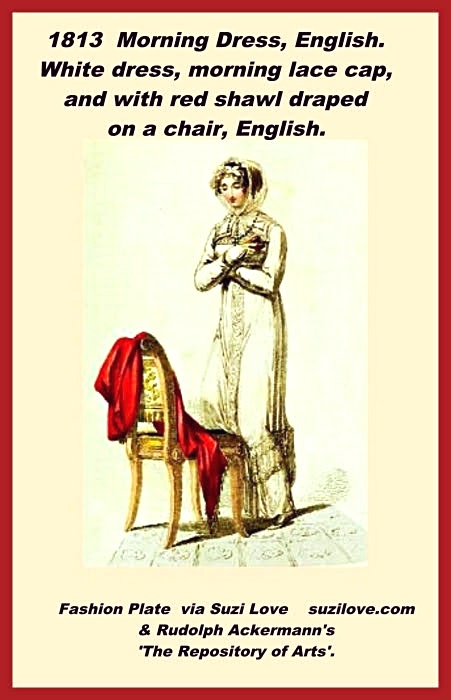
Definition Empire Style Dress: High-waisted white gowns defined women’s fashion during the Regency Era. ‘Empire’ is the name given to the period when Napoleon Bonaparte built his French Empire. High-waisted, loose gowns were adopted by the aristocracy as a symbol of turning away from the elaborate clothing worn in the 1700s. This sort of high-waisted dress would have been worn by Jane Austen and her contemporaries in England.
Definition Shawls: The shawl started off in India as a fine wool garment for men that could be worn as a scarf, turban or as a mantle: the word comes from the Persian shäl. Originally imported from the East, European Kashmir shawls were made first in Norwich and Edinburgh in Britain in the late 18th century. Shawls were an essential item in the early 1800s to cover the thin gowns women wore. They were made of muslin, gauze, silk, wool, and velvet, though cashmere shawls were the softest and most prized.
Love the Bridgerton family and Jane Austen? Reader Or Writer of Regency Era stories? Mourning and riding fashion, dresses, hats, shoes, reticules or bags, underclothing and fashion accessories. books2read.com/SuziLoveFashionWomen1815-1819
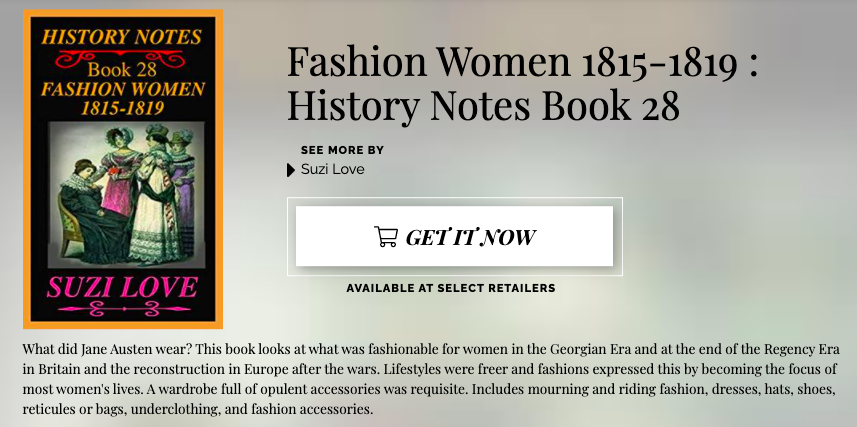
History Notes 28 Fashion Women 1815-1819: This book looks at what was fashionable for women in the Georgian Era and at the end of the Regency Era in Britain and the reconstruction in Europe after the wars. Lifestyles were freer and fashions expressed this by becoming the focus of most women’s lives. A wardrobe full of opulent accessories was requisite. Includes mourning and riding fashion, dresses, hats, shoes, reticules or bags, underclothing, and fashion accessories.
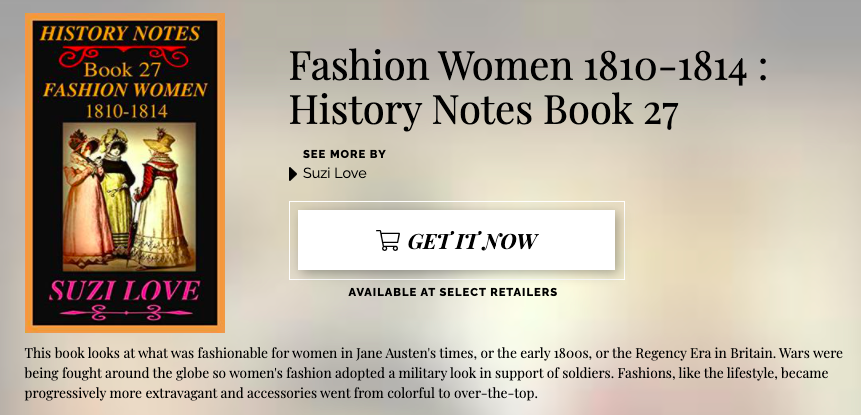
What was fashionable for women in Jane Austen’s times? Mourning, riding, daytime, evening clothing, plus underclothing, corsets and accessories. Fashion Women 1810-1814 History Notes Book 27 This book looks at what was fashionable for women in Jane Austen’s times, or the early 1800s, or the Regency Era in Britain. Wars were being fought around the globe so women’s fashion adopted a military look in support of soldiers. Fashions, like the lifestyle, became progressively more extravagant and accessories went from colorful to over-the-top. https://books2read.com/SuziLoveFashion1810-1814
The Lady’s Magazine said of the basis of women’s fashion that was popular for the first twenty years of the 1800s, ‘White is still the prevailing color for robes. For morning dresses, linen gowns, in large diamonds or squares, are fashionable. Indian muslins, plain or embroidered, are preferred to Florence and satins. The designs of embroidery for shawls are of infinite variety. Long gloves, which reach above the elbow, are not yet laid aside. Medallions are hung around the neck from crossed chains and some of these medallions are shaped like the bags, called ridicules. These reticules are of the lozenge or hexagon shape, with a small tassel at each angle. Reticules, or ridicules, are in lozenge or hexagon shapes with a small tassel at each angle. In capotes, or hats, and ribbands, the violet and dark green prevail over jonquil. Bracelets in hair, pear-shaped ear-rings, medallions on square plates, saltiers of colored stones, are still in fashion.’