Light-hearted look at Young Lady in Jane Austen’s times, or early 1800s. A glimpse into both the frivolous and more serious occupations filling a young lady’s day in the lifetime of Jane Austen, or the Regency Era, or the early 19th Century. Historic images and historical information show her fashions and frolics. https://books2read.com/suziloveYLD
1812 Two Ladies, French. Orange sleeveless Redingote over a white dress with high neck frill and interesting sleeves. High-waisted white dress with blue pattern on the short sleeves and hem. Both with gloves, matching bonnets and shoes. Fashion Plate via Journal des Dames et des Modes, or Costume Parisien.
1896 Sainted Prince Vladimir. Porcelain egg. Oval medallion on a golden background depicts Vladimir-wearing crown, a red mantle, and holding a cross. https://books2read.com/suziloveEasterAfter the painting by Victor Vasnetsov. Imperial Porcelain Factory, St Petersburg. Porcelain, overglaze polychrome painting and gilding/ Height: 11.4 cmOn the one side in an oval medallion on a golden background with plant ornament is a depiction of the Sainted Prince Vladimir wearing a crown and red mantle and holding a cross. The green frame is embellished with a garland of leaves. On the reverse, in another green frame with a garland of leaves on a pale blue background is an ornamented Greek cross with Christ Pantocrator in the centre. A pattern of stars and rosettes surrounds the cross.The prototype for the painting was the image of St Vladimir created by Victor Vasnetsov in St Vladimir’s Cathedral in Kiev.
1788 Armchair or bergère en cabriolet. Part of a set by Jean-Baptiste-Claude Sené (French, 1748–1803). Made for Marie Antoinette, Queen of France, for her Cabinet de Toilette in Palace of Saint-Cloud, France. Carved, painted and gilded walnut; modern cotton twill embroidered in silk. Made for Marie-Antoinette’s dressing room at the château de Saint Cloud. The queen’s initials are carved on the top rail.
The Palace of St. Cloud belongs to the Duke of Orleans, is situated on the declivity of a mountain washed by the Seine. . . . The view from the house is delightful. By Harry Peckham, A Tour through Holland and Part of France
Louis XVI purchased the country residence of the duc d’Orléans a few miles west of Paris for Marie-Antoinette in 1785. Being in need of renovation, the palace was enlarged and altered for the queen, and many pieces of furniture were commissioned from Jean-Baptiste-Claude Sené. A member of an important dynasty of Parisian chairmakers, Sené had been appointed menuisier to the Crown in 1784.
A 1788 description of this set, four matching armchairs and a stool, shows that it was for one of Marie-Antoinette’s private rooms at Saint-Cloud, her Cabinet Particulier. Frame of the daybed embellished with carving of ivy and garlands of roses, ionic capitals on the short legs and Egyptian female half-figures on tapering supports. These figures express the queen’s taste for ornaments from ancient Egyptian art, well before Napoléon’s North African campaign made it fashionable. The bergère, or armchairs, has a medallion on top with Marie-Antoinette’s initials framed by myrtle branches and roses. The matching screen has classical female figures on its feet and top rail.
The 1789 inventory of Saint-Cloud records the entire suite in the queen’s Cabinet de Toilette, or dressing room. The set is upholstered in white cotton twill, embroidered with a small floral ornament in silk. Known to have worked on needlepoint projects all her life, Marie-Antoinette did the embroidery herself. The colorful floral embroidery on the light cotton ground conveys a sense of summer, the season Marie-Antoinette preferred to spend at Saint-Cloud. via Epigraph. Peckham 1788, p. 199.
Lady Rebecca Jamison ticked off numbers on the fingers of one revolting brown glove. “First, I’m not a thief. Second, I’m not a courtesan needing coin. Third, I’ve never been your mistress.” She looked down at her maid’s drab clothes, shuddered. “And if the women you’re taking to your bed dress this shabbily, I suggest you raise your standards.”
The Duke of Sherwyn drew several shuddering breaths. “Correct, on all counts. Now, appease my burning curiosity. What deception did you employ to hoodwink my servant?”
One shoulder lifted in the semblance of a shrug. “Oh, that! A child’s ploy. I laid coins on the fourth step and paid a street urchin to knock on your door and then run. When your gatekeeper bent to retrieve the coins, I slipped around the door and inside.”
Incredulity, then infuriation, surrendered to mirth. The simplicity of her ruse, alongside her detached style of recounting her deception, startled him into a snort of amusement.
“Huh! My ever-vigilant butler diverted by the sight of a few pennies.”
“Oh, no, not mere pennies. Gleaming new gold coins. Rest easy. Your servant’s momentary distraction cost me a high price.”
He lifted his hand to hide his smirk. Since he’d become Sherwyn, Jenner’s behavior vacillated between extreme formality due a duke or nose-lifting disdain owed to the family’s black sheep. This chink in Jenner’s polished armor pleased him.
He dipped his head, and said, “I bow to your finesse as a trickster. Now for my next pressing question. Why are you here?”
“I need your assistance.”
He grinned. “Ah, so once again your white knight is being asked to draw an imaginary sword and defend your ladyship’s honor.”
She groaned. “If only things were still as uncomplicated as in our childhood games.”
Four Times A Virgin: “Are you suffering some sort of aliment in your abdomen, Your Grace?” #RegencyRomance #HistoricalMystery #ReadARegency #HistoricalEroticRomancebooks2read.com/suziloveFTAV
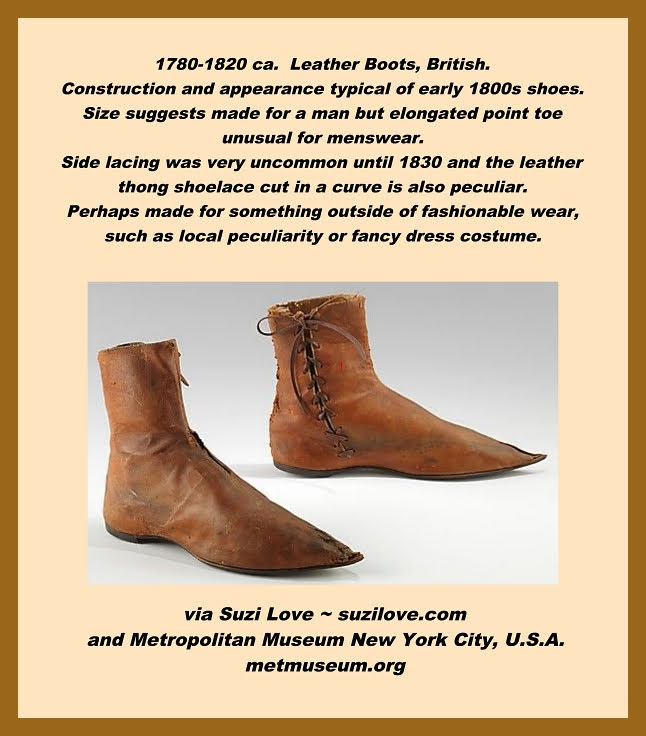
1840s Opera Boots, British. Black leather with suede leg and silk bow, hand and machine sewn. via Victoria and Albert Museum, London, UK. collections.vam.ac.uk.
20th Century Early Easter Egg. Side 1. The Resurrection of Christ. The Descent into Limbo. Side 2. The Most Orthodox Prince St. Vladimir. Made By Lukutin Factory Russia. Papier-mache and silk, painted in oil gilded and lacquered.
The production of the famous Fabergé jewelry firm that created eggs with surprises from gold, silver and precious stones won the world recognition. Jewelry miniature eggs
were very popular gifts and objects of collecting among rich Russians at the turn of the 20th century. They were used for making necklaces, pendants and bracelets that were worn during the Easter Week according to the well-established traditions.
Imperial and private fabrics and works, best artists, jewelers and craftsmen took part in creating Easter souvenirs.