1818 Descriptions for types of ‘DRESS’ during Bridgerton’s and Jane Austen’s years. Dresses, coats or Redingotes, Spencers, shawls, fichu or shoulder cape, shoes, hats and headdresses, gloves, and Reticules or bags were displayed in various fashion magazines and copied by ladies and their modistes.
Morning Dress: Worn either at home, out shopping, or for walking in the park or country. Presentable but not overly accessorized.
Afternoon Dress: Dress made from the best fabric and beautifully decorated to see and be seen in when visiting friends, going to a museum or attending a daytime public event.
Walking Dress: Worn out shopping, walking in a city park or the country estate. Presentable and warm, more fashionable than Morning Dress but accessorized for sun protection and warmth, rather than display.
Promenade Dress: Includes gown, hat, and other accessories and more styled and fashionable than morning or walking dress. An ensemble designed to see and be seen in.
Evening Dress: Minute distinctions between ball, dinner, evening and opera gowns meant different quality of fabrics, designs, and embellishments.
Ball Dress: Gown of expensive silk fabrics, light or heavy, decorated with lace, embroidery or beading, with low-cut bodice, short or barely-there sleeves, and full skirts. Often shorter length skirt for dancing.
Mourning Dress: Mourning dress wasn’t as strict during the Regency as in Victorian era but periods of wearing black, white and grey were observed, especially for Royal deaths.
Empire Dress: Light and flowing dresses with waists just under bust worn during French Empire Period, or early 1800s.
Fashion Women 1815-1819 History Notes Book 28 What did Jane Austen wear? What was fashionable for women in Regency Era? Mourning and riding fashion, dresses, hats, shoes, reticules or bags, underclothing and fashion accessories. books2read.com/SuziLoveFashionWomen1815-1819
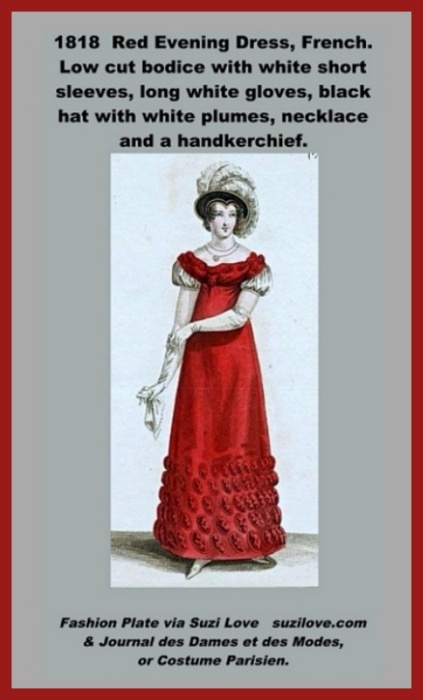
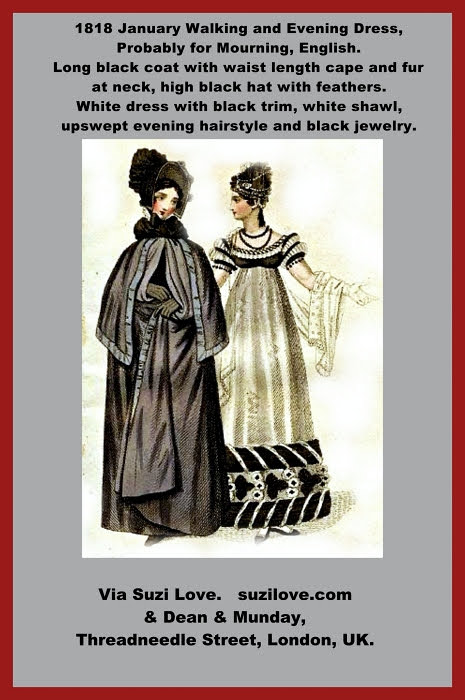
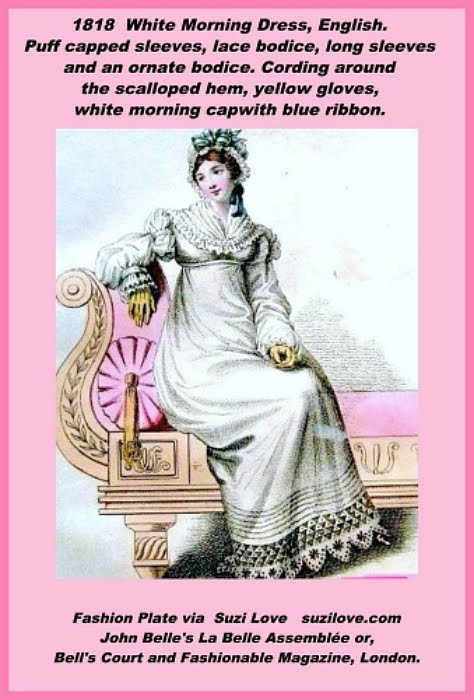
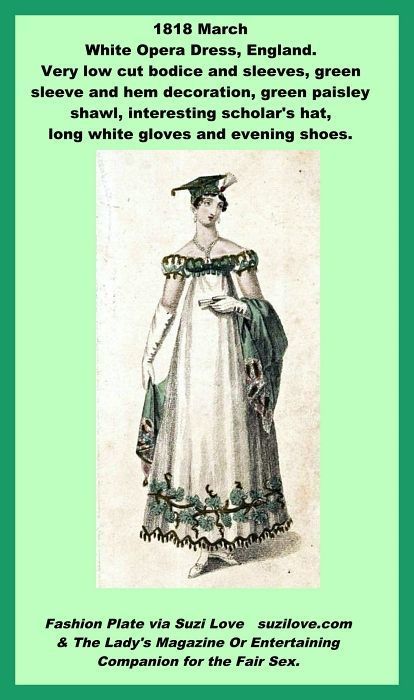
1818 March Yellow Walking Dress, Or Pelisse, Or Redingote, English. Yellow pelisse with elaborately decorated hem, red draping shawl, red reticule or bag, high yellow bonnet trimmed with flowers and yellow shoes. Fashion Plate via Rudolph Ackermann’s ‘The Repository of Arts’, London, U.K.1818 Red Evening Dress, French. Low cut bodice with white short sleeves, long white gloves, black velvet torque, or hat, with white plumes, necklace and a handkerchief. Fashion Plate via Journal des Dames et des Modes, or Costume Parisien. 1818 January Walking and Evening Dress, English. Probably for Mourning. Long black coat with waist length cape and fur at neck, high black hat with feathers. White dress with black trim, white shawl, upswept evening hairstyle and black jewelry. Via Dean & Munday, Threadneedle Street, London, UK.1818 White Morning Dress, English. Puffed capped sleeves, lace shawl like neckline, ornate bodice cording around a scalloped hem, small white hat with blue flowers, and yellow gloves. Fashion Plate via John Belle’s ‘La Belle Assemblee’, London. 1818 Promenade Dress, English. White dress with multiple layers of lace from hem upwards. Narrow striped scarf of bright colors, large brimmed hat decorated with flowers and a pink parasol. Fashion Plate via John Belle’s La Belle Assemblée or, Bell’s Court and Fashionable Magazine, London.1818 March White Opera Dress, England. Very low cut bodice and sleeves, green sleeve and hem decoration, green paisley shawl, interesting scholar’s hat, long white gloves and evening shoes. Fashion Plate via Lady’s Magazine. Fashion Women 1815-1819 History Notes Book 28 https://books2read.com/SuziLoveFashionWomen1815-1819
1880s-1890s Bust improvers.In the late Victorian years, the emphasis was on the silhouette so sometimes ‘bust-improvers’ were used to provide extra padding to the bust shape.
In Jane Austen’s times craftsmen created boxes and containers of precious metals, leather, silks, and decorated them with jewels. Boxes, Cases, Etui, Necessaire and everything else that was used to carry essential items for travel, sewing, medicine, writing, and toiletries. Containers were engraved to make exquisite and expensive items as well as practical carrying cases. books2read.com/suziloveBoxesCases
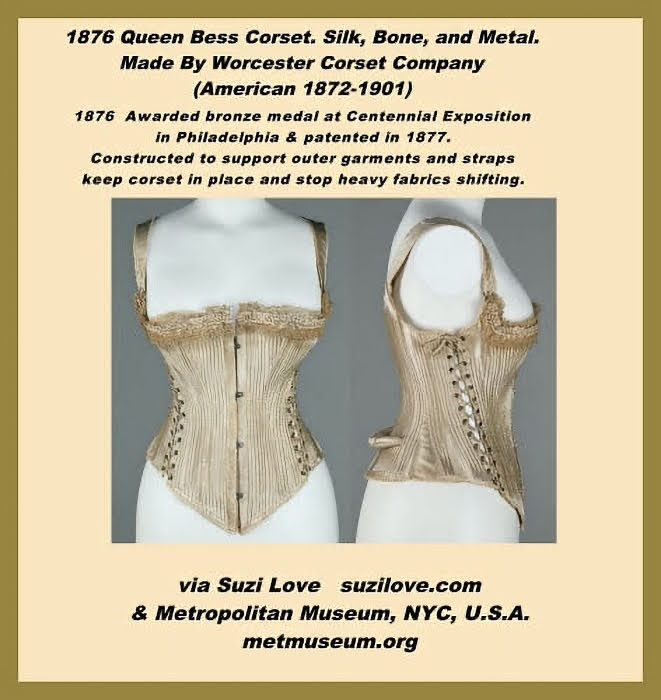
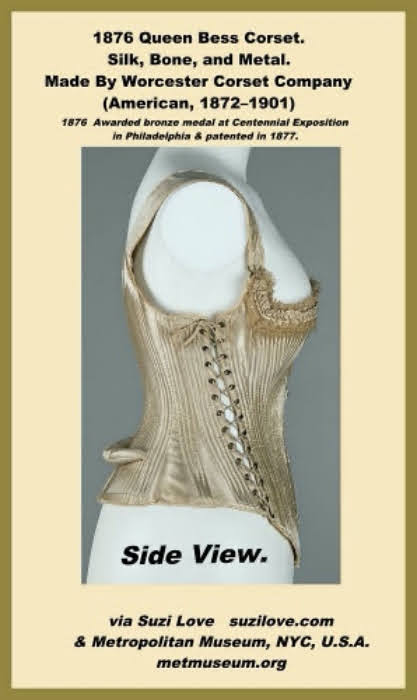
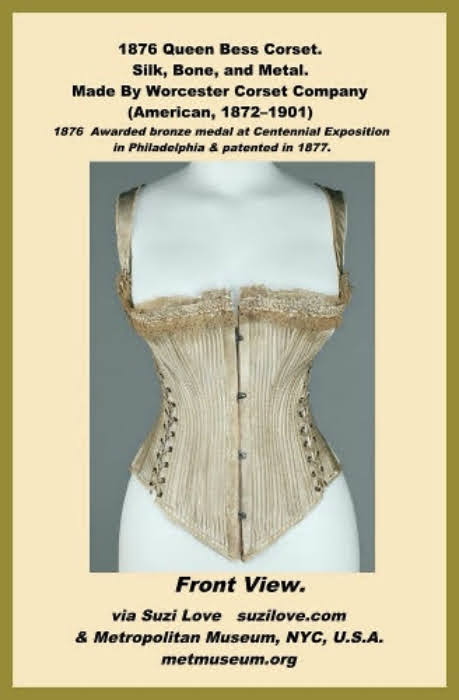
1876 ‘Queen Bess’ Corset By Worcester Company, American. Made of silk, bone, and metal. Named ‘Queen Bess’, this corset was awarded the bronze medal at the Centennial Exposition in Philadelphia in 1876 and was patented in 1877. A well documented piece, it is unique in its design, which has been carefully constructed to support the wearer’s outer garments. The straps would assist in keeping the corset in place and hinder any shifting due to the heavy fabrics, and the bustle roll at back would ease any strain the wearer might experience from the excessive weight of the skirt. Credit Line:Brooklyn Museum Costume Collection at The Metropolitan Museum of Art, Gift of the Brooklyn Museum, 2009; Gift of E. A. Meister, 1950 Accession Number:2009.300.3496a–e
Corsets 1850-1880 History Notes Book 19 Towards the end of the 1800s, corsets changed to give a fashionable silhouette and be a decorative fashion item. Tight lacing helped give a narrow waist and a feminine form under clothing while decorative corsets became desirable fashion items. Victorian corsets for small waists and fashionable silhouettes. Corsets during the Victorian Era, or late 1800s, tightened to give tiny waists and fashionable silhouettes.
Kelly’s Justice. I lived in Vanuatu, South Pacific, for 9 years and loved setting my book there.
Blurb: Kelly normally needs no help solving international security problems, but when someone from her past damages her reputation and threatens her life, she needs assistance. Joining forces with her old friend from the Australian army, now an expert on South Pacific politics, they destroy an island drug cartel and rescue kidnapped teenagers. https://books2read.com/SuziLoveKellysJustice
Excerpt
Working in tandem, Kelly and Grant hauled their captive up and supported him as they hop-walked him back towards the shed.
“Are the kids all there? All five of them?”
“I didn’t hang around to find out,” Grant said. “You screamed. I ran.”
Back at the shed, the rest of the team had things under control. The three most mobile hostages were climbing into the van and one of the girls was being supported by a tall young man who had his arms around her shoulders and was helping her move towards the vehicle.
Kelly and Grant looked inside the shed. The last girl was being carefully moved from the dirty mattress on the floor onto the folding stretcher they’d brought with them in the van.
They rushed forward to help as this girl looked battered and bruised, though she was being incredibly brave as they settled her on the stretcher. Four of them picked up the ends to carry her as carefully as they could to the sunshine outside. As they lifted the stretcher, she gave a pained moan and held her left arm to her chest. The edges of the stretcher had folded inwards and squeezed her arm, causing all color to drain from her face, so thankfully the distance to the van wasn’t far.
Looked like a dislocated shoulder and possibly broken bones in her forearm, but her other limbs looked okay and her only bleeding was from a gash on the side of her face where she’d obviously been struck, hard and repeatedly. No clothing appeared to be ripped or missing on this girl or the others, so though they had obviously suffered physical abuse, thankfully there was no outward evidence of sexual assault.
The other four teens squashed onto one seat, leaving one free to slide in the stretcher and ensure that the injured girl didn’t need to climb up, or to sit upright. Unfortunately, island roads were made of compacted coral and were notoriously full of potholes, so the poor girl would definitely suffer on the drive back to town thanks to the rocking and bouncing of the van.
Jacky was doctoring minor injuries on the boys with antibiotic cream and dosing them with water and pain killers, but overall the three boys appeared to have suffered less abuse than the two girls. Both girls looked teary, a combination of shock and relief at having been rescued before their abductors had administered any more beatings. Or had escalated the level of their abuse.
“What are your names?” Kelly asked. Even though she’d read the briefing notes, she wanted these kids to tell her their details themselves so she could list the kid’s injuries and have a full report to send back to Marci. Their anxious families would be relieved to hear the five teenagers were all alive and safe, but would want to know every detail of their children’s injuries.
She quickly jotted a list of the kid’s personal details.
Kimberley, 18, daughter of the American senator who had requested Marci’s help. Lacerations to face. Antibiotic ointment applied and was given pain killers. Probable dislocated shoulder and broken bone in forearm and put into a sling.
Brodie, 18, American.
Aaron, 17, American.
All three American college students who had volunteered to help rebuild four schools in different villages after their mini conference wrapped up.
Ryan, 18, Australian waiting to join the Air Force.
Catrina, 17, about to start training as a nurse.
List completed, Kelly started questioning the group to try and work out who had taken them, and more importantly, why. Their story seemed to be a case of wrong place, wrong time, more than a deliberate attack and kidnapping as four out of the five had no high profile or super rich parents.
The kids had decided to spend their day off from their community work by going by boat to the town of Port Vila, the main town on the most populated island. They’d hired a car and went exploring the local villages and beaches. At a coastal village, they’d bought local food for lunch and were driving to another beach to enjoy their lunch when they’d taken a wrong turn.
By the time they’d realized their mistake and were attempting to turn their rental car around, a vehicle full of men had driven up the dirt road behind them and blocked in their car. The new arrivals had yelled lots of demands, but the teenagers hadn’t understood the language being spoken and had signaled, by arm gestures and pointing down the road, that they would drive away.
After ten minutes of total confusion on the parts of both parties, the group of kids had been forced out of their rental car and marched, at gunpoint, up the track. Using guns rather than words, the newly arrived men had herded the group into the front section of the large shed, where they’d been held captive for the past few days.
Their captors had singled out the two girls as the weakest members of the group after the three young guys had tried to bluster their way past the men and their guns and get to the road. Unfortunately, every time they’d attempted an exit from the shed or a bolt for freedom, they’d been confronted by a line of men carrying weapons and forced back into the shed.
Broken English man had targeted the two girls, battering them repeatedly with a barrage of questions about who the girls were, where they’d come from, how many kids had been with them and why only five of them had driven down this road. Doing their best to explain with broken English and mimes, the girls had tried desperately to convince their captor that they’d turned their rental car around as soon as they’d sighted the shed. And that they knew nothing about what was happening at this remote shed. They were simply tourists looking for a swimming beach. Nothing had worked. Not their mimes, broken English or their begging.
Kelly’s Justice. I lived in Vanuatu, South Pacific, for 9 years and loved setting my book there.
Blurb: Kelly normally needs no help solving international security problems, but when someone from her past damages her reputation and threatens her life, she needs assistance. Joining forces with her old friend from the Australian army, now an expert on South Pacific politics, they destroy an island drug cartel and rescue kidnapped teenagers. https://books2read.com/SuziLoveKellysJustice
Excerpt
Kelly and Grant had guessed correctly that the other three kidnappers had no weapons because as soon a bullet was fired they turned and bolted around the shed, one on the left and two on the right. They sprinted towards them, but no-telephone-man quickly re-emerged through the shed door holding a weapon.
Kelly made a lightning change of direction and came at him from the side with a solid round house kick which knocked the rifle from his hands and the gun flew up into the air. She followed up with a chop to his neck, a knee to his groin and finished him off with a two-handed blow to his head. The man went down in a heap, screaming in pain, presumably from a burst ear drum.
Jacky’s voice called from one hundred meters down the road where she and Terry were closing in at a fast pace. “We’ve got this. Go after the runners.”
Kelly shot around the right of the buildings and sprinted after the two unarmed men who had crazily trampled their way through the undergrowth, giving her a clear path to follow them. She mentally thanked Marci and her grueling fitness course, because the long hours they’d all put in scrambling over and under obstacles and working out in the gym had honed her fitness so she wasn’t even puffing when she came up behind the pair of runaways. When she caught them up, they used their least bit of energy to try to run ahead with a desperate burst of speed.
Kelly kicked the feet out from the slower of the two and he hit the ground face down and slid, squalling like a baby as branches stripped skin from his face and ripped his clothing. When she lifted her foot to the side of his head, he squealed like a pig and covered his bleeding head with his arms. Quick as a flash, she took the chance to grab his arms and zip tie his hands behind his head. Planting her foot in the small of his back, she yelled, “Stay down or I’ll shoot.”
The quaking man might not have understood the language she spoke, but he sure as hell understood her gun digging into his temple and her finger pointing at the ground. The idiot frantically nodded, chanting something in his own language while his sobs increased and his chants became wails. He sounded like a two year old having a temper tantrum. Huh, not a trained operative then.
Jacky would only need to follow the wailing to find this one. Kelly took off again through the scrub, but the faster man had been so panicked he’d plowed through bushes and broken branches and left her an open trail to follow. She jumped broken bushes, weaved in and out of the dense scrub and sighted her prey just ahead.
“Stop or I’ll shoot,” she screamed in every language she knew. He fleetingly turned a frightened face to her, but then raced off again. “Shit,” she muttered, raising her pistol. They’d all practiced firing on the run at the compound, over and over. Even though it wasn’t Kelly’s best skill, Marci’s insistence on them being at least proficient at armed pursuit proved a blessing. She lifted her arm and fired. The guy screamed and fell to the ground, clutching his right leg as blood poured from his knee. Even with one leg out of action, he tried to shuffle backwards towards the scrub.
Kelly stood over him, her weapon now aimed at his groin, when Grant came rushing up. Bending over, hands to his knees, he sucked in some deep breaths.
“Christ, Kelly.” He struggled to catch his breath. “I heard the shot and thought it was you.” Ignoring the man groaning on the ground, he pulled her in for a hug, despite them both wearing bullet proof vests and layered clothing. “I swear my heart stopped,” he muttered onto the top of her head. The wounded man writhed on the ground, grasping his bent leg and moaning loudly. “Wow, Kel, good shooting there. Got his knee from behind while he was running.”
“Yeah, well,” Kelly muttered. “Marci, my boss, won’t be happy.”
“Really?” Grant held her away from him but kept his hands on her upper arms. “Why the hell not?”
“Because we trained hard for this, and I have one of the best hit rates.”
“So?” Grant said, looking puzzled.
“I was aiming for his lower leg, not his knee.”
Grant burst out laughing. “Then don’t tell her. Our secret.”
Kelly’s Justice. I lived in Vanuatu, South Pacific, for 9 years and loved setting my book there.
Blurb: Kelly normally needs no help solving international security problems, but when someone from her past damages her reputation and threatens her life, she needs assistance. Joining forces with her old friend from the Australian army, now an expert on South Pacific politics, they destroy an island drug cartel and rescue kidnapped teenagers. https://books2read.com/SuziLoveKellysJustice
Excerpt
Kelly and Grant went into the kidnappers compound first, as they both spoke a reasonable amount of Bislama, the local Pidgin, plus conversational French. Before independence, Vanuatu had been a condominium, shared by both Britain and France. The locals referred to it as pandemonium as both languages were spoken and street signage was in both languages and most locals spoke a variety of languages. Foreigners who didn’t speak any of languages stood out. Luckily, Kelly and Grant could competently converse with most of the people they encountered.
When Grant threw an arm across her shoulders, she stiffened, but he grinned. “Gotta look the part, sweetlips. Think we’re being watched.”
She fake smiled while she poked him in the ribs. “Yes, Pookie. Two either side of the shed. One on left armed. Can’t see weapons on others.”
Grant squeezed her shoulder. “Play tourist as long as we can. Then you take right and I’ll go left.”
“Big generator on left. Too big for normal farm.” She looked up at him adoringly and gave him another sickly-sweet smile while sliding her hand to the pistol in her holster. The loose peasant blouse she’d worn over her training singlet hid the bullet proof vest and her Glock. She turned slightly towards Grant, giving him time to slide out his own pistol and hold it behind his back.
As they took more steps towards the shed, the men standing guard in front straightened and went on alert. Kelly lifted a hand, gave a friendly smile, and said in English, “Hi, guys. Our car broke down and we wanted to use your telephone.”
Their expressions didn’t change so English wasn’t their first language. She greeted them again in Bislama, but still no reaction. Grant tried French. The men shifted on their feet, their expressions wary but, apart from the man on the far left, the men didn’t appear to have weapons. By their appearance, she guessed they were from Asia, possibly Indonesia.
Kelly made the universal sign by holding an invisible phone to her ear. “Phone,” she said.
“No phone.” He pointed down the dirt road. “You go.”
Kelly’s Justice. I lived in Vanuatu, South Pacific, for 9 years and loved setting my book there.
Blurb: Kelly normally needs no help solving international security problems, but when someone from her past damages her reputation and threatens her life, she needs assistance. Joining forces with her old friend from the Australian army, now an expert on South Pacific politics, they destroy an island drug cartel and rescue kidnapped teenagers. https://books2read.com/SuziLoveKellysJustice
Excerpt
“Why didn’t you leave the army, but stay around?” Grant asked Kelly. “Australia or Vanuatu. Always plenty of private security jobs up for grabs.”
“No, I couldn’t. The brass made it clear I needed to resign, or I would be legally charged. And if I lost my case, I might be jailed as well as dishonorably discharged.” She huffed. “So I was forced out of the career I loved on an unproven drug charge while Ronnie invented the cheating story to make himself look like the injured party. He wanted me out of the army and away from my friends, yet he insisted I stay around. Take a desk job with a friend of his, a business partner, so he could keep doing whatever he wanted while I was kept close and still under his control.”
“So, you ran away?” His face screwed up with pain “I’m sorry. I should have tried harder to help you sort out that mess. Done more to keep you in Australia. You could have taken a private security job. Kept fighting crime.”
That made her laugh. Between their army friends, there was a long standing joke about Kelly’s drive to fight crime and get justice for victims. They frequently teased her about being the female Aussie version of Superman. Fighting for justice on all fronts.
She shook her head. “No. Staying around was too dangerous because Ronnie discovered that I’d been digging through his paperwork to find something incriminating on he and his business mate. Whatever I uncovered would always make me a threat to Ronnie and anyone working with him. My only option was to get out of the country before his associates became aware that I had uncovered some of their secrets. I didn’t have enough evidence to expose them at that time, though Ronnie sensed I was about to go public with what I knew. I needed to leave Vanuatu quickly before things went from bad to worse. I didn’t know how far Ronnie would go to ensure my silence.”
“Briefing in five in the common room,” Jacky called to her.
Kelly was grateful that her partner had subtly nudged the other two men towards the building and allowed she and Grant a few minutes privacy. She acknowledged her friend with a nod. “Be right there.”
She turned to Grant. “Water under the bridge now. I always knew Ronnie could track me down, same as you could have found me with a bit of sleuthing. Hiding from anyone ex-military isn’t foolproof so I covered my tracks enough that old friends or distant family members couldn’t trace me, although I knew that one day my past would reappear.” She waved a hand towards Jacky. “But I’m living in a safer place now and working with people who’d protect me with their dying breath.”