1771 Tattersall’s Horse Training School, London, U.K. via Yale Center for British Art, Paul Mellon Collection.
Tattersall’s was founded in 1766 by Richard Tattersall (1724–1795), the Duke Of Kingston’s stud groom in premises near Hyde Park Corner, London. Two Subscription rooms were designated for members of the Jockey Club and became a meeting place for sporting and betting men. ‘Old Tatt’ conducted sales for the Duke of Kingston’s stud in 1774 and the Prince of Wales, or Prinny, in 1786. The prince often visited Richard Tattersall who was succeeded by his son, Edmund Tattersall (1758–1810), who extended the business to France.
“Be warned, my lord,” the woman said. “I shall return. Tomorrow. Early. Very early. And if you refuse to speak with me, I’ll haunt your house until you are prepared to listen to me.”
Justin Tremayne, Viscount Hawkesbury, felt the air suck out of the room. Movements ceased, breaths held, no one spoke. Every person in the room, including the courtesans, was aware of the reason he’d spent four years debasing himself before the wealthiest members of the ton.
The reason he forced himself to get out of bed each day, to place one foot in front of the other and go through the rituals, the pretense of living a normal life. Why he arranged wild bedroom antics for women and men that he barely knew and certainly didn’t like or respect. His guilt festered like an open wound and the pain never lessened. His obsession was to locate his mother and two sisters, to bring them home, and try to make amends for his absence at the time his deranged father had evicted them.
Unable to reply, he shook his head, robbed of coherent thought, unable to believe her declaration. Unable to convince himself it wasn’t another misery-causing lie. Unable to gather the energy to conclude his night’s business. Nothing mattered above the bait she dangled before his nose, the thing he yearned for more than any other—to bring his family back to him. This tiny despot had forced him into negotiating with her.
“Bart, Thomas. I ask you to leave me to my visitor. Then I’m off to find my bed.”
19th Century First Half Woman’s Embroidered Cap, French. In the 19th Century, women wore some sort of headwear during the day and the evening. Finely decorated cotton caps were worn during the morning with informal or At-Home, dress and at night with nightwear. These caps had fine embroidery, ruffles, lace edgings on the streamers, embroidered, pointed edges of the ruffles, ties, and streamers, known as ‘follow me lads’ or ‘flirtation ribbons’.
19th Century First Half Woman’s Embroidered Cap, French. Cotton mull with cotton embroidery, linen bobbin lace insertion, silk ribbon, round gathered crown with spoked wheel design in center surrounded by long leafed wreath, outside this a wreath of carnations, same carnations around forehead band and neck band, design embroidered with white linen thread, white taffeta ribbon run through the embroidered net casing and tied in center back. via Museum of Fine Arts, Boston, U.S.A. mfa.org
Chatelaines and Chains History Notes Book 9 By Suzi Love. What do you know about Chatelaines and Chains worn in Jane Austen’s and Bridgerton times? Women in charge of households carried important items with them. History Notes Book 9 Chatelaines and Chains. books2read.com/SuziLoveChatelaines
Personal Necessities, keys, or chatelaines was a set of useful items hung from waist by decorative chain. Chatelaines and Chains. History Notes Book 9 By Suzi Love. Women in charge of households dangled long chains from their waists to keep essentials within easy reach e.g. keys, notebook and pen, watch, sewing items, vinaigrette or perfume, or magnifying glass. Early chatelaine were simple essentials. Later chatelaine were decorative and expensive. http://books2read.com/SuziLoveChatelaines
Definition Chatelaine: The word Chatelaine is French and means the keeper of the keys. Chatelaine” derives from the Latin word for castle. In Medieval times, the chatelaine was in charge of the day-to-day running of the castle. Women in charge of households dangled long chains from their waists to keep essentials within easy reach e.g. keys, notebook and pen, watch, sewing items, vinaigrette or perfume, or magnifying glass. Early chatelaine were simple essentials. Later chatelaine were decorative and expensive.books2read.com/SuziLoveChatelaines
What did a chatelaine do? Most important task was keeper of the keys. Also ordered supplies, did bookkeeping, supervised servants, taught castle children, and organized guests.
1800–1805 ca. Cotton Linen Empire Style Dress, American. Typical Empire Style high-waisted dress. Full skirts fall from under the bust, lightweight cotton, drapes in imitation. of the classical styles of Rome and Greece. via Metropolitan Museum, NYC, U.S.A. metmuseum.org
1815 Blue Striped Dress, Norway. Empire style, or high-waisted, dress with short puffed sleeves over long straight sleeves and gold trim. I can picture Jane Austen and her female friends and family wearing this sort of dress to an evening event. via Nordiska Museet, Nordic Museum, Stockholm, Sweden. digitaltmuseum.se
1810–1850 ca. Corset, American or European. Front lacing, extra wide straps for under a square neckline dress. via Metropolitan Museum, N.Y.C., U.S.A. metmuseum.org
Surviving stays, or corsets as they became to be called in the nineteenth century, show that both longline and shorter corsets were worn and that they were made of cotton, silk and sateen. A lot of these corsets were front fastening, plus many were laced at both the front and the back so our aristocratic fictional heroines could indeed dress and undress themselves without the assistance of a maid.
Corsets 1810-1830 History Notes Book 17 This book shows how corsets changed to fit well under clothing, give maximum support and comfort. Corsets pushed up breasts and showed off the bust line beneath a square-cut and low-cut neckline as in the early 1800s, or Regency years. Jane Austen and her female and friends wore these corsets. https://books2read.com/SuziLoveCorsetBook17
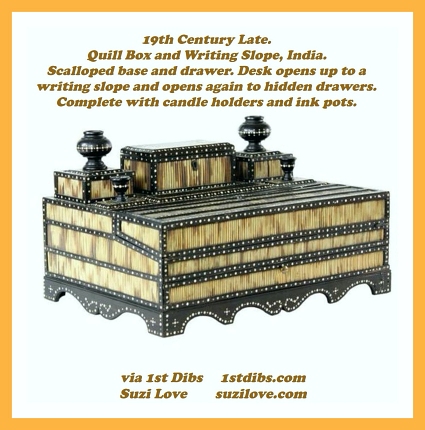
19th Century Late. Quill Box and Writing Slope, India. Scalloped base and drawer. Desk opens up to a writing slope and opens again to hidden drawers. Complete with candle holders and ink pots. The type of inkstand that households woulds have in Jane Austen’s times for writing letters and keeping track of estate matters. Many of these exotic and decorative items were brought to England by gentlemen doing their Grand Tour through Europe and Asia. via 1st Dibs Auctions ~ 1stdibs.com
1800 ca. Fawn Cotton Bodiced Petticoat With Front Lacing, English. via National Trust Collections, UK. nationaltrustcollections.org.uk
Because dresses were so light and airy as to be almost see-through, petticoats were needed to protect a woman’s modesty. If a glimpse of an ankle was supposed to turn a man’s head, imagine what would happen if he saw an entire lady’s exposed leg.
Did Jane Austen wear this type of petticoat under her dress? Probably. This wide necked, small shoulder straps and Empire, or high-waisted, undergarment would have provided some warmth plus protect the modesty of Regency Era women. This would be worn under the high-waisted, wide necked, small bodiced type of thin, or even almost transparent, dresses of the early 1800s.
1817 March. Opera Dress, English. The sort of outfit Jane Austen and her contemporaries or the Bridgerton women would wear for an evening at the opera or theatre. Fashion Plate via Rudolph Ackermann’s ‘The Repository of Arts’.
A blue crape dress over a white satin slip; the dress trimmed round the skirt with a deep blond lace, which is headed with a light and novel trimming, composed of white floss silk and small pearl beads: this trimming is surmounted with a beautiful deep embroidery of lilies, surrounded by leaves. The body and sleeves of this dress, as our readers will perceive by our print, are extremely novel. Head-dress, toque à la Berri; it is a crown of a novel form, tastefully ornamented round the top with lilies to correspond with the trimming of the skirt, and a plume of white feathers, which droop over the face. Ear-rings, necklace, and bracelets, sapphire mixed with pearl. The hair dressed in loose light ringlets on the forehead, and disposed in full curls in the back of the neck. White kid gloves, and white satin slippers.