1811 Walking Dress, French. High-waisted lavender Redingote over a white dress, paisley shawl, white gloves, slippers, and a ruched, or gathered fabric, hat to match the high ruched neck frill. Fashion Plate via Journal des Dames et des Modes, or Costume Parisien.
19th Century Writing Set, French. Old Paris porcelain pot with ormolu fittings, set on a pen tray that is papier mache and hand painted in Chinoiserie, Or Japonaise, Style. The type of writing sets that households would have in Jane Austen’s times for writing letters and keeping track of estate matters. Chinese and Japanese styles of household goods were very fashionable during the English Regency and Victorian years. via Ruby Lane Antiques. rubylane.com
HN_13_D2D_WritingTools Book 13 What did the lady of the house use to pen notes? What sat on the desk of the man of the house when managing his accounts? #History #Nonfiction #travel books2read.com/SuziLoveWritingTools
1810 Man’s Suit and Girl’s Dress, Portugal. Man’s purple pleated silk jacket, vest, and breeches embroidered with silk threads. Girl: White silk tulle dress embroidered with silk threads and an overdress of yellow cotton satin. via National Costume Museum, Portugal. The sort of men’s formal clothing worn for court and typical girl’s dress as worn in Jane Austen’s times.
1810 Man’s Suit and Girl’s Dress, Portugal. Man’s purple pleated silk jacket, vest and breeches. via National Costume Museum, Portugal. https://books2read.com/SuziLoveFashionMen1800-1819
1810-1829 ca. Green Silk Street Shoes, Probably British. As Worn by Jane Austen and her contemporaries and the Bridgerton family. Heavier sole than ordinary day shoes, although the silk fabric meant they were only worn for easy promenades. Rounded toe means prior to 1830, when toes became square. Strong colors in shoes complimented fashionable colorful garments of the time. via Metropolitan Museum, NYC, U.S.A. metmuseum.org
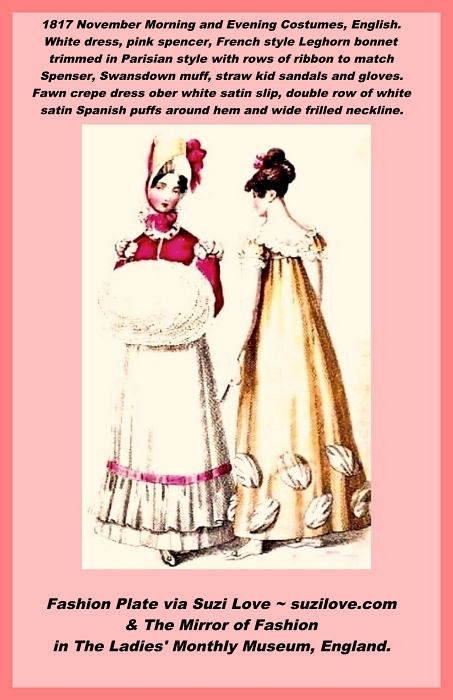
1817 November Morning Dress and Evening Dress, English. Morning Dress is a round dress of Jaconot muslin with back buttons, small collar open in front to display the throat, lower part of front with bias tucks, moderately full skirt finished around bottom with small tucks and deep flounce with bright rose ribbon. Rose velvet Spenser trimmed with white satin and rose silk, finished at throat with white satin puffings. Plain long sleeves, French style Leghorn bonnet trimmed with large rows of ribbon to match Spenser and tied under the chin, stand-up lace frill around throat, swansdown muff, straw kid sandals and gloves.
Evening dress of fawn crepe over a white satin slip, cut low around the bust, confined to waist by a narrow cestus of white satin, fastened in front by a brilliant clasp. Single fall of Mecklin lace on dress, very short full sleeve finished at bottom by a rouleau of white satin and narrow lace plait. Skirt trimmed with double row of white satin Spanish puffs, very full and in bias. Hair high, parted and curled on the forehead with garland of Provence roses. Pearl earrings and necklace, spangled crape fan, white kid gloves and white satin slippers. Fashion Plate via The Mirror of Fashion in The Ladies’ Monthly Museum, England.
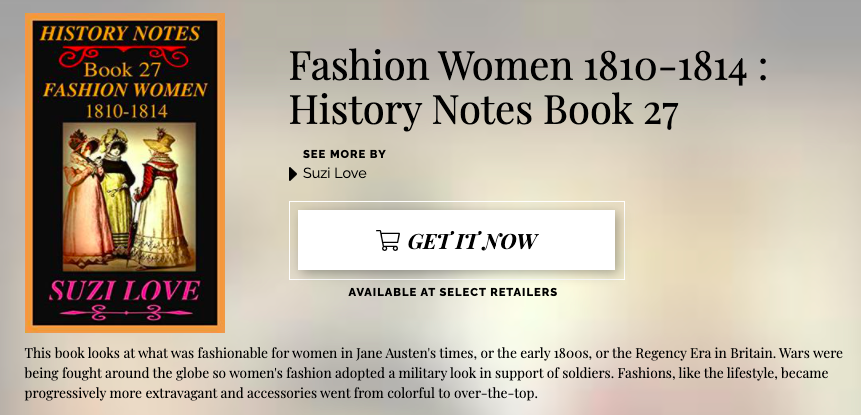
Fashion Women 1815-1819 History Notes Book 28 https://books2read.com/SuziLoveFashionWomen1815-1819
1810 Les Invisibles. By James Gillray. Two men walk towards each other, each with a lady hanging to each arm, all have their faces concealed by some part of their dress, hat, or collar, or both. One man has a round hat, with a fantastically curved brim projecting downwards. The other has a huge crescent-shaped cocked hat with the peaks dipping over face and back. Via British Museum, London, UK. britishmuseum.org (PD-Art)
1810 Les Invisibles. By James Gillray. Two men walk towards each other, each with a lady hanging to each arm, all have their faces concealed by some part of their dress, hat, or collar, or both. One man has a round hat, with a fantastically curved brim projecting downwards. The other has a huge crescent-shaped cocked hat with the peaks dipping over face and back. Via British Museum, London, UK.RL_2_D2D_RetailerBuyLink_RL_2
https://books2read.com/suziloveYGD
1810 “A Bonnet Shop” By Thomas Rowlandson.A shopkeeper with a hat in each hand converses with an elderly woman wearing a similar hat. A child holding a rattle looks up at them at left, a plump woman wearing a bonnet sits at center, and a group of young women make bonnets in the background. Many groups of hats hang overhead in the shop. Via British Museum, London, UK. britishmuseum.org (PD-Art)
1815 Blue Dress Bodice, French. Layers of frills on dress back. Hairstyle and Various Bonnets as Jane Austen would have worn. Fashion Plate via Journal des Dames et des Modes, or Costume Parisien.
Fashion Women 1815-1819 History Notes Book 28 https://books2read.com/SuziLoveFashionWomen1815-1819
1811 Green Dress French. High waist with bow under the bust, Mamaluke sleeves as “a long full sleeve partitioned into five sections, each section being drawn and seamed to fit around the arm up sleeves, white collar lining, fashionable blue bonnet tied under the chin and wearing yellow shoes. The sort of fashionable outfit worn by women in Jane Austen’s times, or 1800s, or Regency Era. Fashion Plate via Journal des Dames et des Modes, or Costume Parisien.
Mamaluke Sleeves: Long full sleeves partitioned into five sections, each section being drawn and seamed to fit around the arm up.