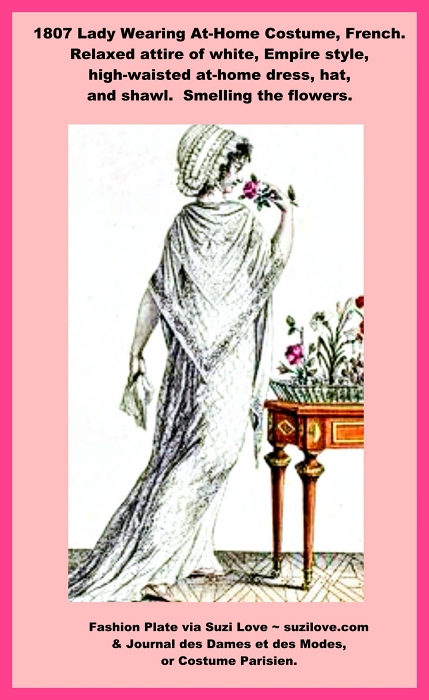
1807 Lady Wearing At-Home Costume, French. Relaxed attire of white, Empire style, high-waisted at-home dress, hat, and shawl. Smelling the flowers. Jane Austen and her family and friends would have worn this style of dress. Fashion Plate via Journal des Dames et des Modes, or Costume Parisien.
Typical outfit worn at home in the morning when at home and to be seen only by family or close friends. A lady might wear this while writing having breakfast, writing letters, or reading. Called by the various names of Undress, to At-Home dress, or Morning dress, it is the most relaxed ensemble a lady will wear all day.
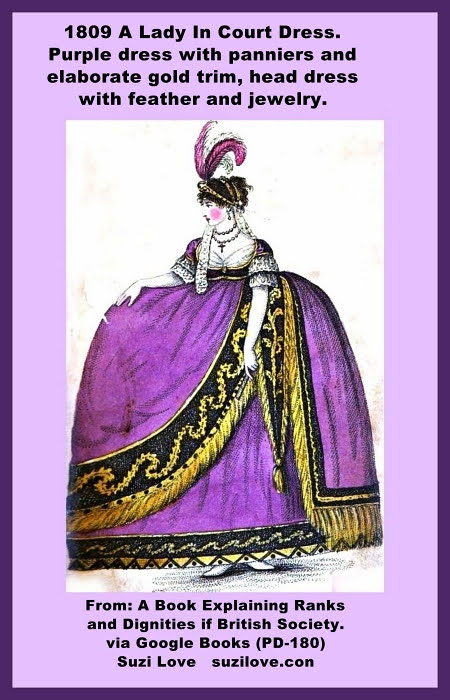
1809 A Lady In Court Dress. From: 1809 A Book Explaining Ranks and Dignities in British Society. via Google Books (PD-180)
Definition Court Dress: Usually, the difference between a court dress and a ball dress was in the quality of fabrics used, how elaborate the design, and the number and quality of the accessories. Plus, in England in the early 1800s court dresses were required by Queen Charlotte to have hoops and in France and other European countries court dresses a long train, usually expensively decorated. During the Regency Era, white cotton dresses were considered suitable for many evening events, but definitely not for an evening event in a palace.
1809 A Lady In Court Dress. From: 1809 A Book Explaining Ranks and Dignities in British Society. via Google Books (PD-180)
Fashion Women 1805-1809 History Notes Book 26 What did Jane Austen and friends wear? This book looks at early 1800s fashions, which were elegant and pretty with high waists and fabrics that were almost transparent. These Empire style gowns, named after Napoleon’s first Empress, became popular throughout Europe, and were then copied around the world. Colorful outwear was added to make an ensemble more attractive and warmer.
1809 White Walking Dress, French. Green cashmere shawl, green shoes and close-fitting hat. This is a fashionable ensemble as would have been worn by Jane Austen and her family and friends. Walking dress such as this would have been worn when out shopping, walking in a park or the country estate. This sort of outfit needed to be presentable and warm, but not overly accessorized. Fashion Plate via Journal des Dames et des Modes, or Costume Parisien.
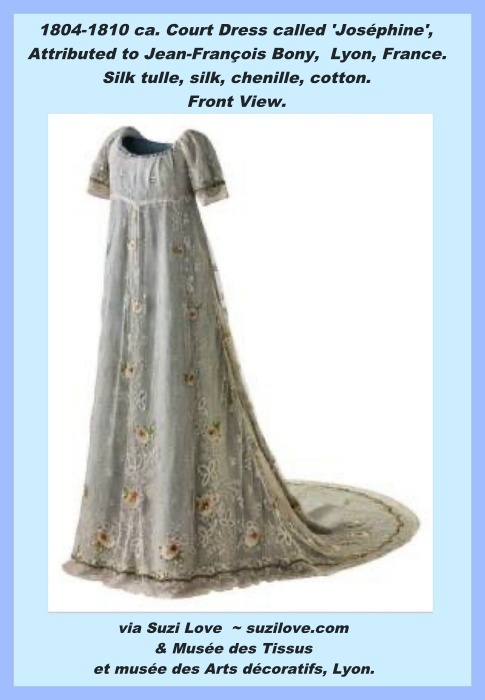
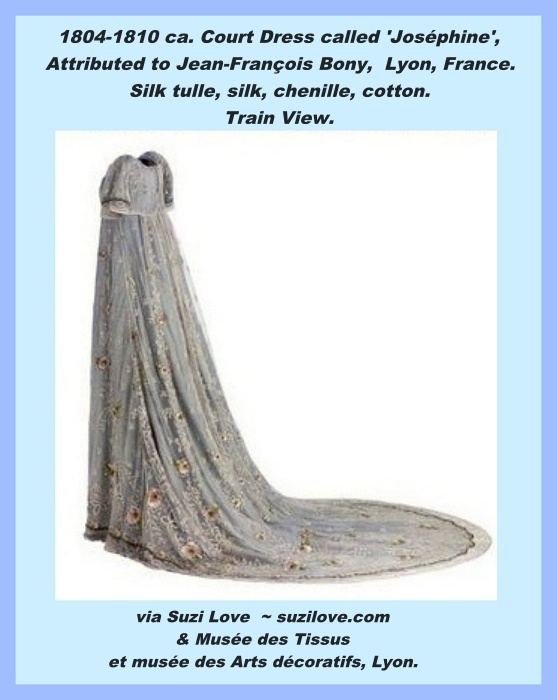
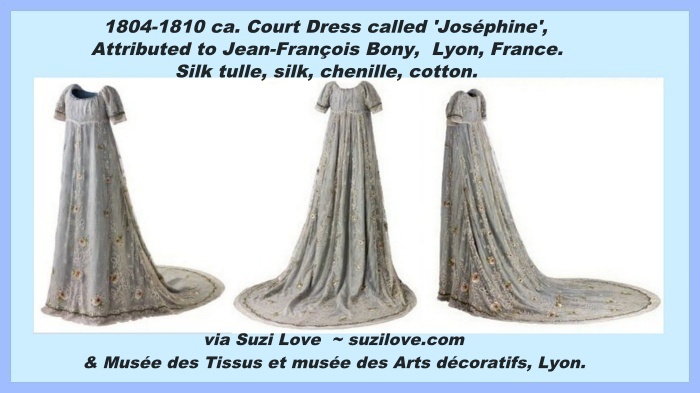
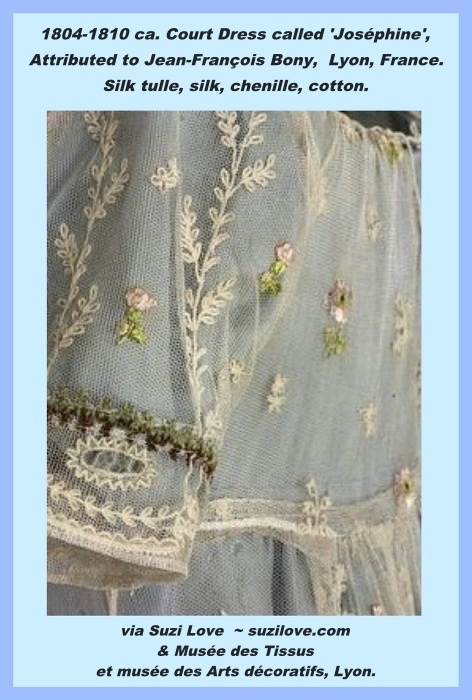
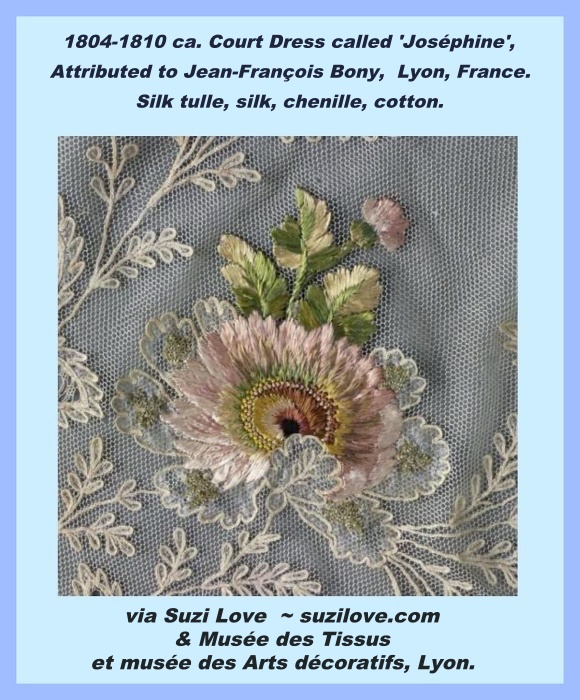
1804-1810 ca. Empire style, or high-waisted, French Court Dress called ‘Joséphine’, Attributed to embroiderer Jean-François Bony, Lyon, France. Silk tulle, silk, chenille, and cotton. via Musée des Tissus et musée des Arts décoratifs, Lyon. via Musée des Tissus et musée des Arts décoratifs, Lyon.
Definition Empire Style: Named after the First Empire in France, by 1800 Empire dresses had a very low décolleté, or neckline and a short narrow backed bodice attached to a separate skirt. Skirts started directly under the bust and flowed into the classical relaxed wide styles of Greece and Rome. This style of dress is associated with Jane Austen and her contemporaries as a simple cotton high-waisted dress was worn most days and accessorized according to the importance of the occasion.
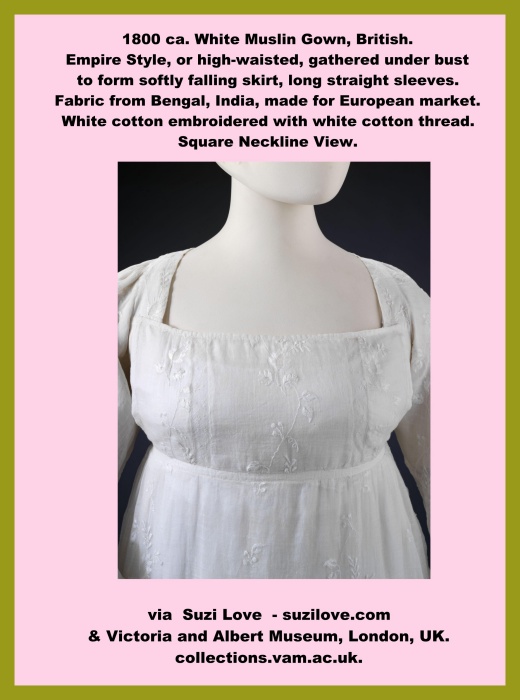
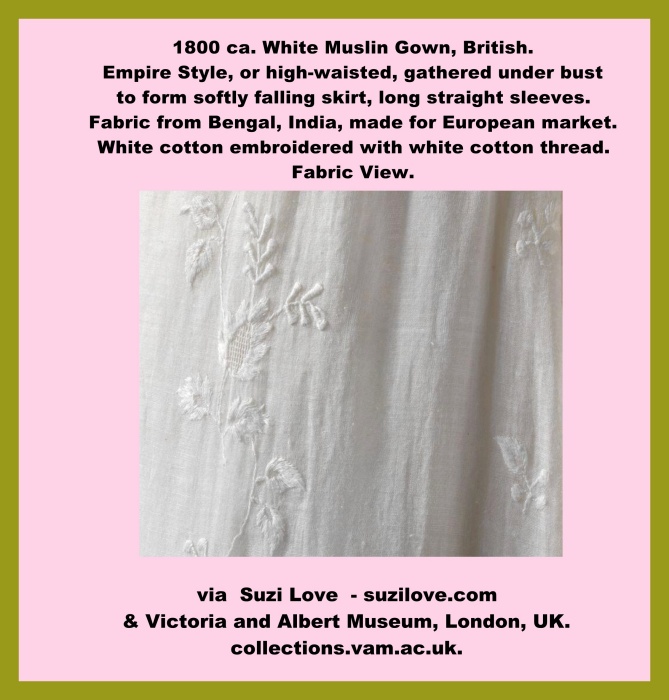
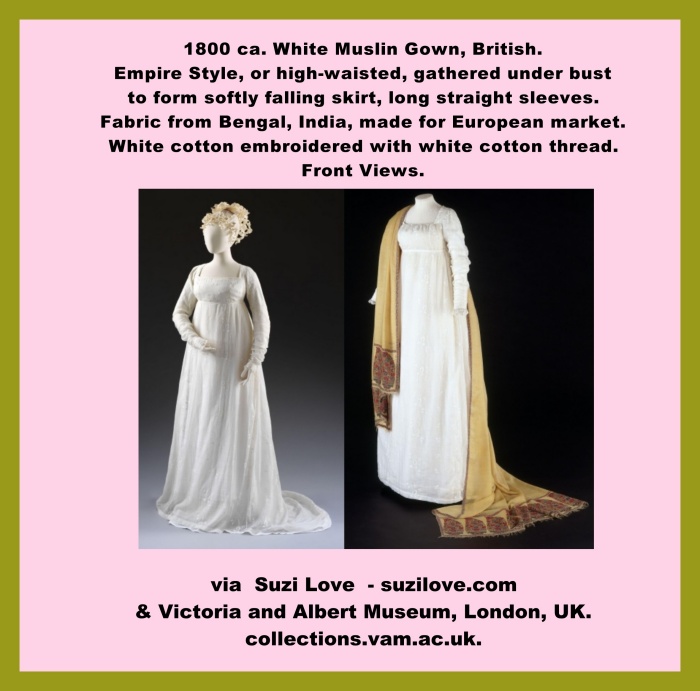
1800 ca. White Muslin Gown, British. Empire Style, or high-waisted, gathered under bust to form softly falling skirt, long straight sleeves. Fabric from Bengal, India, made for European market. White cotton embroidered with white cotton thread. via Victoria and Albert Museum, London, UK. collections.vam.ac.uk.
About 1800 Women’s dress changed dramatically after 1785. The rich fabrics and complicated, formal shapes of the late 18th century gave way to simple, light fabrics that draped easily. These new gowns achieved something of the effect of the simple tunics shown on classical Greek and Roman statues and vases, Muslin embroidered with cotton thread Fabric made in India, gown made in England Given by Miss Frances Vickers Museum no. 444-1888 (2013) Victoria and Albert Museum, London.
By the end of the 18th century, rigidly tailored garments for both men and women were replaced by styles made for ease and comfort, resulting in the neoclassical style of the 1780s. Inspired in part by the statuary of ancient Greece and Rome, the new fashion was epitomised by light cotton gowns falling around the body in an unstructured way, held around the high waist with a simple sash and accompanied by a soft shawl draped around exposed shoulders. This style was ideal for the Indian imports like Kashmiri shawls and Bengali muslin, as used in this embroidered gown. Championed by such influential figures as Emma Hamilton in England and Madame Récamier in France, the so-called ‘Empire’ style catapulted Indian muslin into the forefront of fashion.
Definition Empire Style Dress: Named after the First Empire in France. Empire dresses had a low neckline and skirts started directly under the bust and flowed into the classical relaxed wide styles of Greece and Rome. This style of dress is associated with Jane Austen and her contemporaries as a high-waisted dress was worn most days. Cotton, silk or taffeta were the popular fabrics. Only the very wealthy could afford white dress in this style as the cottons were imported from India and had to be carefully cleaned, usually by a lady’s maid.
1820 Ball Gown of Embroidered Net, British. Silk satin and silk net embroidered with metal and trimmed with silk blonde bobbin lace, hand sewn. Short-sleeved ball gown comprising of an underdress of silk satin and an overdress of machine-made silk net embroidered with metal and trimmed with blonde bobbin lace. The dress has a low oval neckline, puffed short sleeves, a wedge shaped front bodice panel, and a medium high waist. The skirt has a central front panel, wedge shaped panels and the centre back panels are tightly gathered at the waist.
From the Museum Curator: ‘Women saved their most elaborate dresses for special occasions such as balls. Lavish gowns embellished with gold thread or sparkling beads glittered in the artificial light of the dancing room. Thin, gauzy materials created a soft dreamy look. These light materials also prevented the wearer from getting too hot while dancing in stuffy, overcrowded spaces’. Victoria and Albert Museum, London, UK
1815 French Couple. Lady in evening dress with scooped neckline on low-cut pink bodice, floral headpiece and long white gloves. Gentleman in brown tailcoat and stirrup trousers, vest, and casual necktie. Fashion Plate via Journal des Dames et des Modes, or Costume Parisien.
The sort of fashionable outfits and items worn or carried by Jane Austen and her contemporaries when out in public. Ladies outfits for evening were accessorized with gloves, headdresses and jewelry and often dresses were of this shorter length for dancing. Gentlemen were always heavily accessorized as well with the essential of gloves, coats, waistcoats and neatly tied cravats. For more about the fashions of 1815, take a look at History Notes Books 23 and 28 men’s and women’s regency Era fashions.
Fashion Women 1815-1819 History Notes Book 28 What did Jane Austen wear? What was fashionable for women at the end of the Regency Era in Britain and the reconstruction in Europe after the wars. Book 28 for 1815-1819 in History Notes Includes fashions for mourning, riding, dresses, hats, shoes, reticules or bags, underclothing, accessories.
Fashion Men 1800-1819 History Notes Book 23 What was fashionable for men in early 1800s, or Jane Austen’s time, or Regency Era? Suits, hats, shoes, underclothing, fashion accessories, military and bedroom fashions. French fashions and Georgian and Regency Era fashions from Great Britain were copied around the world.
1805 Regency Group of Ladies and Gentlemen dressed as Jan Austen and her family and friends would have dressed. Ladies in dresses, bonnets, shawls, gloves, and carrying a reticule, or bag, and a parasol. Gentlemen in tailcoats, overcoats, trousers, vests, cravats, hats, boots and shoes and carrying walking sticks. via Men And Women In Costumes, 1804-1829. The Miriam and Ira D. Wallach Division, The New York Public Library, U.S.A.
1816 August Walking Costume, or Pelisse, or Coat, English. Round dress, composed of cambric and trimmed with lace. The body is let in with a profusion of lace. Plain long sleeves, very full, except at the wrist where the fulness is confined by small plaits, sleeve finished by double frill of lace. Over the dress is a Pelisse of blue and white shot sarcenet, lined with white sarcenet and trimmed with white satin. Pelisse sleeve is very full and finished at the wrist by a cuff and bows of ribbon. Pelisse is made half high and finished at neck with a triple fall of rich lace but the neck is bare. White satin hat is turned up in front and ornamented with flowers. Kid gloves, blue kid shoes and a parasol. We are indebted for this tasteful dress to Mrs. Gill of Cork Street, Burlington Garden, London. Fashion Plate via Rudolph Ackermann’s ‘The Repository of Arts’.
Definition: Pelisse Or Redingote: Woman’s long, fitted coat often worn open in front to show off the dress underneath. Sometimes cut away in front. Originally made with several capes and trimmed with large buttons. French word developed from English words, riding coat. reefer. Single- or double-breasted, fitted, tailored, over-all coat usually made from sturdy fabric. Jane Austen and her contemporaries wore long coats like these to keep warm when out and about, visiting, shopping etc. The thin muslin dresses worn in the early 1800s were little protection against European winters. #Regency #Fashion #History
1803 Jane Austen Style Dress Bodice and Five Trimmed Hats. Low cut bodice, puffed sleeves, scarf, four variations of trimmed hats. Fashion Plate via Journal des Dames et des Modes, or Costume Parisien. https://books2read.com/SuziLoveFashionWomen1801-1804