1815-1818 ca. Morning Dress, British. Typical Regency Era Day Dress. Very simple printed cotton dress with long sleeves and a very high waist. This is the typical Empire style, or high-waisted dress made of printed cotton that Jane Austen and her female friends and family would wear during a normal day. via Metropolitan Museum, N.Y.C., U.S.A. metmuseum.org
1815-1818 ca. Morning Dress, British. Front View.1815-1818 ca. Morning Dress, British. Back View. 1815-1818 ca. Typical Regency Era Printed Cotton Day Dress. #Regency #Fashion #JaneAusten
1804 September Exhibition of Water Coloured Drawings, Old Bond Street, London, U.K. Designed and etched by Thomas Rowlandson. Via Wikimedia Commons commons.wikimedia.org (PD-ART)
Here is an example of when English magazines copied French fashion plates.
1815 December Left: French fashion plate Ensembles French and English via Journal des Dames et des Modes. White short length ball dress with tiny bodice.
Right: English fashion plate by Rudolph Ackermann in the Repository Of arts. Blue sarsnet Pelisse, or Walking dress, or Redingote. Decorated with white lace trim on neck, vertical front, and hem. Carrying red shawl and with high plumed bonnet.
1815 December Blue Walking Dress, English. Blue twilled sarsnet pelisse, or Redingote, with ribbon bows adorning the front. Decorated with white lace trim on neck, vertical front, and a border of leaves on the hem. Slashed sleeves at shoulders and wrists plus an elaborate collar would have been time consuming to make. Carrying a red shawl and with a high bonnet with a white plume, or feather. Fashion Plate via Rudolph Ackermann’s ‘The Repository of Arts’.
1815 December Blue Walking Dress, English. Decorated with white lace trim on neck, vertical front, and hem. Carrying red shawl and with high plumed bonnet. Fashion Plate via Rudolph Ackermann’s ‘The Repository of Arts’.
Below is the French version of this pelisse but with a lady in a ball dress. Possibly another example of the English magazines ‘copying’ French designs.
1815 Ensembles French and English. White short length ball dress with tiny bodice and sleeves. Blue sarsnet Redingote, or pelisse, decorated with white lace trim and border of leaves, slashed sleeves at shoulders and wrists, elaborate collar, red shawl, high bonnet with white plume, or feather. Fashion Plate via Journal des Dames et des Modes, or Costume Parisien.
19th Century Inkstand, English. Ormolu and tortoiseshell. The type of inkstand that households would have in Bridgerton’s and Jane Austen’s times for writing letters and keeping track of estate matters. Curved, recessed top, two square inkwells of faceted cut glass with round necks and ormolu lids. via 1st Dibs Auctions ~ 1stdibs.com
1820 August Walking and Evening Dresses, English. Walking Dress of cambric muslin with frilled hemline. Blue-purple Spencer with epaulettes of points of satin. Bonnet to match of metallic gauze and tied under her chin, yellow Limeric gloves, reticule or bag, and blue boots. Evening Dress of Urling’s lace with aqua blue leaf decoration, earl combs, pearl necklace and ear-rings, gold chain or chatelaine with a watch, white kid gloves and white silk shoes. Via Ladies’ Monthly Museum in The Mirror of Fashion, London, U.K.
Definition Limerick Gloves: Named after County Limerick in Ireland where they were first made. Often referred to as chicken skin gloves, though actually made from skins of unborn calves. Usually cream or yellow, superior quality and very thin.
Definition Ridicule, Reticule, Indispensable, or Handbag: From the late 1700s, pockets could no longer be sewn into gowns, as skirts fell from just under the bust and were full and flowing. Instead, women began carrying small bags, known at first as ridicules and later as reticules, to keep necessary items on their person e.g. handkerchiefs, coins, vinaigrettes, calling cards, glasses etc.
Definition Spencer: Short jackets cut to match the high waistlines of Empire dresses. They often copied military styling, such as braiding, shoulder decoration, buttons and loop fasteners, and wrist adornments. They were generally of complex construction, often with a diamond shaped piece in the back. Said to have originated in an accident to Lord Spencer while hunting when his coat tails were torn off and he wore it as a short jacket.
1807 January Couple In Morning Walking Ensembles, English. Lady in white dress with lemon pelisse or coat, fitted hat and interesting reticule, or bag. Gentleman in long black tailcoat over yellow breeches, high black boots with wide tan tops, yellow gloves, cane and top hat. via Le Beau Monde, or Literary and Fashionable Magazine, London, U.K.
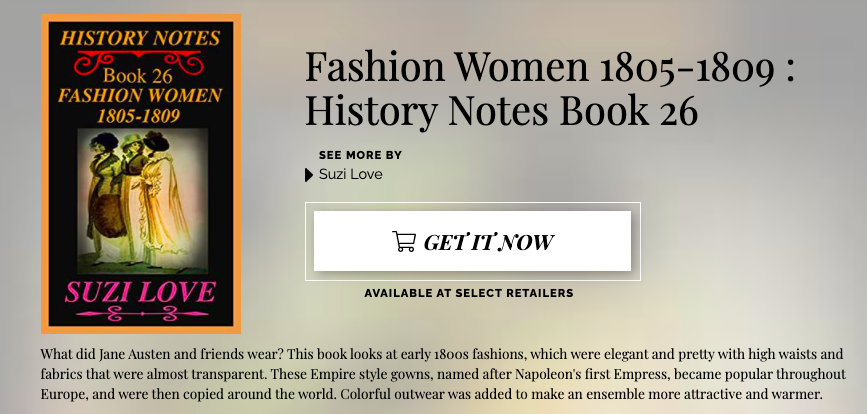
These are the types of outfits worn by Jane Austen and contemporaries in England and shown in their English magazines.The same designs had probably already been seen in France, because English publishers obsessively copied French fashions despite the two countries being at war for many years. https://books2read.com/SuziLoveFashionWomen1805-1809
1809 May Walking Dress, English. Dress of white Scotia washing silk. Bishop’s mantle of sage or olive green striped and plain silks, made entirely without seams, border of the same color. Spanish hat to match the mantle turned up in front and decorated with artificial flowers. Shoes of sage or olive green match. Design by Mrs. James, New Bridge Street, Blackfriars. Fashion Plate via Rudolph Ackermann’s ‘The Repository’ of Arts.
General Observations for 1809 fashions from The Repository Of Arts: Spanish hats with feathers were worn all winter but are now worn as walking hats and the feathers have been replaced with flowers. Light silk mantles of all colors are being much worn. Scotia silk is now in great request for dresses and colors vary according to individual taste but silver-grey is the most elegant and fashionable. The attempt to introduce long waists failed. Full dress is the present standard.
On January 27th, 1772, The Pantheon opened on Oxford Street, London. Designed by James Wyatt, The Pantheon featured a rotunda which was one of the largest rooms in England at the time. The Pantheon was intended as London’s answer to Ranelagh Gardens for winter entertainment and opened to a crush when nearly “two thousand persons of rank and fashion assembled.” The Pantheon officially closed for public entertainments in 1814, after Lord Chamberlain restrictions on the building’s use as a theatre made the final venture unprofitable. It was converted to a bazaar in 1833 and in 1867 became a winemakers office and showrooms until being demolished in 1937.
From 1819 Ackermann: The Pantheon was built “for the purpose of public evening entertainments” and was a “superb and beautiful structure” with elegant interiors furnished with fine paitnings, gilt vases, and statues depicting gods and goddesses. The building consisted of a suite of fourteen rooms, and between 1789-1792 (until a fire) was used as an exhibition space for Italian operas after the destruction by fire of the King’s Theatre in Haymarket.
1814 January The Pantheon via Ackermann’s Repository : This once noble structure, situated on the south side of Oxford-street, was originally built by Mr. James Wyatt, for the purpose of public evening entertainments. It was a most superb and beautiful structure, the admiration of all connoisseurs, foreigners as well as natives. The interior was fitted up in such a magnificent style, that it is scarcely possible for those who never saw it to conceive the elegance and grandeur of the apartments, the boldness of the paintings, or the effect produced by the disposition of the lights, which were reflected from gilt vases. Below the dome were a number of statues, representing most of the heathen gods and goddesses, supposed to be the ancient Pantheon at Rome, from which it derived its name. To these were added three beautiful statues of white porphyry, representing the King and Queen and Britannia.
The whole building formed a suite of fourteen rooms, each affording a striking specimen of taste and splendor. After the destruction of the King’s Theatre in the Haymarket by fire in June 1789, the Pantheon was used for the exhibition of Italian operas, and was frequently honored with the presence of their Majesties; till on the 14th of January, 1792, this beautiful structure also fell a prey to the same devouring element.
The fire broke out in the new buildings which had been added for the most convenient performance of operas; and before any engine reached the spot, the flames had gained such a height, that all attempts to save the building were in vain. Owing to the scenery, oil, paint and other combustible materials in the house, the conflagration was so rapid that not a single article could be saved. Persons who witnessed the progress of this tremendous fire, declare that the appearances exhibited through the windows, the lofty pillars enveloped in flames and smoke, the costly damask curtains waving from the rarefaction of the air, and the superb chandeliers turning round from the same circumstance, together with the successive crashing and falling of different portions of the building, furnished to their minds a more lively representation of Pandemonium than the imagination alone cam possibly supply.
The effects, too, of the intense frost which then prevailed, upon the water poured from the engines upon the blazing pile, are described as equally singular and magnificent. The loss occasioned by this catastrophe amounted to £60,000; only one fourth of which sum was insured. The height of the walls fortunately prevented the conflagration from spreading to the contiguous houses.
The Pantheon has been rebuilt; the original elegant front and portico still remain, but the rest of the edifice exhibits not eve a shadow of its former magnificence. Since its re-edification, it has been used principally for exhibitions, and occasionally for masquerades. Various plans have at different times been brought forward for opening it for dramatic representations; and this was actually done a few months since under a license from the magistrates, by a Mr. Condy, who is understood to have embarked a considerable fortune in the concern; but whose right has been contested by the winter theatres, and is likely to become a subject of legal discussion.
1800 Pantheon Masquerade, London, U.K. via Rudolph Ackermann’s Microcosm of London. Engraved by John Bluck. (1791-1831)
1818 May ‘Beau’s of 1818’ By George Cruikshank. Two Dandies shake hands while third watches. All wearing bell-shaped top-hats, extra high collars, short waists, long spurs and yellow gloves. One with moustache wears wide and short white trousers, one wears top-boots and riding-breeches and has monocle in his eye and third has very full trousers gathered above ankle. These are the sort of outfits that the Bridgerton men and Jane Austen’s male contemporaries would have worn. Hand colored etching. Via British Museum, London, UK. britishmuseum.org (PD-Art)