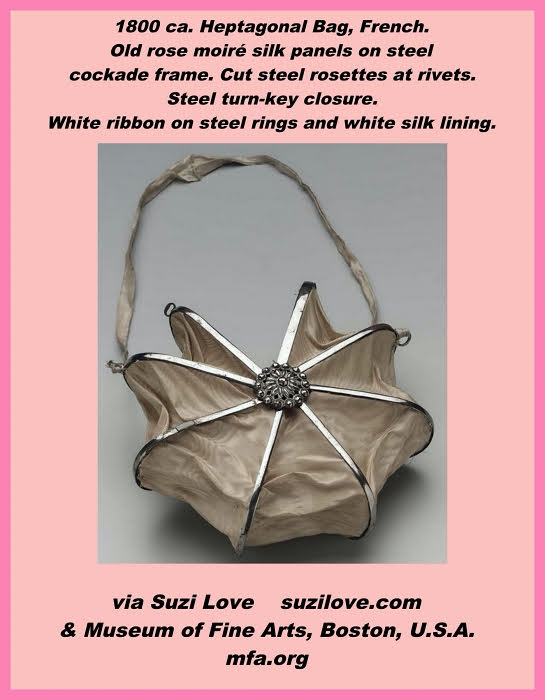
1800 ca. Heptagonal Bag, French. Old rose moiré silk panels on steel cockade frame. Cut steel rosettes at rivets. Steel turn-key closure. White ribbon on steel rings. White silk lining. Credit: The Elizabeth Day McCormick Collection via Museum of Fine Arts, Boston, U.S.A. mfa.org
Reticule Or Bag: As the silhouette of dresses became more form fitting and fabrics lighter and more transparent, pockets could no longer be hidden in the folds of skirts or underwear. Something else was needed to hold a lady’s essentials. Small purses, like men’s money pouches, were used by women to carry money for gambling, sewing necessities, and women’s daily requirements such as combs. A bag or purse, often with a drawstring to pull closed and usually made of cloth or covered cardboard and often decorated with beading or embroidery was called a reticule, or ridicule. They came in a variety of shapes, sizes, and materials. Jane Austen and her contemporaries would have purchased or hand made reticules, or bags, for each other for gifts and carried them with them whenever they went out.
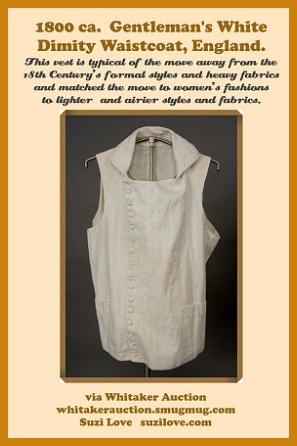
1800 ca. Gentleman’s White Dimity Waistcoat, England. This vest is typical of the move away from the 18th Century’s formal styles and fussy fabrics and matched the move of women’s fashions towards lighter and airier styles and fabrics. via Whitaker Auction whitakerauction.smugmug.com
Jane Austen Men’s Waistcoats: Waistcoats worn at the very beginning of the early 19th century generally had a straight bottom, double-breasted and with wide lapels. Not long after this, waistcoats began to be cut higher up to the waist in front so men during Jane Austen’s lifetime would have worn both styles.
1802 Silk and Metal Dress, Spanish. Brown silk dress with very high waist, decorated bodice, zig-zag hem decoration, long straight sleeves. I can picture Jane Austen and her female friends and family wearing this sort of dress to a dinner party or musical evening. via Metropolitan Museum, NYC, U.S.A. metmuseum.org
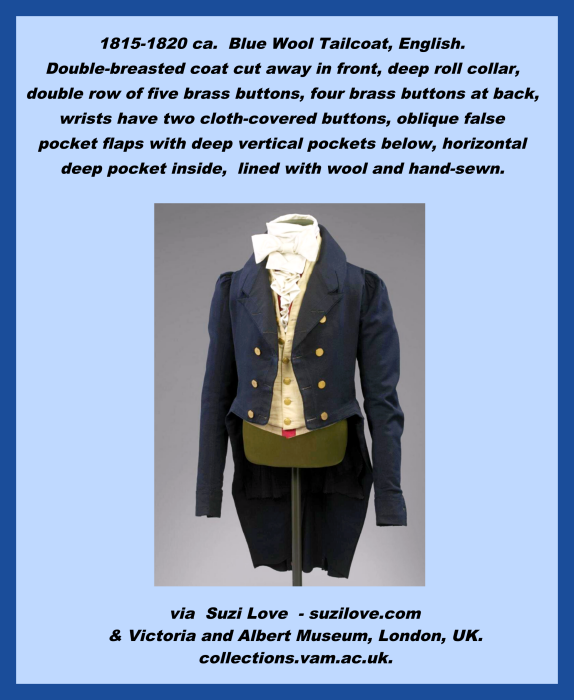
1815-1820 ca. Blue Wool Tailcoat As Worn By Bridgerton Gentlemen and the Men In Jane Austen’s Life.
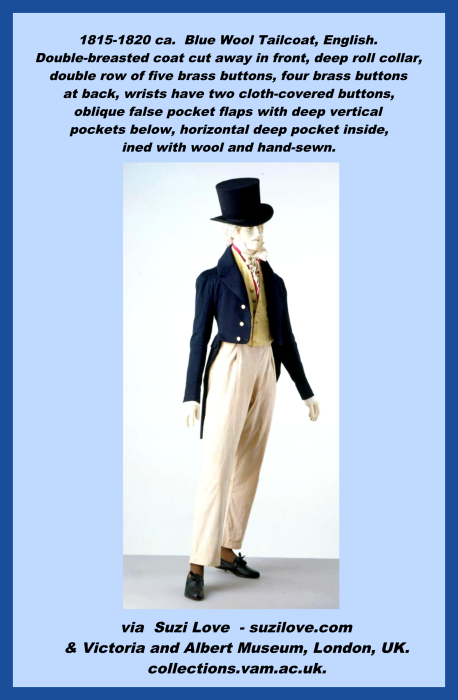
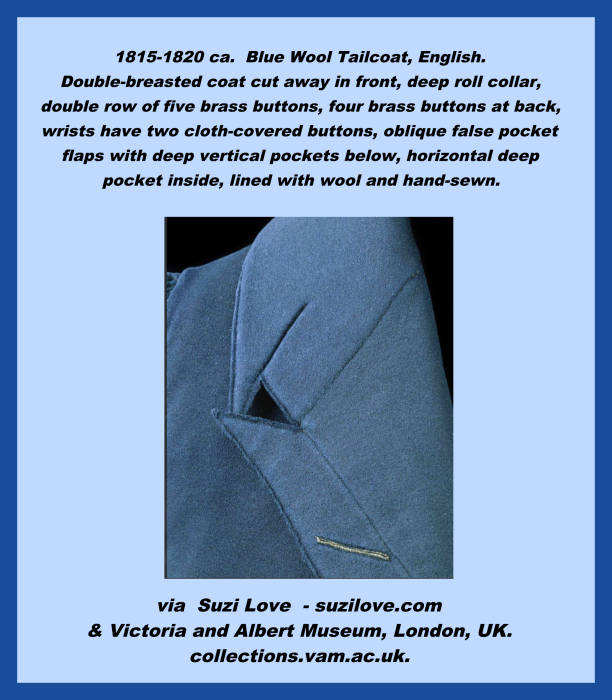
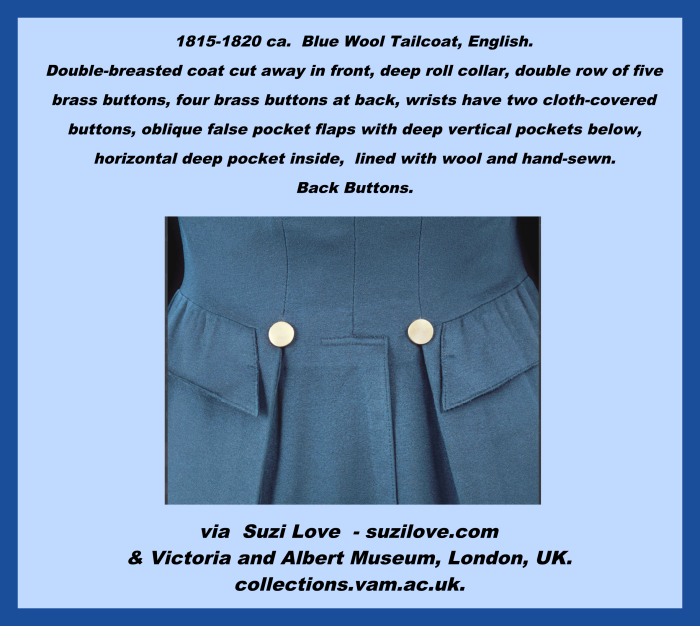
1815-1820 ca. Man’s Blue Wool Tailcoat, English. Chest View. Blue wool, lined with wool, brass buttons, and hand sewn. Double-breasted coat of blue wool, cut away in the front. With a fairly deep roll collar, a double row of five brass buttons, and four further brass buttons at the back. The wrists fasten with two cloth-covered buttons. With oblique false pocket flaps, one on each side, with deep pockets below them entered vertically, and another deep pocket inside entered horizontally. Lined with wool. Hand-sewn. Marks and Inscriptions: ‘Hammond Turner & Sons, Extra Superfine’ (Stamped behind the brass buttons) The cut-away coat remained formal daywear for men until the 1850s. This example has long tight sleeves, puffed at the shoulder, a style typical of the period 1815-1820. The roll collar has an M-shape notch, introduced about 1803, and a waist seam. via Victoria and Albert Museum, London, UK. Given by Lady Osborn.
From the finish of the 18th century until 1820, men’s fashions in European and European-influenced countries moved away from the formal wear of brocades, lace, wigs and powder to more informal and relaxed styles. Focus was on undress rather than formal dress. Typical menswear in the early 1800s included a tailcoat, a vest or waistcoat, either breeches, pants, or the newer trousers, stockings, shoes or boots, all worn with an overcoat and hat. This basic ensemble was accessorized with some form of neckcloth or cravat, gloves, walking stick, cane or riding crop, handkerchief, fobs, watch and perhaps a quizzing glass or eye glass.
Skirted coats were replaced with short-fronted, or cutaway, tailcoats worn over fitted waistcoats and plain, white linen shirts. Knee breeches were gradually replaced by tight-fitting pantaloons and later trousers, decorative shoes with buckles were replaced with a variety of boot styles, and fussy and ruffled neckwear gave way to intricately tied, white linen neck cloths. A Regency Era, or early 1800s, gentleman was outfitted in more practical fabrics, such as wool, cotton and buckskin rather than the fussy brocades and silks of the late 1700s.
1811 Typical Regency Era Man’s Overcoat or Driving Coat. Fashion Plate via Journal des Dames et des Modes, or Costume Parisien. Overcoats were called many names: Greatcoat, Carrick or Garrick Coat, Coachman’s or Driving Or Box Coat. With many shoulder capes, or pelerines, to keep rain and snow off the body.
From the finish of the 18th century until 1820, men’s fashions in European and European-influenced countries moved away from the formal wear of brocades, lace, wigs and powder to more informal and relaxed styles. Focus was on undress rather than formal dress. Typical menswear in the early 1800s included a tailcoat, a vest or waistcoat, either breeches, pants, or the newer trousers, stockings, shoes or boots, all worn with an overcoat and hat. This basic ensemble was accessorized with some form of neckcloth or cravat, gloves, walking stick, cane or riding crop, handkerchief, fobs, watch and perhaps a quizzing glass or eye glass.
Skirted coats were replaced with short-fronted, or cutaway, tailcoats worn over fitted waistcoats and plain, white linen shirts. Knee breeches were gradually replaced by tight-fitting pantaloons and later trousers, decorative shoes with buckles were replaced with a variety of boot styles, and fussy and ruffled neckwear gave way to intricately tied, white linen neck cloths. A Regency Era, or early 1800s, gentleman was outfitted in more practical fabrics, such as wool, cotton and buckskin rather than the fussy brocades and silks of the late 1700s.
Are you a reader or writer of Regency Romance? Love Jane Austen’s books? Want to know more about the mourning, riding, underclothing and other Regency Era women’s fashions in Regency romances? What was fashionable for women in Jane Austen’s times? Mourning, riding, daytime, evening clothing, plus underclothing, corsets and accessories. This book looks at what was fashionable for women in Jane Austen’s times, or the early 1800s, or the Regency Era in Britain. Wars were being fought around the globe so women’s fashion adopted a military look in support of soldiers. Fashions, like the lifestyle, became progressively more extravagant and accessories went from colorful to over-the-top.
What was fashionable for women in Jane Austen’s times? Mourning, riding, daytime, evening clothing, plus underclothing, corsets and accessories. Wars were being fought so women adopted military looks in support of soldiers. https://books2read.com/SuziLoveFashion1810-1814 History Notes Book 27 Women’s Fashions 1810-1814.
These are the types of outfits worn by Jane Austen and contemporaries in English magazines, where French fashions were obsessively copied despite the two countries being at war for many years. In Jane Austen’s years, she and her contemporaries spent a lot of time walking outdoors. People were encouraged to partake in outdoor pursuits to maintain good health. Fragile slippers were worn for balls and evening events but for walking sturdier shoes were needed, In the early 1800s, these were typically made of leather, had a very small heel, slightly rounded toes and were laced up on the top.
1800-1820 ca. Small Pieces Of Drawing Room Furniture as would have been used in houses where Jane Austen lived. Side tables, book tables, chest and foot stool. Collage by Suzi Love.
1800-1820 ca. Small Pieces Of Drawing Room Furniture. Side tables, book tables, chest and foot stool.
1800-1820 ca. Small Pieces Of Drawing Room Furniture As Jane Austen Would Have Used. #Regency #Furniture #BritishHistory
1809 ca. Empire Style, Or High-Waisted, Dress, English. Hand-embroidered white cotton muslin, cotton bobbin lace, shell buttons and linen tape. via National Gallery of Victoria, Australia. ngv.vic.gov.au
The gowns associated with Empire or Regency style have a low neckline and short sleeves and were usually worn for evening, dress, or dancing. Toward the end of the era, dancing dresses featured higher hemlines that rose several inches above the ankle. Day dresses had a higher neckline and long sleeves. The Empire styles at the beginning of the 19th century were made of a soft, lightweight fabric gathered just under the breasts. It featured a low square neckline, and small, short, puffed sleeves with a low shoulder line. Although lawn and batiste were used, muslin was the fabric of choice as it was easy to clean. The thin muslin clung close to the body and emulated styles worn in ancient Greece. Shades of white predominated, with the addition of pale pastel shades worn for day wear.
Empire Style Dress: Named after the First Empire in France. Empire dresses had a low neckline and skirts started directly under the bust and flowed into the classical relaxed wide styles of Greece and Rome. This style of dress is associated with Jane Austen and her contemporaries as a high-waisted dress was worn most days. Cotton, silk or taffeta were the popular fabrics.
1812 June Couple In Fashionable Walking Dress, English. Lady wears a green cape and hat over a high-waisted, or Empire style, white dress with a pink parasol. Man wears a tailcoat over fawn breeches, yellow gloves, black shoes and hat and a walking stick. Fashion Plate via The Lady’s Magazine Or Entertaining Companion for the Fair Sex.
By the end of the 18th century, tailored garments for both men and women were replaced by styles made for ease and comfort, resulting in the neoclassical style of the 1780s. Inspired in part by the statuary of ancient Greece and Rome, the new fashion was epitomized by light cotton gowns falling around the body in an unstructured way, held around the high waist with a simple sash and accompanied by a soft shawl draped around exposed shoulders. This style was ideal for the Indian imports like Kashmiri shawls and Bengali muslin, as used in this embroidered gown.