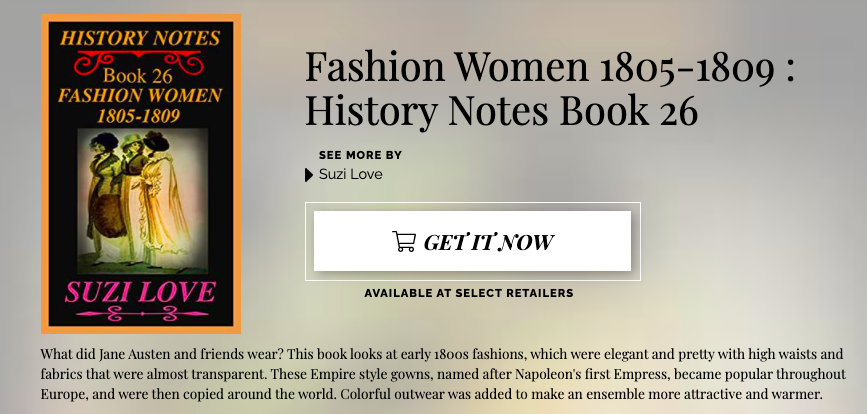
Light-hearted look at Young Lady in Jane Austen’s times, or early 1800s. A glimpse into both the frivolous and more serious occupations filling a young lady’s day in the lifetime of Jane Austen, or the Regency Era, or the early 19th Century. Historic images and historical information show her fashions and frolics. https://books2read.com/suziloveYLD
Ordinary people began to celebrate Easter by sending postcards as gifts. At first, mainly religious pictures appeared on postcards. Then postcards images became more about real life and people. In the early 1900s, postcards became more fanciful and pretty for young children. Religious images were gradually replaced by images that children could understand and relate to about Easter.
Postcards then concentrated on images of chickens and eggs, symbolic of birth and rebirth such as chickens emerging from cracked shells as Christ emerged from the tomb. Children were then added to the images so cards became for something for the whole family. Children with chickens and eggs became very popular on postcards. Bunny rabbits became associated with Easter and children could relate to these as it fitted with their idea of the Easter bunny.
Ellen Clapsaddle (1865 – 1934). An American illustrator from the late 19th and early 20th centuries and recognized as the most prolific postcard and greeting card artist of her time. Her greatest success was single-faced cards that could be kept as souvenirs or mailed as postcards. These cards were highly prized particularly during the peak of the golden age of souvenir postcards from 1898 to 1915. She is credited with over 1000 designs in post cards and souvenir cards. Cards in the mid 1900s were created to send personal Easter messages to loved ones such as mothers and fathers, grandparents, aunts and uncles and siblings. Artists from around the world began creating beautiful cards to share at Easter.
Jenny Eugenia Nyström (1854 – 1946) was a Swedish painter and illustrator who illustrated Easter postcards for, and about, children and happy ideas, especially European subjects.Jenny Nystrom (1884-1946)
Egg With Flowers. Easter Greetings.
Suzi Love – suzilove.comEgg With Flowers. Easter Greetings.
Suzi Love – suzilove.comEaster Egg Vintage Cards. #Easter #Vintage #Cards. https://books2read.com/suziloveEaster Share on X
Jenny Nystrom (1884-1946) Vintage Easter Cards. Jenny Eugenia Nyström (1854 – 1946) was a Swedish painter and illustrator who illustrated Easter postcards for, and about, children and happy images.
Want a glimpse into the life of a young lady in Jane Austen and the Bridgerton years? #bridgerton #RegencyEra #JaneAusten
Young Lady’s Day is Book 4 in the Regency Life Series. This book depicts the often-frivolous life and fashions of a young lady in the early 1800’s, but also gives a glimpse into the more serious occupations a young lady may undertake. Through historic images, historical information, and funny anecdotes, it shows how a young lady fills her day, where she is permitted to go, and who she is allowed spend time with. These light-hearted looks at the longer Regency years are an easy to read overview of what people did and wore, and where they worked and played. There is plenty of information to interest history buffs, and lots of pictures to help readers and writers of historical fiction visualize the people and places from the last years of the 18th Century until Queen Victoria took the throne. https://books2read.com/suziloveYLD
Love the life of Jane Austen and her stories? Fan of the Bridgerton series? Reader or writer of the early 1800s, or Regency Era? For information and pictures, try Regency Life Series by Suzi Love. Light-hearted series about Regency Era, or early 1800s. For writers, readers and history lovers.
Thes books use historic images, historical information, and funny anecdotes to give an overview of life through the late Georgian and the Regency years. A light-hearted look at the people, places, and fashions of the times, plus an easy to read overview of the politics and economics. There is plenty of information to interest history buffs, and lots of pictures to help readers and writers of historical fiction visualize the people and places from the last years of the 18th Century until Queen Victoria took the throne.
Try Books 1-5 Regency Life Series by Suzi Love. Regency Overview – Young Gentleman’s Day – Older Gentleman’s Day – Young Lady’s Day – Older Lady’s Day
George, Prince of Wales (1762-1830), later George IV. By Mather Byles Brown (1761-1831) via Royal Collection, London, U.K.
The decision to make Prince George the Regent took a lot of political debate. After nearly two and a half months of political wrangling, the British government agreed to grant the title of Prince Regent on George. The Act of Parliament was finally passed by a commission in the House of Lords on February 5th 1811 and the Prince was formally sworn in as Regent at Carlton House the next day. He continued to rule as Regent until 1820 when, on his father’s death, he assumed the title George IV and reigned until his own death in 1830.
The British Regency was the period from 1811-1820. King George III was deemed mad and unfit to rule so his son became his proxy, the Prince Regent, or Prinny to his close friends. This was the situation when Jane Austen was alive. The Regency Era was famous for its beautiful clothing as well as the magnificent buildings erected and furnished in the ‘Regency Style’ under orders from the extravagant Prince Regent.
This book depicts the often-frivolous life and fashions of a young lady in the early 1800’s, but also gives a glimpse into the more serious occupations a young lady may undertake. Through historic images, historical information, and funny anecdotes, it shows how a young lady fills her day, where she is permitted to go, and who she is allowed spend time with. These light-hearted looks at the longer Regency years are an easy to read overview of what people did and wore, and where they worked and played. There is plenty of information to interest history buffs, and lots of pictures to help readers and writers of historical fiction visualize the people and places from the last years of the 18th Century until Queen Victoria took the throne. Young Lady’s Day Regency Life Series Book 4 by Suzi Love. https://books2read.com/suziloveYLD
An early 1800’s glimpse into both the frivolous and more serious occupations filling a young lady’s day in the lifetime of Jane Austen, or the Regency Era. Historic images and historical information show her fashions and frolics. Shows the often-frivolous life and fashions of a young lady in the early 1800’s, plus a glimpse into the more serious occupations a young lady may undertake. Through historic images, historical information, and funny anecdotes, it shows how a young lady fills her day. Young Lady’s Day Regency Life Series Book 4 by Suzi Love. https://books2read.com/suziloveYLD
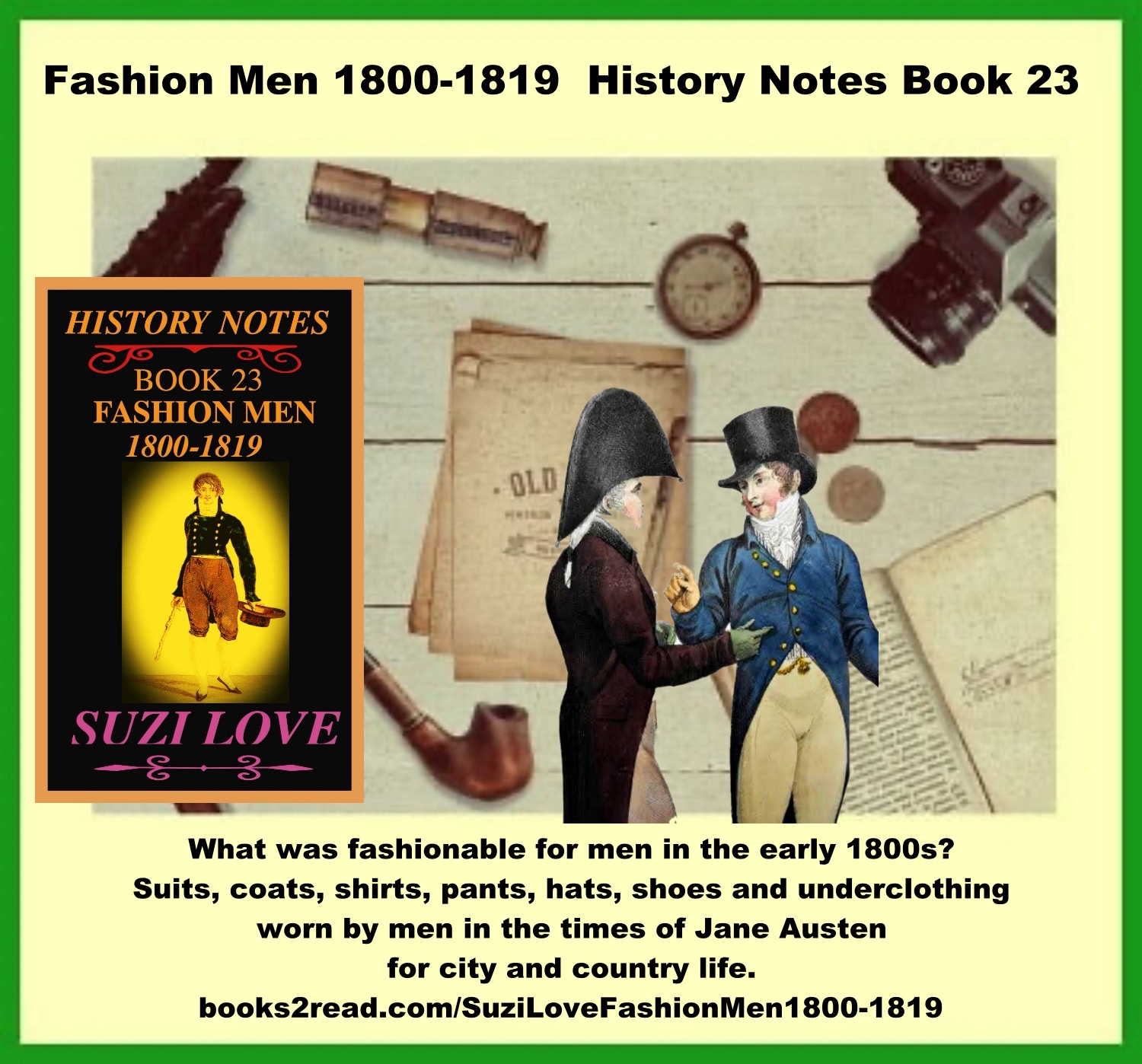
Love the Bridgerton Series? Fan of Jane Austen? What did men wear in the early 1800s? Suits, hats, shoes, underclothing, military and bedroom fashions. #Bridgerton #RegencyFashion #JaneAusten #BritishHistory.
The Regency Era saw a wide variety of acceptable pants for men. Breeches were worn as part of a man’s daily outfit during the early 1800s and were necessary for formal occasions, such as court appearances, during the entire Regency Era. However, younger gentlemen moved away from breeches for daytime wear around 1807 and adopted a variety of long pants called trousers, pantaloons, buckskins or inexpressables. Knee-length breeches, worn with stockings, continued to be worn by older gentlemen through the entire Regency Era.
Around 1807, upper class gentlemen wore trousers held up by suspenders or pantaloons, which were closely fitted and worn with tall boots. Buckskins, made from deerskin, were comfortable to wear for riding. Inexpressibles were very tight leggings that left little to the imagination of young ladies. Every Regency man’s outfit included a hat, gloves, shoes or boots, and a selection of added accessories from a walking stick, watch on a chain, fobs, coin purse and a handkerchief.