1800 White Walking Dress, English. Worn with a full length bronze wrap and matching turban. Engraved Plate via Rudolph Ackermann’s ‘The Repository’ of Arts.
The Empire dress which evolved in the late 1790s began as a chemise shift gathered under the breasts and at the neck. Named after the First Empire in France, by 1800 Empire dresses had a very low décolleté, or neckline and a short narrow backed bodice attached to a separate skirt. Skirts started directly under the bust and flowed into the classical relaxed wide styles of Greece and Rome. This style of dress is associated with Jane Austen and her contemporaries as a simple cotton high-waisted dress was worn most days and accessorized according to the importance of the occasion.
1800 White Walking Dress, English. Worn with a full length bronze wrap and matching turban. Engraved Plate via Rudolph Ackermann’s ‘The Repository’ of Arts.
1800 Jane Austen style White Walking Dress, English. Worn with a full length bronze wrap and matching turban. #RegencyEra #JaneAusten #HistoricalFashion books2read.com/SuziLoveFashionWomen1800
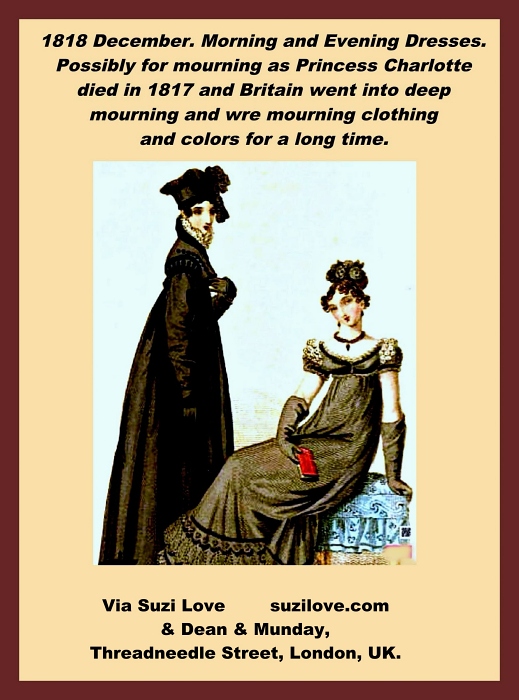
1818 December Morning and Evening Dresses, possibly for mourning as Princess Charlotte died in 1817. Published by Dean and Munday, Threadneedle Street, London, U.K.
Walking Dress is a plain high dress of black bombazine with long sleeves. Skirt trimmed on hem with a broad bias piece of black crape with narrow puffing of black crape. Sleeve hem has three narrow puffings of black crape. Fastens in front and ornamented on the bust with black crape, no collar but a very full mourning ruff of clear muslin. Over this dress is a Spanish coat of fine black Merino, cut tight to the body, short in the waist and trimmed with a row of black buttons on each side of the bust. Black velvet collar is finished round the edge with black crape, long sleeves of an easy fullness and trimmed at the wrist the same as the collar. Very tasteful epaulette is a mixture of black velvet and crape. Skirt is slightly full, trimmed up the fronts and round the hem with a broad band of black velvet, edged on each side by narrow rouleaux of black crape.
Dinner Dress is of black crape over a black sarsnet slip with a gored skirt, trimmed on the hem with black crape flounces, lower very narrow and higher considerably broader and surmounted by another narrow one. They are scalloped and finished at the edge by black satin, narrow rouleau of the same material heads top and bottom flounce. Corsage of black satin cut very low round the bust and waist and bust finished French style with points of black crape. Short full sleeve of black satin with three falls of black crape on the shoulder. Via Lady’s Monthly Museum ~ Dean & Mundy, Threadneedle Street, London, UK.
1818 December Morning and Evening Dresses, possibly for mourning as Princess Charlotte died in 1817. Published by Dean and Munday, Threadneedle Street, London, U.K.
1818 December Morning and Evening Dresses, Possibly For Mourning As Worn In Bridgerton and Jane Austen Times. #Bridgerton #JaneAusten #RegencyFashion #HistoricalFashion #Mourning https://books2read.com/SuziLoveFashionWomen1815-1819
Scandalous Siblings Series Books 1-3 Historical romance with science, history and mystery.
Embracing Scandal Book 1 Scandalous Siblings After Lady Rebecca Jamison, a mathematical genius, saves her family from financial ruin by secretly investing in railway stocks on the London stock exchange, a greedy syndicate, desperate for Becca’s calculations and predictions, murders her friend and threatens the Jamison family, forcing Becca to beg assistance from her childhood friend, Cayle St. Martin. The newly titled Duke of Sherwyn has returned to London after five years on the continent extending his family’s shipping interests. He’s shunned his privileged London life and his father’s unbending attitudes, and becomes committed to employing the spying tactics he learned on the continent to help Becca indict the syndicate – and using his skills as a lover to seduce her into his bed. But how will Cayle be able to convince Becca, a determinedly self-sufficient spinster, that he can be more to her than just a protector? https://books2read.com/suziloveES
Scenting Scandal Book 2 Lady Laura Jamison uses her extraordinary olfactory senses to sniff out her perfect match, a husband who fits all her scientific criteria. But after she evades an assassin’s bullets, twice, while attending her sister’s wedding, she is forced to accept the protection of their family friend, and her nemesis, the Earl of Winchester. Richard evades marriage with someone as beautiful and intelligent as Laura, fearing she’ll uncover his shameful childhood secret. The mismatched pair risks their wealth and reputations racing around London’s seedier areas in a desperate attempt to stop a madwoman before she recruits more criminals and rebuilds her illegal share trading syndicate. When they accept each other’s strengths and weakness, will Laura and Richard also discover a passion neither counted on? https:/books2read.com/suziloveSS
December Scandal Book 3 Michael Brandon travels to introduce the woman he loves to family but is shocked when his missing brother arrives. The Jamisons join the St. Martins at the duke’s country estate but a December snowstorm doubles guest numbers. https:/books2read.com/suziloveDS
Scandalous Siblings Series Books 1-3. The scientifically gifted Jamison siblings beg assistance from the St. Martin clan to battle a greedy railway investment syndicate. https://books2read.com/suziloveEShttps://books2read.com/suziloveSShttps://books2read.com/suziloveDS
Scandalous Siblings Series Books 1-3 Historical romance with science, history and mystery. #histrom #Regencyromance Victorianromance #ReadARegency https://books2read.com/suziloveES
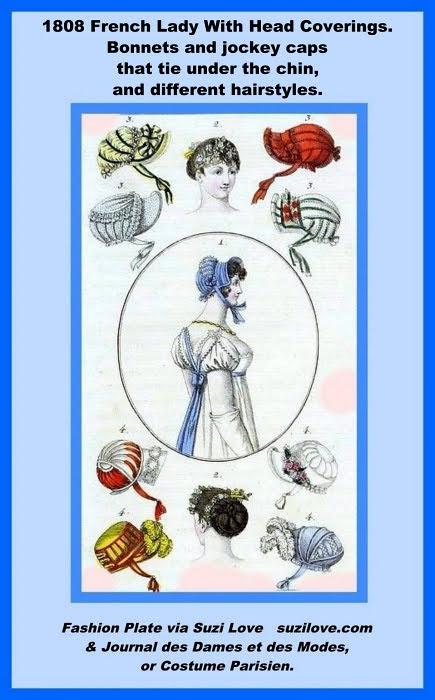
1808 French Lady With Head Coverings. Bonnets and jockey caps that tie under the chin and different hairstyles. Fashion Plate via Journal des Dames et des Modes, or Costume Parisien. French fashions like this were copied by English magazines so these styles of hats would have been worn by Jane Austen and her contemporaries.
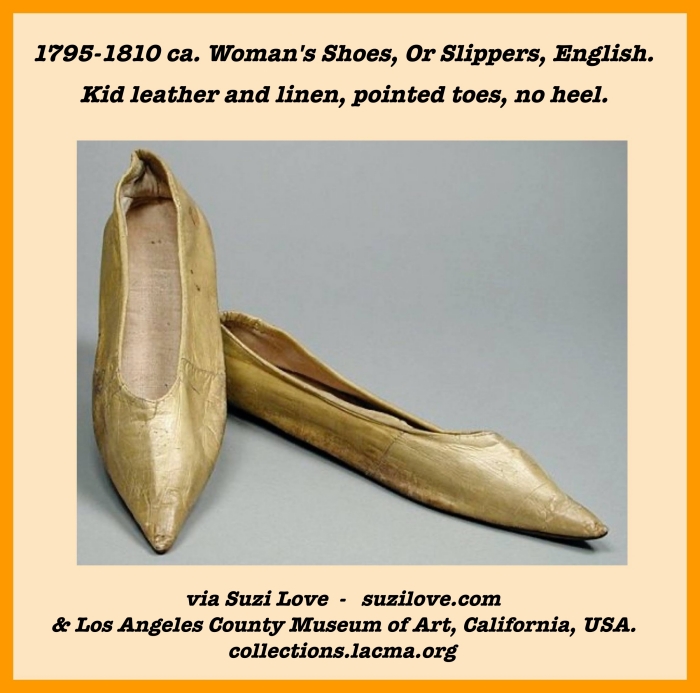
1795-1810 ca. Woman’s Shoes, Or Slippers, English. Kid leather and linen, pointed toes, no heel. via Los Angeles County Museum of Art, California, USA.
Digital Capture
1795-1810 ca. Jane Austen Style Woman’s Kid Leather Shoes, Or Slippers, English. #janeausten #shoes #regencyfashion https://books2read.com/SuziLoveFashionWomen1801-1804
Blurb: Love After Waterloo: Lady Melton and her son are forced to join antagonistic Captain Belling and the last group of wounded British soldiers evacuating Waterloo and traveling back to London. https://books2read.com/suziloveLAW
Book Hook: Lady Melton and the Captain held vastly different views on women’s roles, she instinctively knew he would convey them safely to English shores. Her son liked him, so she’d make allowances for the Captain’s abrasive manner and assume that his stiffness was due to the stress of conveying a party of injured men, a lady, and a child to London.
“Captain, despite you not wanting me to tend to your own wounds, I shall still offer to help your soldiers. Changing their bandages, massaging their limbs, and that sort of thing.”
“Good grief. You’re telling me that your brothers allowed you to massage men’s arms and legs?”
Her amenable attitude towards him dissipated faster than mist on a sunny morning. “Yes, Captain.” She shifted her sleepy son to her other hip. “Brendon is a knowledgeable physician, and he not only allowed me to massage the men’s painful limbs, but he actively encouraged it.”
“Not under my command, you won’t.”
“Perhaps each soldier should decide for himself. I’m sure they would welcome any relief, even if a mere woman offers the only available treatment. Massaging is known to stimulate blood flow which means a limb doesn’t atrophy while a wound is healing. Faster healing means less time in pain.”
“Humph. We’re British soldiers. Taught to keep a stiff upper lip and suffer in silence.”
She scowled. “Are you making a jest? Because I didn’t picture you as capable of levity.”
He snorted. “Yes, sorry. My pathetic attempt at a joke fell flat. I’m not capable of true levity at the moment. Not after spending days searching for friends, or what was left of them, and retrieving valuables and letters before the battlefield pickers stole items I would rather see returned to their loved ones.” He shook his head. “And why did our men charge over those hills and die?” He pointed towards the battleground where thousands of soldiers had been either slaughtered outright, or had passed their last hours in agony. “So that our fat and complacent Regent can congratulate himself on a brilliant battle. So Wellington can be proclaimed Britain’s greatest war hero.”
Anne winced. Gabe had reached his limit, and with good reason. His grief was palpable and she was back to feeling sorry for the wretched man.
Book Hooks: Lady Melton and the Captain held vastly different views on women’s roles. #Waterloo #regencyromance #historicalromance #BookHook https://books2read.com/suziloveLAW
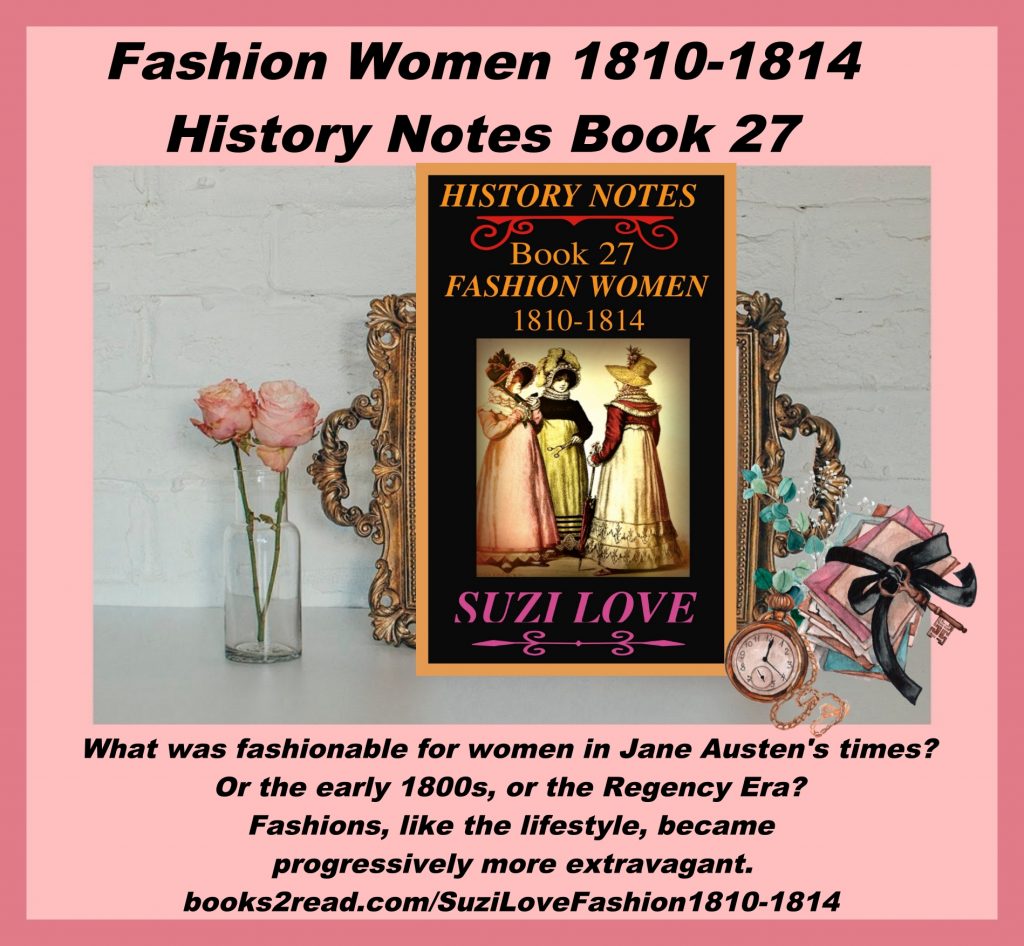
What was fashionable for women in Jane Austen’s times? Mourning, riding, daytime, evening clothing, plus underclothing, corsets and accessories. Fashion Women 1810-1814 History Notes Book 27 This book looks at what was fashionable for women in Jane Austen’s times, or the early 1800s, or the Regency Era in Britain. Wars were being fought around the globe so women’s fashion adopted a military look in support of soldiers. Fashions, like the lifestyle, became progressively more extravagant and accessories went from colorful to over-the-top. https://books2read.com/SuziLoveFashion1810-1814
The Lady’s Magazine said of the basis of women’s fashion that was popular for the first twenty years of the 1800s, ‘White is still the prevailing color for robes. For morning dresses, linen gowns, in large diamonds or squares, are fashionable. Indian muslins, plain or embroidered, are preferred to Florence and satins. The designs of embroidery for shawls are of infinite variety. Long gloves, which reach above the elbow, are not yet laid aside. Medallions are hung around the neck from crossed chains and some of these medallions are shaped like the bags, called ridicules. These reticules are of the lozenge or hexagon shape, with a small tassel at each angle. Reticules, or ridicules, are in lozenge or hexagon shapes with a small tassel at each angle. In capotes, or hats, and ribbands, the violet and dark green prevail over jonquil. Bracelets in hair, pear-shaped ear-rings, medallions on square plates, saltiers of colored stones, are still in fashion.’
What was fashionable in Bridgerton and Jane Austen times? Mourning, riding, daytime, evening fashion plus corsets and underclothing. #Bridgerton #RegencyFashion #JaneAusten https://books2read.com/SuziLoveFashion1810-1814
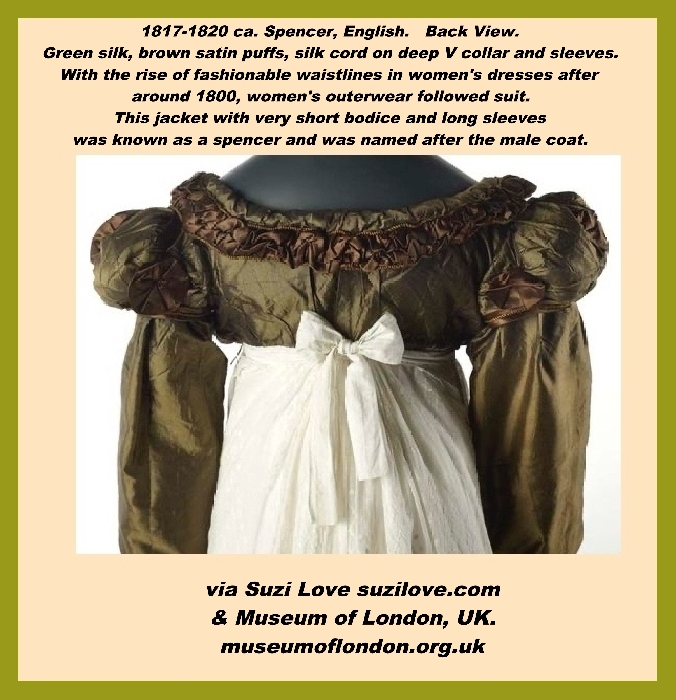
1817-1820 ca. Spencer, or Jacket, English. The sort of jacket worn by Jane Austen and friends over their loose Empire style dresses. Green silk Spencer, brown satin puffs, silk cord on deep V collar and sleeves. With the rise of fashionable waistlines in women’s dresses after around 1800, women’s outerwear followed suit. This jacket with very short bodice and long sleeves was known as a Spencer and was named after the male coat. via Museum of London, UK. museumoflondon.org.uk
Description Spencer: Short jackets worn for warmth over the high-waisted Empire style gowns that were popular after the French Revolution, where there was a shift away from opulence and decadence to simpler fashion. This jacket with very short bodice and long sleeves was known as a Spencer and was named after the male coat made famous by the Earl Spencer and said to have originated in accident to Lord Spencer in hunting when coat tails torn off and a cropped jacket was invented. The dresses in the early 1800s therefore became looser, lighter, and flowing and women became cold due to their very low cut and short bodices. Short fitted jackets that went easily over the dresses and provided extra modesty and some warmth. As Europe and many other parts of the world were deep in wars in the late 1700s and early 1800s, men in uniform were found everywhere. In support of these military men, fashions leaned towards military style shoulder paddings, shoulder embellishments, loops, buttons, and braids.
1817-1820 ca. Spencer, English. With the rise of fashionable waistlines in women’s dresses after around 1800, women’s outerwear followed suit. This jacket with very short bodice and long sleeves was known as a spencer. via Museum Of London.
1817-1820 ca. Jane Austen and Bridgerton Style Green Silk Spencer, Or Jacket, English. #Bridgerton #RegencyFashion #BritishFashion #JaneAusten https://books2read.com/SuziLoveFashionWomen1815-1819
1800-1820 ca. Small Pieces Of Drawing Room Furniture as would have been used in houses where Jane Austen lived. Side tables, book tables, chest and foot stool. Collage by Suzi Love.
1800-1820 ca. Small Pieces Of Drawing Room Furniture as Jane Austen and the Bridgertons would have used. #bridgerton #janeausten #RegencyEra #Furniture https://books2read.com/suziloveOLD