1807 Fashionable French Couple. Man: Blue cutaway coat and yellow breeches. Lady: Lemon and blue dress and bonnet. Typical of the ensembles worn by Jane Austen and her family and friends. Fashion Plate via Journal des Dames et des Modes, or Costume Parisien.
There has been some discussion on the names for Corset Makers. I’ve seen lots of names, including Stay Maker, Stay Manufacturer, Corset Maker, Body Tailor and Milliner. It was mainly men who were Stay Makers, but there were also some women who included stay making with their millinery.
Corsets Overview History Notes Nonfiction Book 14. This book shows how body wraps, stays, and corsets were worn to create a variety of fashionable silhouettes through past centuries. Corsets flattened breasts and accentuated rounded hips or pushed up breasts and showed off the bust line depending on the fashions of the time and the desired silhouette. Includes corsets through the Georgian, Regency, Victorian and Edwardian Eras and Jane Austen’s lifetime. Overview of corsets through history, including the Georgian, Regency, Victorian and Edwardian Eras and Jane Austen’s lifetime.
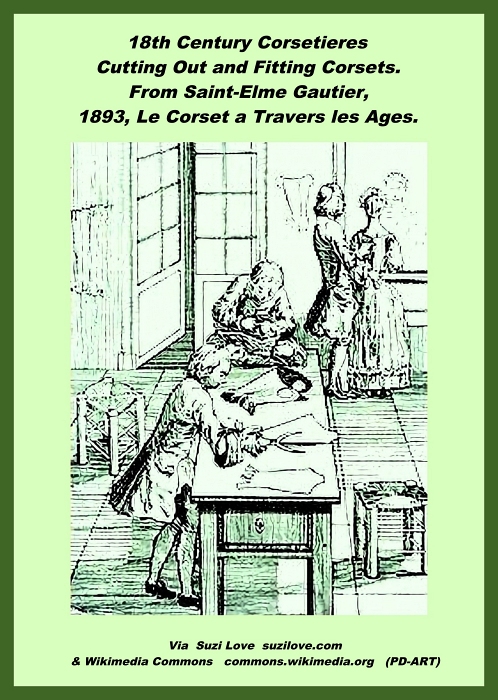
1776 April 28th John McQueen, Stay Maker., New York. At the sign of the White Stays in Smith Street,near the Mayor’s baths, New York. Making all sorts of stays in the newest fashion that is worn by the ladies of Great Britain or France. Packthread stays for babies from one month to seven years, stays for children of Tabby, Ruffled Canvas, Or Buckram, and for older girls an assortment of thin boned stays of different sorts and sizes.1835 Milliner, Dress and Corset Maker to the Royal Family. Mrs. Langdon. 37 Milson Street, Bath, U.K. Local Trade Advertisements. From 1835 The Historical and Local New Bath Guide By C. Duffield. via Google Books (PD- 150)18th Century Interior of the shop of a body tailor, or corset maker. From 1893 The Art of the Tailor of the Bodies of Women and Children.1835 Fashionable Long and Short Stay Manufacturer. Robert Drew & Co. Local Trade Advertisements. From- 1835 The Historical and Local New Bath Guide. Published by C. Duffield via Google Books (PD-150)18th Century Corset Maker From 1893 Le Corset, A Travers Les Ages.18th Century Corsetieres cutting out and fitting. From Saint-Elme Gautier, Le Corset a Travers les Ages. en.wikipedia.orgNames For Corset Makers in Jane Austen and Bridgerton times? Lots of them including Stay Maker, Corset Maker, Body Tailor and Milliner. #janeausten #bridgerton #Corset https://books2read.com/SuziLoveCorsetBook14 Share on X
1804–1815 ca. Fawn Cotton Dress With Embroidery Beading, Austrian. Simple Empire style dress with A-line skirt from a high waistline and short bodice as Jane Austen and contemporaries across Europe would have worn. Fawn colored cotton with deep bead embroidered hem, embroidery on the wrists and around the wide scooped neckline. Transparent fabrics of the early were beginning to be replaced with fabrics with more weight that were less likely to tear. Plain silks in vivid colors were at first made up in the simple lines of muslin dresses but then plain gowns began to be decorated with intricate contrasting applications and beading. This dress was part of “The Fine Art of Costume” exhibition, 1954 October 15th at the Met Museum, N.Y.C. via Metropolitan Museum, NYC, U.S.A. metmuseum.org.
Empire Style Dress: Named after the First Empire in France. Empire dresses had a low neckline and skirts started directly under the bust and flowed into the classical relaxed wide styles of Greece and Rome. This style of dress is associated with Jane Austen and her contemporaries as a high-waisted dress was worn most days. Cotton, silk or taffeta were the popular fabrics.
1804-1815 ca. Front Fawn Cotton Dress with Bead Embroidery, Austrian.
1804-1815 ca. Back Fawn Cotton Dress with Bead Embroidery, Austrian.
1804-1815 ca. Side Fawn Cotton Dress with Bead Embroidery, Austrian.
1804-1815 ca. Black and White. Fawn Cotton Dress with Bead Embroidery, Austrian.
1804-1815 ca. Black and White Group. Fawn Cotton Dress with Bead Embroidery, Austrian.
1804-1815 ca. Beading View. Fawn Cotton Dress with Bead Embroidery, Austrian.
1804-1815 ca. Beading View. Fawn Cotton Dress with Bead Embroidery, Austrian.
1804-1815 ca. Beading View. Fawn Cotton Dress with Bead Embroidery, Austrian.
1804-1815 ca. Beading View. Fawn Cotton Dress with Bead Embroidery, Austrian.
1804-1815 ca. Beading View. Fawn Cotton Dress with Bead Embroidery, Austrian.
1804-1815 ca. Fawn Cotton Dress With Embroidery Beading, Austrian. #Regency #JaneAusten #Fashion https://books2read.com/SuziLoveFashionWomen1805-1809 Share on X Fashion Women 1805-1809 History Notes Book 26 What did Jane Austen and friends wear? https://books2read.com/SuziLoveFashionWomen1805-1809
19th Century Early Women’s Cotton Caps. Worn as morning caps, night caps, or under other hats. The proper 19th century woman wore various forms of headwear throughout the day and evening. Unstructured, finely decorated cotton caps were worn in the morning hours with the informal attire appropriate for the early part of the day. Jane Austen and her family and female friends, and the Bridgerton family, would have worn caps like these, sometimes during the morning at home, to bed to keep their long hair from becoming knotted, or under a bonnet to hold a hairstyle in place. via Museum of Fine Arts, Boston, U.S.A. mfa.org
Definition Boudoir Or Morning Cap: worn by women in the privacy of their ‘boudoir’ and was not a simple night-cap but a lightweight, decorated cap which covered the hair before it was dressed for daytime activities or for at-home pursuits.
Definition Cornette or Morning Cap: Muslin or other lightweight material, worn to cover hair during at-home pursuits such as reading or sketching, tied under chin and sometimes worn under bonnet.
Definition Lappets: Two long strips of material, often lace, hanging from top of head down back or over shoulders. Sometimes extensions of a headdress and a requirement for court dress.
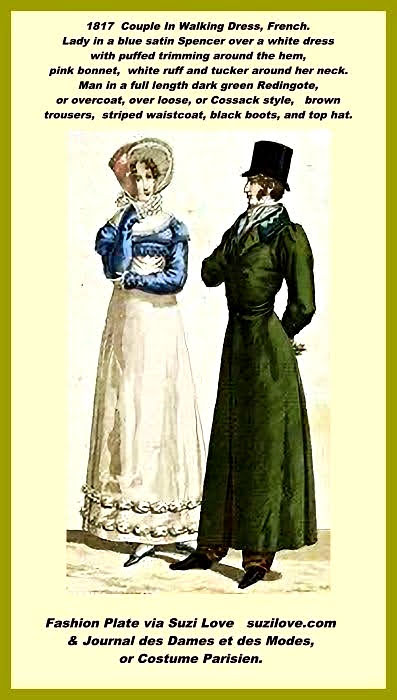
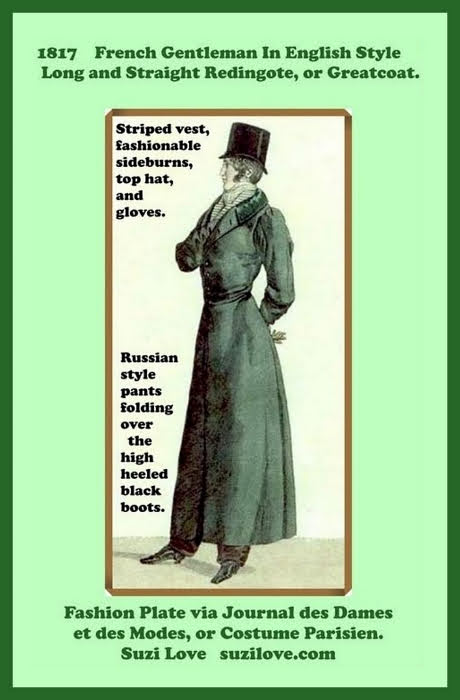
1817 Couple In Jane Austen and Bridgerton style Walking Dress and Gentleman in Same Green Redingote.
Lady: Blue satin Spencer over a white dress with puffed trimming around hem, pink bonnet, white ruff and tucker. Man: Long green Redingote, or overcoat, in the English style. Long brown trousers, striped waistcoat or vest, top hat, gloves and boots. Fashion Plate via Journal des Dames et des Modes, or Costume Parisien. Definition Redingote Or Coat Or Pelisse: Long fitted outdoor coat worn over other garments for warmth. French word developed from English words, riding coat. French fashion plates call these coats a Redingote and English plates call them a Pelisse, Or Walking Dress, or Carriage Costume. These are the types of outfits worn by Jane Austen and contemporaries in English magazines, where French fashions were obsessively copied despite the two countries being at war for many years.
This same Fashion Plate is seen below for the gentleman.
1808 Hats, Capotes, Caps as worn by Jane Austen and contemporaries. #Regencyfashion #JaneAusten #Hats Velvet, Satin and Crepe. Fashion Plate via Journal des Dames et des Modes, or Costume Parisien.
French fashions like this were copied by English magazines so these styles of hats would have been worn by Jane Austen and her contemporaries.
1802 Jane Austen Style Riding Habit, French. Blue riding habit made of castor, worn with a Fichu of white lace to cover her chest and preserve her modesty and carrying a long riding whip. Fashion Plate via Journal des Dames et des Modes, Costume Parisien.
Riding Habit: Early 1800s riding habits still copied men’s riding fashion and usually made by male tailors. They were often a close-fitting jacket worn over a shirt, or with a fichu covering the neck. A skirt with train had either a waistband or straps over the shoulders to keep it in place. Sometimes, habits were made in one piece with the skirt and bodice joined.
Writing Regency Era Fiction Or Nonfiction? Need more information on Older Gentleman’s Day in early 1800s, or the Bridgerton family or Jane Austen’s Regency Era. A lighthearted overview of an older gentleman’s clothing, social life, and responsibilities in the early 1800s. Take a look at where an older man went, what he wore, and how he managed the family’s finances and his estates. Older Gentleman’s Day Regency Life Series Book 3 books2read.com/suziloveOGD
Are you a reader or writer of Regency Romance? Love Jane Austen’s books? Want to know more about the mourning, riding, underclothing and other Regency Era women’s fashions in Regency romances? What was fashionable for women in Jane Austen’s times? Mourning, riding, daytime, evening clothing, plus underclothing, corsets and accessories. This book looks at what was fashionable for women in Jane Austen’s times, or the early 1800s, or the Regency Era in Britain. Wars were being fought around the globe so women’s fashion adopted a military look in support of soldiers. Fashions, like the lifestyle, became progressively more extravagant and accessories went from colorful to over-the-top. https://books2read.com/SuziLoveFashion1810-1814
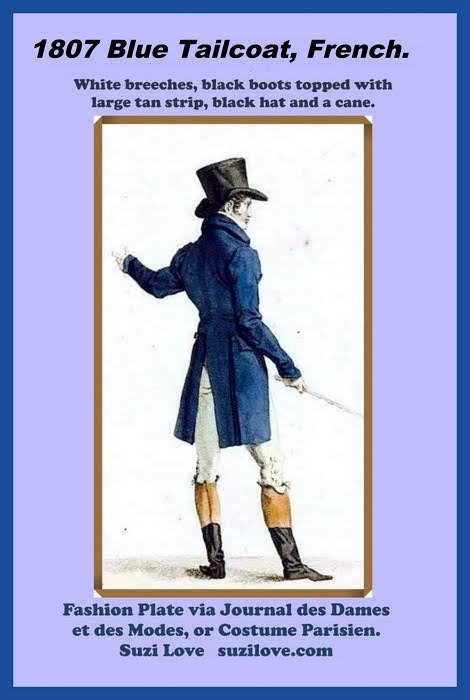
1807 Gentleman’s Blue Tailcoat, French. White breeches, black boots topped with large tan strip, black hat and a cane. Plate via Journal des Dames et des Modes, or Costume Parisien.
French fashions and Georgian and Regency Era fashions from Great Britain were copied around the world. This is what men wore in the times of Jane Austen for city and country life.