1810 Man’s Suit and Girl’s Dress, Portugal. Man’s purple pleated silk jacket, vest, and breeches embroidered with silk threads. Girl: White silk tulle dress embroidered with silk threads and an overdress of yellow cotton satin. via National Costume Museum, Portugal. The sort of men’s formal clothing worn for court and typical girl’s dress as worn in Jane Austen’s times.
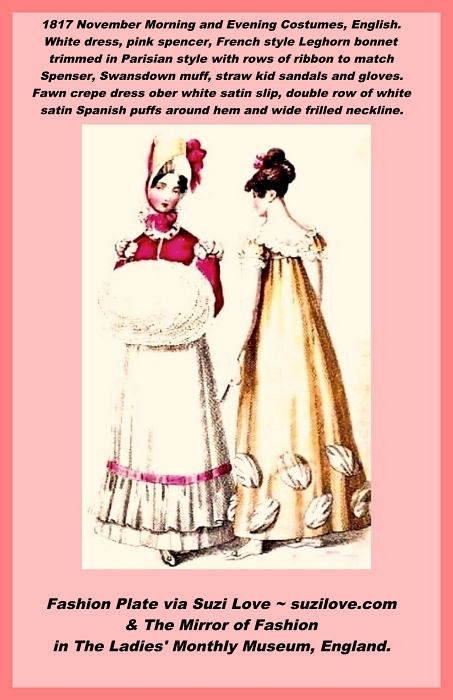
1817 November Morning Dress and Evening Dress, English. Morning Dress is a round dress of Jaconot muslin with back buttons, small collar open in front to display the throat, lower part of front with bias tucks, moderately full skirt finished around bottom with small tucks and deep flounce with bright rose ribbon. Rose velvet Spenser trimmed with white satin and rose silk, finished at throat with white satin puffings. Plain long sleeves, French style Leghorn bonnet trimmed with large rows of ribbon to match Spenser and tied under the chin, stand-up lace frill around throat, swansdown muff, straw kid sandals and gloves.
Evening dress of fawn crepe over a white satin slip, cut low around the bust, confined to waist by a narrow cestus of white satin, fastened in front by a brilliant clasp. Single fall of Mecklin lace on dress, very short full sleeve finished at bottom by a rouleau of white satin and narrow lace plait. Skirt trimmed with double row of white satin Spanish puffs, very full and in bias. Hair high, parted and curled on the forehead with garland of Provence roses. Pearl earrings and necklace, spangled crape fan, white kid gloves and white satin slippers. Fashion Plate via The Mirror of Fashion in The Ladies’ Monthly Museum, England.
1810 Les Invisibles. By James Gillray. Two men walk towards each other, each with a lady hanging to each arm, all have their faces concealed by some part of their dress, hat, or collar, or both. One man has a round hat, with a fantastically curved brim projecting downwards. The other has a huge crescent-shaped cocked hat with the peaks dipping over face and back. Via British Museum, London, UK. britishmuseum.org (PD-Art)
1815 Blue Dress Bodice, French. Layers of frills on dress back. Hairstyle and Various Bonnets as Jane Austen would have worn. Fashion Plate via Journal des Dames et des Modes, or Costume Parisien.
1811 Green Dress French. High waist with bow under the bust, Mamaluke sleeves as “a long full sleeve partitioned into five sections, each section being drawn and seamed to fit around the arm up sleeves, white collar lining, fashionable blue bonnet tied under the chin and wearing yellow shoes. The sort of fashionable outfit worn by women in Jane Austen’s times, or 1800s, or Regency Era. Fashion Plate via Journal des Dames et des Modes, or Costume Parisien.
Mamaluke Sleeves: Long full sleeves partitioned into five sections, each section being drawn and seamed to fit around the arm up.
1801 Dress With Train, French. English style coat and Polonaise hat to match dress. Fashion Plate via Journal des Dames et des Modes, or Costume Parisien.
1815 Blue Striped Dress, Norway. Empire style, or high-waisted, dress with short puffed sleeves over long straight sleeves and gold trim. I can picture Jane Austen and her female friends and family wearing this sort of dress to an evening event. via Nordiska Museet, Nordic Museum, Stockholm, Sweden. digitaltmuseum.se
1817 March. Opera Dress, English. The sort of outfit Jane Austen and her contemporaries or the Bridgerton women would wear for an evening at the opera or theatre. Fashion Plate via Rudolph Ackermann’s ‘The Repository of Arts’.
A blue crape dress over a white satin slip; the dress trimmed round the skirt with a deep blond lace, which is headed with a light and novel trimming, composed of white floss silk and small pearl beads: this trimming is surmounted with a beautiful deep embroidery of lilies, surrounded by leaves. The body and sleeves of this dress, as our readers will perceive by our print, are extremely novel. Head-dress, toque à la Berri; it is a crown of a novel form, tastefully ornamented round the top with lilies to correspond with the trimming of the skirt, and a plume of white feathers, which droop over the face. Ear-rings, necklace, and bracelets, sapphire mixed with pearl. The hair dressed in loose light ringlets on the forehead, and disposed in full curls in the back of the neck. White kid gloves, and white satin slippers.
1813 Yellow Redingote Or Coat, French. Hooded coat with gorgeous white trim, yellow boots, yellow velvet bonnet with a white plume. Jane Austen and her female family and friends wore fashions like these. Fashion Plate via Journal des Dames et des Modes, or Costume Parisien.
Redingote, or Pelisse, or Walking Dress, or Promenade Dress: Going by many names, this is a coat copied from men’s overcoats but worn by both men and women. Generally, opens down the front, worn for warmth over a dress or coat and breeches, and has a military look with front vertical buttoning or decoration. Called a Redingote in French periodicals but English magazines called them by many other names: pelisse, carriage dress, walking dress, promenade costume.
1798 Woman’s Light Blue Douillette, Or Housecoat, French. Trimmed with pink velvet, pink fan, black slave sandals, apricot hat with black trim. Fashion Plate via Journal des Dames et des Modes, or Costume Parisien.
Description Douillette: A coat or housecoat, sometimes quilted, worn in France.