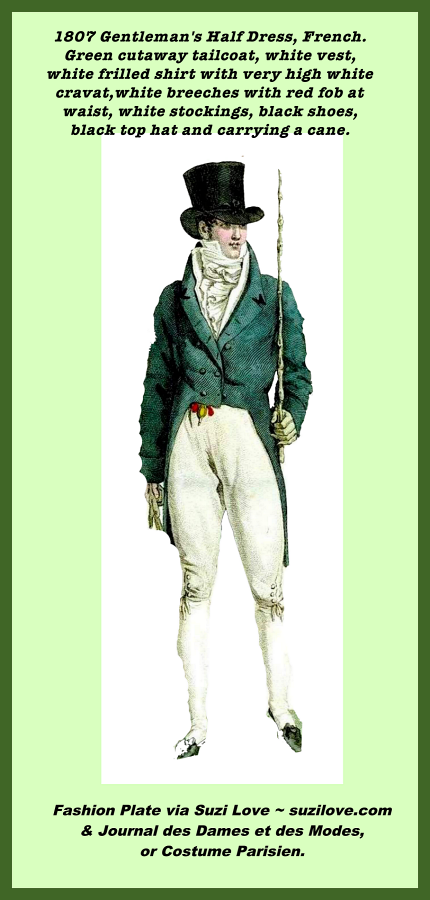
1807 Gentleman’s Half Dress, French. Green cutaway tailcoat, white vest, white frilled shirt with very high white cravat, white breeches with red fob at waist, white stockings, black shoes, black top hat and carrying a cane. Fashion Plate via Journal des Dames et des Modes, or Costume Parisien.
French fashions and Georgian and Regency Era fashions from Great Britain were copied around the world. This is the normal daily outfit for a gentleman in the early 1800s, or in the times of Jane Austen, for daily city and country life. https://books2read.com/SuziLoveFashionMen1800-1819
1812 Man’s Overcoat With Layered and Rounded Capes, French. Black breeches tied at the knees, white stockings, blue waistcoat, black shoes and carrying a bicorn, or two-cornered black hat. Fashion Plate via Journal des Dames et des Modes, Costume Parisien.
In the early 1800s, men no longer wore complicated styles and extravagant fabrics. Men’s fashion simplified and became more conservative. A well cut tailcoat, vest, pantaloons and an immaculate cravat of beautiful white linen in the style of George Bryan, or Beau, Brummell. Clothes were a status symbol and indicated a man’s social position. These clothing items were the sort worn by Jane Austen’s male family and friends.
From the finish of the 18th century until 1820, men’s fashions in European and European-influenced countries moved away from the formal wear of brocades, lace, wigs and powder to more informal and relaxed styles. Focus was on undress rather than formal dress. Typical menswear in the early 1800s included a tailcoat, a vest or waistcoat, either breeches, pants, or the newer trousers, stockings, shoes or boots, all worn with an overcoat and hat. This basic ensemble was accessorized with some form of neckcloth or cravat, gloves, walking stick, cane or riding crop, handkerchief, fobs, watch and perhaps a quizzing glass or eye glass.
Skirted coats were replaced with short-fronted, or cutaway, tailcoats worn over fitted waistcoats and plain, white linen shirts. Knee breeches were gradually replaced by tight-fitting pantaloons and later trousers, decorative shoes with buckles were replaced with a variety of boot styles, and fussy and ruffled neckwear gave way to intricately tied, white linen neck cloths. A Regency Era, or early 1800s, gentleman was outfitted in more practical fabrics, such as wool, cotton and buckskin rather than the fussy brocades and silks of the late 1700s.
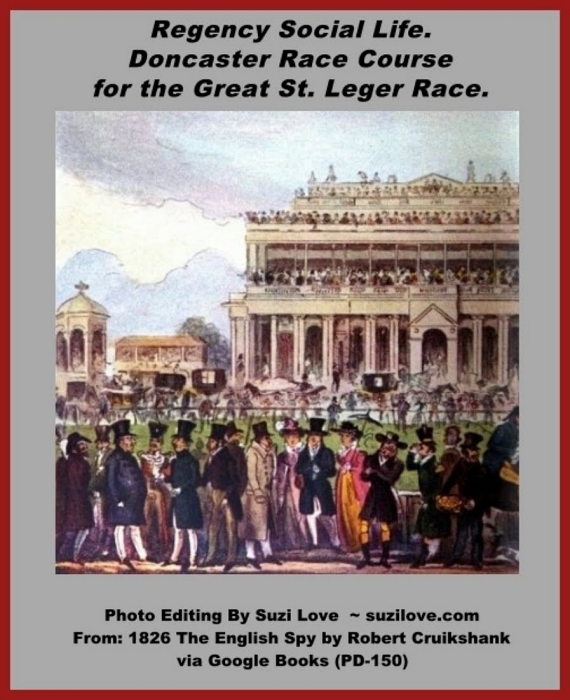
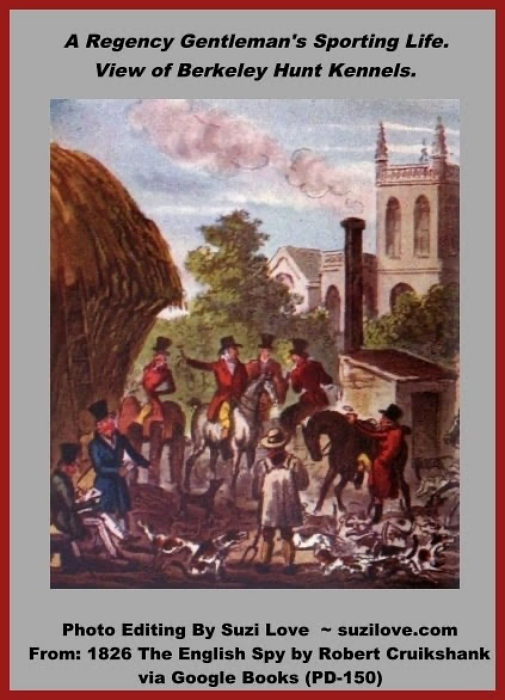
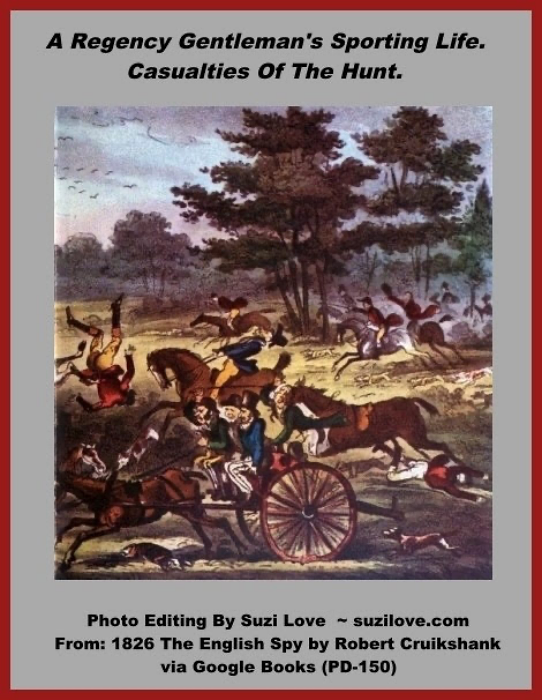
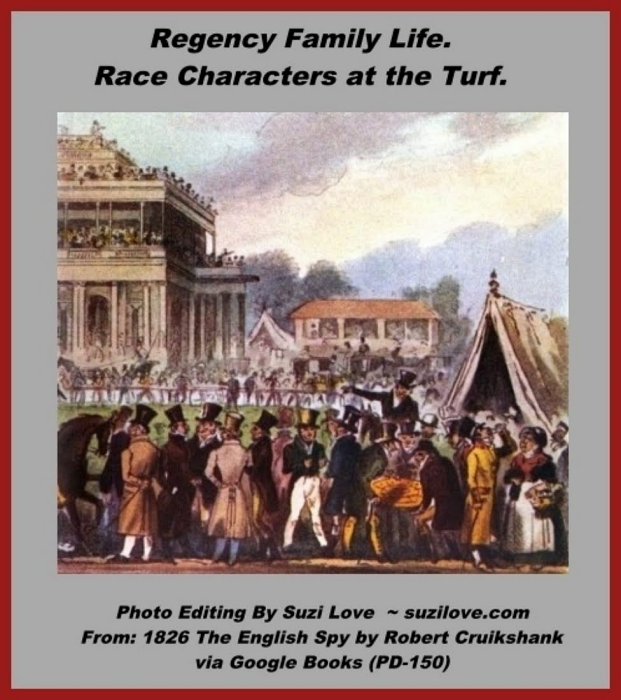
Regency Gentleman’s Sporting Life in the times of Jane Austen. By Robert Cruikshank via Google Books Races, bowls, sailing, fox hunting… all the sports enjoyed by people in Regency Era. From: 1826 The English Spy by Robert Cruikshank via Google Books (PD150)
1826 Doncaster Race Course for the Great St. Leger Race. Regency Sporting Life. via 1826 The English Spy By English Cartoonist, Robert Cruikshank.1826 Bowling Alley at Worcester, England. Regency Sporting Life. via 1826 The English Spy By English Cartoonist, Robert Cruikshank.1826 View of Berkeley Hunt Kennel, England. Regency Sporting Life. via 1826 The English Spy By English Cartoonist, Robert Cruikshank.1826 Casualties Of The Hunt.A Regency Gentleman’s Sporting Life. Regency Sporting Life. via 1826 The English Spy By English Cartoonist, Robert Cruikshank.1826 Race characters at the turf, Regency Sporting Life. via 1826 The English Spy By English Cartoonist, Robert Cruikshank.1826 Regency Gentleman's Sporting Life By Robert Cruikshank. #Cartoon #RegencyEra #GoogleBooks https://books2read.com/suziloveYGD Share on XRL_2_D2D_RetailerBuyLink_RL_2
https://books2read.com/suziloveYGD
Top Hat Styles Chart during the 1800s, from the Regency Era through to the Victorian years. Most popular style was cone shaped and tall in height. Originally made of beaver and very short but later from silk and taller. Tall crown, widens at top, narrow brim turns up slightly at sides.
From the finish of the 18th century until 1820, men’s fashions in European and European-influenced countries moved away from the formal wear of brocades, lace, wigs and powder to more informal and relaxed styles. Focus was on undress rather than formal dress. Typical menswear in the early 1800s included a tailcoat, a vest or waistcoat, either breeches, pants, or the newer trousers, stockings, shoes or boots, all worn with an overcoat and hat. This basic ensemble was accessorized with some form of neckcloth or cravat, gloves, walking stick, cane or riding crop, handkerchief, fobs, watch and perhaps a quizzing glass or eye glass.
Skirted coats were replaced with short-fronted, or cutaway, tailcoats worn over fitted waistcoats and plain, white linen shirts. Knee breeches were gradually replaced by tight-fitting pantaloons and later trousers, decorative shoes with buckles were replaced with a variety of boot styles, and fussy and ruffled neckwear gave way to intricately tied, white linen neck cloths. A Regency Era, or early 1800s, gentleman was outfitted in more practical fabrics, such as wool, cotton and buckskin rather than the fussy brocades and silks of the late 1700s.
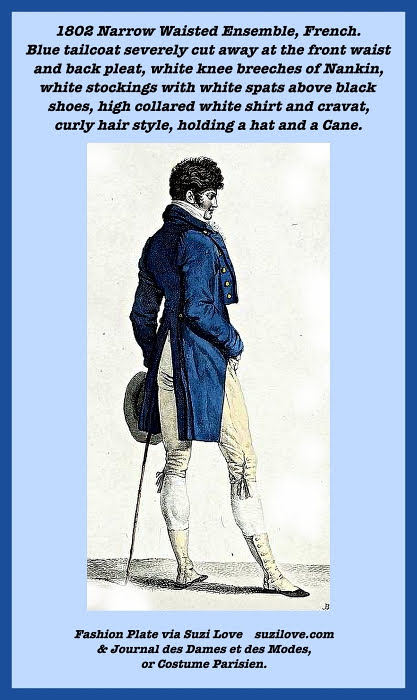
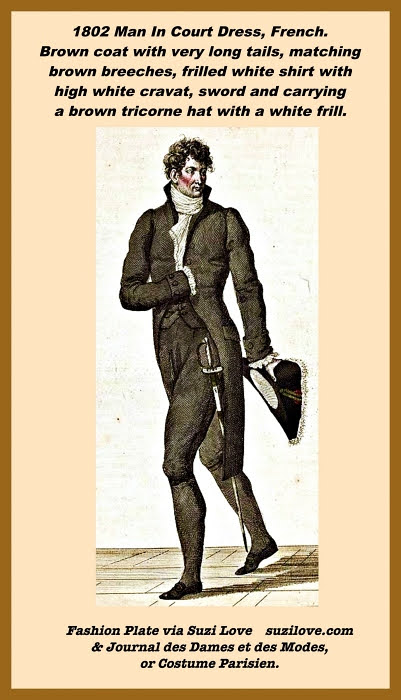
1802 Typical Gentlemen’s Fashions worn during the early 1800s, or Regency Era, or Jane Austen’s times. Fashion Plates via Journal des Dames et des Modes, Costume Parisien.
Regency Menswear: Typical menswear in the early 1800s included a tailcoat, a vest or waistcoat, either breeches, pants, or the newer trousers, stockings, shoes or boots, all worn with an overcoat and hat. This basic ensemble was accessorized with some form of neckcloth or cravat, gloves, a walking stick, cane or riding crop, handkerchief, fobs, a watch and perhaps a quizzing glass or eye glass.
From the finish of the 18th century until 1820, men’s fashions in European and European-influenced countries moved away from the formal wear of brocades, lace, wigs and powder to more informal and relaxed styles. Focus was on undress rather than formal dress. Typical menswear in the early 1800s included a tailcoat, a vest or waistcoat, either breeches, pants, or the newer trousers, stockings, shoes or boots, all worn with an overcoat and hat. This basic ensemble was accessorized with some form of neckcloth or cravat, gloves, walking stick, cane or riding crop, handkerchief, fobs, watch and perhaps a quizzing glass or eye glass.
Skirted coats were replaced with short-fronted, or cutaway, tailcoats worn over fitted waistcoats and plain, white linen shirts. Knee breeches were gradually replaced by tight-fitting pantaloons and later trousers, decorative shoes with buckles were replaced with a variety of boot styles, and fussy and ruffled neckwear gave way to intricately tied, white linen neck cloths. A Regency Era, or early 1800s, gentleman was outfitted in more practical fabrics, such as wool, cotton and buckskin rather than the fussy brocades and silks of the late 1700s.
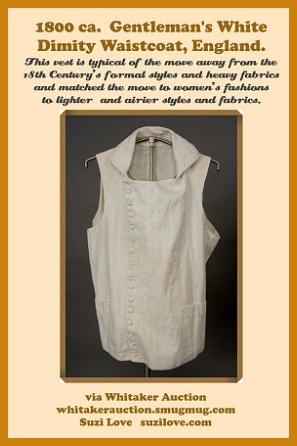
1800 ca. Gentleman’s White Dimity Waistcoat, England. This vest is typical of the move away from the 18th Century’s formal styles and fussy fabrics and matched the move of women’s fashions towards lighter and airier styles and fabrics. via Whitaker Auction whitakerauction.smugmug.com
Jane Austen Men’s Waistcoats: Waistcoats worn at the very beginning of the early 19th century generally had a straight bottom, double-breasted and with wide lapels. Not long after this, waistcoats began to be cut higher up to the waist in front so men during Jane Austen’s lifetime would have worn both styles.
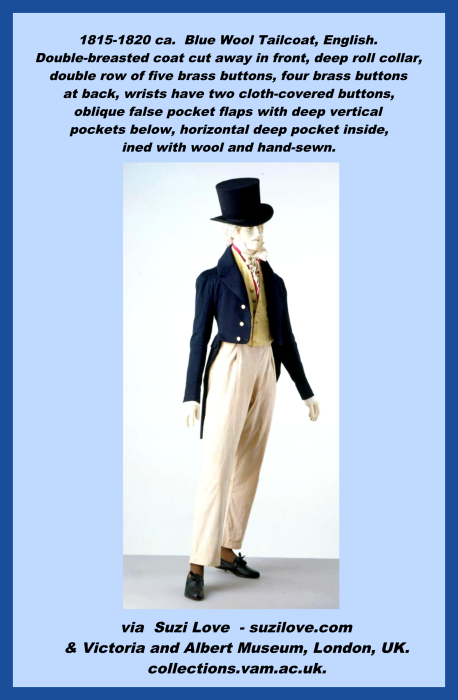
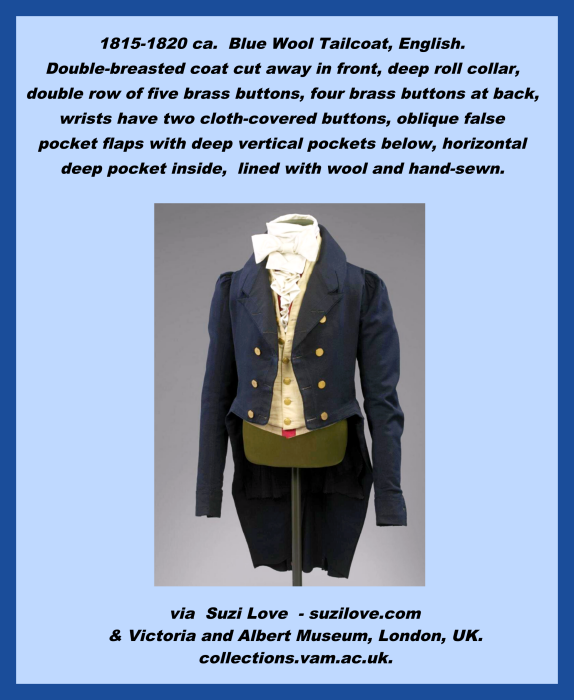
1815-1820 ca. Blue Wool Tailcoat As Worn By Bridgerton Gentlemen and the Men In Jane Austen’s Life.
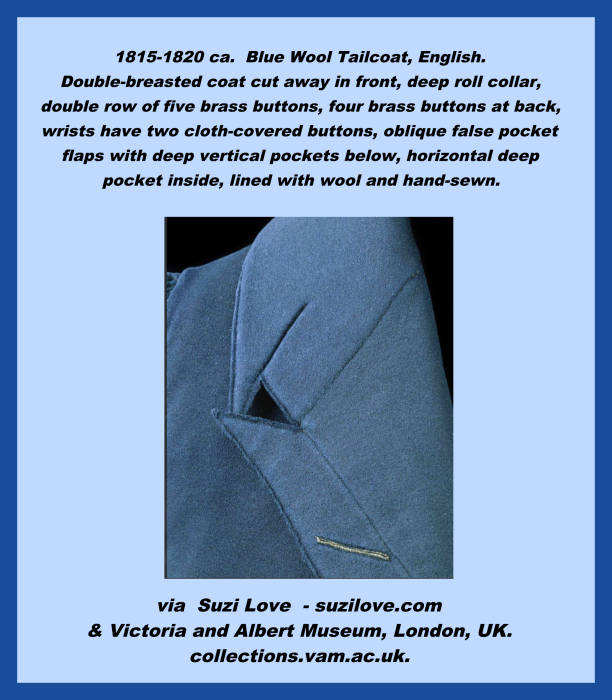
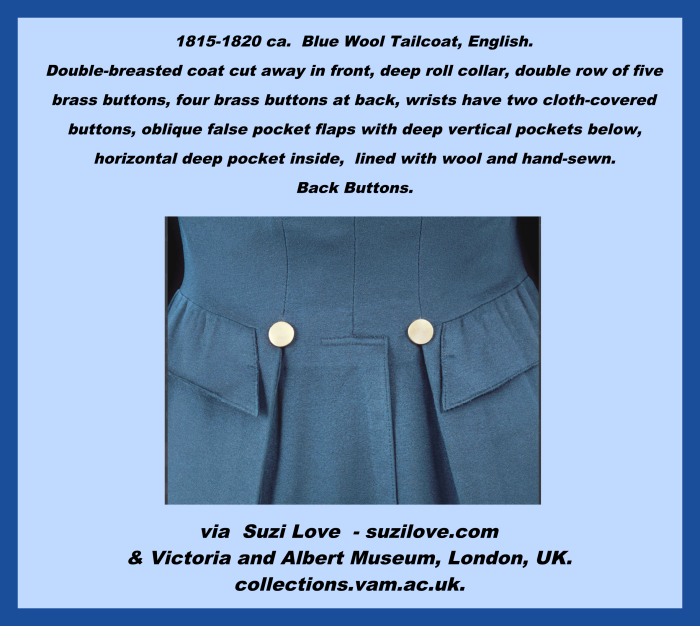
1815-1820 ca. Man’s Blue Wool Tailcoat, English. Chest View. Blue wool, lined with wool, brass buttons, and hand sewn. Double-breasted coat of blue wool, cut away in the front. With a fairly deep roll collar, a double row of five brass buttons, and four further brass buttons at the back. The wrists fasten with two cloth-covered buttons. With oblique false pocket flaps, one on each side, with deep pockets below them entered vertically, and another deep pocket inside entered horizontally. Lined with wool. Hand-sewn. Marks and Inscriptions: ‘Hammond Turner & Sons, Extra Superfine’ (Stamped behind the brass buttons) The cut-away coat remained formal daywear for men until the 1850s. This example has long tight sleeves, puffed at the shoulder, a style typical of the period 1815-1820. The roll collar has an M-shape notch, introduced about 1803, and a waist seam. via Victoria and Albert Museum, London, UK. Given by Lady Osborn.
From the finish of the 18th century until 1820, men’s fashions in European and European-influenced countries moved away from the formal wear of brocades, lace, wigs and powder to more informal and relaxed styles. Focus was on undress rather than formal dress. Typical menswear in the early 1800s included a tailcoat, a vest or waistcoat, either breeches, pants, or the newer trousers, stockings, shoes or boots, all worn with an overcoat and hat. This basic ensemble was accessorized with some form of neckcloth or cravat, gloves, walking stick, cane or riding crop, handkerchief, fobs, watch and perhaps a quizzing glass or eye glass.
Skirted coats were replaced with short-fronted, or cutaway, tailcoats worn over fitted waistcoats and plain, white linen shirts. Knee breeches were gradually replaced by tight-fitting pantaloons and later trousers, decorative shoes with buckles were replaced with a variety of boot styles, and fussy and ruffled neckwear gave way to intricately tied, white linen neck cloths. A Regency Era, or early 1800s, gentleman was outfitted in more practical fabrics, such as wool, cotton and buckskin rather than the fussy brocades and silks of the late 1700s.
1811 Typical Regency Era Man’s Overcoat or Driving Coat. Fashion Plate via Journal des Dames et des Modes, or Costume Parisien. Overcoats were called many names: Greatcoat, Carrick or Garrick Coat, Coachman’s or Driving Or Box Coat. With many shoulder capes, or pelerines, to keep rain and snow off the body.
From the finish of the 18th century until 1820, men’s fashions in European and European-influenced countries moved away from the formal wear of brocades, lace, wigs and powder to more informal and relaxed styles. Focus was on undress rather than formal dress. Typical menswear in the early 1800s included a tailcoat, a vest or waistcoat, either breeches, pants, or the newer trousers, stockings, shoes or boots, all worn with an overcoat and hat. This basic ensemble was accessorized with some form of neckcloth or cravat, gloves, walking stick, cane or riding crop, handkerchief, fobs, watch and perhaps a quizzing glass or eye glass.
Skirted coats were replaced with short-fronted, or cutaway, tailcoats worn over fitted waistcoats and plain, white linen shirts. Knee breeches were gradually replaced by tight-fitting pantaloons and later trousers, decorative shoes with buckles were replaced with a variety of boot styles, and fussy and ruffled neckwear gave way to intricately tied, white linen neck cloths. A Regency Era, or early 1800s, gentleman was outfitted in more practical fabrics, such as wool, cotton and buckskin rather than the fussy brocades and silks of the late 1700s.
1827 ca. Gentleman’s Dressing Box, London. Mahogany box with brass carrying handles, lid opens to velvet and leather interior with twelve engraved silver topped bottles, all with an engraving of an oak tree. Top tray lifts out to another tray of tools.
1827 ca. Gentleman’s Dressing Box, London. Mahogany box with brass carrying handles, lid opens to velvet and leather interior with twelve engraved silver topped bottles, all with an engraving of an oak tree. Top tray lifts out to another tray. via Antique Tea Caddies, U.K. 1827 ca. Mahogany Gentleman's Dressing Box With Silver Topped Bottles, London. #Regency #Antiques #London. books2read.com/suziloveBoxesCases Share on XHN_11_D2D_Craftsmen created containers of precious metals, leather, silks, and decorated them with jewels to make exquisite and expensive items as well as practical carrying cases. books2read.com/suziloveBoxesCases
1812 June Couple In Fashionable Walking Dress, English. Lady wears a green cape and hat over a high-waisted, or Empire style, white dress with a pink parasol. Man wears a tailcoat over fawn breeches, yellow gloves, black shoes and hat and a walking stick. Fashion Plate via The Lady’s Magazine Or Entertaining Companion for the Fair Sex.
By the end of the 18th century, tailored garments for both men and women were replaced by styles made for ease and comfort, resulting in the neoclassical style of the 1780s. Inspired in part by the statuary of ancient Greece and Rome, the new fashion was epitomized by light cotton gowns falling around the body in an unstructured way, held around the high waist with a simple sash and accompanied by a soft shawl draped around exposed shoulders. This style was ideal for the Indian imports like Kashmiri shawls and Bengali muslin, as used in this embroidered gown.