1808 Two Bodices, French. Green and white striped dress has short puffed sleeves and matching green turban. White dress with pink overdress has short sleeves and a pink headdress to match. Fashion Plate via Journal des Dames et des Modes, or Costume Parisien.
French fashions like this were copied by English magazines so these styles of hats would have been worn by Jane Austen and her contemporaries.
1807 Two Ladies and a Gentleman, English. Lady in lavender walking dress, or Pelisse, with fur trim, holding a blue reticule or bag, fitted lavender bonnet with tassel and yellow gloves. Lady in white evening dress with salmon tunic caught up at one side and evening turban. Man in long blue overcoat, or Redingote, with contrasting collar, high white cravat, yellow gloves, tall Hessian boots with tassels, and wearing a top hat. via Le Beau Monde, or Literary and Fashionable Magazine, London, U.K.
These are the types of outfits worn by Jane Austen and contemporaries in England and shown in their English magazines.The same designs had probably already been seen in France, because English publishers obsessively copied French fashions despite the two countries being at war for many years.
1809 January Walking Dress, English. Polish bonnet, mantle of gold velvet with an invisible hood trimmed with ermine, antique collar fastened with a gold ornament in form of a shell. Morning dress, white muslin Brussels spot, with worked stomacher, trimmed down the front and at the bottom, worked along hanging sleeves, twisted and fastened at the wristband with small gold ornament to match mantle and cincture of the dress, gold sandals laced with brown cords and tassels and York tan gloves. Plate via Rudolph Ackermann’s ‘The Repository’ of Arts.
1818 Deep Green Redingote, French. Merino wool coat or walking dress. High white neck frill, black velvet dress decoration and velvet bonnet shaped like a shell, green shoes and white gloves. Fashion Plate via Journal des Dames et des Modes, or Costume Parisien. The type of outfit young Regency Era ladies would have worn if they were out shopping on Bond Street, walking in a park, or taking a carriage ride through Hyde Park.
Definition Redingote Or Pelisse Or Walking Dress Or Coat: French word developed from English words, riding coat. Long fitted outdoor coat worn over other garments for warmth. Often left open at the front to show off the dress underneath. Sometimes cut away in front. Originally made with several capes and trimmed with large buttons. French fashion plates call these coats Redingotes and they are designed for women, men and children. English fashion plates call them a Pelisse, a walking dress, Promenade dress, or Carriage dress.
1818 Gorgeous women’s fashion In the late Regency Era. Dresses, coats or Redingotes, Spencers, shawls, fichu or shoulder cape, shoes, hats and headdresses, gloves, and Reticules or bags as displayed in various fashion magazines.
Fashion Accessory: Completes and complements outfit. Two groups- 1. Those worn e.g. bonnets, caps and hats, boots and shoes, cravats and ties, gloves, mittens and muffs, jewelry, scarves and shawls, socks and stockings 2. Those carried e.g. bags, fans, and parasols.
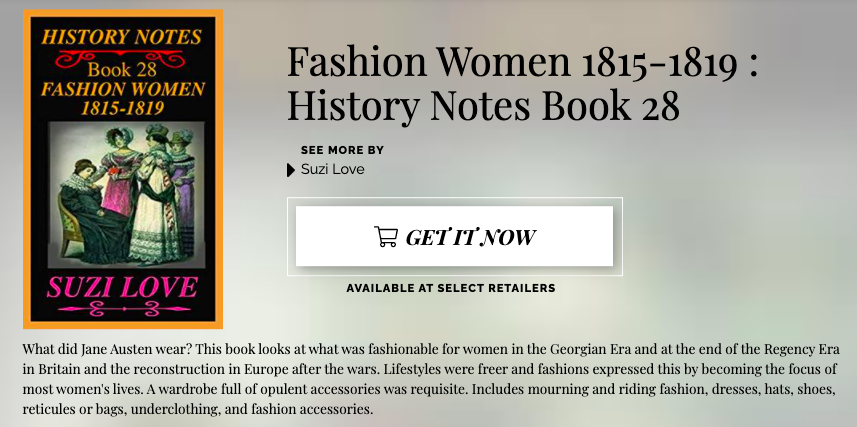
If you are a reader or writer of early 1800s, or Regency Era fashions such as mourning and riding fashion, dresses, hats, shoes, reticules or bags, underclothing and fashion accessories, try History Notes Book 28 Women’s Fashions 1815-1819
1880’s Corset, French, silk satin, steel busk, and bone. Women used corsets to get closer to an ‘ideal physical form’. Until the beginning of the 20th century, women’s waists were tightened by corsets. via Kyoto Institute, Japan.
Corsets 1880-1900 History Notes Book 20 This book shows how a fashionable silhouette became of paramount importance and how a well-fitted corset became a fashion essential. As well as a decorative fashion item, tight lacing gave a narrow waist and the desired feminine form under clothing.
1840 Group In An Outdoor Setting, French. Two men in top hats. Modes de Longchamps’. Men’s outfits, a woman’s riding habit and a small boy, all tailored by Robin of 21 Rue Saint Marc, Paris. via Le Bon Ton. via Victoria and Albert Museum, London, UK. collections.vam.ac.uk.
1809 Women’s Fashions: Dresses, Shawls, Hats and Jewelry from various fashion magazines. Typical of the outfits worn by Jane Austen and her contemporaries for daytime and evening activities. An Empire style, or high-waisted white cotton dress worn under a Spencer or short jacket, a Redingote, or coat, for warmth and with pretty hats, shawls and shoes.
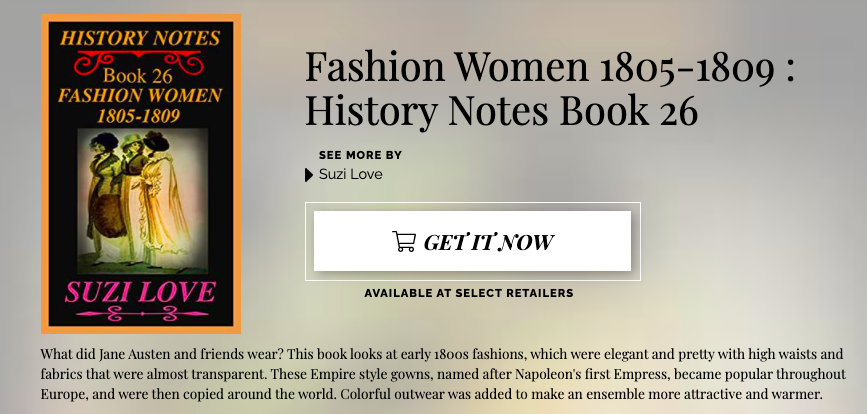
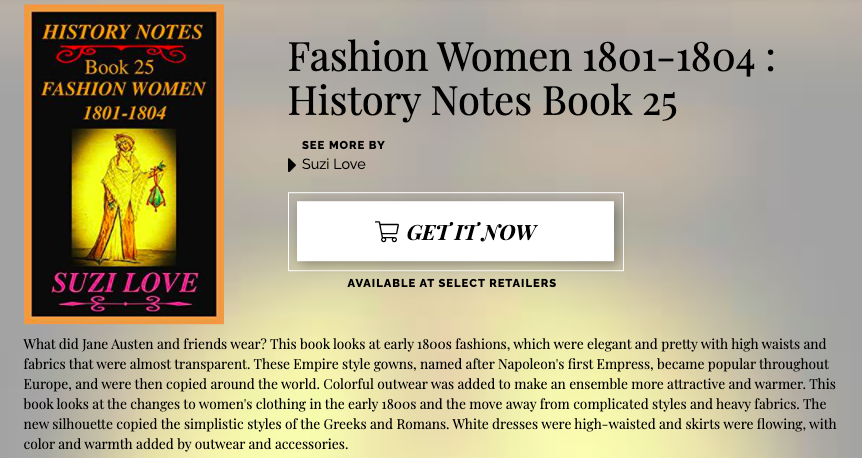
1805 Women’s Dresses and Fashion Accessories. Fashion plates from Fashions of London and Paris. Gorgeous Regency Era clothing came in a wide range of styles to suit every season and occasion. Ladies in Jane Austen’s times wore Empire style dresses which were usually of light fabric and floaty in style so accessories were essential to keep women warm. Accessory: item which contributes to the overall effect but is of secondary importance is the dictionary definition of an accessory, but the term has only been applied in relation to personal appearance since the 19th century. As defined by dress historians, accessories usually complete an outfit and are chosen to complement it. Accessories fall into two groups: Those worn, such as bonnets, caps and hats, boots and shoes, cravats and ties, gloves, mittens and muffs, jewellery, scarves and shawls, socks and stockings. Those that are carried, such as bags, canes, fans, parasols and umbrellas, and swords.
1816 January Blue Carriage Dress, English. High neck but no collar, front is fitted but back has slight fullness and very short bodice. Puffed roll to decorate the hem, trimmed in bias cut blue satin, long sleeves finished at wrists with satin, gloves of white kid and ‘sandals’ or shoes of blue kid leather. Head-dress à la mode de Paris is an unusual cap of white lace and decorated with two rolls of ribbon. “We are indebted to the tasteful fancy of Mrs. Bean, of Albemarle Street, for both our dresses this month.” Fashion Plate via Rudolph Ackermann’s ‘The Repository of Arts’.
Jane Austen and her contemporaries would have worn this style of outdoor, or carriage ensemble with a coat over a dress. These outdoor dresses were labelled a variety of names. In England, this might also have been called a Walking Or Promenade dress, or Pelisse. In Europe, it would be called a Redingote.
Definition: Pelisse, Walking Dress, Carriage dress, Promenade Dress, Redingote. Long, fitted coat sometimes cut away in front to show off the dress underneath. Originally made for men with several capes and trimmed with large buttons, they were adapted to add an additional, and warmer, layer to the typical white muslin dresses worn in the early 1800s. Those light weight dresses were good in summer but not suited to harsh winters. Over the carriage dress, a shawl could be added as well as a muff to give a warm and comfortable outfit for traveling by carriage.
1816 January Blue Carriage Dress, English. High neck but no collar, front is fitted but back has slight fullness and very short bodice. Puffed roll to decorate the hem, trimmed in bias cut blue satin, long sleeves finished at wrists with satin, gloves of white kid and ‘sandals’ or shoes of blue kid leather. Head-dress à la mode de Paris is an unusual cap of white lace and decorated with two rolls of ribbon. “We are indebted to the tasteful fancy of Mrs. Bean, of Albemarle Street, for both our dresses this month.” Fashion Plate via Rudolph Ackermann’s ‘The Repository of Arts’.1816 January Blue Carriage Dress And Unusual Lace Cap. #Regency #JaneAusten #Fashion https://books2read.com/SuziLoveFashionWomen1805-1809 Share on X