1810 ca. Full Dress Jacket, Lothian Yeomanry Cavalry, Britain. The East Lothian Yeomanry Cavalry was raised as a one troop formation at Haddington in May 1797. Five years later a second troop was raised and in 1803 a third and fourth troop. The regiment was reduced to one troop in 1823 and disbanded 15 years later. National Army Museum, London, UK. https://books2read.com/SuziLoveFashionMen1800-1819 In Jane Austen’s time, or the early 1800s, gentlemen were seen in military coats like this often because many Englishmen were involved in the long lasting wars against Napoleon. .
Richard, Earl of Winchester, has no time for their family friend and mad scientist, Lady Laura Jamison, yet when he’s with her, passion and desire explodes. Scenting Scandal By Suzi Love Book 2 Scandalous Siblings Series. books2read.com/suziloveSS
Richard had schooled himself into playing the role of mentor with such brilliance, Laura’s brothers and sisters would applaud his aptitude for match-making. He’d find Laura’s perfect husband as quickly as possible. And at those long and interminable dinners, he’d prove his own unsuitability by arguing until their fellow diners rolled their eyes and closed their ears to another of their battles of wit. When their companions’ eyes glazed over and they turned to more interesting conversation, he’d be free to let his eyes roam and his senses feast on Laura as she raved about the wonders of evolutionary science.
It was more likely that he’d need to dig his fingers into the elegant carvings on his chair to stop himself leaping across the table like a lunatic and shocking everyone at the sixty-seat table. He’d been in control of himself and his minor kingdom since he’d turned eighteen. So, for pity’s sake, why did being within thirty yards of Laura turn him into a wet-behind-the ears randy youth?
After her olfactory tests had proved he wasn’t her ideal mate, he should feel relieved, not affronted. And rather than reveling in a bachelor’s escape from the clutches of another would-be countess, Laura’s rejection had prompted him to childishly extol his own virtues. For an earl who also held minor titles and controlled several estates, being categorized as ‘Examined and Disregarded’ was as abnormal as it was lowering.
“Laura,” he said, dodging lace frills. “Picture my brutalized face if Michael and Jonathon caught me, the one man able to resist your charms and ignore your demands, composing appalling odes to the length of your lashes like your other fawning fops.”
“Is that why Sherwyn needed to coerce you into acting as my keeper?”
Ah yes, trust Laura to demand to know the reason he complied with his cousin’s wishes. “I was the only able-bodied male available for the time required.”
1810 Cotton Waistcoat. Blue black and white woven plaid, narrow double breast with self buttons, buttons create optional lapels, stand collar, hemline pockets, white cotton back with ties and cotton lining. via Whitaker Auction whitakerauction.smugmug.com
Typical of a gentleman’s waistcoat, or vest, worn during the early 1800s, or Regency Era, or Jane Austen’s times with a fancy collar, straight cut, and straight buttoned front.
1800s Early Gentleman John Jackson, London, U.K. #Regency Boxing was known as pugilism and was wildly popular in the Regency Era with all classes of men both as a spectator sport and an athletic hobby. Pugilists didn’t wear gloves. Jackson was a champion prize fighter from 1795-1818 ca. Opened his boxing studio where he taught young bucks the manly art of self-defense. via Wikimedia Commons.
1800s Early Gentleman John Jackson, London, U.K. #Regency Boxing was known as pugilism and was wildly popular in the Regency Era with all classes of men both as a spectator sport and an athletic hobby. Piugilists didn’t wear gloves. Jackson was a champion prize fighter from 1795-1818 ca. Opened his boxing studio where he taught young bucks the manly art of self-defense.1800s Early Gentleman John Jackson, London, U.K. #Regency #Boxing #Pugilism https://books2read.com/suziloveYGD Share on XRL_2_D2D_RetailerBuyLink_RL_2
https://books2read.com/suziloveYGD
1860–1870 ca. Pink Silk Bag, Or Reticule, Italian. Two layers of contrasting pink silk with tassels and a drawstring. via Metropolitan Museum New York City, U.S.A. metmuseum.org
Definition Ridicule, Reticule, Indispensable, or Handbag: From the late 1700s, pockets could no longer be sewn into gowns, as skirts fell from just under the bust and were full and flowing. Instead, women began carrying small bags, known at first as ridicules and later as reticules, to keep necessary items on their person e.g. handkerchiefs, coins, vinaigrettes, calling cards, glasses etc. http://books2read.com/suziloveReticules
The term ‘ridicule’ derived from the Latin ‘ridiculum’ and first used in France during the 17th century and meant subjecting something or someone to mockery. As women’s tiny bags were mocked, or ridiculed, for being a useless fashion accessory carried outside when they were first used in the late 1700s, it’s likely this is how the name ‘ridicule’ started. The later term ‘reticule’ derived from the Latin reticulum, meaning ‘netted bag’ and was applied when bags became larger and often made from netting. In the late 1700s and early 1800s, they were also known as indispensables as they carried all the personal items a lady needed upon her person every day. They were easily made by ladies, easy to carry and became an indispensable fashion accessory.
In the early nineteenth century, reticules started to look like future handbags as they were often made from rigid card or molded mâché or card into a variety of shapes. Early bags were circular and with a drawstring but as women wanted their reticules to look individual they could be made with two halves and a hinged metal closure or with concertina sides. Materials varied from silk, cotton and string and shapes were round, hexagonal or lozenge shapes with shell shaped bags becoming very popular during the Regency and Romantic Eras.
1800s magazines were written for well bred women who could read, so they gave plenty of ideas for how ladies could make and embellish reticules for their own use and as pretty gifts. Needlework was highly encouraged as a pastime for a lady so bags were frequently embroidered or decorated with beading. By the 1820s, reticules became more like our modern handbags using soft leather gathered at the top or hard leather with a rigid fastener and metal chain for carrying.
1840 Group In An Outdoor Setting, French. Two men in top hats. Modes de Longchamps’. Men’s outfits, a woman’s riding habit and a small boy, all tailored by Robin of 21 Rue Saint Marc, Paris. via Le Bon Ton. via Victoria and Albert Museum, London, UK. collections.vam.ac.uk.
1818 September Morning Dress and Spencer, English. Empire style, high-waisted white dress with elaborate blue decoration above hem, short blue Spencer, or jacket, with puffs at the shoulders and straight sleeves, cap with plumes, or feathers, tied under her chin and holding another plumed bonnet, blue walking boots, and wearing blue gloves. Fashion Plate via Ladies Magazine.
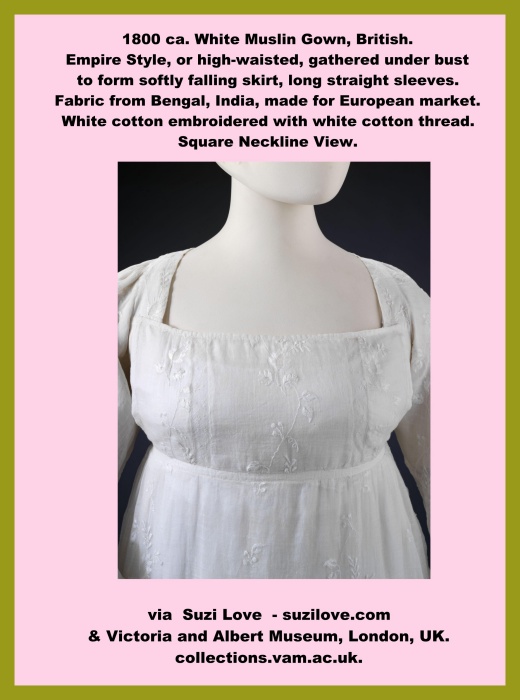
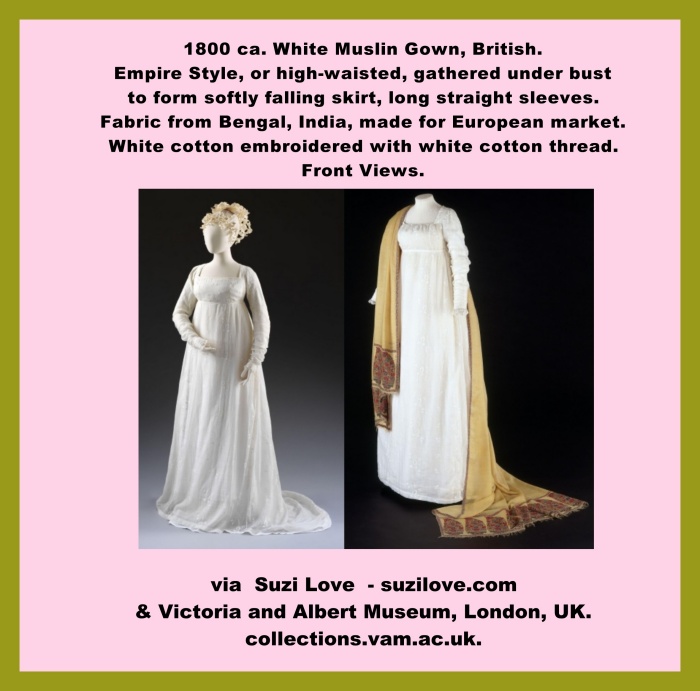
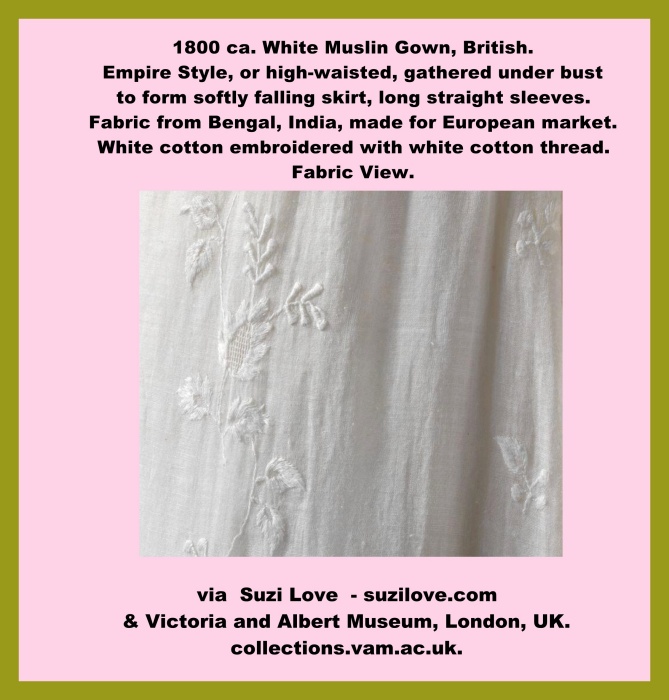
Definition Empire Style Dress: High-waisted white gown defined women’s fashion during the Regency Era. ‘Empire’ is the name given to the period when Napoleon Bonaparte built his French Empire. High-waisted, loose gowns were adopted by the aristocracy as a symbol of turning away from the fussy, elaborate and expensive clothing worn in the 1700s.
Definition Spencer: Short jacket, cropped at the waist, worn over a dress, or gown. These close-fitting, tight sleeved, waist length jackets were modeled on a gentleman’s riding coat, but without tails. Delicate and regency dresses provided so little protection from the cold, so over garments were essential for warmth, modesty and good health.