Do you need more factual and visual information for your historical fiction? Try History Notes Books 1-28. Non-fiction Series: Fashion, corsets, Regency Era, music and social manners in the 18th and 19th centuries e.g.
1800-1805 ca. White cotton petticoat of the sort worn by Jane Austen in the early 1800s. Worn under a sleeved, trained dress and over a loose knee length chemise and corset which covered the exposed bust area. The skirt of the petticoat has an apron front open down the side seams. Drawers were not commonly worn at the time. via The John Bright Collection. thejohnbrightcollection.co.uk
Petticoats were made to fit under the low cut bodices of the early 1800s fashions, and to not be seen under a wide and square bodice. This meant thin ribbons were sometimes attached at the shoulders so the petticoat would be virtually without a bodice.
1819 White Percale Dress, French. Deep hem of bubbly muslin, matching Percale Spencer or jacket, pink parasol and flowered straw hat. Spencer has short puffed sleeves over long straight sleeves and military style trimmings. Fashion Plate via Journal des Dames et des Modes, or Costume Parisien. Even though this a French fashion plate, this is typical of the outdoor outfit worn by Jane Austen and her contemporaries when going outside. An Empire style, or high-waisted white cotton dress worn under a Spencer, or jacket, for warmth and with a parasol to protect fair complexions from the sun.
Description Spencer: Short jackets worn for warmth over the high-waisted Empire style gowns that were popular after the French Revolution, where there was a shift away from opulence and decadence to simpler fashion. This jacket with very short bodice and long sleeves was known as a Spencer and was named after the male coat made famous by the Earl Spencer and said to have originated in accident to Lord Spencer in hunting when coat tails torn off and a cropped jacket was invented. The dresses in the early 1800s therefore became looser, lighter, and flowing and women became cold due to their very low cut and short bodices. Short fitted jackets that went easily over the dresses and provided extra modesty and some warmth. As Europe and many other parts of the world were deep in wars in the late 1700s and early 1800s, men in uniform were found everywhere. In support of these military men, fashions leaned towards military style shoulder paddings, shoulder embellishments, loops, buttons, and braids.
Definition Percale or Perkale: From the Persian word pargalah. Fine cotton fabric, or cambric muslin of good quality, originally from India, generally bleached, printed and finished without gloss. Contains more dressing than ordinary muslin, but without the glossy finish of cambric and is printed in fancy patterns on white and colored grounds. In May 1816, Percale was commented on in Rudolph Ackermann’ Repository Of Arts, “Perkale, as they call cambric muslin, is now almost the only thing worn in the morning costume: you must not, however, fancy that this proceeds from a wish to encourage English manufacture, but partly from a love for novelty, and partly because it is less expensive than cambric, and equally fashionable.”
1811 January Walking Dress, or Pelisse, English. Jane Austen and her contemporaries wore long coats like these to keep warm when out and about, visiting, shopping etc. Their thin muslin dresses worn in the early 1800s were little protection against European winters.
Round high morning robe of cambric with deep full-trimmed collar. Swedish coat of velvet, trimmed with swansdown or blue fox fur. Spanish pelerine of the same, fastened in front of the throat with a mother-of-pearl brooch, clasps to correspond for the bottom of the waist. Traveller’s, or slouch, hat of velvet turned up with shell ornament, half-boots of grey cloth, laced and bound with black velvet. Chinese ridicule, or reticule, or bag, of grey satin, embellished with black medallions and tassels. Gold chain and eye-glass, or quizzing glass.. Fashion Plate via Rudolph Ackermann’s ‘The Repository’ of Arts.
Definition Redingote Or Coat Or Pelisse Or Walking Dress: Long fitted outdoor coat worn over other garments for warmth. French word developed from English words, riding coat. French fashion plates call these coats a Redingote and English plates call them a Pelisse, Or Walking Dress, or Carriage Costume. For more of these, try my book on Pelisses, History Notes Book 5 . books2read.com/suzilovePelisse
Definition Swansdown: Fine down of a swan, used for trimmings on clothing and for making powder puffs.
Definition Velvet or Velour: Silk with short, dense and smooth pile produced by pile warp raised in loops above ground weave through introduction of rods during the weaving.
Definition Ridicule, Reticule, Indispensable, or Handbag: From the late 1700s, pockets could no longer be sewn into gowns nor could separate pockets be tied around their waists and accessed by slits in the gown and petticoats, as skirts fell from just under the bust and were full and flowing. Instead, women began carrying small bags, known at first as ridicules and later as reticules, to keep necessary items on their person e.g. handkerchiefs, coins, vinaigrettes, calling cards, glasses etc. For more on reticules, try my History Notes book 3 http://books2read.com/suziloveReticules
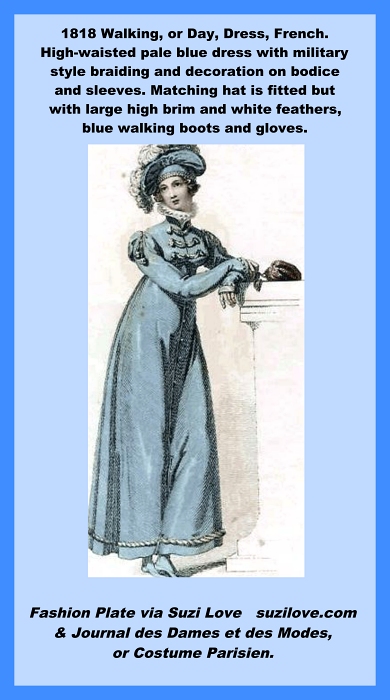
1818 Military style Redingote, or Coat,or Walking dress, French. High-waisted pale blue outdoors coat with military style braiding and decoration on bodice and sleeves. Matching hat is fitted to her head but with a large high brim and white feathers, or plume, blue walking boots and gloves. The type of outfit young Regency Era ladies would have worn if they were out shopping on Bond Street, walking in a park, or taking a carriage ride through Hyde Park. Fashion Plate via Journal des Dames et des Modes, or Costume Parisien. .
Definition Redingote Or Pelisse Or Walking Dress Or Coat: French word developed from English words, riding coat. Long fitted outdoor coat worn over other garments for warmth. Often left open at the front to show off the dress underneath. Sometimes cut away in front. Originally made with several capes and trimmed with large buttons. French fashion plates call these coats Redingotes and they are designed for women, men and children. English fashion plates call them a Pelisse, a walking dress, Promenade dress, or Carriage dress.
Young Lady’s Day is Book 4 in the Regency Life Series. This book depicts the often-frivolous life and fashions of a young lady in the early 1800’s, but also gives a glimpse into the more serious occupations a young lady may undertake. Through historic images, historical information, and funny anecdotes, it shows how a young lady fills her day, where she is permitted to go, and who she is allowed spend time with. These light-hearted looks at the longer Regency years are an easy to read overview of what people did and wore, and where they worked and played. There is plenty of information to interest history buffs, and lots of pictures to help readers and writers of historical fiction visualize the people and places from the last years of the 18th Century until Queen Victoria took the throne.
1810-1820 ca. Double Breasted Red Hunting Coat, English.
1810-1820 ca. Red Hunting Coat, English. Hunting was both a popular sport and an essential part of social success. Double-breasted tailcoat of woolen superfine, lined with sateen and cotton, M-notch lapels, nine gold buttons with heraldic crest, cuffs with three smaller matching buttons. via Collection from Castle Howard, Yorkshire, U.K. Victoria and Albert Museum, London, UK. Hunting coats, or colors, often red coats called pinks, were worn by hunt masters and hunters. In Bridgerton and Jane Austen times, or the early 1800s, gentlemen wore red coats like this while riding to the hounds.
Historically, hunt members wore ‘colors’ to distinguish between types of hunters and their level of experience. Traditional red coats were worn by huntsmen, masters, former masters, whippers-in, regardless of sex, while other hunt staff members and male members invited by masters wore colors and hunt buttons as a mark of appreciation for their involvement in the organization and running of the hunt. After the Hunting Act in England and Wales, only Masters and Hunt Servants wore red coats or hunt livery. Gentleman subscribers usually wore black coats, with or without hunt buttons and in some countries, women wore colored collars on their black or navy coats to help them stand out from the rest of the field. Some hunts, including most harrier and beagle packs, wear green rather than red jackets, and some hunts wear other colors such as mustard.
Are you a Bridgerton fan? Love Jane Austen? Love history? Take a look at a Young Gentleman’s Day in early 1800s. Young Gentleman’s Day Regency Life Series Books 2 by Suzi Love. Easy to read books on what a young gentleman did, wore, and lived during the early 1800s, or the Regency Era when King George 3rd was mad and his son, Prince George, was the Regent in Britain. #Regency #JaneAusten #amwriting books2read.com/suziloveYGD
1806 Two Ladies In White Dresses, French. High-waisted, Or Empire line, dresses, pink and blue paisley shawls, bonnets tied under their chins, and long gloves, one in gorgeous yellow. Fashion Plate via Journal des Dames et des Modes, or Costume Parisien. These fashionable ensembles with a variety of fashionable and practical accessories would have been worn by Jane Austen and her family and friends during the day when out walking in the park or visiting village shops. Hats were a necessity to protect fair skin from the sun and scarfs and shawls added color and warmth to an outfit.
Definition Empire Style Dress: Named after the First Empire in France. Empire dresses had a low neckline and skirts started directly under the bust and flowed into the classical relaxed wide styles of Greece and Rome. This style of dress is associated with Jane Austen and her contemporaries as a high-waisted dress was worn most days. Cotton, silk or taffeta were the popular fabrics. Only the very wealthy could afford white dress in this style as the cottons were imported from India and had to be carefully cleaned, usually by a lady’s maid.
Definition Paisley Shawl: Made of intricately woven and delicate wool with a teardrop motif that originated in Persia and India.