“Vanity working on a weak head, produces every sort of mischief.” — Jane Austen Emma (1815


“Vanity working on a weak head, produces every sort of mischief.” — Jane Austen Emma (1815


1805 November Three English Ladies In Full Dress. White walking dress with high neck under a purple tunic, or pelisse, and a masculine style straw hat. Two in evening dresses, one white and one pink, fur stoles and plumed, or feathered, hats. via Vernon and Hood Poultry at The Lady’s Monthly Museum, London, U.K.
These gorgeous dresses show the transition from the round dresses of the late 1700s to the Empire style dresses with the waistline high under the bust. Small trains were still worn in the early 1800s, but much more manageable than the larger and more elaborate trains of the late 1700s. Jane Austen and her friends would have worn dresses like this to their assemblies and evening events.
Definition Accessory: An accessory completes and complements an outfit.
Two groups – 1. Those worn e.g. bonnets, caps and hats, boots and shoes, cravats and ties, gloves, mittens and muffs, jewelry, scarves and shawls, socks and stockings.
2. Those carried e.g. bags, fans, and parasols.
Definition Full Dress: The most formal and complete ensemble, worn for day or night events, and includes the fullest range of accessories that could be added to the outfit to make the most impressive display.


1800-1805 ca. Pink Silk Bonnet, French. Similar to hats worn in England by Jane Austen and friends. Silk net, silk satin ribbon, and silk flowers. via Museum of Fine Arts, Boston, U.S.A. mfa.org


19th Century Mid-Late Five Desk Seals. L-R Carnelian seal with silver mounts set with colored stones; malachite urn seal: gilt-bronze seal with winged cherub heads: Silver-gilt seal eagle, Silver-gilt seal as eagle’s leg below a blue glass ball. via Sotheby’s Auctions. sothebys.com
In the Bridgerton family, or Jane Austen’s household, and during the Regency Era, sealing wax was not only impressed onto the back of a letter with a seal to protect against tampering, but also to identify the sender of the letter. People, especially aristocrats, kept personal and family seals to be used for many different purposes e.g. A letter to a government official would be sealed with an aristocrat’s crest or title. Personal seals for identification have been since early civilizations. The rubber stamps and embossers we use today serve the same purpose, identifying the sender.
Definition: Wax Seals: Pressed onto a letter or envelope to show that a document is unopened or to verify the sender’s identity. A signet ring or was seal is pressed into a dollop of hot wax to seal a letter or envelope closed.


Do you need more factual and visual information for your historical fiction? History of fashion, music, peerage and customs in 18th and 19th centuries. Non-fiction series full of gorgeous pictures and engraved fashion plates. A visual history of fashion, music, peerage, social manners and customs from late 1700s to late 1800s, or 18th and 19th centuries.


1807 Fashionable French Couple. Man: Blue cutaway coat and yellow breeches. Lady: Lemon and blue dress and bonnet. This is the fashion styles worn by Jane Austen and her family and friends in the early 1800s. Fashion Plate via Journal des Dames et des Modes, or Costume Parisien.https://books2read.com/SuziLoveFashionMen1800-1819

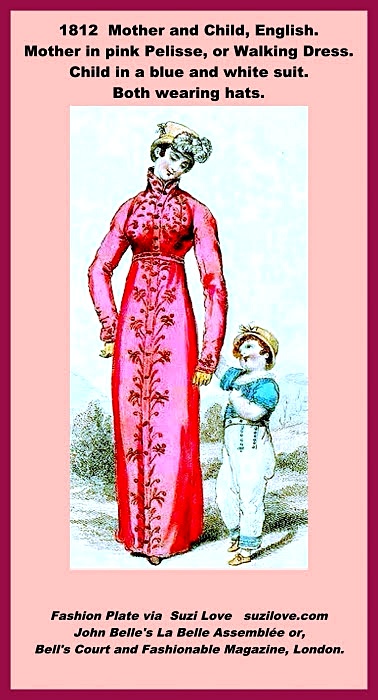
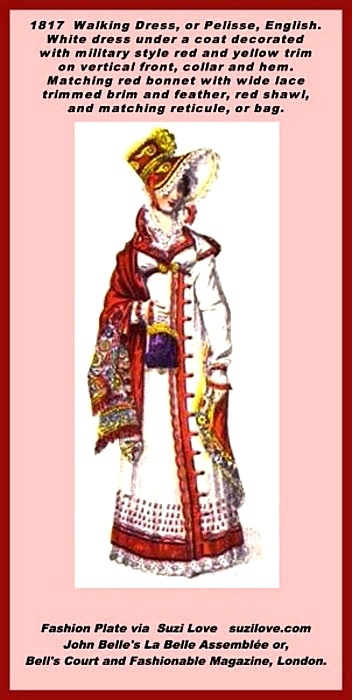
1818 Women’s outdoor fashions In the times of Jane Austen. Pelisses or coats or Redingotes, with matching hats, shoes, goves, reticules or bage, plus other accessories as displayed in various fashion magazines. Definition Redingote Or Coat Or Pelisse: Long fitted outdoor coat worn over other garments for warmth. French word developed from English words, riding coat. French fashion plates call these coats a Redingote and English plates call them a Pelisse, Or Walking Dress, or Carriage Costume.


1805-1815 ca. Empire Style, High-Waisted Dress, American. Typical style of dress worn in the time of Jane Austen. Long sleeves under short sleeves, square neckline, back fastening. Via Five Colleges and Historic Deerfield Museum Consortium. museums.fivecolleges.edu
Definition Empire Style Dress: High-waisted white gown defined women’s fashion during the Regency Era. ‘Empire’ is the name given to the period when Napoleon Bonaparte built his French Empire. High-waisted, loose gowns were adopted by the aristocracy as a symbol of turning away from the fussy, elaborate and expensive clothing worn in the 1700s.


1803-1809 ca. A Berlin silver taper box. Small, ornate container for holding tapers, which are long wax-coated wicks used to light candles or gas lamps. Marks of Esajas Carl Hoffmann, prominent silversmith in early 19th-century Prussia. This is a piece of domestic decorative art from the Regency Era and the Napoleonic period in Germany.


1800 ca. Writing Box, British, as would have been used by people in Jane Austen’s times, or, the Regency Era. Small brass bound solid mahogany writing box of dovetail construction. Green baize sloping writing surface with compartments for storing papers beneath. Small size may be designed for private intimate correspondence. Drop down carrying handles on two sides are early form of handle. Side drawer pulls out after retaining brass pin is taken out. via hygra.com