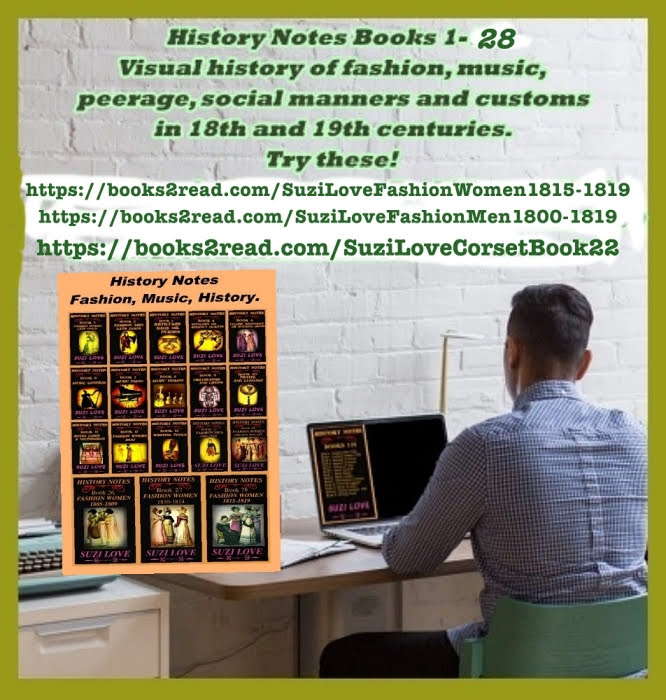
Do you need more factual and visual information for your historical fiction? Try History Notes Books 1-13. Non-fiction Series: Fashion, music and social manners in the 18th and 19th centuries e.g.
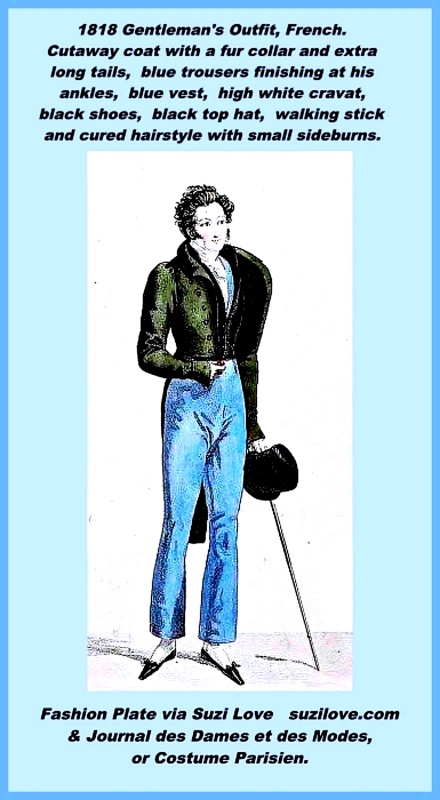
1818 Gentleman’s Outfit, French. Cutaway coat with a fur collar and extra long tails, blue trousers finishing at his ankles, blue vest, high white cravat, black shoes, black top hat, walking stick and cured hairstyle with small sideburns. Fashion Plate via Journal des Dames et des Modes, or Costume Parisien.
19th Century Early Caroline Bonaparte Murat, Wife and Queen Consort Of Joachim, King Of Naples. Wearing a Grand Parure, or jewelry set of tiara, necklace, earrings etc, of red coral, pearls and diamonds. By Salomon-Guillaume Counis, after Nicholas-Francois Dun.
Want a glimpse into the life of a young lady in Jane Austen and the Bridgerton years? #bridgerton #RegencyEra #JaneAusten
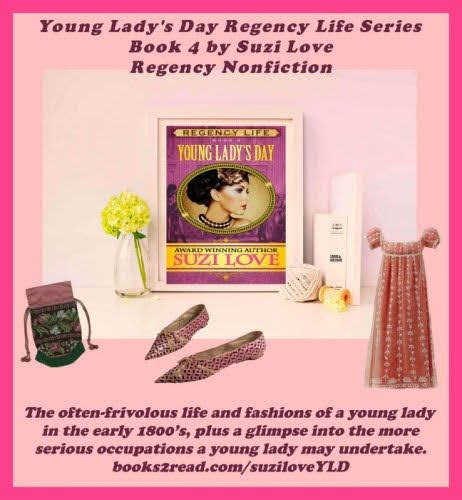
Young Lady’s Day is Book 4 in the Regency Life Series. This book depicts the often-frivolous life and fashions of a young lady in the early 1800’s, but also gives a glimpse into the more serious occupations a young lady may undertake. Through historic images, historical information, and funny anecdotes, it shows how a young lady fills her day, where she is permitted to go, and who she is allowed spend time with. These light-hearted looks at the longer Regency years are an easy to read overview of what people did and wore, and where they worked and played. There is plenty of information to interest history buffs, and lots of pictures to help readers and writers of historical fiction visualize the people and places from the last years of the 18th Century until Queen Victoria took the throne. https://books2read.com/suziloveYLD
1818 Visiting Ensemble Of Patterned Gold Silk Dress And Bonnet, American. High-waisted, or Empire style, dress with a softly flowing skirt trimmed with three scalloped rows of gold ribbon and two narrow straight rows just above the hem. The sleeves are long and straight and have gold ribbon trim on the top to give the effect of a short puffed sleeve over the long one. The neckline is wide cut in the front and the back fastens with a row of self covered buttons. The bonnet is made of the same patterned gold silk and has a ruched band across the forehead. The hat is gathered at the back and is trimmed with gold ribbon and has gold ribbon ties under the chin. The side has faux flowers made of the same gold fabric and ribbon. via Metropolitan Museum NYC, U.S.A. metmuseum.org
Fashion Women 1815-1819 History Notes Book 28 https://books2read.com/SuziLoveFashionWomen1815-1819
Love the life of Jane Austen and her stories? Fan of the Bridgerton series? Reader or writer of the early 1800s, or Regency Era? For information and pictures, try Regency Life Series by Suzi Love. Light-hearted series about Regency Era, or early 1800s. For writers, readers and history lovers.
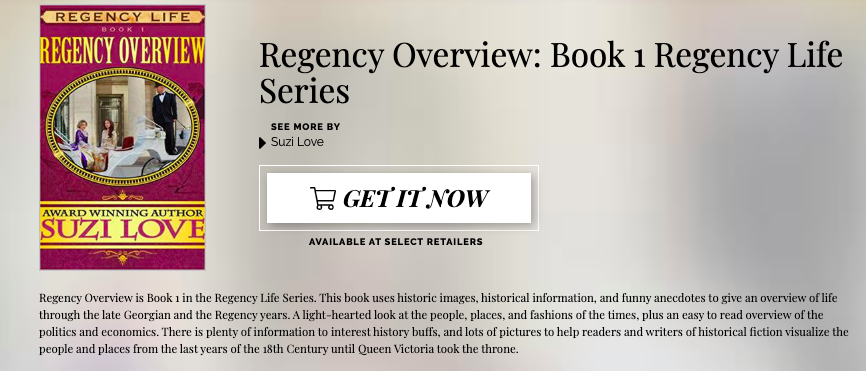
Thes books use historic images, historical information, and funny anecdotes to give an overview of life through the late Georgian and the Regency years. A light-hearted look at the people, places, and fashions of the times, plus an easy to read overview of the politics and economics. There is plenty of information to interest history buffs, and lots of pictures to help readers and writers of historical fiction visualize the people and places from the last years of the 18th Century until Queen Victoria took the throne.
Try Books 1-5 Regency Life Series by Suzi Love. Regency Overview – Young Gentleman’s Day – Older Gentleman’s Day – Young Lady’s Day – Older Lady’s Day
Regency Era Overview: Images, information and funny anecdotes give an overview of life in Jane Austen’s times or early 1800s. #Regency #JaneAusten #BritishHistory
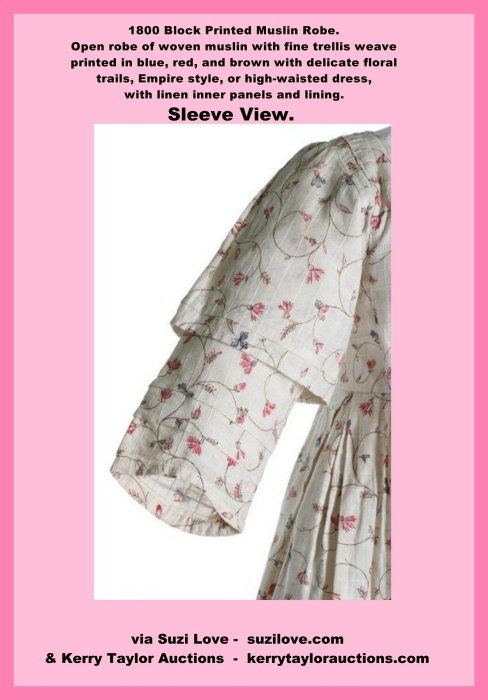
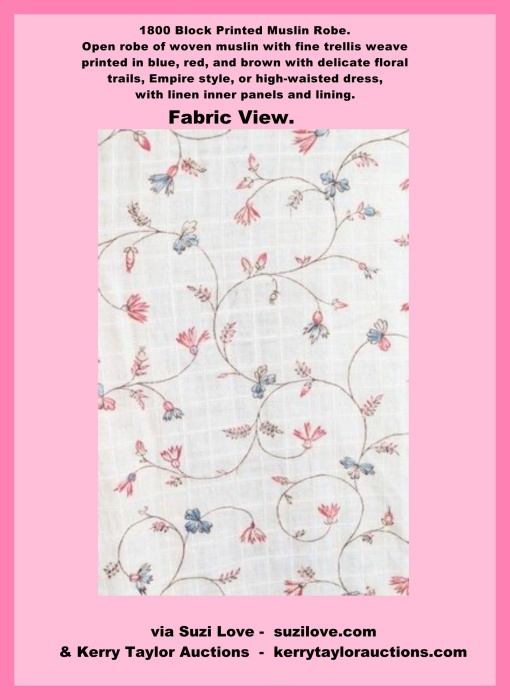
1800 Block Printed Woven Muslin Robe. Open robe of block printed muslin with a fine trellis weave printed in blue, red, and brown, and with delicate floral trails. Empire style high-waisted dress with linen inner panels and lining. via Kerry Taylor Auctions kerrytaylorauctions.com
Definition Empire Style Dress: Named after the First Empire in France. Empire dresses had a low neckline and skirts started directly under the bust and flowed into the classical relaxed wide styles of Greece and Rome. This style of dress is associated with Jane Austen and her contemporaries as a high-waisted dress was worn most days. Cotton, silk or taffeta were the popular fabrics. Only the very wealthy could afford white dress in this style as the cottons were imported from India and had to be carefully cleaned, usually by a lady’s maid.
1800 Block Printed Woven Muslin Robe. Open robe of block printed muslin with a fine
trellis weave printed in blue, red, and brown, and with delicate floral trails. Empire style high-waisted dress with linen inner panels and lining. via Kerry Taylor Auctions kerrytaylorauctions.com1800 Block Printed Woven Muslin Robe. Open robe of block printed muslin with a fine
trellis weave printed in blue, red, and brown, and with delicate floral trails. Empire style high-waisted dress with linen inner panels and lining. via Kerry Taylor Auctions kerrytaylorauctions.com1800 Block Printed Woven Muslin Robe. Open robe of block printed muslin with a fine
trellis weave printed in blue, red, and brown, and with delicate floral trails. Empire style high-waisted dress with linen inner panels and lining. via Kerry Taylor Auctions kerrytaylorauctions.com1800 Block Printed Woven Muslin Robe. Open robe of block printed muslin with a fine
trellis weave printed in blue, red, and brown, and with delicate floral trails. Empire style high-waisted dress with linen inner panels and lining. via Kerry Taylor Auctions kerrytaylorauctions.com1800 Block Printed Woven Muslin Robe. Open robe of block printed muslin with a fine
trellis weave printed in blue, red, and brown, and with delicate floral trails. Empire style high-waisted dress with linen inner panels and lining. via Kerry Taylor Auctions kerrytaylorauctions.com1800 Block Printed Woven Muslin Robe. Open robe of block printed muslin with a fine
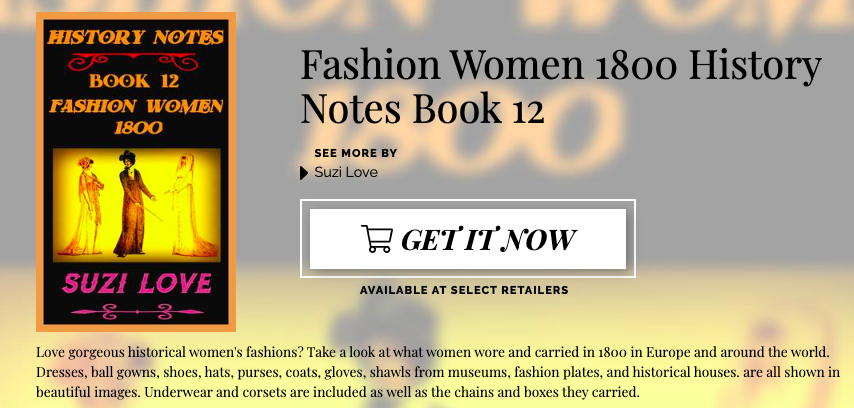
trellis weave printed in blue, red, and brown, and with delicate floral trails. Empire style high-waisted dress with linen inner panels and lining. via Kerry Taylor Auctions kerrytaylorauctions.comHN_12 D2D_RetailerBuyLink_HN_12 books2read.com/SuziLoveFashionWomen1800
1805-1810 ca. India Muslin Dress, English. Slight train, embroidered panel down centre between two lines of drawn-thread work, embroidery of cotton in chikan stitch and knots in scrolls and plume design. Elbow length sleeves with two insertions of embroidery in leaf pattern. via Manchester Art Gallery
Definition Empire Style: Named after the First Empire in France, by 1800 Empire dresses had a very low décolleté, or neckline and a short narrow backed bodice attached to a separate skirt. Skirts started directly under the bust and flowed into the classical relaxed wide styles of Greece and Rome. This style of dress is associated with Jane Austen and her contemporaries as a simple cotton high-waisted dress was worn most days and accessorized according to the importance of the occasion.
Fashion Women 1805-1809 History Notes Book 26 What did Jane Austen and friends wear? https://books2read.com/SuziLoveFashionWomen1805-1809
1816-1817 ca. Man’s Linen Shirt, American. High collar, ruffles down front opening, fullness from gathered shoulders and sleeves for unrestricted movement. Beautifully created and monogrammed by Elizabeth Wild Hitchings for her husband, Benjamin Hitchings, a sea captain. Wives or servants regularly hand stitched shirts from 1800s-1840s, before sewing machines, but handiwork rarely recorded.
From The Creator: This shirt was created, from the linen fiber to the finished garment, by the donor’s great-grandmother, Elizabeth Wild Hitchings, for her husband Benjamin Hitchings, a sea captain, in 1816. It was common practice for a wife or servant to hand stitch family members’ shirts prior to the mid-19th century, but rarely was such handiwork recorded, making this case rare and intriguing. In addition, its elegant stitching makes it a perfect example of the familial care taken in sewing prior to the common possession and use of the sewing machine. via Metropolitan Museum, N.Y.C., U.S.A. metmuseum.org
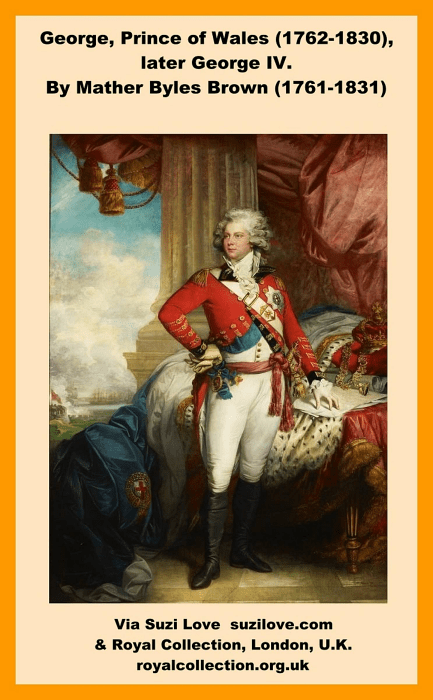
George, Prince of Wales (1762-1830), later George IV. By Mather Byles Brown (1761-1831) via Royal Collection, London, U.K.
The decision to make Prince George the Regent took a lot of political debate. After nearly two and a half months of political wrangling, the British government agreed to grant the title of Prince Regent on George. The Act of Parliament was finally passed by a commission in the House of Lords on February 5th 1811 and the Prince was formally sworn in as Regent at Carlton House the next day. He continued to rule as Regent until 1820 when, on his father’s death, he assumed the title George IV and reigned until his own death in 1830.
The British Regency was the period from 1811-1820. King George III was deemed mad and unfit to rule so his son became his proxy, the Prince Regent, or Prinny to his close friends. This was the situation when Jane Austen was alive. The Regency Era was famous for its beautiful clothing as well as the magnificent buildings erected and furnished in the ‘Regency Style’ under orders from the extravagant Prince Regent.