1826 The Dinner Party. Social Life. From 1826 The English Spy By Robert Cruikshank. via Google Books (PD-180). https://books2read.com/suziloveOLD


1826 The Dinner Party. Social Life. From 1826 The English Spy By Robert Cruikshank. via Google Books (PD-180). https://books2read.com/suziloveOLD
1826 Bath Beau and His Lady. Photo Editing By Suzi Love. ~ suzilove.com
From: 1826 The English Spy By Robert Cruikshank via Google Books (PD-150)


1826 A Regency Gentleman’s Life In Jane Austen’s Times. #JaneAusten #RegencyEra #Cartoon #England. via 1826 The English Spy By Robert Cruikshank via Google Books (PD-150)
The young man’s friends may help him decide what activities they would engage in. Perhaps they would decide to watch a dogfight or a cockfight. Or perhaps go and see a mill, where two burly boxers would pummel each other’s faces until one was declared winner and bets could be settled. Later that night, the rowdy group would head to whatever gambling hell was in vogue where they would pass several hours drinking and playing cards. Dark and sordid rooms, smoky interiors, loud and drunken men, and losing your quarter’s allowance from your father were all willingly suffered if a young man had enticed a buxom wench to sit on his lap and make him forget his woes. And how angry his father would be when he learned his son had gambled away yet another three months of his allowance.
Having filled in their morning, the men wander into Town to meet their cronies for luncheon. Thank goodness it’s time for a few bottles of claret!! Just the thing for fixing a hang-over, plus, a great place to discuss how to eke out their never-enough allowances until the young men could beg their long-suffering fathers for a little more spending money.
Price Egan’s ‘Life In London in 1823 described a young man’s entertainment choices. ‘ …bit of a stroll,’ in order to get rid of an hour or two. A turn or two in Bond Street, a stroll through Piccadilly, a look in at Tattersall’s, a ramble through Pall Mall, and a strut on the Corinthian path, fully occupied the time until the hour for dinner arrived, when a few glasses of rich wine put them on the path for vice.’ A group of young men would then head to Vauxhall. ‘‘…if enjoyment is your motto, you may make the most of an evening at Vauxhall, more than at any other place in the metropolis. It is all free-and-easy. Stay as long as you like, and depart when you think proper.’


Fan of Regency London in the times of Jane Austen and Bridgertons? Regency Overview Book 1 Regency Life Series #JaneAusten #RegencyEra #Bridgerton #Nonfiction #amwriting https://books2read.com/ROver
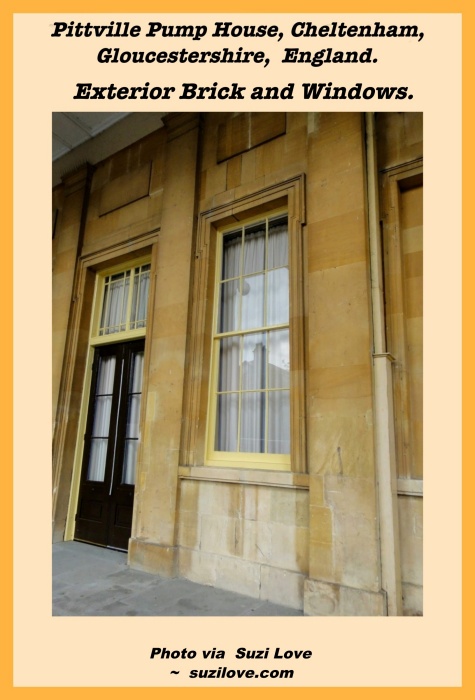
Continue reading →Cheltenham Spa, England: Pittville Pump Room: Cheltenham is a famous spa town within easy reach of the Cotswolds in in the county of Gloucestershire, England, and was a popular Georgian and Regency spa town where one could rest and recuperate. It became famous as a Spa town following the discovery of mineral springs in 1716, and claims to be the most complete Regency town in Britain. The Pittville Pump Room is an elegant Grade 1 listed Regency building and perhaps the most famous example of Regency architecture in Cheltenham, despite the town being filled Regency buildings. The Pittville Pump Room was the last and largest of the spa buildings to be built in Cheltenham.
Location: The Pump Room stands at one end of Pittville Park, about two miles from Cheltenham’s town centre, and is a monument to more than 100 years of fame which Cheltenham enjoyed as a Spa town. The building is set in beautiful parkland and is surrounded on three sides by a grand colonnade of ionic columns opening into the impressive hall with its domed ceiling and original crystal chandeliers. The park has extensive open lawns surrounded by trees and ornate bridges and pathways lead around the lakes where swans and ducks swim.

History: The waters were first discovered in around 1715 on a site now occupied by Cheltenham Ladies’ College. In 1788 George III and Queen Charlotte came to take the waters and it was their visit that set the seal on Cheltenham’s future. After a visit to Cheltenham, a banker named Joseph Pitt commissioned the architect John Forbes to design a pump room that was to act as the centrepiece to his vision of a town to rival Cheltenham – a town he would call Pittville.
The foundation stone was laid on 4 May 1825 and the work completed in 1830. The laying of the foundation was celebrated by the ringing of the bells, firing of cannons, as well as a Masonic Procession which set out from the Masonic Hall in Portland Street. In the evening banquets were held at two of the town’s hotels and grand fireworks display was to be seen at Pittville. The building took five years to complete. Following disagreements between Forbes and the builder, a second architect, John Clement Mead from London, was employed to finish the interior. He designed the elaborate stoves which heated the building. The original official opening on 6th July, 1830 was postponed until 20th July, 1830 because of the death of George IV. A grand public breakfast and ball marked the occasion.
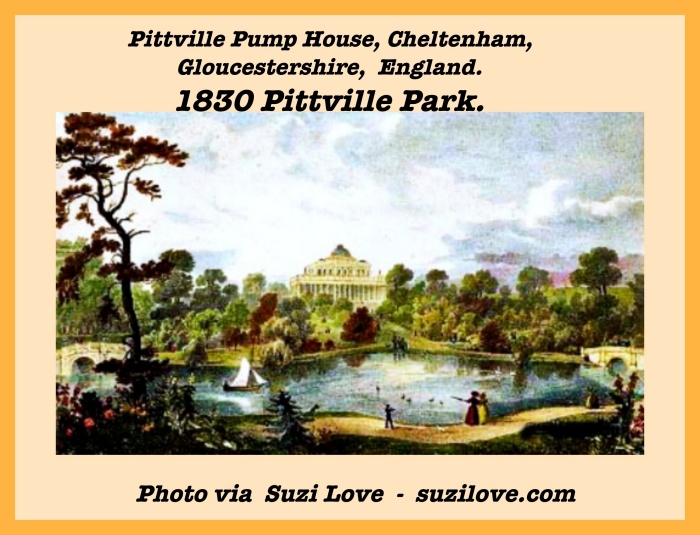

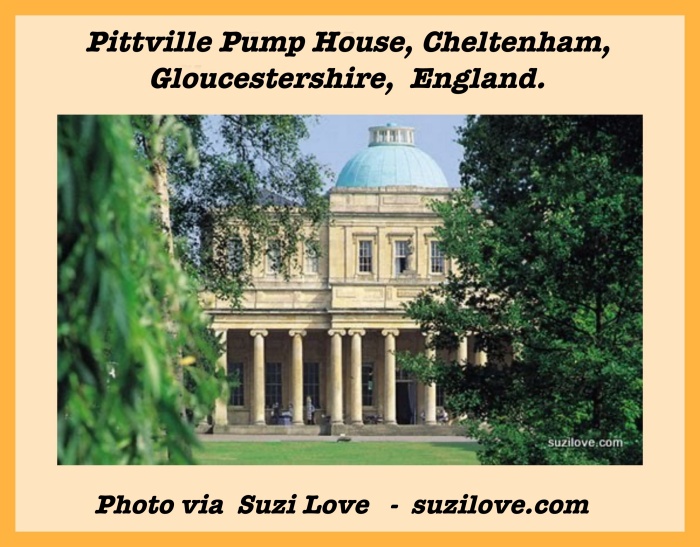


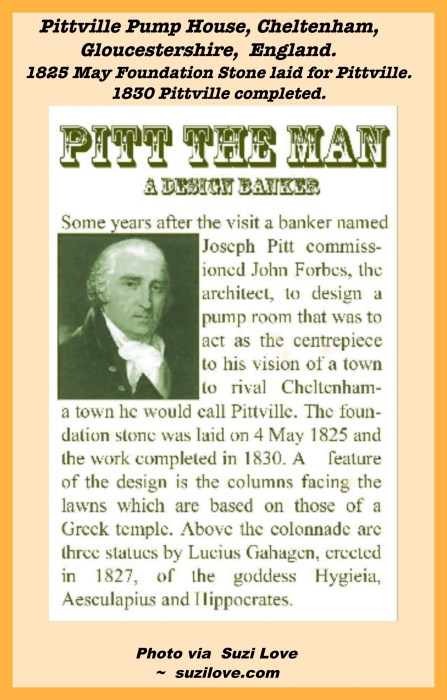
Building the Pump Room: The total cost of the project was over £40,000, and incredible price for that time. Like many bankers of his time, Pitt ran into financial difficulties, the building went out of favour and was sold in 1890 to the Borough of Cheltenham for £5,400, a fraction of the original cost. The building is decorated in Ionic style and the great hail reflects the genius of John Forbes with the spa opening on the north side and the gallery and dome surmounting the hall.
The grand building is 92 feet long by 43 feet, surrounded by a colonnade 13 feet wide the roof of which are supported by fluted Ionic columns 22 feet high. Along the facade stand three figures representing Aesculapius, Hygeia and Hippocrates, originally made by Lucius Gahagan of Bath. In its design, the building combines elements of both Greek and Roman architecture. It was modelled on the temple on Illisus in Athens, the engravings of which appeared in Stuart and Revett’s Antiquities of Athens (1762).
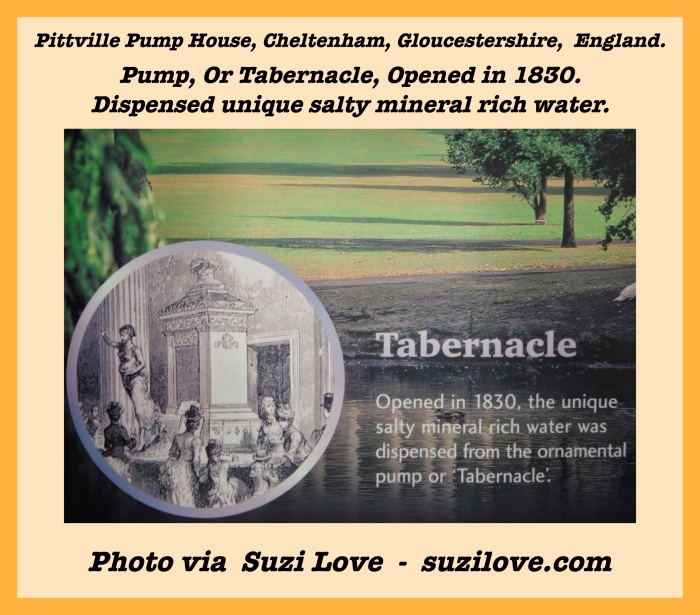
The inspiration for the dome probably came from the Panthenon in Rome. A large ballroom was situated on the ground floor where even today visitors can attend music concerts, dances and other events. With a capacity of 400 and remarkable acoustics, it is Cheltenham’s finest concert venue. The spa with an oval pump room to the rear of the building are still there for the visitors to enjoy, available from a marbled pump and counter. A reading room, library and billiard room occupied the first floor.

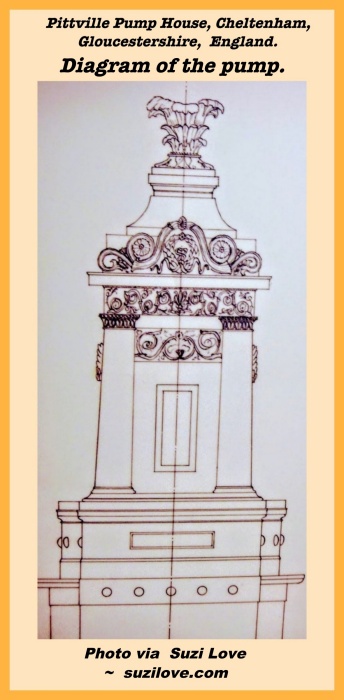
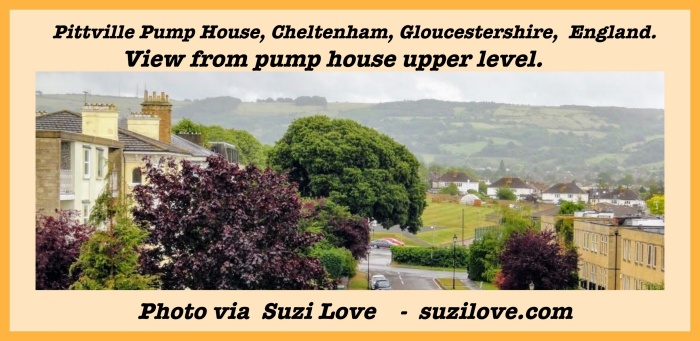

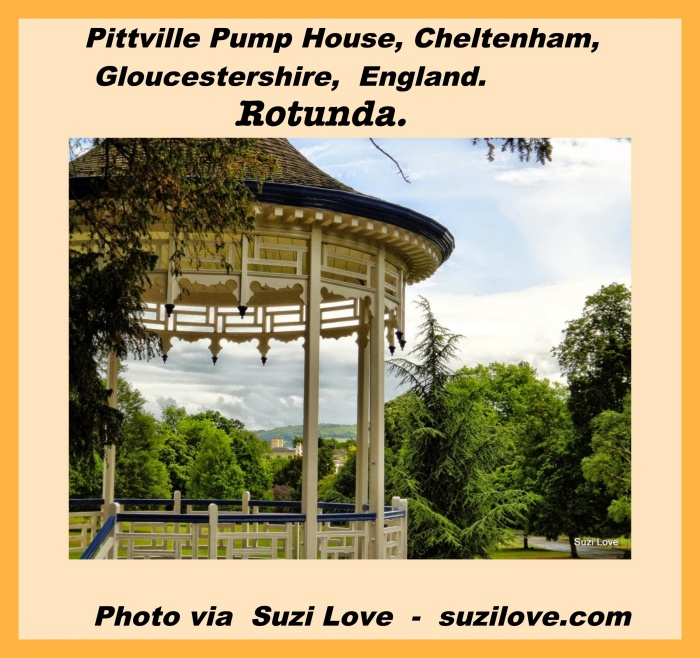


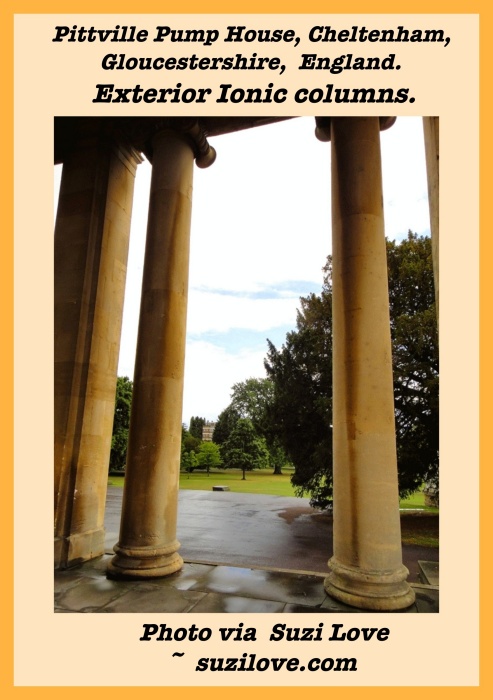
Fashion History: “Cheltenham will be the summer village of all that is fashionable and all that is dignified; the residence of the royal ” family being a thing quite new so far from the metropolis . Already we hear of nothing but Cheltenham modes — the Cheltenham cap — the Cheltenham bonnets — the Cheltenham buttons — the Cheltenham buckles , in short all the fashions are completely Cheltenhamized throughout Great Britain.” via 1826 Griffith’s New Historical Description of Cheltenham and Its Vicinity.
Second World War: The Pump Room housed British and American army personnel, when dry rot was allowed to creep through the structure unchecked, and only after the war was the full extent of the damage revealed. Plaster, brickwork, timber: nearly everything had been affected. The dome was only held in position by a shell of plaster; the timber had been eaten away by the fungus.
The Duke of Wellington: Public subscriptions carne to the rescue, which were accompanied by Public Works grants and Historic Building Council contributions. A total of £43,250 was raised and by 1960 the building was partially restored to its former glory and reopened in 1960 by the Duke of Wellington. The old card room had been replaced by a new foyer, cloakrooms and second staircase, and heating and new lighting were in stalled.
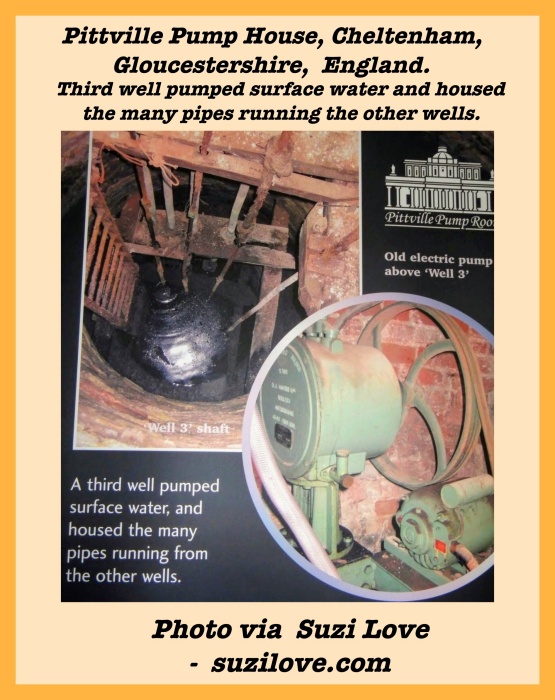
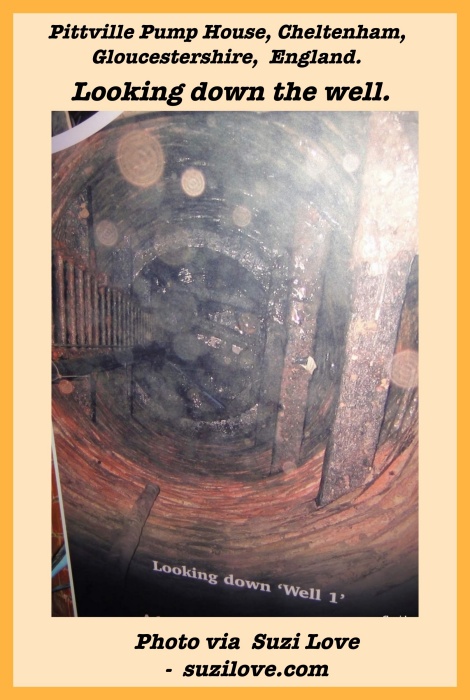
Recent History: In 2003, the old Victorian wells were leaking and allowing ground water to dilute the natural mineral water so Pittville Pump Room no longer qualified as a spa and the well was shut down. The spa was then repaired and reopened so visitors can taste the only alkaline spa water in the country. The Pump Room’s old maple-strip floor was replaced with a stunning English oak floor, better flooring found for the ball room, and old pipes replaced. Nowadays the Pittville Pump Room is in use most days of the year for private and public functions and is one of Cheltenham’s most popular wedding venues. The venue is also used frequently by orchestras, choirs and chamber groups because it has stunning acoustics.

1820 ca. Groups of Dandies fashionably dressed. Hand Colored etching. Published By J. Le Petit, Dublin, U.K. Via British Museum, London, UK. britishmuseum.org (PD-Art)
A dandy is a man who places a lot of importance on his appearance, on having refined language living his life in a leisurely manner. A dandy didn’t have to be an aristocrat. He could also be a middle class man or a self-made man of wealth who could afford to place all his emphasis on his clothing and his leisure time.


1725-1730 ca. Gold Double-Opening Snuffbox, France. Two tortoiseshell pique panels and two miniatures inside, of Louis XV of France and his wife Marie Leczinska. Made by Jean Baptiste Massé, painter.
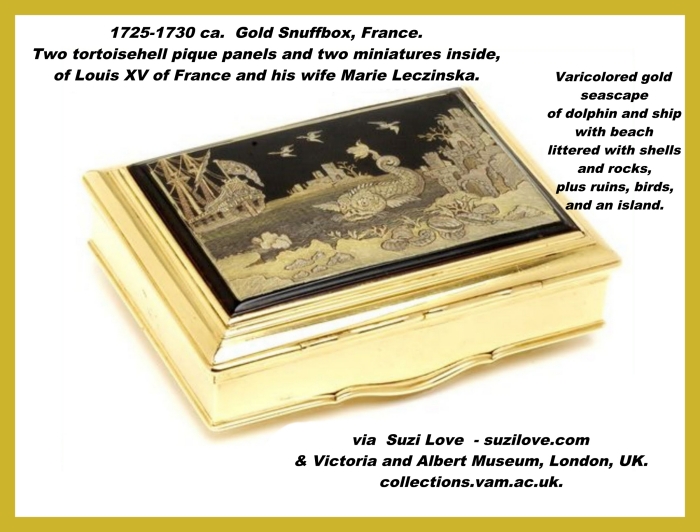
Varicolored gold seascape of dolphin and ship with beach littered with shells and rocks, plus ruins, birds,
and an island. Inside the box are miniature portraits of Louis XV of France and his wife Marie Leczinska. It has been suggested that the box commemorates the birth of the ‘dauphin’ Louis in 1729, the royal couple’s fourth child, and first son, heir to the throne. A few elements contradict this suggestion: the dolphin does not bear any regal symbol such as a crown, the marks that date the box indicate that it was initiated before the birth of Louis, when the arrival of a son was unknown.
It is most probable that these delicate panels, together with the miniature of Louis XV, date from 1725-1730 and have been associated later into this gold snuffbox, and a later miniature of Queen Marie Leczinska.The miniature of the king may have been painted by Jean-Baptiste Massé – he is recorded as supplying miniatures of the king for boxes intended as diplomatic gifts from 1720-26-, or by his lesser known contemporary Jean-Baptiste Ducanel.
The lid is hinged to reveal a miniature, under glass, of Marie Leczinska, queen of France, probably 19th century or heavily restored, wearing a cloak of blue embroidered with gold fleurs-de-lis and lined with ermine overa lace-trimmed dress of red embroidered with gold. In the base is a panel of tortoiseshell pique with a cornucopia of small shells, also hinged to reveal a contemporary miniature of Louis XV of France in armour, wearing a whitestock and the sash of the Order of the Holy Ghost. The gold box, probably early 19th century or later, has plain walls, reeded borders, and a double thumbpiece.
Sir Arthur Gilbert and his wife Rosalinde formed one of the world’s great decorative art collections, including silver, mosaics, enamelled portrait miniatures and gold boxes. Arthur Gilbert donated his extraordinary collection to Britain in 1996.
via Victoria and Albert Museum, London, UK. collections.vam.ac.uk.
Snuff Boxes: Decorative boxes of all types were prized, especially in the 18th Century when everything decorative and extravagant was in vogue and taking a pinch of snuff was fashionable. Snuff is made from ground or pulverized tobacco leaves, flavorings added, and then a pinch of snuff is placed on the back of the hand and sniffed.

1801 November 9th Playing Cards. Men and women play cards at round table. Supreme Bon Ton Plate 2. Published by S W Fores. Men and women play cards at round table. Man and woman talk to players. Woman sleeps in upright chair, two others, one with parasol and other fan, walk off arm-in-arm.Men: High-waisted coats, high collars, huge neck-cloths, with pumps or Hessian boots. Women: High-waisted dresses, short sleeves, long trains, very low necklines, short ringlets, two in caps. Via British Museum, London, UK. britishmuseum.org (PD-Art)
In Jane Austen’s times, cartoons posted in the windows of shops were one of the main ways people found news. Common people couldn’t afford newspapers so cartoonists ridiculed the people and the places with cartoons of the daily events happening in London and other cities. The ridiculous fashion trends of the late 1700s and early 1800s were easy targets for satirical cartoons as was the addiction to gambling by women and men alike.

“It is particularly incumbent on those who never change their opinion, to be secure of judging properly at first.” Jane Austen Pride and Prejudice (1813) .#JaneAusten #Regency #Quote


1800s “Admiration”. By Vittorio Reggianini. Oil on canvas. This looks like a typical drawing room scene from Jane Austen’s lifetime, or the early 1800s, or the Regency Era. Via Wikimedia Commons commons.wikimedia.org