1805 May Two Ladies In Jane Austen Style Walking Dress and Full Dress, English. White dress with a train under a purple cape, purple reticule or bag, and green parasol. Pink evening full dress with low cut bodice, short sleeves and light draping shawl. via Vernon and Hood at The Lady’s Monthly Museum, London, U.K. Definition Reticule, or Ridicule, or Bag or Purse: Often with a drawstring to pull closed and usually made of cloth or covered cardboard and often decorated with beading or embroidery. A reticule, or purse, or handbag, was usually carried by a woman during the Regency period to carry all their daily necessities. Earlier, women used pockets that tied at the waistline and were hidden in the folds of their skirts. Empire style, or early 1800s, high-waisted dresses made it impossible to either sewn in a pocket or to tie on a pocket. So women began carrying small, decorated bags called Reticules, or ridicules, which generally pulled close at the top with a drawstring.
1801 White Dress With Train, French. Empire style high-waisted dress under a green Spencer and carrying a gorgeous reticule,or bag, with the additional accessories of gloves and red slippers. I can picture Jane Austen and her female friends and family wearing a white Empire style dress and Spencer like this for shopping or paying visits. Fashion Plate via Journal des Dames et des Modes, or Costume Parisien.
Definition Reticule Or Bag: Purse, often with a drawstring to pull closed and usually made of cloth or covered cardboard and often decorated with beading or embroidery. Carried by a woman during the Regency period to carry all their daily necessities. in the place of pockets. Definition Spencer: Short jacket, cropped at the waist, worn over a dress, or gown. Delicate and regency dresses provided so little protection from the cold, so over garments were essential for warmth, modesty and good health.
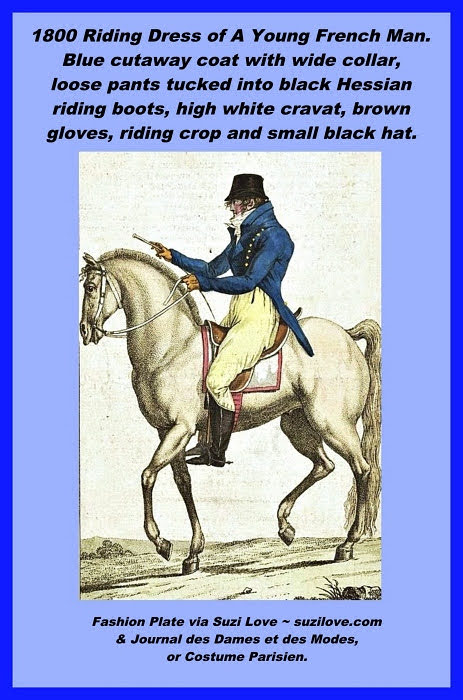
1800 Riding Dress of A Young French Man. Blue cutaway coat with wide collar, loose pants tucked into high black riding boots, high white cravat, brown gloves, riding crop and a very small black hat. Fashion Plate via Journal des Dames et des Modes, or Costume Parisien.
1804-1829 ca. Two Gentlemen and A Lady, Italian. Dressed as ladies and gentlemen would be in the times of the Bridgerton family and Jane Austen and friends. Gentleman in a caped overcoat with black top hat and red umbrella. Lady in walking costume of lavender cape over red dress, red shawl, white bonnet and black walking shoes. Gentleman in blue opera cloak with red lining, black top hat and black shoes. Men And Women In Costumes, 1804-1829 The Miriam and Ira D. Wallach Division, The New York Public Library. nypl.org The sort of fashionable outfit and items worn or carried by Jane Austen and her contemporaries when out walking. Outfits were always heavily accessorized with coats, shawls, hats and parasols.
A portrait from 1810-1814 of Rudolph Ackermann, shop owner and founder of ‘The Repository Of Arts’ magazine, The Strand, London. via National Portrait Gallery, London. Plus, an image of Ackermann’s premises in 1809. His ‘Repository of Arts, Literature, Fashion, Manufactures, etc.’ was published from 1809 to 1829 with images of Regency London, Regency furnishings and grand homes as well as beautiful fashion prints and descriptions every month. Ackermann originally supplied artists, amateur and professional, with supplies for watercolor painting. In 1799, he began manufacturing and selling his own watercolor paint blocks which were supplied by other colourmen, although at least three colors were his own mixture – Ackermann’s Green, White and Yellow. From 1817, his eldest son Rudolph Ackermann junior was responsible for the watercolor manufacturing. Ackermann also trained as a carriage designer. He began publishing prints and colour-plate books like ‘The Microcosm of London’ and ‘Doctor Syntax’ in the early 1800s.
The Repository of Arts was one the most popular magazines in Jane Austen’s time as it displayed everything ladies wanted to learn e.g. history, important country seats and houses in England, music, current events such as theatre plays, plus fashion plates and embroidery patterns. Ackermann’s shop in The Strand, London, was one of the fashionable places to shop during the Regency Era. The Repository also included poetry, travel reports, society reports and upcoming lectures. It also included serious subjects e.g. politics, legal matters, medicine and agriculture, a meteorological journal and details of the London markets. In 1817, the price of the magazine was 4 Shillings, so quite expensive for the time.
In the first issue, published for January 1809, Ackermann included an ‘introduction to the history of the useful and polite arts’ which said: “It is universally admitted, that to cultivate a taste for the arts, and an acquaintance with the sciences, is a pleasure of the most refined nature; but to do this without regard to its influence upon the passions and affections, is to ‘tear a tree for its blossoms, which is capable of yielding the richest and most valuable fruit.’ The cultivation of this taste may and ought to be subservient to higher and more important purposes: it should dignify and exalt our affections, and elevate them to the admiration and love of that Being who is the author of every thing that is fair, sublime, and good in nature.”
1817 January Carriage Costume, English. Red velvet pelisse trimmed with ermine to match muff, tops of sleeves caught up à la Mancheron with military silk chain work, Russian hussar cap of ermine with gold military chain, Limerick gloves and matching kid half-boots.
The ‘General Observations on Fashion and Dress’ describes this fashion plate as, ‘The truly elegant and costly carriage costume of which we have given so beautiful a specimen in our Plate, while it confers the highest honor on the taste of the inventress, is likely to be a most prevailing out-door covering for the carriage amongst ladies of wealth and fashion, being particularly adapted for the open barouche, as the manner in which it is made, with warm hussar cap of light and valuable fur, shields the fair wearer from all the severity of the pinching frost or cutting north wind.’
The Fashion Plate was invented by Mrs. Bell, a relative of the publisher, John Bell, and most likely also the writer of the general observations. Fashion Plate via John Belle’s La Belle Assemblée or, Bell’s Court and Fashionable Magazine, London.
Definition: Coat or Redingote Or Pelisse: Long fitted outdoor coat worn over other garments for warmth. French word developed from English words, riding coat.
Definition Sleeve à la Mancheron: An ornamented trimming or puff attached to the upper sleeve.
What was fashionable for women in Jane Austen’s times? Mourning, riding, daytime, evening clothing, plus underclothing, corsets and accessories. Wars were being fought so women adopted military looks in support of soldiers. https://books2read.com/SuziLoveFashion1810-1814
1817 November Cambric Muslin Walking Dress, English. As would have been worn by Jane Austen and her female contemporaries when out walking. Row of pointed work forms a narrow pelerine, high on the bosom, and ends in a point in front. The skirt has a deep muslin flounce beneath a row of soft muslin bouffone. Brown Spencer of gros de Naples has figured buttons which are intermixed with an elegant trimming. Sleeves ends are like the hem with a double row of buttons and trimming. The newly fashionable epaulette is edged and finished with buttons on the shoulder. Autumnal bonnet has a large front, low crown, and ties under the chin with a large bow. Swansdown muff, lilac sandals and pale lemon kid gloves finish the ensemble. ‘We have been favored this month with both our dresses by a lady, one of our subscribers, who purchased them, we understand, at Mrs. Bell’s in St. James’s Street.’ Fashion Plate via Rudolph Ackermann’s ‘The Repository of Arts’.
1812 Woman wearing an extraordinary hat, flounced dress and a cashmere shawl. 1801-1818 Le Bon Genre Fashion Series Plate 50. Published by: Pierre La Mésangère. Via British Museum, London, UK. britishmuseum.org (PD-Art)
Fashion Women 1810-1814 History Notes Book 27 This book looks at what was fashionable for women in Jane Austen’s times, or the early 1800s, or the Regency Era in Britain. Wars were being fought around the globe so women’s fashion adopted a military look in support of soldiers. Fashions, like the lifestyle, became progressively more extravagant and accessories went from colorful to over-the-top. https://books2read.com/SuziLoveFashion1810-1814