1807 Gentleman’s Everyday Outfit, French. Brown coat, high collared shirt, and vest simply tied, wit a cravat and a black hat and a cane. Brutus style hair cut of curled hair. Fashion Plate via Journal des Dames et des Modes, or Costume Parisien.
French fashions and Georgian and Regency Era fashions from Great Britain were copied around the world. This is what men wore in the times of Jane Austen for city and country life.
1818 Blue Levantine Redingote, French. High-waisted walking coat, high white neck frill, bonnet of blue Gros de Naples with pink flowers, short puffed sleeves over long straight sleeves, white gloves and blue shoes. Fashion Plate via Journal des Dames et des Modes, or Costume Parisien. The type of outfit young Regency Era ladies would have worn if they were out shopping on Bond Street, walking in a park, or taking a carriage ride through Hyde Park.
Definition Redingote Or Pelisse Or Walking Dress Or Coat: French word developed from English words, riding coat. Long fitted outdoor coat worn over other garments for warmth. Often left open at the front to show off the dress underneath. Sometimes cut away in front. Originally made with several capes and trimmed with large buttons. French fashion plates call these coats Redingotes and they are designed for women, men and children. English fashion plates call them a Pelisse, a walking dress, Promenade dress, or Carriage dress.
1818 Blue Levantine Redingote, French. High-waisted walking coat, high white neck frill, bonnet of blue Gros de Naples with pink flowers, short puffed sleeves over long straight sleeves, white gloves and blue shoes. Fashion Plate via Journal des Dames et des Modes, or Costume Parisien.
1818 Walking Dress and Redingote, French. White walking dress under a royal blue redingote, or pelisse, or coat, with a wide fur trim and high shawl collar and with a large bonnet with black plume. The type of outfit young Regency Era ladies would have worn if they were out shopping on Bond Street, walking in a park, or taking a carriage ride through Hyde Park. Fashion Plate via Journal des Dames et des Modes, or Costume Parisien. .
Definition Redingote Or Pelisse Or Walking Dress Or Coat: French word developed from English words, riding coat. Long fitted outdoor coat worn over other garments for warmth. Often left open at the front to show off the dress underneath. Sometimes cut away in front. Originally made with several capes and trimmed with large buttons. French fashion plates call these coats Redingotes and they are designed for women, men and children. English fashion plates call them a Pelisse, a walking dress, Promenade dress, or Carriage dress.
1818 Blue Levantine Redingote, French. High-waisted walking coat, high white neck frill, bonnet of blue Gros de Naples with pink flowers, short puffed sleeves over long straight sleeves, white gloves and blue shoes. Fashion Plate via Journal des Dames et des Modes, or Costume Parisien. The type of outfit young Regency Era ladies would have worn if they were out shopping on Bond Street, walking in a park, or taking a carriage ride through Hyde Park.
Definition Redingote Or Pelisse Or Walking Dress Or Coat: French word developed from English words, riding coat. Long fitted outdoor coat worn over other garments for warmth. Often left open at the front to show off the dress underneath. Sometimes cut away in front. Originally made with several capes and trimmed with large buttons. French fashion plates call these coats Redingotes and they are designed for women, men and children. English fashion plates call them a Pelisse, a walking dress, Promenade dress, or Carriage dress.
1800s Silver and Carved Mother of Pearl Writing and Desk Set, French. Wax Seal, Dip Pen and Letter Opener in the style that Jane Austen would have used to write her novels and her letters. via Ruby Lane Antiques. rubylane.com
HN_13_D2D_WritingTools Book 13 What did the lady of the house use to pen notes? What sat on the desk of the man of the house when managing his accounts? #History #Nonfiction #travel books2read.com/SuziLoveWritingTools
1800-1809 ca. Colorful Day Dresses, Designed by Jean-Francois Bony, France.
Though white was the most fashionable color, some designers, such as Jean-Francois, advocated greater use of color in women’s fashion. He was primarily a fabric designer and flower painter and his designs frequently made use of his ornate and colorful fabric designs.
.
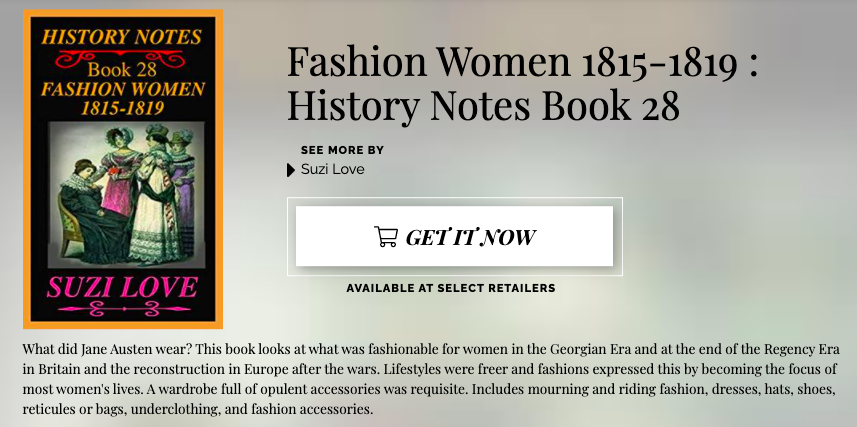
Fashion Women 1805-1809 History Notes Book 26 What did Jane Austen and friends wear? https://books2read.com/SuziLoveFashionWomen1805-1809
1800s French Palais Royal Sewing Box and Twelve Mother of Pearl Enamel Tools. This is the style of sewing box Jane Austen and her family would have used in the early 1800s, or Regency years. via via suzilove.com and 1st Dibs Auctions 1stdibs.com
Definition: Palais Royal: Name of an area around the Royal Palace in Paris, France, that specialized in making small and exquisite works of art during the 18th and 19th centuries. Palais Royal sewing tools were elaborate and usually feature mother-of-pearl, often intricately carved or engraved. During the 19th century, workboxes were often works of art with engravings, carvings, mother-of-pearl, and elaborate gilt metal mounts. Most popular were scissors with steel blades and gilt mounts, thimbles and needle cases which were often shaped like animals or other natural forms. Workmanship was exceptional and the tools almost too fragile to use.
1800s French Palais Royal Sewing Box and Twelve Mother of Pearl Enamel Tools. via via suzilove.com and 1st Dibs Auctions 1stdibs.com
1660-1700 ca. Gaming Purse, Probably French. Green velvet trimmed with copper-gilt thread. Gaming or gambling with cards popular 17th-century pastime and any gentleman or lady not playing games like Quadrille and Basset would have been considered ‘low-bred and hardly fit for conversation’ according to ‘The Compleat Gamester’, published in 1674. Typically, gaming purses had flat, circular bases with sides gathered on a drawstring. via Victoria and Albert Museum, London, UK. collections.vam.ac.uk.
1789-1790 ca. Man’s Red Riding Coat, England or France. Wool plain weave, full finish, with metallic-thread embroidery, tan breeches, black riding boots and crop. Credit: (M.2007.211.46) via Los Angeles County Museum of Art, California, USA. collections.lacma.org
1789-1790 Man’s Red Riding Coat, England or France. Wool plain weave, full finish, with metallic-thread embroidery Credit: (M.2007.211.46) via Los Angeles County Museum of Art, California, USA. collections.lacma.org suzilove.comHN_2_D2D_Fashion Men 1700s
books2read.com/suziloveFashMen1700
1800 Outfit Of A Young Man With Grey Cutaway Coat, French. Grey cutaway coat, red vest or waistcoat, high white cravat, yellow breeches with red fob at waist, yellow gloves, black boots with tassels, hat and walking stick. Fashion Plate via Journal des Dames et des Modes, or Costume Parisien.
In the early years of the 19th century, men’s fashions changed dramatically. Coats were cut higher in the front and finished in long tails at the back. Waist length square-cut waistcoats were displayed beneath tailcoats. The lining of the shoulders and upper chest of the coat was sometimes quilted to improve the fit and some dandies wore boned corsets to give them a small waist. Trousers became increasingly fashionable in the first quarter of the 19th century as men gradually adopted long trousers rather than knee breeches. At first long length pants were only worn for day and informal dress and breeches were still required for court dress, but by the 1820s trousers were accepted as evening wear.
Typical menswear in the early 1800s included a tailcoat, a vest or waistcoat, either breeches, pants, or the newer trousers, stockings, shoes or boots, all worn with an overcoat and hat. This basic ensemble was accessorized with some form of neckcloth or cravat, gloves, walking stick, cane or riding crop, handkerchief, fobs, watch and perhaps a quizzing glass or eye glass. The tan hat from the late 18th century was worn and developed into the top hat which was worn for day and formal dress throughout the 19th century. Hair was carefully styled into a windswept look or worn short and curled.