1715-1775 ca. Flat Drawstring Bag, French. Strung glass beads, or sablé, held together by looping stitches. Polychrome Rococo design on white ground, shepherd, shepherdess, four sheep around orange tree center, border with cornucopias and flowers. Ecru silk cord drawstrings with floral bead-covered wood tassels. Blue silk lining. via Museum of Fine Arts, Boston.
1820-1850 ca. Cotton and Beadwork Reticule Or Bag, Dutch. Couple on shore, man in boat, house and windmill behind, musicians, dancers, onlookers. Yellow metallic frame and green braided silk cord. Beadwork on cotton foundation. Polychrome design: couple on shore, man in boat, house and windmill behind (obv.); musicians, dancers, onlookers (rev.); acanthus motif at base. Yellow metallic frame with dotted design, stud closure, green braided silk cord. Ecru silk lining. via Museum of Fine Arts, Boston, U.S.A. mfa.org
Definition Reticule Or Bag or Purse: Often with a drawstring to pull closed and usually made of cloth or covered cardboard and often decorated with beading or embroidery. A reticule, or purse, or handbag, was usually carried by a woman during the Regency period to carry all their daily necessities. Earlier, women used pockets that tied at the waistline and were hidden in the folds of their skirts. Empire style, or early 1800s, high-waisted dresses made it impossible to either sewn in a pocket or to tie on a pocket. So women began carrying small, decorated bags called Reticules, or ridicules, which generally pulled close at the top with a drawstring.
1820-1850 ca. Cotton and Beadwork Reticule Or Bag, Dutch. Couple on shore, man in boat, house and windmill behind, musicians, dancers, onlookers. Yellow metallic frame and green braided silk cord. via Museum of Fine Arts, Boston, U.S.A. mfa.org
1820-1850 ca. Cotton and Beadwork Reticule Or Bag, With Couple on Shore, Dutch. #holland #sewing #Reticule #RegencyEra #RomanticEra #HistoricalFashion #Antiques http://books2read.com/suziloveReticules
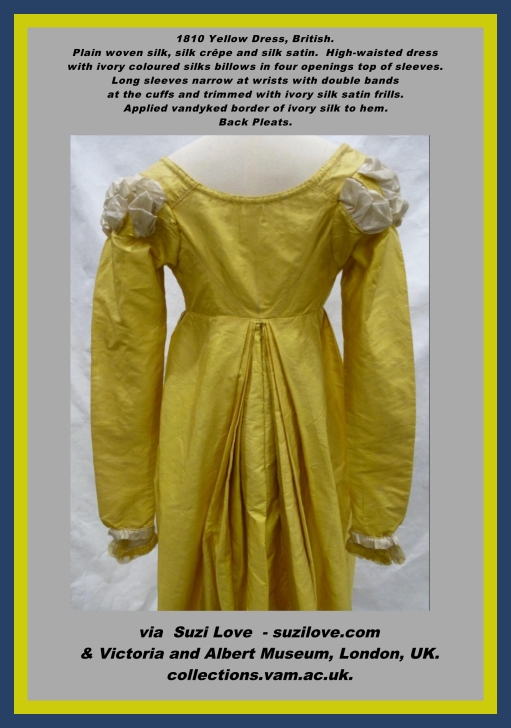
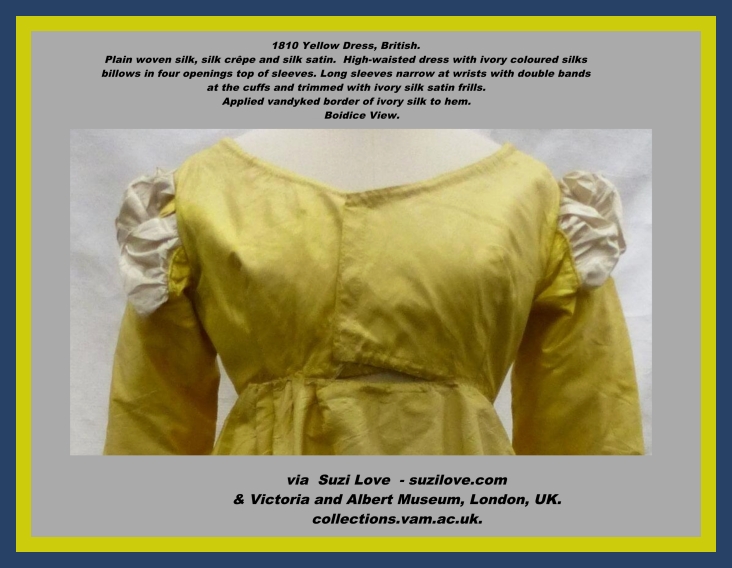
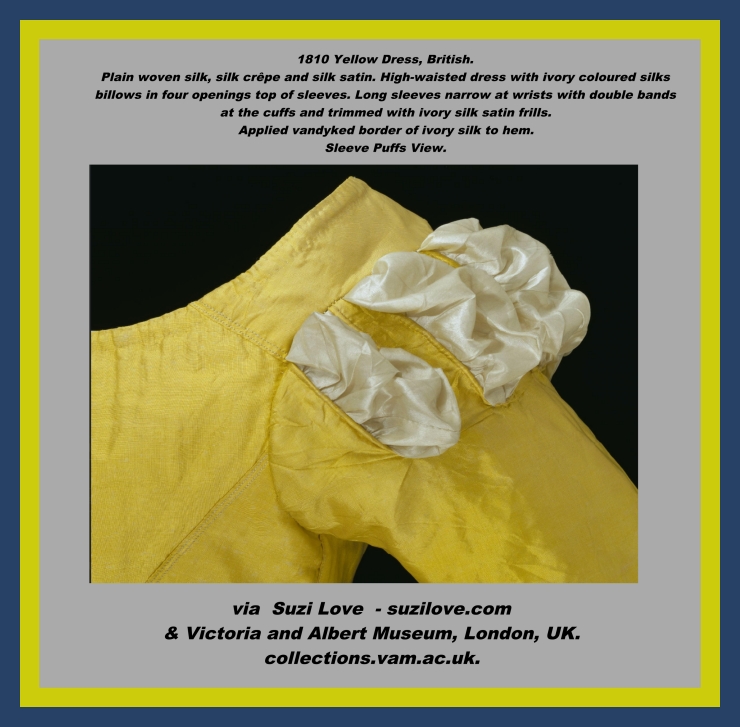
1810 Yellow Dress, British. Plain woven silk, silk crêpe and silk satin. High-waisted dress of yellow silk, ivory colored silks billow out of four openings at sleeve tops. The puffed trimmings are inspired by the fashionable slashing of garments in the Renaissance period when the top fabric was cut to reveal a colored lining or garment worn underneath. A long rectangular strip of ivory silk on inside of sleeve head and excess gathered into pudds through openings. The 19th-century version of slashing is much more controlled by cut, stitching and piped edges, rather than the raw cuts in fabric seen in the 16th century.
Long sleeves narrow at wrists with double bands at cuffs and trimmed with ivory silk satin frills, yellow silk crêpe, cream ribbon and cording. Trimming around lower hem of skirt of applied vandyked border of ivory silk. Length center back neckline to hem of train length: 158cm Front length shoulder to hem length: 139cm
1810_YellowSilkDressBritish_Plain wovensilk, silk crêpe and silk satin. High-waisted dress with shoulder decoration and contrasting hem trim_HemView_vam.ac.ukHN_27_D2D_fashwomen1810-1814
https://books2read.com/SuziLoveFashion1810-1814
1825 Pale Gold Pelisse, or Walking Dress, or Redingote, British. Pale gold silk with linen lining. Long sleeves puffed at shoulders and narrowed at wrist, large round collar, nipped in high wais and A-line skirt, zig-zag lace trim above the hem. A beautiful example of the love of gold and silver fabrics during the 1820s. Styles may have been simple, but fabrics were definitely not. They were luxurious and expensive. via Metropolitan Museum New York City, U.S.A. metmuseum.org
Definition Redingote Or Pelisse Or Walking Dress Or Coat: French word developed from English words, riding coat. Long fitted outdoor coat worn over other garments for warmth. Often left open at the front to show off the dress underneath. Sometimes cut away in front. Originally made with several capes and trimmed with large buttons. French fashion plates call these coats Redingotes and they are designed for women, men and children. English fashion plates call them a Pelisse, a walking dress, Promenade dress, or Carriage dress. books2read.com/suzilovePelisse
1825 Pale Gold Silk Pelisse, or Walking Dress, or Redingote, British. #RegencyFashion #Fashion #Pelisse books2read.com/suzilovePelisse
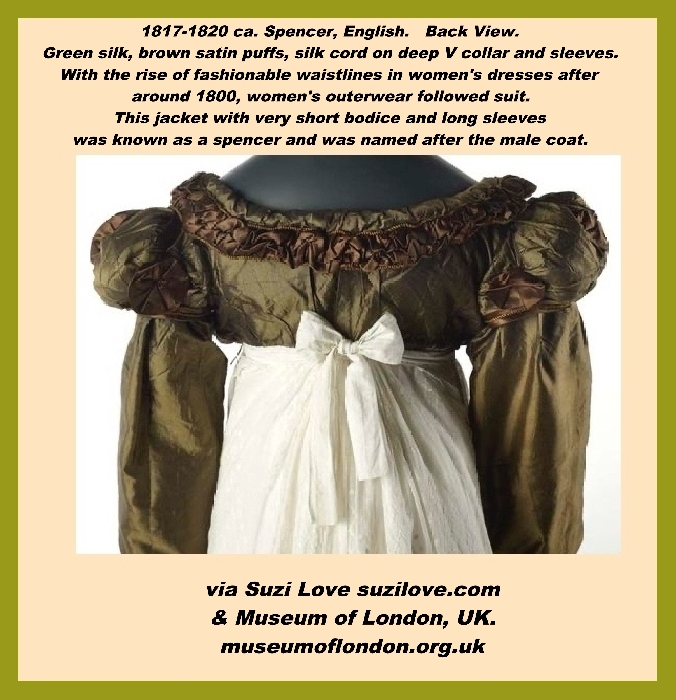
1817-1820 ca. Spencer, or Jacket, English. The sort of jacket worn by Jane Austen and friends over their loose Empire style dresses. Green silk Spencer, brown satin puffs, silk cord on deep V collar and sleeves. With the rise of fashionable waistlines in women’s dresses after around 1800, women’s outerwear followed suit. This jacket with very short bodice and long sleeves was known as a Spencer and was named after the male coat. via Museum of London, UK. museumoflondon.org.uk
Description Spencer: Short jackets worn for warmth over the high-waisted Empire style gowns that were popular after the French Revolution, where there was a shift away from opulence and decadence to simpler fashion. This jacket with very short bodice and long sleeves was known as a Spencer and was named after the male coat made famous by the Earl Spencer and said to have originated in accident to Lord Spencer in hunting when coat tails torn off and a cropped jacket was invented. The dresses in the early 1800s therefore became looser, lighter, and flowing and women became cold due to their very low cut and short bodices. Short fitted jackets that went easily over the dresses and provided extra modesty and some warmth. As Europe and many other parts of the world were deep in wars in the late 1700s and early 1800s, men in uniform were found everywhere. In support of these military men, fashions leaned towards military style shoulder paddings, shoulder embellishments, loops, buttons, and braids.
1817-1820 ca. Spencer, English. With the rise of fashionable waistlines in women’s dresses after around 1800, women’s outerwear followed suit. This jacket with very short bodice and long sleeves was known as a spencer. via Museum Of London.
1817-1820 ca. Jane Austen and Bridgerton Style Green Silk Spencer, Or Jacket, English. #Bridgerton #RegencyFashion #BritishFashion #JaneAusten https://books2read.com/SuziLoveFashionWomen1815-1819
1810 ca. Cotton Dress Ensemble With Train, French. Cut out in back, lace shawl with sequins can be added to cover shoulders, small low cut bodice, all over embroidery and very short decorative sleeves. Front, Back and Side Views. via Metropolitan Museum New York City, U.S.A. metmuseum.org
1810 ca. Cotton Dress Ensemble With Train in Jane Austen style. #RegencyFashion #JaneAusten #historicalfashion https://books2read.com/SuziLoveFashion1810-1814
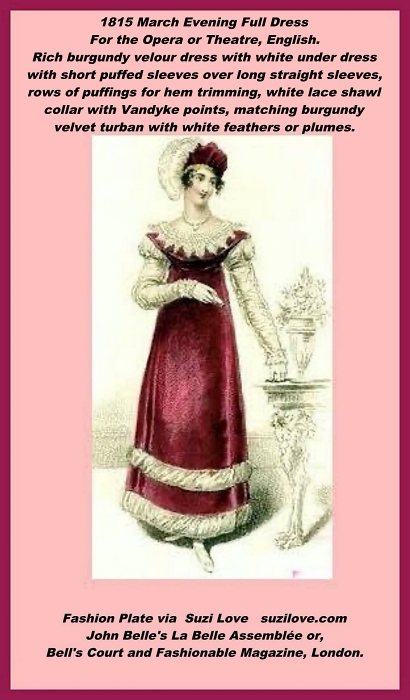
1815 March Evening Full Dress For the Opera or Theatre, English. As would have been worn in Bridgerton and Jane Austen years. Rich burgundy velour dress with white under dress with short puffed sleeves over long straight sleeves, rows of puffings for hem trimming, white lace shawl collar with Vandyke points, matching burgundy velvet turban with white feathers or plumes. Fashion Plate via John Belle’s La Belle Assemblée or, Bell’s Court and Fashionable Magazine, London.
Dress Full Dress: The most formal and complete ensemble, worn for day or night events, and includes the fullest range of accessories that could be added to the outfit to make the most impressive display.
Definition Evening Dress: There were minute distinctions between ball, dinner, evening and opera gowns meant different quality of fabrics and designs. A Ball Gown differed from an evening dress as expensive silk fabrics were usually worn, light or heavy, decorated with lace, embroidery or beading, with low-cut bodice, short or no sleeves, and full skirts. In the early 1800s, white cotton dresses were considered suitable for many evening events, but not for balls. And definitely not for an evening event in a palace or at the opera or theatre.
Definition Van Dyke Points: V-shaped lace and trims named after a 17th Century Flemish painter, Sir Anthony Van Dyck, known for painting V-shaped lace collars and scalloped edges on sitters.
1815 March Evening Full Dress For the Opera or Theatre, English. Rich burgundy velour dress with white under dress with short puffed sleeves. Fashion Plate via John Belle’s La Belle Assemblée or, Bell’s Court and Fashionable Magazine, London.
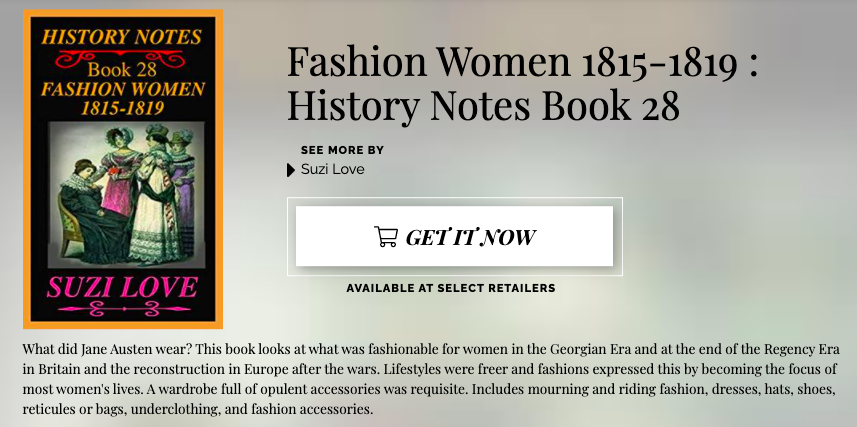
Fashion Women 1815-1819 History Notes Book 28 What did Jane Austen wear? This book looks at what was fashionable for women in the Georgian Era and at the end of the Regency Era in Britain and the reconstruction in Europe after the wars. Lifestyles were freer and fashions expressed this by becoming the focus of most women’s lives. A wardrobe full of opulent accessories was requisite. Includes mourning and riding fashion, dresses, hats, shoes, reticules or bags, underclothing, and fashion accessories.
1816 December. Promenade Dress, or Pelisse, English, also called a Redingote in France. High cambric muslin dress trimmed at the bottom with a single flounce of work, shaped without any fulness to fit the body, plain long sleeve finished by a triple fall of narrow lace. Over this is the Angouleme pelisse of crimson velvet, lined with white Sarsnet, and trimmed with a single Welt of crimson satin, a shade lighter than the pelisse. Shaped the to the body and without much fullness, confined at the short waist with narrow velvet band, edged to match. Small stand-up collar, supports a rich lace ruff, which is worn open in front of the throat. Sleeve has little fullness and is confined at the wrist by three narrow bands of puckered satin. Bonnet of white satin a la Royale with a large bunch of flowers and tied under the chin with satin ribbon and finished in front with a full quilling of tulle. Black silk ridicule, exquisitely worked in imitation of the ends of an India shawl and trimmed with black silk fringe. White kid gloves and black walking shoes. Fashion plate, hand-colored engraving on paper. Published in Rudolph Ackermann’s ‘The Repository of Arts’, London.
Promenade Dress, Pelisse, Redingote, Or Walking Dress. Jane Austen and her contemporaries wore long coats like these to keep warm when out and about, visiting, shopping etc. The thin muslin dresses worn in the early 1800s were little protection against European winters.
1816 December. Promenade Dress, or Pelisse, English, called Redingote in France. High cambric muslin dress trimmed at the bottom, plain long sleeve finished by a triple fall of narrow lace. Over this is the Angouleme pelisse of crimson velvet, lined with white Sarsnet, and trimmed with a single Welt of crimson satin, a shade lighter than the pelisse. Bonnet of white satin a la Royale with a large bunch of flowers and tied under the chin with satin ribbon. White kid gloves and black walking shoes. Fashion Plate in Rudolph Ackermann’s ‘The Repository of Arts’, London. Fashion Women 1815-1819 History Notes Book 28 https://books2read.com/SuziLoveFashionWomen1815-1819
1823 Couple In Evening Costumes, French. Short length dancing dress of white gauze, short sleeves, pink ribbon trim, flowers, parure, or jewelry set, dancing shoes and hair in a bandeau. Man in half dress of black tailcoat, yellow vest, short length white trousers, high white cravat, blue fob, and curled hair style. via Modes Francaises L’Indiscreet, France.
From the finish of the 18th century until 1820, men’s fashions in European and European-influenced countries moved away from the formal wear of brocades, lace, wigs and powder to more informal and relaxed styles. Focus was on undress rather than formal dress. Typical menswear in the early 1800s included a tailcoat, a vest or waistcoat, either breeches, pants, or the newer trousers, stockings, shoes or boots, all worn with an overcoat and hat. This basic ensemble was accessorized with some form of neckcloth or cravat, gloves, walking stick, cane or riding crop, handkerchief, fobs, watch and perhaps a quizzing glass or eye glass.
Skirted coats were replaced with short-fronted, or cutaway, tailcoats worn over fitted waistcoats and plain, white linen shirts. Knee breeches were gradually replaced by tight-fitting pantaloons and later trousers, decorative shoes with buckles were replaced with a variety of boot styles, and fussy and ruffled neckwear gave way to intricately tied, white linen neck cloths. A Regency Era, or early 1800s, gentleman was outfitted in more practical fabrics, such as wool, cotton and buckskin rather than the fussy brocades and silks of the late 1700s.
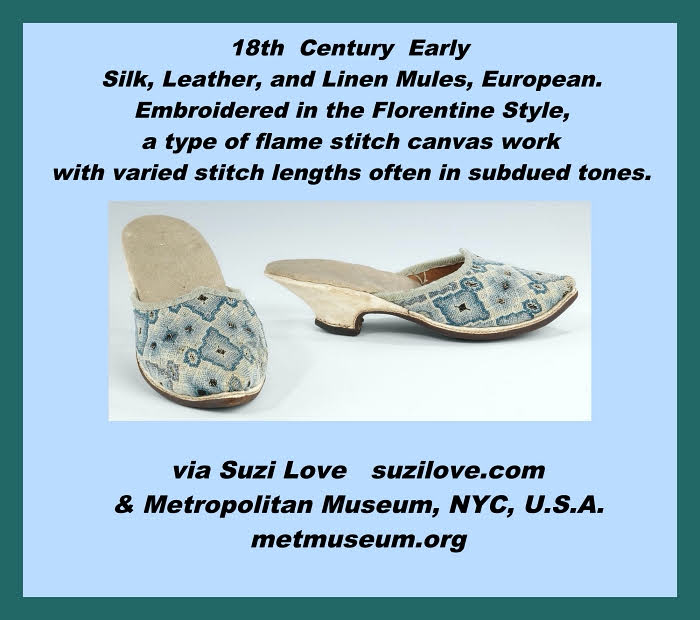
18th Century Early. Silk, Leather, and Linen Mules, European. Embroidered in the Florentine Style, a type of flame stitch canvas work with varied stitch lengths often in subdued tones. via Metropolitan Museum, NYC, U.S.A.
shoes_18th Century Early. Silk, Leather, and Linen Mules, European. Embroidered in the Florentine Style, a type of flame stitch canvas work with varied stitch lengths often in subdued tones. via Metropolitan Museum, NYC, U.S.A.
18th Century Early. Silk, Leather, and Linen Mules (shoes), European, and embroidered in Florentine Style. #shoes #georgianfashion #europe https://books2read.com/suziloveFashWomen1700s
HN_1 Fashion Women Late 1700s History Notes Book 1 by Suzi Love.
What was fashionable for women in the late 1700s? Extravagant colors and fabrics and outrageous styles were all seen in these flamboyant fashions.
books2read.com/suziloveFashWomen1700s