19th Century Early Caroline Bonaparte Murat, Wife and Queen Consort Of Joachim, King Of Naples. Wearing a Grand Parure, or jewelry set of tiara, necklace, earrings etc, of red coral, pearls and diamonds. By Salomon-Guillaume Counis, after Nicholas-Francois Dun.
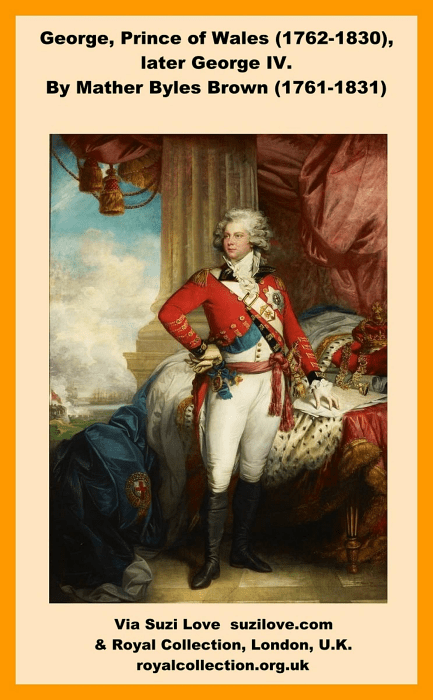
George, Prince of Wales (1762-1830), later George IV. By Mather Byles Brown (1761-1831) via Royal Collection, London, U.K.
The decision to make Prince George the Regent took a lot of political debate. After nearly two and a half months of political wrangling, the British government agreed to grant the title of Prince Regent on George. The Act of Parliament was finally passed by a commission in the House of Lords on February 5th 1811 and the Prince was formally sworn in as Regent at Carlton House the next day. He continued to rule as Regent until 1820 when, on his father’s death, he assumed the title George IV and reigned until his own death in 1830.
The British Regency was the period from 1811-1820. King George III was deemed mad and unfit to rule so his son became his proxy, the Prince Regent, or Prinny to his close friends. This was the situation when Jane Austen was alive. The Regency Era was famous for its beautiful clothing as well as the magnificent buildings erected and furnished in the ‘Regency Style’ under orders from the extravagant Prince Regent.
How many dukes were there in England in 1804? The number varied from year to year, depending on which titles became extinct etc. From: 1804 Kearsley’s Complete Peerage via Google Books (PD-200)
1804 Nine Princes of the Royal Blood, some of whom are Dukes.
Prince of Wales, Duke of York, Duke of Clarence, Duke of Kent, Duke of Cumberland,
Duke of Sussex, Duke of Cambridge, Duke of Gloucester, Prince William.
1804 Eighteen English Dukes, excluding the Prince Royals holding the title of ‘Duke’.
Norfolk, Somerset, Richmond, Grafton, Beaufort, St. Albans, Leeds,