Are you a reader or writer of Regency Romance? Love Jane Austen and the Bridgertons? Want to know more about the mourning, riding, underclothing and other Regency Era women’s fashions in Regency romances? What was fashionable for women in Jane Austen’s times? Mourning, riding, daytime, evening clothing, plus underclothing, corsets and accessories. This book looks at what was fashionable for women in Jane Austen’s times, or the early 1800s, or the Regency Era in Britain. Wars were being fought around the globe so women’s fashion adopted a military look in support of soldiers. Fashions, like the lifestyle, became progressively more extravagant and accessories went from colorful to over-the-top.
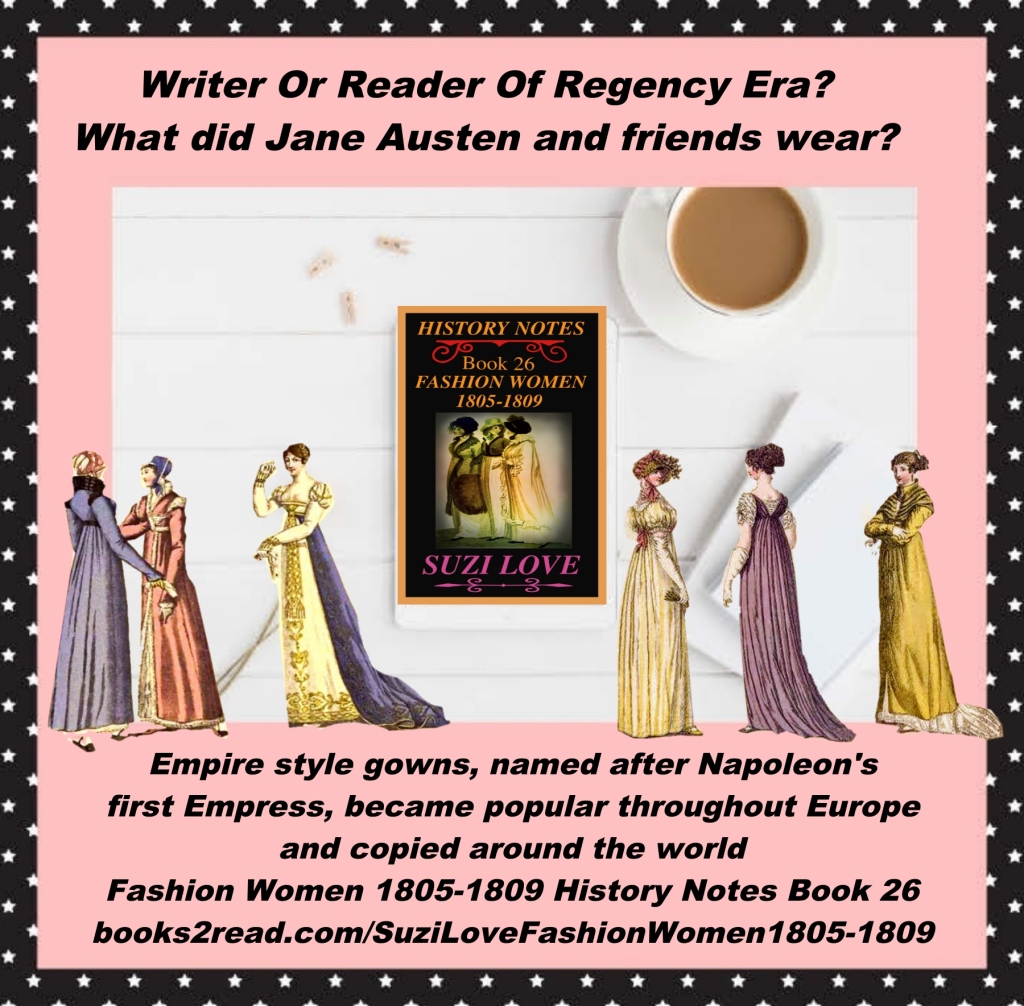
What did Jane Austen and friends wear? Early 1800s fashions were elegant and pretty with high waists and fabrics that were almost transparent. These Empire style gowns, named after Napoleon’s first Empress, became popular throughout Europe, and were then copied around the world. Colorful outwear was added to make an ensemble more attractive and warmer. History Notes Book 26 Fashion Women 1805-1809. https://books2read.com/SuziLoveFashionWomen1805-1809
The Empire waist gown defined women’s fashion during the Regency Era. ‘Empire’ is the name given in France to the period when Napoleon built his French Empire. High-waisted, loose gowns were adopted by the aristocracy as a symbol of turning away from the fussy, elaborate and expensive clothing worn in the 1700s. Jean-Jaques Rousseau advocated copying peasants and returning to a simpler life and more natural fashions. Unrestricting clothing was part of the new Democracy in France and these simpler and flowing fashions were adopted all over Europe, including Britain and despite the continual wars being fought against France during the early 1800s. Not even war stopped fashions from being copied everywhere.
1818 January Fancy Mourning Dishabille. A lady reading a pink book while wearing Dishabille, or morning dress, though as this labeled ‘Fancy’, it was most likely more formal than any normal At-Home morning dress. Dress of crepe with a lavishly decorated hem, worn over a white cambric Spencer, ornamented with fine muslin, embroidered at the edge with black, finished at neck with a triple ruff of muslin, tied in front with black love. Black sarsnet French apron, edged round with a newly invented trimming of black love. Cornette, or hat, of fine muslin, crowned with a garland of black flowers. Black chamois slippers. Fashion Plate via John Belle’s La Belle Assemblée or, Bell’s Court and Fashionable Magazine, London. The magazine’s General Observations on Fashion and Dress tries to explain why the outfit is labeled ‘Fancy’, ‘However little versatility can possibly be attached to the sable garment of sorrow, yet the Print we have presented to our readers representing the home costume of a lady of high fashion, will prove to them how busy Fancy is in her endeavors to throw a changeful hue over the tinct of solid black.’
I can picture Jane Austen and her female friends and family wearing this sort of dress if they were in half-mourning yet wanted to look fashionable. .
1817 December Lady Reading A Pink Book. Blue dress with a lavishly decorated hem, worn under a black tunic, white sleeves and a high lace morning cap. Fashion Plate via John Belle’s La Belle Assemblée or, Bell’s Court and Fashionable Magazine, London.
1812 April Morning Walking Dress, English. White dress with high ruffled collar under a green military style pelisse, or Redingote, with long sleeves and braiding across the bodice, boots and short yellow gloves.
Definition Redingote, Pelisse, Walking Dress: The term, Redingote, was used more in France and other parts of Europe and Pelisse or Walking Dress was used more in England. While the terms Redingote and Pelisse are often used interchangeably, the Redingote usually features a close fitted top and flares out at the hemline with a more tailored or military look than a Pelisse.
Redingotes or Pelisses were needed to cover the flimsy dresses made of lightweight fabrics of the Regency years to provide warmth and some protection from windy conditions when gowns might lift and cause modesty issues. Jane Austen and her contemporaries often walked to places and so would have needed the warmth of a Pelisse or coat in the cold British winters.
1812 August. Ball Dress, English. Dress with lower waistline than normal in the Empire period, pink laced bodice, with decorative sleeves, skirt with pink hem decoration, pink hat with pretty plume, and yellow gloves. Fashion Plate via John Belle’s ‘La Belle Assemblee’, London. https://books2read.com/SuziLoveFashion1810-1814
Are you a reader or writer of Regency Romance? Love Jane Austen’s books? Want to know more about the mourning, riding, underclothing and other Regency Era women’s fashions in Regency romances? What was fashionable for women in Jane Austen’s times? Mourning, riding, daytime, evening clothing, plus underclothing, corsets and accessories. This book looks at what was fashionable for women in Jane Austen’s times, or the early 1800s, or the Regency Era in Britain. Wars were being fought around the globe so women’s fashion adopted a military look in support of soldiers. Fashions, like the lifestyle, became progressively more extravagant and accessories went from colorful to over-the-top.
What was fashionable for women in Jane Austen’s times? Mourning, riding, daytime, evening clothing, plus underclothing, corsets and accessories. Wars were being fought so women adopted military looks in support of soldiers. https://books2read.com/SuziLoveFashion1810-1814 History Notes Book 27 Women’s Fashions 1810-1814.
These are the types of outfits worn by Jane Austen and contemporaries in English magazines, where French fashions were obsessively copied despite the two countries being at war for many years. In Jane Austen’s years, she and her contemporaries spent a lot of time walking outdoors. People were encouraged to partake in outdoor pursuits to maintain good health. Fragile slippers were worn for balls and evening events but for walking sturdier shoes were needed, In the early 1800s, these were typically made of leather, had a very small heel, slightly rounded toes and were laced up on the top.
What was fashionable for women in Jane Austen’s times? Mourning, riding, daytime, evening clothing, plus underclothing, corsets and accessories. Fashion Women 1810-1814 History Notes Book 27 This book looks at what was fashionable for women in Jane Austen’s times, or the early 1800s, or the Regency Era in Britain. Wars were being fought around the globe so women’s fashion adopted a military look in support of soldiers. Fashions, like the lifestyle, became progressively more extravagant and accessories went from colorful to over-the-top. https://books2read.com/SuziLoveFashion1810-1814
The Lady’s Magazine said of the basis of women’s fashion that was popular for the first twenty years of the 1800s, ‘White is still the prevailing color for robes. For morning dresses, linen gowns, in large diamonds or squares, are fashionable. Indian muslins, plain or embroidered, are preferred to Florence and satins. The designs of embroidery for shawls are of infinite variety. Long gloves, which reach above the elbow, are not yet laid aside. Medallions are hung around the neck from crossed chains and some of these medallions are shaped like the bags, called ridicules. These reticules are of the lozenge or hexagon shape, with a small tassel at each angle. Reticules, or ridicules, are in lozenge or hexagon shapes with a small tassel at each angle. In capotes, or hats, and ribbands, the violet and dark green prevail over jonquil. Bracelets in hair, pear-shaped ear-rings, medallions on square plates, saltiers of colored stones, are still in fashion.’
1818 Blue Pelisse, Or Coat, English. Short puffed sleeves over long straight sleeves, military style braiding to decorate. matching shoes and high bonnet with feathers. The short puffed sleeves over the long straight sleeves and the military style of braids across the vertical front opening became popular in the late Regency years when many countries, especially Britain and France, had been fighting wars for many years. It was seen as patriotic to wear military styled clothing in support the hundreds of thousands of soldiers wearing their uniforms in cities all across Europe. Aristocrats wearing uniforms were seen as romantic heroes and men who couldn’t fight in the battles wore coats, Redingotes, and Pelisses that looked military with capes, brass buttons and braids.
The type of outfit young Regency Era ladies would have worn if they were out shopping on Bond Street, walking in a park, or taking a carriage ride through Hyde Park. Fashion Plate John Belle’s La Belle Assemblée or, Bell’s Court and Fashionable Magazine, London.
Definition Redingote Or Pelisse Or Walking Dress Or Coat: French word developed from English words, riding coat. Long fitted outdoor coat worn over other garments for warmth. Often left open at the front to show off the dress underneath. Sometimes cut away in front. Originally made with several capes and trimmed with large buttons. French fashion plates call these coats Redingotes and they are designed for women, men and children. English fashion plates call them a Pelisse, a walking dress, Promenade dress, or Carriage dress.
What did Jane Austen and friends wear? Early 1800s fashions were elegant and pretty with high waists and fabrics that were almost transparent. These Empire style gowns, named after Napoleon’s first Empress, became popular throughout Europe, and were then copied around the world. Colorful outwear was added to make an ensemble more attractive and warmer. History Notes Book 26 Fashion Women 1805-1809. https://books2read.com/SuziLoveFashionWomen1805-1809
The Empire waist gown defined women’s fashion during the Regency Era. ‘Empire’ is the name given in France to the period when Napoleon built his French Empire.
High-waisted, loose gowns were adopted by the aristocracy as a symbol of turning away from the fussy, elaborate and expensive clothing worn in the 1700s. Jean-Jaques Rousseau advocated copying peasants and returning to a simpler life and more natural fashions. Unrestricting clothing was part of the new Democracy in France and these simpler and flowing fashions were adopted all over Europe, including Britain and despite the continual wars being fought against France during the early 1800s. Not even war stopped fashions from being copied everywhere.