“No, she was a very sober- minded young lady, sufficiently well-read in novels to supply her imagination with amusement, but not at all
unreasonably influenced by them.” Jane Austen ~ Sanditon (1817)




I'm an Australian author of contemporary and historical romances, plus history non-fiction. My books range from sexy to erotic, late 1700s to the mid 1800s, and with a dash of Australia thrown into the mix. My heroes and heroines challenge tradition and my stories often expose the seamier levels of life. I now live in a sunny part of Australia after spending many years in developing countries in the South Pacific. My greatest loves are traveling, anywhere and everywhere, meeting crazy characters, and visiting the Australian outback. I hope my books bring history alive and you have fun adventuring with my roguish heroes and feisty heroines.
“No, she was a very sober- minded young lady, sufficiently well-read in novels to supply her imagination with amusement, but not at all
unreasonably influenced by them.” Jane Austen ~ Sanditon (1817)
1809 September. Garden Promenade Dresses. Empire style gowns, shawls, hats, and parasols for walking in the park, to see and be seen, in London or at fashionable resorts. More elegant than walking dresses, which are usually morning dresses with outerwear and more elaborate headdresses. These are the sort of ensembles that Jane Austen and her family and friends would have gone walking in. Foreground lady has a silk shawl mantelet trimmed with an amber silk fringe and fastened on the bosom with a pebble brooch, amber hoop earrings, white Morocco leather shoes, York tan gloves and a blue parasol with a fringe. Straw hat with flowers. Background lady wears a Nun’s hood that falls over her shoulders and holds a purple parasol. Fashion Plate via John Belle’s La Belle Assemblée or, Bell’s Court and Fashionable Magazine, London.


1800-1815 ca. Unusual Skirt and Over Gown As Worn In Europe In Jane Austen’s Lifetime. From Holland. Gathered underdress and overdress with short puffed sleeves. via Dutch Museum – Gemeentemuseum Den Haag
The dresses worn in Holland and other parts of Europe were the same style as dresses worn by Jane Austen and her contemporaries. Empire waist gown defined women’s fashion during the Regency Era. ‘Empire’ is the name given to the loose gowns adopted by the aristocracy as a symbol of turning away from the fussy, elaborate and expensive clothing worn in the 1700s in France to the period when Napoleon built his French Empire.


1808 Gentleman’s Ball Outfit, French. Long tailcoat, black knee breeches, white stockings, high white cravat, white stockings, black shoes and gloves. Fashion Plate via Journal des Dames et des Modes, or Costume Parisien. Typical Gentleman’s outfit as worn by men to balls and evening events in Jane Austen’s Times.

From the finish of the 18th century until 1820, men’s fashions in European and European-influenced countries moved away from the formal wear of brocades, lace, wigs and powder to more informal and relaxed styles. Focus was on undress rather than formal dress. Typical menswear in the early 1800s included a tailcoat, a vest or waistcoat, either breeches, pants, or the newer trousers, stockings, shoes or boots, all worn with an overcoat and hat. This basic ensemble was accessorized with some form of neckcloth or cravat, gloves, walking stick, cane or riding crop, handkerchief, fobs, watch and perhaps a quizzing glass or eye glass.
Skirted coats were replaced with short-fronted, or cutaway, tailcoats worn over fitted waistcoats and plain, white linen shirts. Knee breeches were gradually replaced by tight-fitting pantaloons and later trousers, decorative shoes with buckles were replaced with a variety of boot styles, and fussy and ruffled neckwear gave way to intricately tied, white linen neck cloths. A Regency Era, or early 1800s, gentleman was outfitted in more practical fabrics, such as wool, cotton and buckskin rather than the fussy brocades and silks of the late 1700s.
1804 Men's Fashions In The Time Of Jane Austen. #Regency #Fashion #JaneAusten Share on X
1805-1810 ca. Blue Silk Slippers With Silk Bow and Ribbon Ankle Ties. Woven square pattern and round toes. via Manchester City Galleries, UK.
Shoes in the early 1800s were flat or low heeled and occasionally decorated with a bow or floral embellishments and it wasn’t until the 1820s that square, rather than rounded or pointed toes became fashionable. Made of silk, soft kid or cloth, these delicate shoes were flimsy and wore out quickly. There was often no difference between a left or right shoe, so when one slipper had a hole it was easily replaced. Slippers were often bought in multiples at a time so there were spares.

1860 Corset, American. Cotton, metal, and bone. Manufacturer: Langdon Batcheller and Company, American, founded 1865. Stamped Thompson’s Patent Glove Fitting Corset. via Metropolitan Museum NYC, U.S.A. metmuseum.org


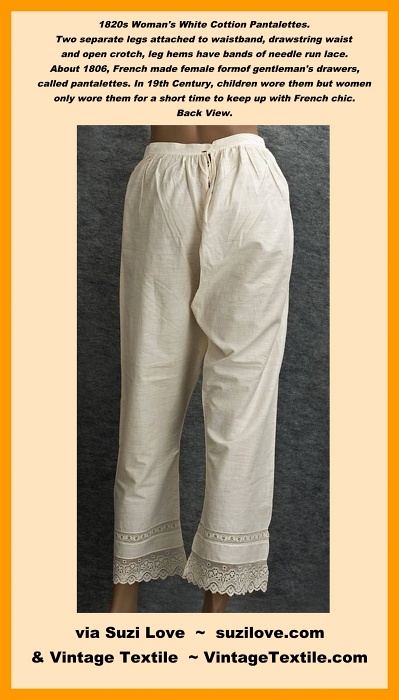
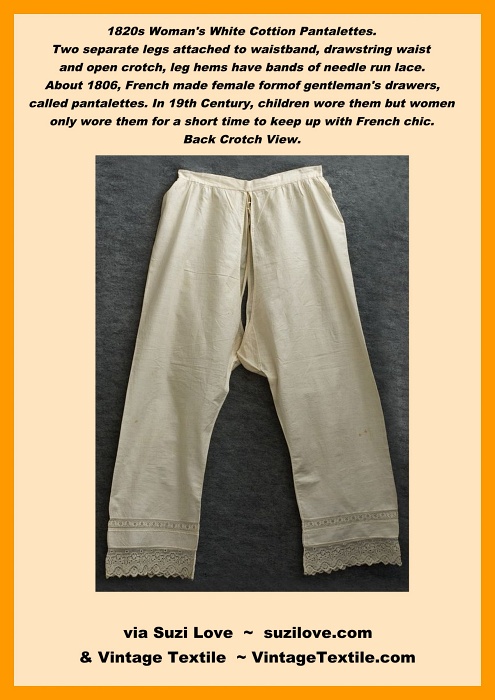
1820s Woman’s White Cotton and Lace Trimmed Pantalettes with Two Separate Legs. About 1806, French made female form of gentleman’s drawers, pantalettes. During the 19th Century, children wore them but women only wore them for a short time to keep up with French chic. The predecessor of women’s panties appeared about 1806 in the form of drawers like those worn by gentleman. Always the leader in forward chic, the French quickly came up with the female version—pantalettes. While the style persisted throughout the 19th century for children, pantalettes for adult women were only a passing fad. The pantalettes consist of two separate legs attached to a drawstring waistband, leaving the crotch open. The legs are bordered at the bottom with bands of needle run lace. The pantalettes are completely hand stitched and close in back with one mother-of-pearl button. The open edges of the crotch are finished with corded piping. via vintagetextile.com



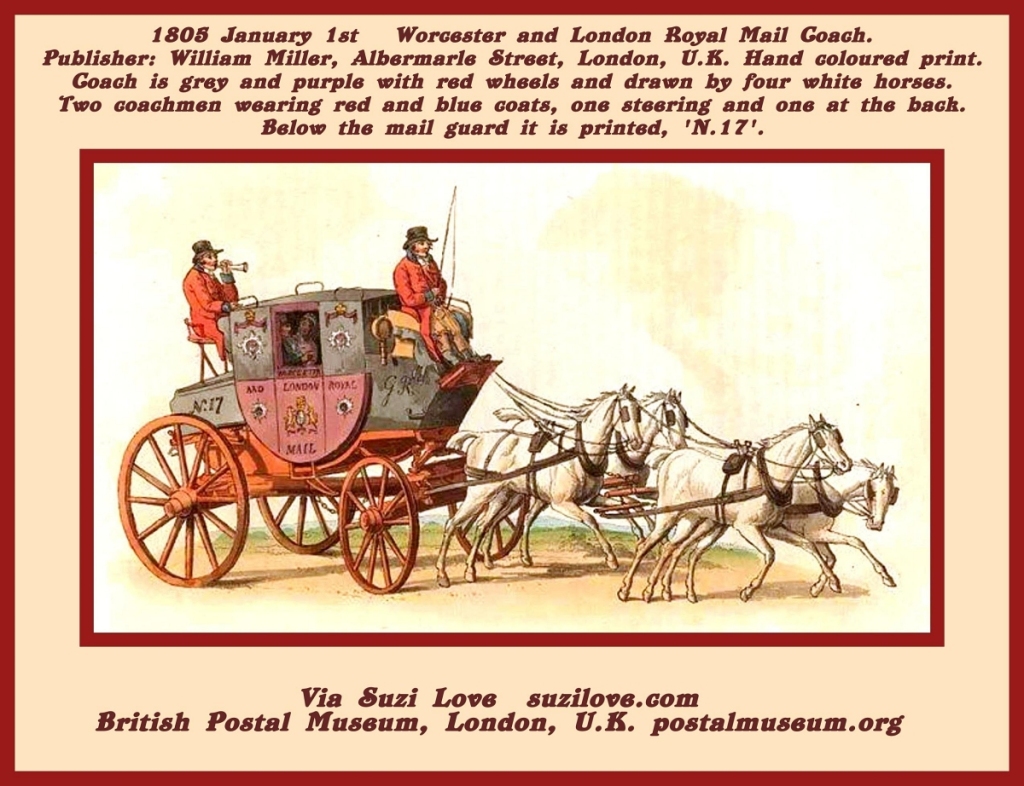
11805 January 1st Worcester and London Royal Mail Coach. The sort of mail coach that Jane Austen and famioy would have either ridden in or sent mail through. Publisher: William Miller, Albermarle Street, London, U.K. Hand colored print. Coach is grey and purple with red wheels and drawn by four white horses. Below the mail guard it is printed, ‘N.17’. Via British Postal Museum, London, U.K. postalmuseum.org

1807 June Couple In Morning Dress, English. Lady in white dress with lemon cape and an interesting white hat with a tassel. Gentleman in black tailcoat, white shirt and cravat, breeches tucked into high black boots with tan tops, fob and watch chain at his waist, black top hat and cane. via Le Beau Monde, or Literary and Fashionable Magazine, London, U.K.
Definition Morning Dress: Comfortable outfits worn either at home, out shopping, or for walking in the park or country. Presentable but not overly accessorized. For women it was often an Empire style, high-waisted, gown made from sprigged or plain muslin, cotton, or wool and either a Spencer or a coat to cover it for warmth, plus shoes and a bonnet. For men it was breeches or trousers, shirt, cravat, coat, boots and hat. This couple is dressed as a lady and gentleman of Jane Austen’s acquaintance would dress for a morning outing to a village, for shopping, or visiting friends.

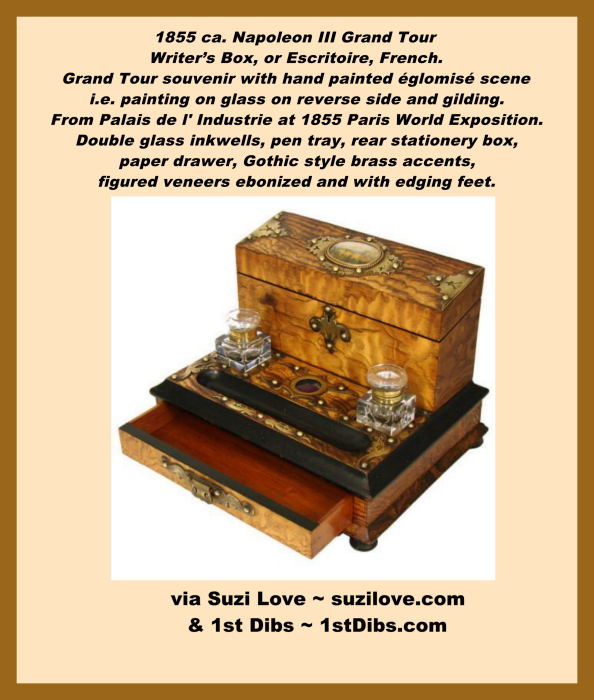
1855 ca. Napoleon III Grand Tour Influenced Travel Writer’s Box, Or Ecritoire, French. Double inkwell with rear stationery box, Gothic style brass accents and Grand Tour souvenir hand painted eglomise scene, the Palais de l’ Industrie from the 1855 Paris World Exposition! Figured veneers, ebonized edging, feet and pen tray and brass or bronze accents. via 1st Dibs 1stdibs.com