1807 Fashionable French Couple. Man: Blue cutaway coat and yellow breeches. Lady: Lemon and blue dress and bonnet. This is the fashion styles worn by Jane Austen and her family and friends in the early 1800s. Fashion Plate via Journal des Dames et des Modes, or Costume Parisien.https://books2read.com/SuziLoveFashionMen1800-1819
1807 Fashionable French Couple. Man: Blue cutaway coat and yellow breeches. Lady: Lemon and blue dress and bonnet. Fashion Plate via Suzi Love ~ suzilove.com & Journal des Dames et des Modes, or Costume Parisien.
I love these snippets from Captain Gronow’s Recollections 1864. Even though they were written after the Regency, they give us fun bits of information about Almack’s Assembly Rooms, the Prince Regent or later King George IV.
“Good society at the period to which I refer was, to use a familiar expression, wonderfully “select.” At the present time one can hardly conceive the importance which was attached to getting admission to Almack’s, the seventh heaven of the fashionable world. Of the three hundred officers of the Foot Guards, not more than half a dozen were honoured with vouchers of admission to this exclusive temple of the beau monde; the gates of which were guarded by lady patronesses, whose smiles or frowns consigned men and women to happiness or despair. These lady patronesses were the Ladies Castlereagh, Jersey, Cowper, and Sefton, Mrs Drummond Burrell, now Lady Willoughby, the Princess Esterhazy, and the Countess Lieven.
Almack’s: Exclusive temple of the beau monde. The gates of which were guarded by the lady patronesses,The Ladies Castlereagh, Jersey, Cowper, Sefton, Willoughby, Princess Esterhazy, and Countess Lieven.
From Captain Gronow’s Recollections 1864.
The most popular amongst these grandes dames was unquestionably Lady Cowper, now Lady Palmerston. Lady Jersey’s bearing, on the contrary, was that of a theatrical tragedy queen; and whilst attempting the sublime, she frequently made herself simply ridiculous, being inconceivably rude, and in her manner often ill-bred. Lady Sefton was kind and amiable, Madame de Lieven haughty and exclusive, Princess Esterhazy was a hon enfant, Lady Castlereagh and Mrs Burrell de tres grandes dames.
Many diplomatic arts, much finesse, and a host of intrigues, were set in motion to get an invitation to Almack’s. Very often persons whose rank and fortunes entitled them to the entree anywhere, were excluded by the cliqueism of the lady patronesses; for the female government of Almack’s was a pure despotism, and subject to all the caprices of despotic rule: it is needless to add that, like every other despotism, it was not innocent of abuses.
Almack’s
The fair ladies who ruled supreme over this little dancing and gossiping world, issued a solemn proclamation that no gentleman should appear at the assemblies without being dressed in knee-breeches, white cravat, and chapeau bras.
From Captain Gronow’s Recollections 1864.
1815 The First Quadrille at Almack’s Assembly Rooms, London. Left to Right: Marquis of Worcester, Lady Jersey, Clanronald MacDonald and Lady Worcester. “It was not until 1815 that Lady Jersey introduced from Paris the favourite quadrille, which has so long remained popular. I recollect the persons who formed the very first quadrille that was ever danced at Almack’s: they were Lady Jersey, Lady Harriett Butler, Lady Susan Ryde, and Miss Montgomery; the men being the Count St Aldegonde, Mr Montgomery, Mr Montague, and Charles Standish.” From The Reminiscences of Captain Gronow 1810-1860.RL_1_D2D_Regency Overview RetailerLinks
https://books2read.com/suziloveROver
1823 Couple In Walking Dress, French, as worn in Europe and England in the Regency Era. Redingote, or Coat, with matching hat, neck frill of Gros de Nice lace. Gentleman in tailcoat, short length brown trousers, yellow vest, high white cravat, top hat and black shoes. via Modes Françaises L’Indiscret, France.
1807 Regency Couple, French.Dressed As In Jane Austen’s times.Back view of a lady’s white dress with a cute back bow, long draping scarf with knotted ends, and straw bonnet with a blue ribbon and bows. Gentleman in a long grey coat, orange vest, extremely high collar of a ruffled shirt, tight taupe pants tucked into topped boots, and with a fashionable short curly hairstyle. Fashion Plate via Costume Parisien.
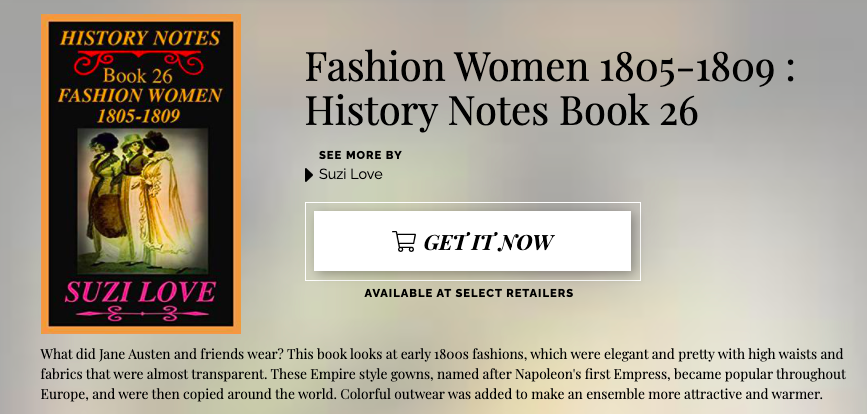
Fashion Women 1805-1809 History Notes Book 26
What did Jane Austen and friends wear? This book looks at early 1800s fashions, which were elegant and pretty with high waists and fabrics that were almost transparent. These Empire style gowns, named after Napoleon’s first Empress, became popular throughout Europe, and were then copied around the world. Colorful outwear was added to make an ensemble more attractive and warmer.
https://books2read.com/SuziLoveFashionWomen1805-1809
1807 Fashionable French Couple. Man: Blue cutaway coat and yellow breeches. Lady: Lemon and blue dress and bonnet. Typical of the ensembles worn by Jane Austen and her family and friends. Fashion Plate via Journal des Dames et des Modes, or Costume Parisien.
Fashion Women 1805-1809 History Notes Book 26 What did Jane Austen and friends wear? https://books2read.com/SuziLoveFashionWomen1805-1809
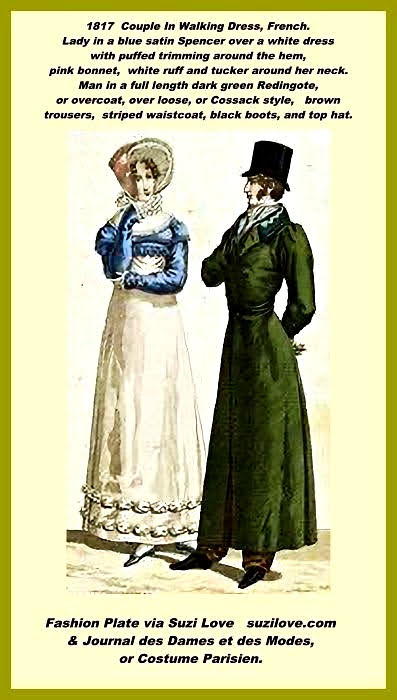
1817 Couple In Jane Austen and Bridgerton style Walking Dress and Gentleman in Same Green Redingote.
Lady: Blue satin Spencer over a white dress with puffed trimming around hem, pink bonnet, white ruff and tucker. Man: Long green Redingote, or overcoat, in the English style. Long brown trousers, striped waistcoat or vest, top hat, gloves and boots. Fashion Plate via Journal des Dames et des Modes, or Costume Parisien. Definition Redingote Or Coat Or Pelisse: Long fitted outdoor coat worn over other garments for warmth. French word developed from English words, riding coat. French fashion plates call these coats a Redingote and English plates call them a Pelisse, Or Walking Dress, or Carriage Costume. These are the types of outfits worn by Jane Austen and contemporaries in English magazines, where French fashions were obsessively copied despite the two countries being at war for many years.
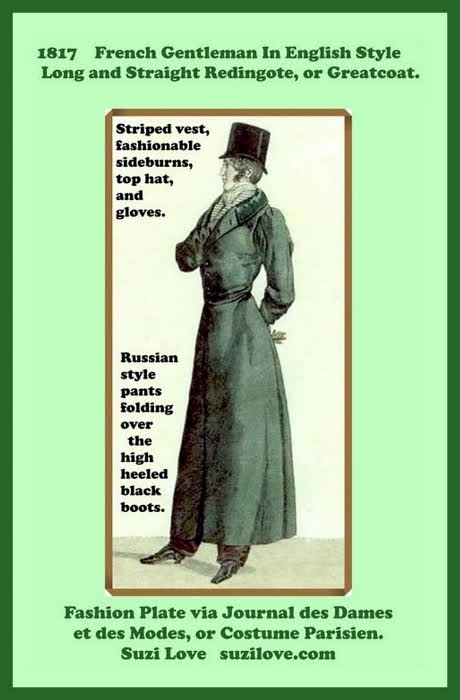
This same Fashion Plate is seen below for the gentleman.
11817 Long Green Straight Redingote, or Greatcoat, French. Gentleman wearing an English style overcoat, long brown trousers, striped waistcoat or vest, top hat, gloves and boots. Fashion Plate via Journal des Dames et des Modes, or Costume Parisien.
HN_23_D2D_Fashion Men 1800-1819 History Notes Book 23
https://books2read.com/SuziLoveFashionMen1800-1819
1807 June Couple In Morning Dress, English. Lady in white dress with lemon cape and an interesting white hat with a tassel. Gentleman in black tailcoat, white shirt and cravat, breeches tucked into high black boots with tan tops, fob and watch chain at his waist, black top hat and cane. via Le Beau Monde, or Literary and Fashionable Magazine, London, U.K.
Definition Morning Dress: Comfortable outfits worn either at home, out shopping, or for walking in the park or country. Presentable but not overly accessorized. For women it was often an Empire style, high-waisted, gown made from sprigged or plain muslin, cotton, or wool and either a Spencer or a coat to cover it for warmth, plus shoes and a bonnet. For men it was breeches or trousers, shirt, cravat, coat, boots and hat. This couple is dressed as a lady and gentleman of Jane Austen’s acquaintance would dress for a morning outing to a village, for shopping, or visiting friends.
Fashion Women 1805-1809 History Notes Book 26
What did Jane Austen and friends wear? This book looks at early 1800s fashions, which were elegant and pretty with high waists and fabrics that were almost transparent. These Empire style gowns, named after Napoleon’s first Empress, became popular throughout Europe, and were then copied around the world. Colorful outwear was added to make an ensemble more attractive and warmer.
https://books2read.com/SuziLoveFashionWomen1805-1809
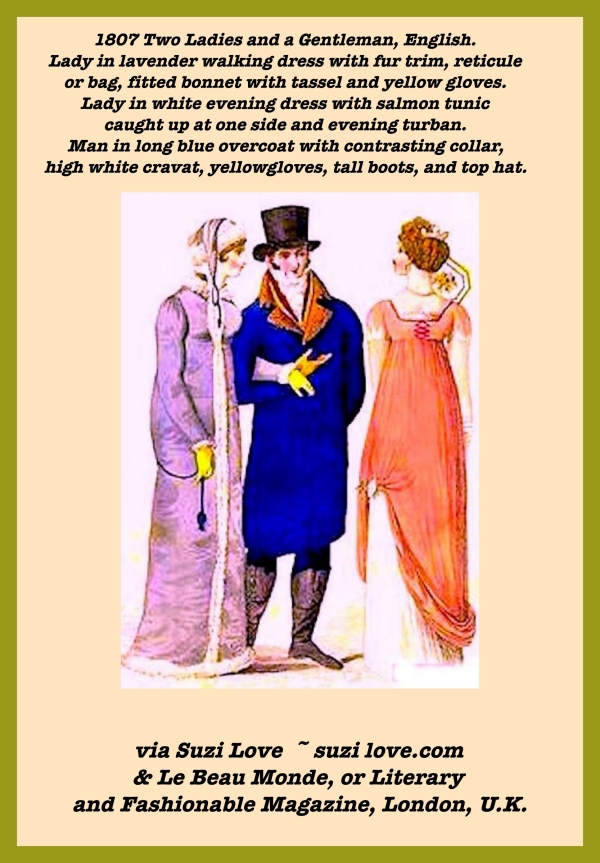
1807 Two Ladies and a Gentleman, English. Lady in lavender walking dress with fur trim, reticule or bag, fitted bonnet with tassel and yellow gloves. Lady in white evening dress with salmon tunic caught up at one side and evening turban. Man in long blue overcoat with contrasting collar, high white cravat, yellow gloves, tall boots, and top hat. Typical of the sort of outfits ladies and gentlemen in Jane Austen’s times would have worn while out walking, visiting friends or for an evening event, like a dinner party. A long coat, or Redingote or Pelisse for warmth when outdoors, and all matched with the essentials, day or night, of hats and gloves. via Le Beau Monde, or Literary and Fashionable Magazine, London, U.K.
1807 January Couple In Morning Walking Ensembles, English. Lady in white dress with lemon pelisse or coat, fitted hat and interesting reticule, or bag. Gentleman in long black tailcoat over yellow breeches, high black boots with wide tan tops, yellow gloves, cane and top hat. via Le Beau Monde, or Literary and Fashionable Magazine, London, U.K.
These are the types of outfits worn by Jane Austen and contemporaries in England and shown in their English magazines.The same designs had probably already been seen in France, because English publishers obsessively copied French fashions despite the two countries being at war for many years. https://books2read.com/SuziLoveFashionWomen1805-1809
1813 French Couple In Morning Dress. Man: Brown overcoat and tan trousers. Lady: White dress and bonnet, long yellow gloves and holding a watering can. Fashion Plate via Journal des Dames et des Modes, or Costume Parisien. books2read.com/SuziLoveFashionMen1800-1819
1813 French Couple In Morning Dress. Man: Brown overcoat and tan trousers. Lady: White dress and bonnet, long yellow gloves and holding a watering can. Fashion Plate via Journal des Dames et des Modes, or Costume Parisien.HN_23_D2D_Fashion Men 1800-1819 History Notes Book 23
https://books2read.com/SuziLoveFashionMen1800-1819