1800s Silver and Carved Mother of Pearl Writing and Desk Set, French. Wax Seal, Dip Pen and Letter Opener in the style that Jane Austen would have used to write her novels and her letters. via Ruby Lane Antiques. rubylane.com



1800s Silver and Carved Mother of Pearl Writing and Desk Set, French. Wax Seal, Dip Pen and Letter Opener in the style that Jane Austen would have used to write her novels and her letters. via Ruby Lane Antiques. rubylane.com
1750 ca. Spanish colonial ‘escritorio’, or writing desk, Columbia. Bone and mother of pearl inlay, hand etched sgraffito and original hand forged iron hinges. Interior has checkerboard drop front and ten compartments, each with original 18th century drawer pulls. Facade over-layed in mother of pearl with hand etched city-scapes, cathedrals, geometric patterns and foliate motifs. Interior has hand carved and gilt wood columns. Via Live Auctions ~ liveauctioneers.com


1797 Elegant Couple Dancing At A Ball. Man: Bottle green tailcoat, yellow knee breeches, white stockings, red vest and black dancing slippers. Lady: White spotted dress with a pale pink overdress open at the front, high belted waist, red and green turban and a parure, or jewelry set. via Fashion Plate via Journal des Dames et des Modes, or Costume Parisien.


1800-1815 ca. Fan of Bone and Silk, French. Jane Austen and her family and friends would have carried this style of fan when attending assemblies, musical evenings and balls. Metropolitan Museum New York City, U.S.A. metmuseum.org


18th Century Wool, Leather And Linen Front Lacing Stays. via digitalmuseum.norway
In the early 18th century, stays were basically quilted waistcoats, laced in the front and un-boned and to be worn on informal occasions. Mid century, the role of stays changed. They were then supposed to create a V shaped form and support a woman’s back, so baleen from whales was inserted into the garments and backs became longer.
Eyelet holes were stitched and staggered in spacing, so stays could be spiral laced. Stays were strapless or had straps attached in the back and tied at the front sides. Eyelet holes were stitched and staggered in spacing, so stays could be spiral laced. Later, they began to support the bust, give a fashionable conical shape, and draw shoulders back.
It was around the 1790s that the term corset started to be used as a refined name for stays. The Times of 24 June 1795 stated that: ‘corsettes about six inches long…are now the only defensive paraphernalia of our fashionable belle’.


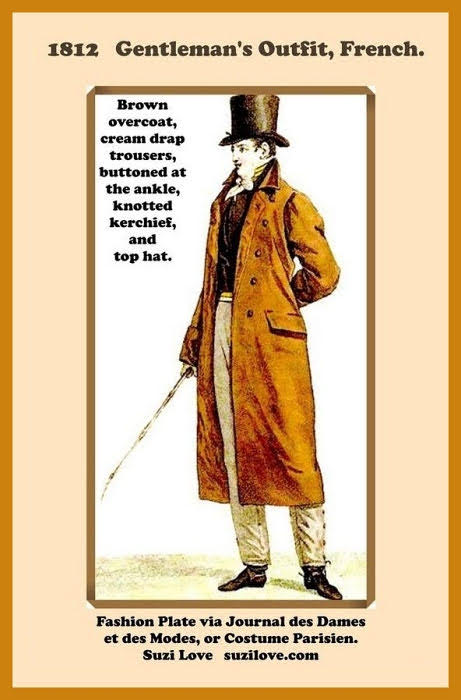
1812 Gentleman’s Outfit, French. Brown overcoat, or Redingote, with front pockets, cream Drap trousers buttoned at the ankle, knotted kerchief, top hat and holding a cane. Fashion Plate via suzilove.com and Journal des Dames et des Modes, or Costume Parisien. By 1812, men no longer wore complicated styles and extravagant fabrics. Men’s fashions had simplified and these practical and relaxed clothing items were the sort worn by Jane Austen’s male family and friends when out and about in town or on their daily excursions.
Definition Redingote Or Coat: French word developed from English words, riding coat. Long fitted outdoor coat worn over other garments for warmth. Originally made with several capes and trimmed with large buttons. French fashion plates call these coats Redingotes and they were worn by men, women, and children. English fashion plates call the coats a Pelisse, a Walking Dress, Promenade dress, or Carriage dress. Definition Drap: French equivalent for the English word cloth or stuff and generally applied to fabrics of wool or silk.

1809 White Court Dress, French. Long train lavishly decorated with blue flowers, long white gloves and evening hairstyle. Fashion Plate via Journal des Dames et des Modes, or Costume Parisien.
Definition Court Dress: Usually, the difference between a court dress and a ball dress was in the quality of fabrics used, how elaborate the design, and the number and quality of the accessories. Plus, in England in the early 1800s court dresses were required by Queen Charlotte to have hoops and in France and other European countries court dresses a long train, usually expensively decorated. During the Regency Era, white cotton dresses were considered suitable for many evening events, but definitely not for an evening event in a palace.


1800s French Palais Royal Sewing Box and Twelve Mother of Pearl Enamel Tools. This is the style of sewing box Jane Austen and her family would have used in the early 1800s, or Regency years. via via suzilove.com and 1st Dibs Auctions 1stdibs.com
Definition: Palais Royal: Name of an area around the Royal Palace in Paris, France, that specialized in making small and exquisite works of art during the 18th and 19th centuries. Palais Royal sewing tools were elaborate and usually feature mother-of-pearl, often intricately carved or engraved. During the 19th century, workboxes were often works of art with engravings, carvings, mother-of-pearl, and elaborate gilt metal mounts. Most popular were scissors with steel blades and gilt mounts, thimbles and needle cases which were often shaped like animals or other natural forms. Workmanship was exceptional and the tools almost too fragile to use.


1818 September 18th Le Palais Royal de Paris, Or ‘A Peep at the French Monstrosities’.
By George Cruikshank. Two English tourists, both dressed as dandies, walk arm-in-arm under the arcade of the Palais Royal, interested in the promenading courtesans. Two Frenchmen make more direct overtures to two women. Their dress is rather similar to that of the Englishmen, but the latter wear bell-shaped top-hats, while the Frenchmen have flower-pot shaped hats. An officer wearing a large cocked hat addresses a girl, and a man, said by Reid to be Irish, jovially accosts another. Some of the women are in evening-dress, others in street costume. Behind are iron railings between the supports of the roof; on one of these is the inscription ‘Caveau des Sauvages’. Published by: George Humphrey. via British Museum.


1820 Ice Blue Figured Silk Pelisse or Redingote. Bodice with hussar-style frogging, trimmed with fringed passementerie and silk covered buttons, puffed mancherons and cuffs en tablier with satin piping and buttons, hem with deep border of blue plush and flecked fringing which gives effect of feathers. This silk pelisse shows how women’s fashions, especially outer garments, were leaning towards men’s military styles. Braiding became popular, sleeves often had layers at the shoulders of either short sleeves under long sleeves or they had the braiding and buttons and buttonholes found on military uniforms. Fabrics were luxurious as seen in this figured silk, and decorative or extravagant hems were added, like the hem fringing on this coat. Because these coats were somewhat fragile due to being made of silk, not many would have survived. Extant Pelisse, or Redingote via Kerry Taylor Auctions. Kerrytaylorauctions.com
Definition Redingote Or Pelisse Or Walking Dress Or Coat: French word developed from English words, riding coat. Long fitted outdoor coat worn over other garments for warmth. Often left open at the front to show off the dress underneath. Sometimes cut away in front. Originally made with several capes and trimmed with large buttons. French fashion plates call these coats Redingotes and they are designed for women, men and children. English fashion plates call them a Pelisse, a walking dress, Promenade dress, or Carriage dress.


