And for another tradition we all love, how about a few facts about the beginning of Birthday Parties,
Suzi
The tradition started in Europe a long time ago when it was feared evil spirits were particularly attracted to people on their birthdays. To protect them from harm, friends and family would to come be with the birthday person and bring good thoughts and wishes.
Giving gifts brought even more good cheer to ward off the evil spirits. At first it was only kings who were recognized as important enough to have a birthday celebration (maybe this is how the tradition of birthday crowns began?).
As time went by, children became included in birthday celebrations. The first children’s birthday parties occurred in Germany and were called Kinderfeste.
Birthstones and their meanings have fascinated people far back in history.
Enjoy these few facts about them,
Suzi
As far back as 1400 BC, the Assyrians believed that rare and beautiful gemstones possessed magical properties. Some minerals were thought to possess a force or contain certain values and powers.
Tradition associates a gem with each sign of the zodiac based on a color system. Color was thought to release the power attributed to the stone.
Later, birthstones became associated with calendar months rather than the zodiac. People began selecting birthstones in colors other than the original colors.
The Roman, Arabic, Jewish, Polish, Russian and Italian lists were all different. In 1912, the American National Association of Jewelers, which later became Jewelers of America, adopted the list as we now know it.
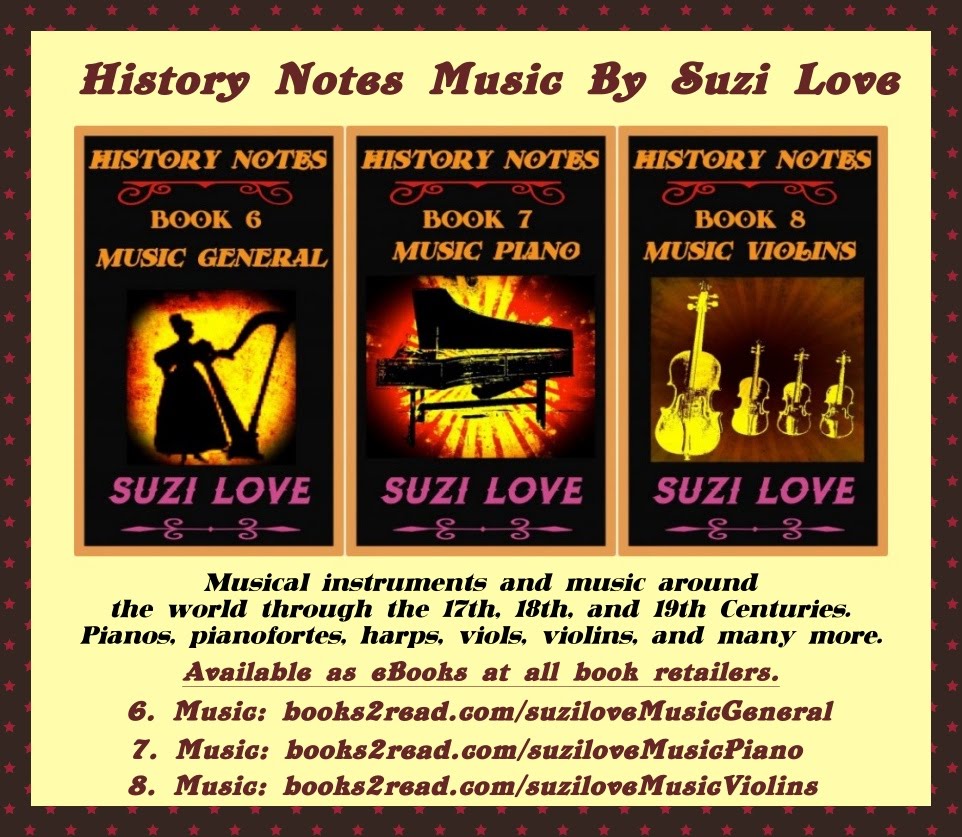
Music history from the 17th, 18th, and 19th Centuries. Pianos, pianofortes, harps, viols, violins played during Jane Austen’s times. Musical Instruments were so important in most of the more affluent households in history that large industries grew all around the world to manufacture instruments, musical accessories, and to print sheet music. Musical instruction and encouragement could be found everywhere and both young ladies and gentlemen were encouraged to have musical appreciation. And of course, playing music was on the list of social requirements for all young ladies desirous of becoming a wife and homemaker.
London became Europe’s leading centre for the manufacture of scientific instruments and this led to the manufacture of more musical instruments as well as factories developed and rail transport helped the faster distribution of goods to regional areas. One of the first places that music was used to tell stories and to share enjoyment was in Christmas music. Because music was such an integral part of households, music was always a feature in Magazines. There were advertisements everywhere for musical instruments for sale, for sheet music, and for music lessons. And of course, of most interest to the ladies were the hundreds of fashion plates included in magazines where people were depicted with their musical instruments.
HN_6-7-8 Music General History NotesHN_6 Music General History Notes, books2read.com/suziloveMusicGeneral
Love music? Love Jane Austen and the Bridgerton family? Treat yourself to a nonfiction book on music history. #Bridgerton #Music #History #JaneAusten https://books2read.com/suziloveMusicGeneral
1600 Pair of Backless Chopines. Pine-wood covered with punched kid leather. via Victoria and Albert Museum, London, UK. collections.vam.ac.uk.
Definition Chopine: Women’s platform shoes worn in the 15th, 16th, and 17th centuries. Used as a patten, clog, or evershoe to protect shoes and dresses from mud and street soil. Worn in Venice by courtesans and patrician women from 1400-1700.
These chopines are made of pine-wood. The wood is covered in kid leather with punched decoration and figured silk underlay. This pair are fairly modest. More extreme versions were over 50 cms high. Chopines were based on the shoes worn at Turkish baths. They were first worn by Venetian prostitutes and fashionable Venetian aristocrats then adopted them. The chopine was originally a form of overshoe, which is why it has no back. Later versions could be worn as either overshoes or on their own.
Music history from the 17th, 18th, and 19th Centuries. Pianos, pianofortes, harps, viols, violins played during Jane Austen’s times. Musical Instruments were so important in most of the more affluent households in history that large industries grew all around the world to manufacture instruments, musical accessories, and to print sheet music. Musical instruction and encouragement could be found everywhere and both young ladies and gentlemen were encouraged to have musical appreciation. And of course, playing music was on the list of social requirements for all young ladies desirous of becoming a wife and homemaker.
London became Europe’s leading centre for the manufacture of scientific instruments and this led to the manufacture of more musical instruments as well as factories developed and rail transport helped the faster distribution of goods to regional areas. One of the first places that music was used to tell stories and to share enjoyment was in Christmas music. Because music was such an integral part of households, music was always a feature in Magazines. There were advertisements everywhere for musical instruments for sale, for sheet music, and for music lessons. And of course, of most interest to the ladies were the hundreds of fashion plates included in magazines where people were depicted with their musical instruments.
Santa Claus The origin of Santa Claus begins in the 4th century with Saint Nicholas, Bishop of Myra, an area in present day Turkey. By all accounts St. Nicholas was a generous man, particularly devoted to children. In the Western world, where Christmas is characterized by the exchange of gifts among friends and family members, some of the gifts are attributed to a character called Santa Claus. He is also known as Father Christmas, Saint Nicholas, St. Nikolaus, Sinterklaas, Kris Kringle, Joulupukki, Weihnachtsmann, Saint Basil and Father Frost.
In the 4th century, Saint Nicholas, Bishop of Myra, Turkey, was a kind and generous man who was particularly devoted to children. His kindness and reputation for generosity gave rise to claims he that he could perform miracles and devotion to him increased. Thousands of churches across Europe were dedicated to him and some time around the 12th century an official church holiday was created in his honor. The Feast of St. Nicholas was celebrated December 6 and the day was marked by gift-giving and charity.
Father Christmas, who predates Santa Claus, was first recorded in the 15th century and then associated with holiday merrymaking and drunkenness. In Victorian Britain, his image was remade to match that of Santa and France’s Père Noël (Papa Noël) evolved the same way and eventually began using the same Santa image.
Today’s version of Santa Claus was created by the German-American cartoonist Thomas Nast (1840-1902), who drew a new image of the character annually, beginning in 1863. By the 1880s, Nast’s Santa had become the one now know and in the 1920s, this image was used in most advertising. But it was the early to mid Coca Cola advertising that cemented the idea of Santa Claus as a jolly man with a white beard and wearing a red suit. He was portrayed as drinking a coke and smiling happily. Many famous artists started doing yearly illustrations of Santa Claus that were used for magazine covers and Christmas postcards.
I love golf and I love bits and pieces of history, so these facts on Golf Holes combine my two loves,
Suzi
The 18 holes come from the renovations of the Old Course at St. Andrews, the ostensible first golf course from 1400’s.
In 1848 or so, with the invention of the new, cheap, golf ball, the Brits went golf mad, like the tennis buffs in the 1970’s and the joggers in the ‘1980’s. They were churning up the Old Course something fierce, playing the 9 holes both directions, (this was way it was done, up, then back same course.)
So decisions were made to alleviate the problem. First thought was to extend the course and bring it around into a circle, ending at beginning. This was met with great uproar and consternation. So the additional 8 greens were added by increasing the width and people go up “the back nine” and back the additional.
Then George V saw what they had done and had an 18 hole course built at Richmond Palace, with the object in mind to provide the people who couldn’t afford the private clubs a golf course. Old Course at St. Andrews 18 hole, this Prince’s and the subsequent Duke’s courses are part of the heart of the British people.
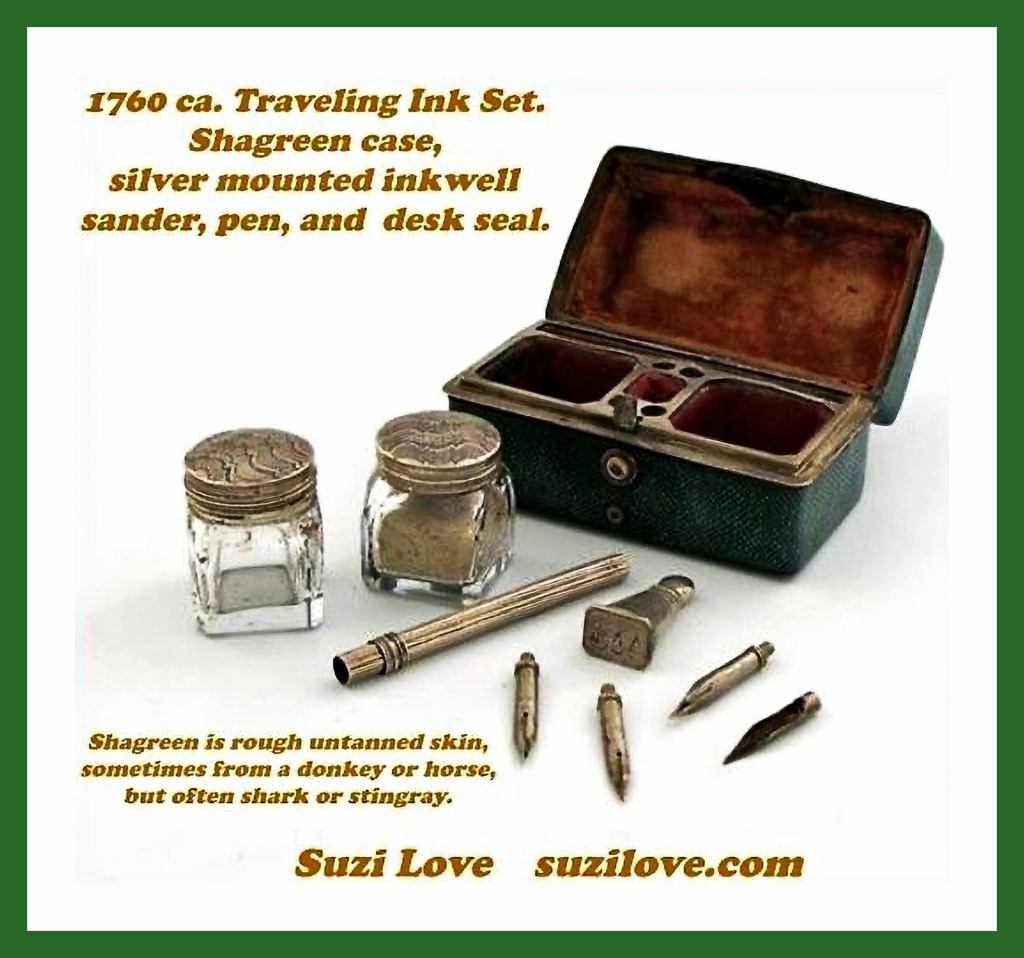
1760 ca. Traveling Ink Set. Rectangular Shagreen case with hinged cover which opens to reveal an unmarked silver mounted inkwell and sander, a pen, and a desk seal.
Definition Shagreen: Type of rough untanned skin, sometimes made from a donkey or a horse, but often from a shark or a stingray.
1760 ca. Traveling Ink Set. Rectangular Shagreen case with hinged cover which opens to reveal an unmarked silver mounted inkwell and sander, a pen, and a desk seal. Shagreen is a type of rough untanned skin, sometimes made from a donkey or a horse, but often from a shark or a stingray.D2D_RetailerBuyLink_HN_10. books2read.com/SuziLoveTravel
1750 ca. Spanish colonial ‘escritorio’, or writing desk, Columbia. Bone and mother of pearl inlay, hand etched sgraffito and original hand forged iron hinges. Interior has checkerboard drop front and ten compartments, each with original 18th century drawer pulls. Facade over-layed in mother of pearl with hand etched city-scapes, cathedrals, geometric patterns and foliate motifs. Interior has hand carved and gilt wood columns. Via Live Auctions ~ liveauctioneers.com