1808 Lady In A Dancing Dress, French. Dress of Tulle Broderie, short puffed sleeves, floral embroidery, dancing slippers and upswept hairstyle. Fashion Plate via Journal des Dames et des Modes, Costume Parisien. When attending assemblies or balls, ladies in Jane Austen’s times women wore Empire style dresses which were usually made of light fabric and floaty in style and often of a shorter length suitable for dancing.
1805 Lady With Her Sketching Portfolio In Half Dress, French. White, At-Home, High-waisted, relaxed & flowing dress with white cap and pink flowers to match, long gloves, slippers. Fashion Plate via Journal des Dames et des Modes, or Costume Parisien. Definition Caps: Worn as morning caps, night caps, or under other hats. Jane Austen and her family and female friends would have worn caps like these, sometimes during the morning at home, to bed to keep their long hair from becoming knotted, or under a bonnet to hold a hairstyle in place. Caps sometimes had hanging ties, or tails, and were also called ‘follow me lads’, or ‘flirtation ribbons’. Or flaps covering theirs called Lappets. Magazine Journal des Dames et des Modes, or Costume Parisien, French. French fashion magazine published between 1797 and 1839 and second oldest fashion magazine published in France. Pierre de la Mesangere was editor and published every five days, which is why there is an abundance of French fashion plates from these years in France and internationally.
What was fashionable for women in the late 1700s? Extravagant colors and fabrics and outrageous styles were all seen in these flamboyant fashions. #Georgian #nonfiction #amwriting books2read.com/suziloveFashWomen1700s
1800-1815 ca. Sprigged Mull Dress. Typical of the white cotton high-waisted dresses in vogue in the early 1800s. They replaced the more formal gowns from the end of the 18th Century and moved away from heavier and more decorative fabrics. This is the type of dress Jane Austen and her contemporaries would have worn on a daily basis. via Whitaker Auctions.
1806 Waiting For the St. Cloud Coach, Place de la Concorde, Paris. Illustrations by Francis Courboin. via Les Modes de Paris. (PD-Art) This couple is depicted waiting for the coach, which was a passenger vehicle drawn by four horses. The woman is wearing a fashionable hat or “capote” that covers her face. Her dress maintains the empire waist and has very long sleeves that also have a ‘mancheron’ or a gathered sleeve at the shoulders. The man is wearing a ‘habit du gagé’ or a coat with tails, buttoned at the waist. His hat is a ‘haut-de-forme’ or what is commonly known in English as a top hat. He wears tight, short pants tucked into large, riding boots, as was the fashion for men. Illustrations by François Courboin from Octave Uzanne‘s Les Modes de Paris. Variations du goût et de l’esthétique de la femme, 1797-1897, L. Henry May, Paris, 1898, or from the English translation of the same work: Fashion in Paris : the various phases of feminine taste and aesthetics from 1797 to 1897, William Heinemann, London, 1898. Modes de Paris VIa Brown University Library .
1816. June Blue Merino wool riding dress with high waist and embroidered and ornamented round the bust and cuffs and fastens on the back of the shoulder. Double ruff of fine Vandyke lace is separated from shirt collar by a Chinese silk handkerchief of blue and white. Small round hat made of fine beaver or moss silk, the half boots are of blue kid with Limerick gloves worked and seamed with blue and she is carrying a riding whip. These riding habits were usually designed by men and were in two pieces, a jacket and a skirt, worn over a shirt but this is in one piece and the full skirt falls from directly under the bust. Fashion Plate via John Belle’s La Belle Assemblée or, Bell’s Court and Fashionable Magazine, London. https://books2read.com/SuziLoveFashionWomen1815-1819
Typical of the riding costumes worn by Jane Austen’s female contemporaries. The style is still in the Empire fashion of a high-waist with the full skirt falling from just under the bust and with a frill and small decorations on the wrists and shoulders to make it look unique.
1820 Brown Evening Dress Of Figured Silk Muslin With Brown Gauze Trim. An evening dress of tobacco coloured figured silk muslin, warp float, small sprig repeat design. Shallow, round neckline, short puffed sleeves, high, empire-style waistline and long tubular skirt. Bodice has narrow cream lace trim above a band of self fabric edged with cream silk braid and brown silk taffeta piping. Bodice front has brown silk gauze joined on at side seams with 3 van dyke points down sides of centre front. Edges of points bound with silk taffeta and trimmed with ball buttons covered in brown silk floss.
Centre front panel has brown silk cord lacing through 17 handworked eyelets bordered by 2 v-shaped strips of same silk taffeta rouleaus. Self fabric waistband is trimmed with cream braid and piping, with two van dyke points either side of centre back. Bodice laced at back from neck to waistband while gauze overlay from front forms a band tucked over the waist, which extends over skirt to form a narrow peplym, also van dyke pointed and bound with taffeta. Two self fabric epaulettes attached at sleeve seams and trimmed with brown silk passmenterie tassel, at shoulder and with same braid and piping. Short sleeves overlaid with brown silk gauze ruched between rouleaux bands stitched to lining. Cuff bands piped and braided and cut into 8 van dyke points above overlay. Points are trimmed with braid, piping and silk covered ball buttons. Skirt of dress falls to the ground, trained at back, and flounce of satin striped silk gauze falling from corded seam. Bodice lined with cream cotton. Via Powerhouse Museum, Sydney, Australia. collection.maas.museum.
Passementerie: Art of making elaborate trimmings or edgings (in French, passements) of applied braid, gold or silver cord, embroidery, colored silk, or beads for clothing or furnishings.Styles of passementerie include the tassel, fringes, ornamental cords, galloons, pompons, rosettes, and gimps, as well as other forms. Tassels, pompons, and rosettes are point ornaments, and the others are linear ornaments.
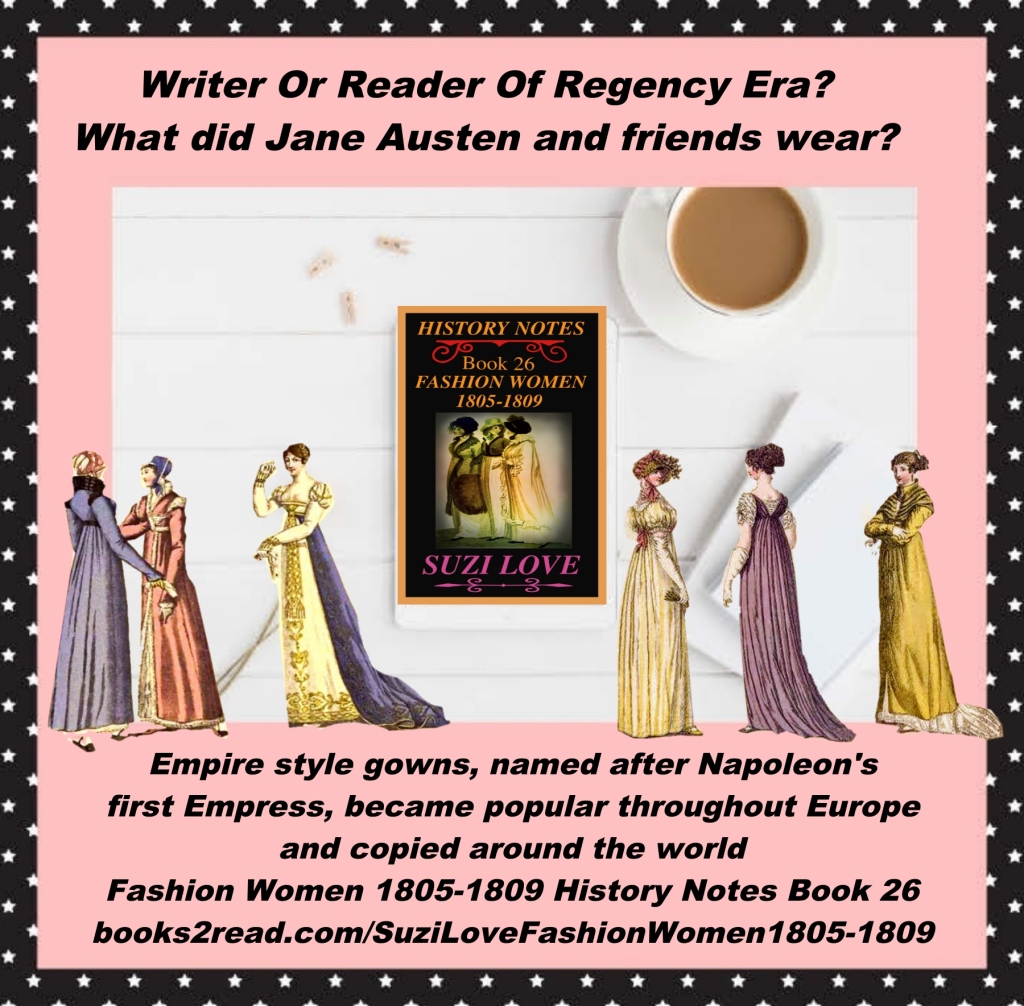
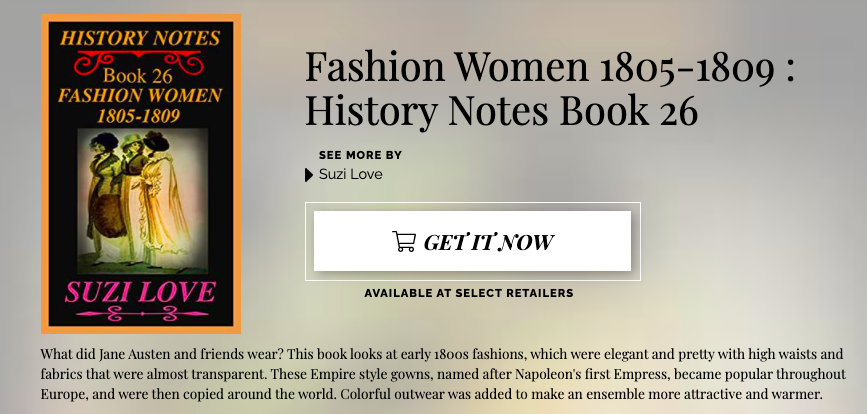
What did Jane Austen and friends wear? Early 1800s fashions were elegant and pretty with high waists and fabrics that were almost transparent. These Empire style gowns, named after Napoleon’s first Empress, became popular throughout Europe, and were then copied around the world. Colorful outwear was added to make an ensemble more attractive and warmer. History Notes Book 26 Fashion Women 1805-1809. https://books2read.com/SuziLoveFashionWomen1805-1809
1805 Typical Regency Era, or Early 1800s, Muslin Dress. Long sleeves, square neckline, and decorated with Palm Tree embroidery. via Whitaker Auction whitakerauction.smugmug.com Typical of the Empire dresses worn by Jane Austen and her contemporaries. Square necklines, long sleeves, and skirts that started directly under the bust and flowed into the classical relaxed wide styles of Greece and Rome. These high-waisted dresses were worn most days and cotton, silk or taffeta were the popular fabrics.
1805 May Two Ladies In Jane Austen Style Walking Dress and Full Dress, English. White dress with a train under a purple cape, purple reticule or bag, and green parasol. Pink evening full dress with low cut bodice, short sleeves and light draping shawl. via Vernon and Hood at The Lady’s Monthly Museum, London, U.K. Definition Reticule, or Ridicule, or Bag or Purse: Often with a drawstring to pull closed and usually made of cloth or covered cardboard and often decorated with beading or embroidery. A reticule, or purse, or handbag, was usually carried by a woman during the Regency period to carry all their daily necessities. Earlier, women used pockets that tied at the waistline and were hidden in the folds of their skirts. Empire style, or early 1800s, high-waisted dresses made it impossible to either sewn in a pocket or to tie on a pocket. So women began carrying small, decorated bags called Reticules, or ridicules, which generally pulled close at the top with a drawstring.


![1805_HalfDress_WhiteAtHomeDress_LadywithSketchingPortfolio_CP_Lge.jpg ]](https://www.suzilove.com/wp-content/uploads/2022/11/1805_HalfDress_WhiteAtHokmeDress_LadywithSketchingPortfolio_CP_Sml.jpg)