1807 Fashionable French Couple. Man: Blue cutaway coat and yellow breeches. Lady: Lemon and blue dress and bonnet. This is the fashion styles worn by Jane Austen and her family and friends in the early 1800s. Fashion Plate via Journal des Dames et des Modes, or Costume Parisien.https://books2read.com/SuziLoveFashionMen1800-1819
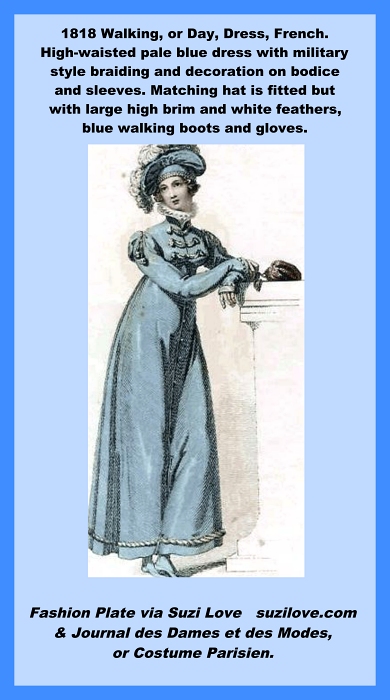
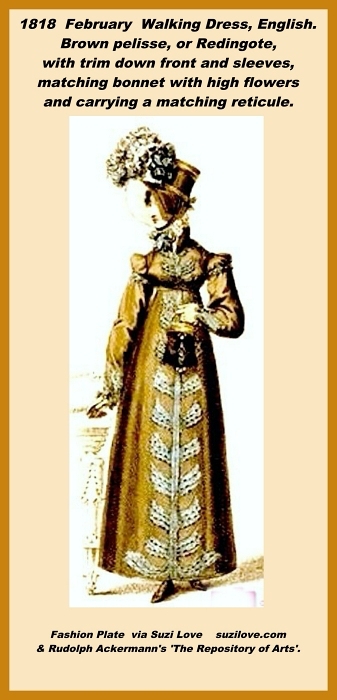
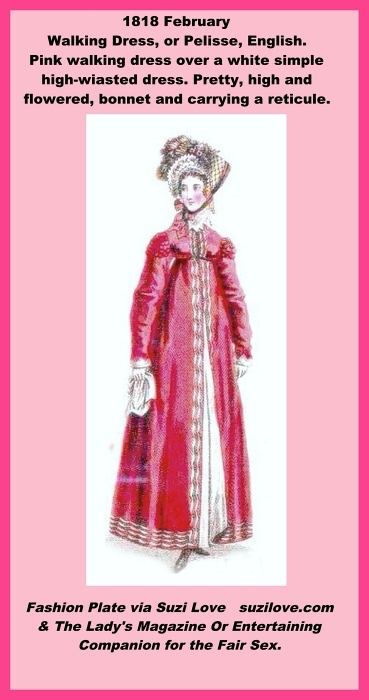
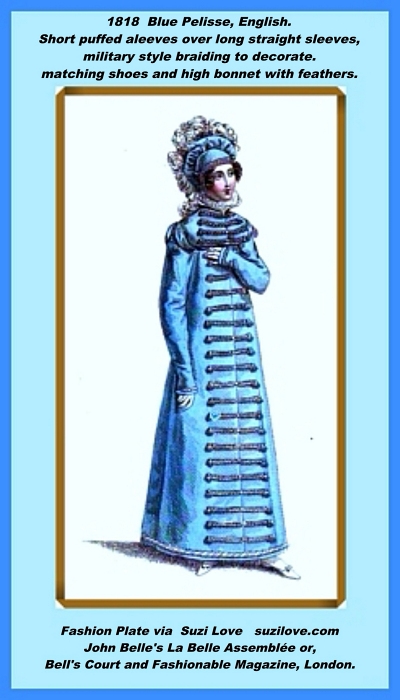
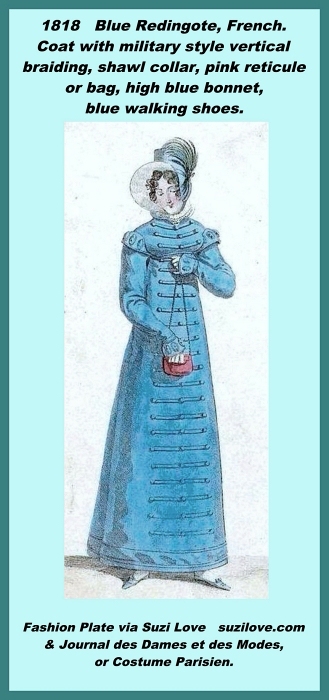
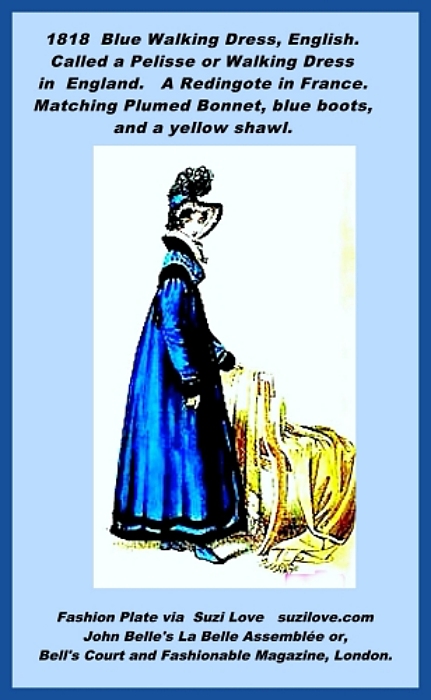
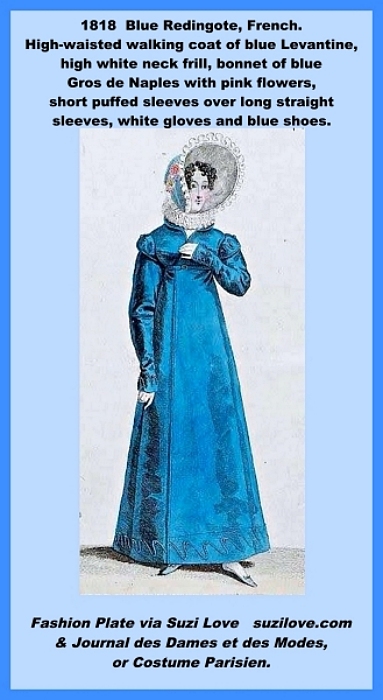
1818 Women’s outdoor fashions In the times of Jane Austen. Pelisses or coats or Redingotes, with matching hats, shoes, goves, reticules or bage, plus other accessories as displayed in various fashion magazines. Definition Redingote Or Coat Or Pelisse: Long fitted outdoor coat worn over other garments for warmth. French word developed from English words, riding coat. French fashion plates call these coats a Redingote and English plates call them a Pelisse, Or Walking Dress, or Carriage Costume.
1805-1815 ca. Empire Style, High-Waisted Dress, American. Typical style of dress worn in the time of Jane Austen. Long sleeves under short sleeves, square neckline, back fastening. Via Five Colleges and Historic Deerfield Museum Consortium. museums.fivecolleges.edu
Definition Empire Style Dress: High-waisted white gown defined women’s fashion during the Regency Era. ‘Empire’ is the name given to the period when Napoleon Bonaparte built his French Empire. High-waisted, loose gowns were adopted by the aristocracy as a symbol of turning away from the fussy, elaborate and expensive clothing worn in the 1700s.
1812 Red Dress, French. High-waisted red Merino wool dress with short puffed sleeves, high Chako hat with a plume long white gloves and white shoes. Jane Austen and her family and friends would have worn this style of dress. Fashion Plate via Journal des Dames et des Modes, or Costume Parisien.
1809 June Evening Full Dress, English. Lemon dress with white underskirt, short sleeves, braid decorated bodice, zig-zag hem, long white gloves, plumed headdress, full Parure of necklace, bracelet and earrings, evening slippers and a fan. Fashion Plate via John Belle’s La Belle Assemblée or, Bell’s Court and Fashionable Magazine, London.
Definition Full Evening Dress – Ball, dinner, evening and opera gowns but with every possible accessory added to make the most impressive display possible, such as adding a Grand Parure, or full jewelry set and including headpieces as with the feathered headdress above.
1810-1815 ca. Salmon Taffeta dress with ruched fabric at shoulders gathers at wrists and on bodice. The type of dress worn across Europe in the early 1800s. This sort of high-waisted dress would have been worn by Jane Austen and her contemporaries in England. via Gemeentemuseum Den Haag, Amsterdam.
The Empire waist gown defined women’s fashion during the Regency Era. ‘Empire’ is the name given in France to the period when Napoleon built his French Empire. High-waisted, loose gowns were adopted by the aristocracy as a symbol of turning away from the fussy, elaborate and expensive clothing worn in the 1700s. Jean-Jaques Rousseau advocated copying peasants and returning to a simpler life and more natural fashions. Unrestricting clothing was part of the new Democracy in France and these simpler and flowing fashions were adopted all over Europe, including Britain and despite the continual wars being fought against France during the early 1800s. Not even war stopped fashions from being copied everywhere.
Lover of Jane Austen and the Regency Era fashions? History Notes Book 25. #JaneAusten #RegencyFashion #HistoricalFashion books2read.com/SuziLoveFashionWomen1801-1804
1816 August. Morning Dress in Bridgerton or Jane Austen style, English. White high-waisted dress worn with a blue striped spencer, blue boots, and a white hat white blue trim. Fashion Plate via Lady’s Magazine.
Description Spencer: Short jackets worn for warmth over the high-waisted Empire style gowns that were popular after the French Revolution, where there was a shift away from opulence and decadence to simpler fashion. This jacket with very short bodice and long sleeves was known as a Spencer and was named after the male coat made famous by the Earl Spencer and said to have originated in accident to Lord Spencer in hunting when coat tails torn off and a cropped jacket was invented. The dresses in the early 1800s therefore became looser, lighter, and flowing and women became cold due to their very low cut and short bodices. Short fitted jackets that went easily over the dresses and provided extra modesty and some warmth. As Europe and many other parts of the world were deep in wars in the late 1700s and early 1800s, men in uniform were found everywhere. In support of these military men, fashions leaned towards military style shoulder paddings, shoulder embellishments, loops, buttons, and braids.
1816 Crossing The Pont des Arts, Paris. Illustrations by Francis Courboin. via Les Modes de Paris. (PD-Art) suzilove.comThis plate depicts two women crossing the Pont des Arts, which is also known as the Passerelle des Arts. The women wear very high-waisted dresses. Both women wear a large white feather in their hats, symbolic of the white plume of Henri IV’s famous battle cry, “Ralliez-vous à mon panache blanc!” and made popular by the 1814 restoration of Louis XVIII on the throne. Restoration also brought back various styles, especially those denoting luxury, from the Ancien Regime. The woman on the left wears an ‘old-fashioned’ lace collar and the resurgence of luxury materials, such as fur are indicative of feminine styles of the Restoration period. (PD-Art) Illustrations by François Courboin from Octave Uzanne’s Les Modes de Paris. Variations du goût et de l’esthétique de la femme, 1797-1897, L. Henry May, Paris, 1898, or from the English translation of the same work: Fashion in Paris : the various phases of feminine taste and aesthetics from 1797 to 1897, William Heinemann, London, 1898. Modes De Paris
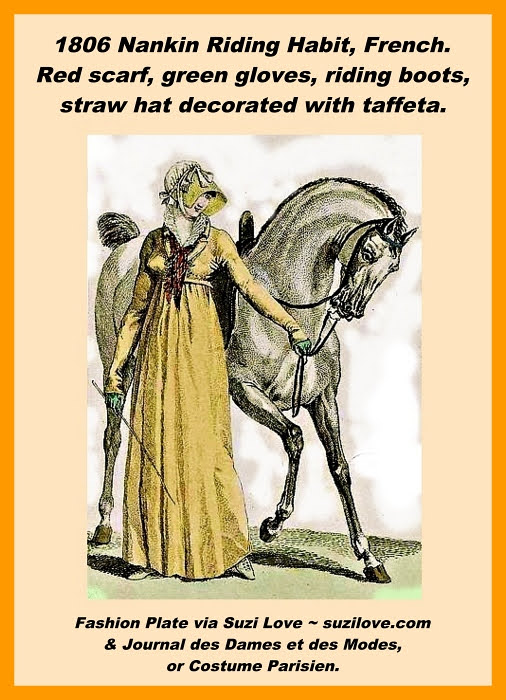
1806 Nankin Riding Habit, French. Red scarf, green gloves, riding boots, straw hat decorated with taffeta. The type of outfit Jane Austen and her friends would have worn if they went horse riding. Nankeen Or Nankin Fabric: Durable, buff colored cloth, made of Chinese cotton which is naturally brownish yellow. Originally brought from Nanking.