Embracing Scandal Book 1, Scandalous Siblings Series. Lady Rebecca Jamison sneaks into the house of the Duke of St. Martin to beg his assistance to combat a rogue and murderous group of railway investors.
Lady Rebecca Jamison told The Duke of St. Martin. ‘We utilize Foster and Braithwaite as our stock trading agents and invest through them using the minimum identification on any documents.”
“Impressive. I heard that Foster and Braithwaite’s business grew twelve fold in the last few years by riding on railway stocks.”
“Hence, our problem. Their profits, our profits, became legendary. People speculated about the mysterious names on share certificates.” At his puzzled look she added, “Simple enough. We draw up letters. Ladies sign with their initials and family name, nothing more, so no one realizes the investors aren’t men. Or rather, no one did before.”
“And now?”
“Two weeks ago, some members of the outer circle approached my brother, Michael. They believe him to be personally responsible for our own change in fortune.”
“How big a change in fortune?”
“Oh, nothing too major.” She waved a hand in a vague manner and hoped her face didn’t flush. “Modest successes. Dividend rates in excess of six percent in some situations.”
His eyebrows shot upwards. “Six percent! Nobody I do business with calls that modest. No wonder they wish to obliterate all reference to your family, and your Society.”
“Yes, if only we’d been able to keep our good fortune a secret. We take the uttermost care with our clandestine activities, as we value our privacy and our reputations.”
The Duke raised a brow and pointed at his clock. “Oh, yes. Great care with your reputation!”
She chose to ignore him. “Michael laughed it off. Refused to join their so-called group of friends who dabbled in investing. So they raised the stakes. If he refuses to hand over m … his calculations for all the new railway share ventures opening, within the next two weeks, they vowed to destroy the members of his family. One by one, until he gives in.”
“Ah, now I understand. That’s why they’re keeping you alive. They’re waiting to acquire the records. They assume as eldest, and involved in a charitable society, you hold the most knowledge of…” When he mumbled, she stiffened. Did he guess? “Of Michael’s future stock predictions. Then, when they have all they require, they’ll kill all–”
“Yes, yes, I know. They’ll dispense with us regardless.”
She lifted her chin a notch. “But I can resolve this situation. Given a little more time, plus a little assistance from you.”
“Ah! Back to the crux of the matter. What you require from me.”
ES_ Embracing Scandal Book 1 Scandalous Siblings Series D2D_ES_ https://books2read.com/suziloveES
1810 ca. Typical Regency Era Day Dress of Sprigged White Muslin, England. High-waisted, hand sewn, bibbed front bodice fastens at shoulders with self covered buttons, net lace insertions on front bodice, squared neck, long tapered sleeves, gathered at shoulders, ankle length skirt, apron panels tied with cotton tapes at back and lined bodice. Via Museum Of applied Sciences, Australia. collection.maas.museum
Definition Empire Style Dress: High-waisted white gown defined women’s fashion during the Regency Era. ‘Empire’ is the name given to the period when Napoleon Bonaparte built his French Empire. High-waisted, loose gowns were adopted by the aristocracy as a symbol of turning away from the fussy, elaborate and expensive clothing worn in the 1700s. This sort of high-waisted dress would have been worn by Jane Austen and her contemporaries in England and in the television series, Bridgerton.
1808 Blue Grey Redingote, French. High waist, coordinating trim, short puffed sleeves over long straight sleeves, yellow striped bandana in her hair, yellow gloves and yellow walking boots. Jane Austen and her female contemporaries wore coats like these when outdoors because they needed the warmth over the fashionable light muslin dresses that all women wore. Redingotes could be both comfortable and decorative. They often had military elements in support of the thousands of men involved in ongoing wars. Fashion Plate via Journal des Dames et des Modes, or Costume Parisien.
Definition Redingote Or Pelisse Or Walking Dress Or Coat: Long fitted outdoor coat worn over other garments for warmth. Often left open at the front to show off the dress underneath. French word developed from English words, riding coat.
Bandeau: Narrow strip or band worn around head to confine hair. Made of either twisted fabric, length of pearls, flowers, jewels or feathers. From the French word for “strip.
1795-1812 ca. Lord Nelson’s Vice-Admiral Undress Coat. Blue cloth tail coat, double breasted, nine gilt buttons on each lapel., two rows gold lace each sleeve with three buttons between, three buttons below each pocket flap, two buttons on skirt pleats, narrow band of wool cloth and two eyelet holes on shoulders to attach epaulettes, fastened edge to edge with three hooks and eyes, four embroidered stars of Nelson’s orders on left, Order of the Bath, Order of St Ferdinand Merit, Order of Crescent, Order of San Joachim. This is Nelson’s Trafalgar Coat worn by Nelson (1758-1805) at Battle of Trafalgar with bullet hole on left shoulder, close to epaulette. Damage to epaulette and blood stains on tails and left sleeve. National Maritime Museum, Greenwich, London, U.K. www.rmg.co.uk
For most of Jane Austen’s life, Britain was involved in conflicts and wars across the world. The Napoleonic Wars only ended in 1815, just two and a half years before Austen died. During her childhood, Britain was fighting the American Revolutionary War and when she was 14 years old, the French Revolution upset traditional roles of the monarchy, aristocracy and landed gentry in Britain, France and many other European countries.
1806 Silver and silver-gilt vinaigrette, Birmingham, England. Commemorating the Battle of Trafalgar in 1805. Rectangular with a hinged lid and a suspension loop. Gilded, pierced inner cover depicts HMS ‘Victory’ in relief inscribed ‘VICTORY’, ‘TRAFALGAR OCT 21 1805’. Via National Maritime Museum, Greenwich, London, U.K.
Vinaigrettes were used from the late 18th century through the 19th Century to revive a person who had fainted, having the vapors, or to mask unsanitary odors. Small containers, often a silver hinged box, held a tiny sponge dipped in an aromatic substance which had been dissolved in vinegar. The sponge was held beneath a grill or perforated cover so, by a flick of the fingers, the container was opened and the restorative substance held directly beneath a person’s nose. Jane Austen and her family and friends would have been very familiar with the use of vinaigrettes because Regency Era ladies were noted for having the vapors or fainting in hot ballrooms or dramatic situations. Ladies in the Romantic and Victorian Eras would have used them when tightly laced corsets became popular and ladies fainted because they were unable to draw in enough oxygen.
Both men and women used vinaigrettes in the late 1700s when people encountered foul aromas on a daily basis, but by the 1820s vinaigrettes were mainly used by women.These tiny containers were carried in a pocket, a reticule or bag, or suspended from the waist by chains as part of a chatelaine. Their sterling silver interiors were gilded to prevent discoloration from the acetic acid. Birmingham produced 90% of England’s silver vinaigrettes. As gold wasn’t affected by vinegar, craftsmen created some elaborate and decorative boxes on the container’s exteriors.
HN_11_D2D_Craftsmen created containers of precious metals, leather, silks, and decorated them with jewels to make exquisite and expensive items as well as practical carrying cases. books2read.com/suziloveBoxesCases
1818 High-waisted Promenade Dress, English. White dress with multiple layers of lace from hem upwards. Narrow striped scarf of bright colors, large brimmed hat decorated with flowers and a pink parasol. Fashion Plate via John Belle’s La Belle Assemblée or, Bell’s Court and Fashionable Magazine, London.
Definition Empire Style Dress: High-waisted white gown defined women’s fashion during the Regency Era. ‘Empire’ is the name given to the period when Napoleon Bonaparte built his French Empire. High-waisted, loose gowns were adopted by the aristocracy as a symbol of turning away from the fussy, elaborate and expensive clothing worn in the 1700s.
For many centuries, road travel was the main way of getting from place to place, but roads were notoriously rutted and badly maintained, especially in Britain. The Romans laid down the roads but they very poorly maintained through the 17th and 18th Centuries. It wasn’t until the 19th Century that improvements were made and rose travel opened up.
Roman Road Construction. Roman roads were constructed in layers. Rubble, slabs of stone, pebbles and gravel, smooth paving stones. Average width of road was 15 to 18 feet.
Roman Road Construction. Roman roads were constructed in layers. Rubble, slabs of stone, pebbles and gravel, smooth paving stones. Average width of road was 15 to 18 feet.
The dreadful condition of British roads caused great apprehension to all classes of travelers. Making a journey anywhere in the country was a big undertaking and often a gentleman composed his last will and testament before his departure. Traveling in vehicles was only possible during the day or on the nights with very bright moonlight with few vehicles attempting road travel in winter and any travel on a Sunday was frowned upon.
From: 1815 Journal of Tour of Great Britain by a French Tourist via Google Books (PD-180) ‘The roads very narrow, crooked, and dirty, continually up and down. The horses we get are by no means good, and draw us with difficulty at the rate of five miles an hour. We change carriages as well as horses at every post house. They are on four wheels, light and easy, and large enough for three persons. The post boy sits on a cross bar of wood between the front springs, or rather rests against it. This is safer, and more convenient both for men and horse, but does not look well and, as far as we have seen, English post horses and postillions do not seem to deserve their reputation.’
If you’ve read Jane Austen you’ll know that it was improper for a woman to travel alone, which meant that well-bred women were dependent on male relations to accompany them or else they had to take a maid in the carriage with her and be accompanied by a driver and footmen, which of course added to the cost of carriage travel. Any woman traveling by herself on a mail coach would be subject to speculation and probably malicious gossip.
Mail coaches raced across these roads trying to stick to a time table but there were numerous accidents on roads that were often flooded, covered in snow, or up such steep hills that passengers had to alight and either push the coach or walk ups the hill.
1790 Turnpike Gates In The Vicinity Of London, U.K.
Tolls were collected on many roads in Britain but, because the turnpikes were mainly on land belonging to the nobility, money collected went into their personal coffers and very little went to road maintenance. This caused a continual push in parliament to make those who owned the land and collected the money responsible for repairing their roads, but these pleas fell on deaf ears as the lords in who sat in parliament had no interest in spending money to better travel for the common people.
Description of Stage Coach Travel in England. via 1815 Journal Tour of Great Britain.
“The gentlemen-coachmen, with half-a dozen great coats about them,—immense capes,—a large nosegay at the button-hole,—high mounted on an elevated seat,—with squared elbows,—a prodigious whip, beautiful horses, four in hand, drive in a file to Salthill, a place about twenty miles from London, and return, stopping in the way at the several public-houses and gin-shops where stage-coachmen are in the habit of stopping for a dram, and for parcels and passengers on the top of the others as many as seventeen persons. These carriages are not suspended, but rest on steel springs, of a flattened oval shape, less easy than the old mode of leathern braces on springs. Some of these stage coaches carry their baggage below the level of the axletree.”
1825 Observations on the Management of Turnpikes by John Loudon Mc Adam. Via Google Books (PD-150)
1825 Observations on the Management of Turnpikes by John Loudon Mc Adam. Via Google Books (PD-150)
John Loudon McAdam, born Ayr, Scotland. (1756 -1836) He acted as a magistrate and assumed other civic roles including one as as trustee of the Ayrshire Turnpike in 1783, where he developed an interest in road construction and engineering, eventually becoming general surveyor for the Bristol Corporation in 1804. He wrote papers on the benefits of raising roads, making them from layers of stone and gravel, and giving priority to drainage. However, no roads were made this way until McAdam was put in charge of remaking the Bristol Turnpike in 1816, when he put his theories into practice and demonstrated macadamization, known as macadam. He made him numerous enemies on the Turnpike Trusts, who preferred to keep the money made from tolls rather than ploughing it back into road improvements but Macadam was soon in widespread use.
John Loudon McAdam (1756 – 1836), Scottish engineer and road-builder who started a new way of raising roads called ‘macadamization’. Via Wikimedia Commons.
John Loudon McAdam (1756 – 1836), Scottish engineer and road-builder who started a new way of raising roads called ‘macadamization’. Via Wikimedia Commons.
1825 John McAdam Observation of English Roads. “In a Country like England, inhabited by an ‘ intelligent people, well educated, active, and enterprising, where every hint at improvement is eagerly caught at and prosecuted with spirit, it is only possible to account for the apathy respecting Roads, and the want of exertion in prosecuting the means given for improvement, by showing that a strong counteracting principle exists in the defects of the Road Laws, and that although much want of encouragement has arisen from the prejudices of old practitioners— the great obstacle to success remains in the zealous opposition of those who profit by mismanagement in various ways.”
McAdam Report on Bristol District Roads, March, 1815.
Expenditure and Debt.
• 1802 – 1812 only two roads maintained themselves.
• Neither able to pay £100 of the debt they owed.
• No other roads supported themselves at all.
McAdam’s List of Reasons for Bad Roads.
• Ignorance and incapacity of Surveyors
• Lack of any control over the lavish spending of Road Trusts
• Trust accounts being in an inexplicable mess
• No system or scientific mode of constructing roads
• Every part of a road being differently formed
• Each road managed by a different person
• Each area managed by a different Turnpike Trust
• Winford Road Trust produced no account books
McAdam informed the Road Trusts that smooth roads were the most useful and lasted longer because carriages do little damage to a smooth road because the horses exert themselves less and the carriages do not rock and roll.
Unfortunately for travelers in the late 1700s and early 1800s, the smoothness of a road surface depended on the preparation and distribution of the road building materials used and was therefore entirely in the hands of each individual road-maker. In 1816, Mc Adam reported to the Bristol District the difference in revenue if roads were built of good material, regularly maintained, and if the finances of Turnpike Trusts were under someone’s control.
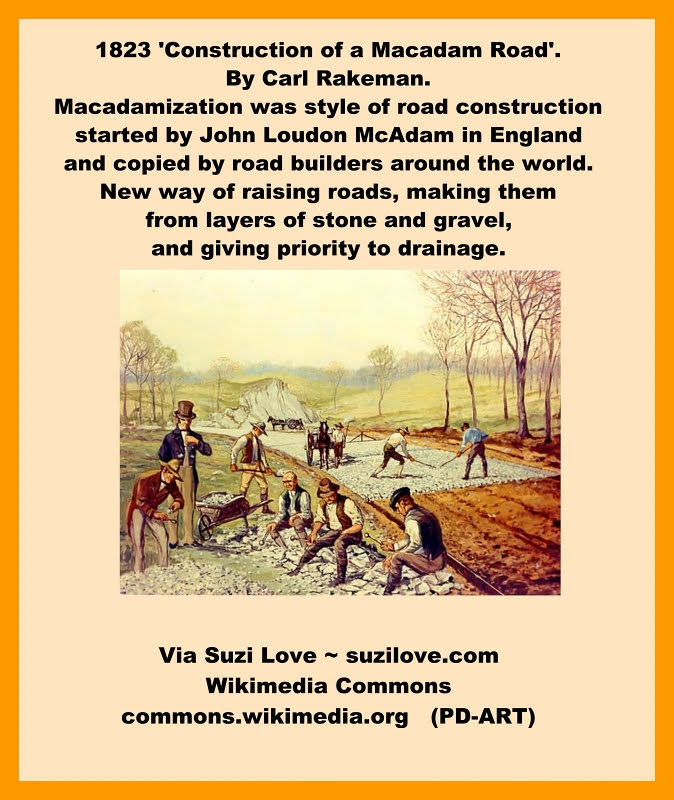
1823 ‘Construction of a Macadam Road’ by Carl Rakeman. Via Wikimedia Commons.
1823 ‘Construction of a Macadam Road’ by Carl Rakeman. Via Wikimedia Commons.
Travel on these roads was also dangerous as highwaymen stopped and robbed anyone who came along. Male or female made no difference to highwaymen in Britain, nor to the bushrangers in Australia or the gangs on American roads, as they robbed indiscriminately and often with violence.
By the end of the 18th Century, however, travel as a pleasurable pursuit came into vogue and numerous guides were written for traveling all over the British Isles as well as on the continent.
The 1812 ‘Tour Of Dr. Syntax’ was an ironic look at the new obsession of travel and travel guides. Before he set off for the Lake District, Dr. Syntax said to his wife, “You well know what my pen can do, and I’ll employ my pencil too: I’ll ride and write, and sketch and print and thus create a real mint: I’ll prose it here, I’ll verse it there and picturesque it everywhere. I’ll do what all have done before; I think I shall and somewhat more.”
Georgian and Regency travelers were envious of aristocrats, even if they were of the nobility themselves, and loved to view all the British Great Houses.
A gentleman and his wife would even drive up to the front door of a mansion house and demand to be given a tour of the house. If they weren’t admitted, they would write in their journals of the inhospitable nature of the people on a particular estate. Thomas Pennant, William Mavor, and others, loved to write about these bad experiences and have them published. Paterson’s British Itinerary, a travel guide had 17 editions between 1785-1832 – it outlined the roads used by the stage and mail coaches, the tolls, the bridges, etc.
This new touring craze created an industry of hospitality that encompassed more than simple mail coach trips from place to place, and more than a noble family traveling from their country seat to the Metropolis of London for parliamentary sittings. Inns had to improve the quality of the linens and meals if they wanted to attract the wealthier traveling class. Before that, many travelers carried their own linen, crockery, glasses, and utensils, as they didn’t trust the hygiene or standards of country inns.
Travel became something written about by poets with many sonnets written to the beauty of places like the Lake District in England, or the pyramids in Egypt. Inns became cleaner and more respectable so they could welcome travelers of the upper classes. This also meant that women could travel more as roads were slowly improved from rutted tracks that were only suitable for horse riding to roads that family coaches could travel along, though these roads were still narrow and subject to extremes of weather, such as flooding. The race was on to travel from places like London to Edinburgh in the fastest possible time.
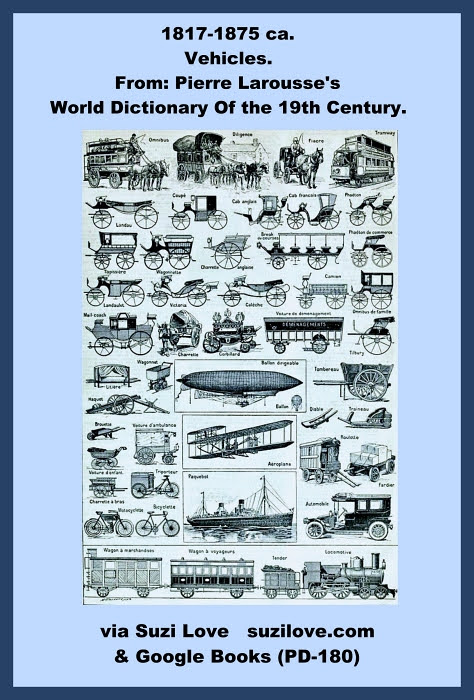
1817-1875 ca. Vehicles. From: Pierre Larousse’s World Dictionary Of the 19th Century.
1920-1922 ca. Automobiles.
HN_10_D2D_RetailerBuyLink_ History Notes Book 10 books2read.com/SuziLoveTravel
1812 October Autumnal Carriage Or Morning Costume, English. Loose white jaconet muslin dress, high in the neck, with double frills of deep vandyke lace that fall over the Spencer. Blue satin Spencer ornamented with silver cord and buttons ‘en militaire’ and held at the throat with a cord and tassels, a quartered foundling cap of lace tied under the chin with a full band and decorated with an autumnal flower. Grey kid shoes, lemon gloves and a ridicule, or bag, of purple velvet. Fashion Plate via Rudolph Ackermann’s ‘The Repository of Arts’.
Dress – Morning: Worn either at home, out shopping, or for walking in the park or country. Presentable but not overly accessorized.
Spencer: Short body-hugging jacket worn for warmth &modesty. Said to have originated in accident to Lord Spencer in hunting when coattails torn off.
1811 Evening Dress, French. Red cashmere dress over white under shirt with short puffed sleeves, carrying a white shawl, long white gloves, earrings and white evening shoes. Fashion Plate via Journal des Dames et des Modes, or Costume Parisien. Though this is a French fashion plate, the outfit is typical of the dresses worn by Jane Austen and her contemporaries. An Empire style, or high-waisted, dress with a white underdress and for warmth there is an extra layer with the shawl.
Definition Cashmere: Soft, fine wool, historically used for costly dress fabric, usually in twill weave. Originally made of yarn handspun from the wool of Cashmere goats but later from other soft wools. Used for dresses, infants’ coats.
1816 January Blue Carriage Dress, English. High neck but no collar, front is fitted but back has slight fullness and very short bodice. Puffed roll to decorate the hem, trimmed in bias cut blue satin, long sleeves finished at wrists with satin, gloves of white kid and ‘sandals’ or shoes of blue kid leather. Head-dress à la mode de Paris is an unusual cap of white lace and decorated with two rolls of ribbon. “We are indebted to the tasteful fancy of Mrs. Bean, of Albemarle Street, for both our dresses this month.” Fashion Plate via Rudolph Ackermann’s ‘The Repository of Arts’.
Jane Austen and her contemporaries would have worn this style of outdoor, or carriage ensemble with a coat over a dress. These outdoor dresses were labelled a variety of names. In England, this might also have been called a Walking Or Promenade dress, or Pelisse. In Europe, it would be called a Redingote.
Definition: Pelisse, Walking Dress, Carriage dress, Promenade Dress, Redingote. Long, fitted coat sometimes cut away in front to show off the dress underneath. Originally made for men with several capes and trimmed with large buttons, they were adapted to add an additional, and warmer, layer to the typical white muslin dresses worn in the early 1800s. Those light weight dresses were good in summer but not suited to harsh winters. Over the carriage dress, a shawl could be added as well as a muff to give a warm and comfortable outfit for traveling by carriage.
Fashion Women 1815-1819 History Notes Book 28 https://books2read.com/SuziLoveFashionWomen1815-1819