1883 Fashion Designs, American. Dresses hats and purses. Harper’s Bazar, New York City.
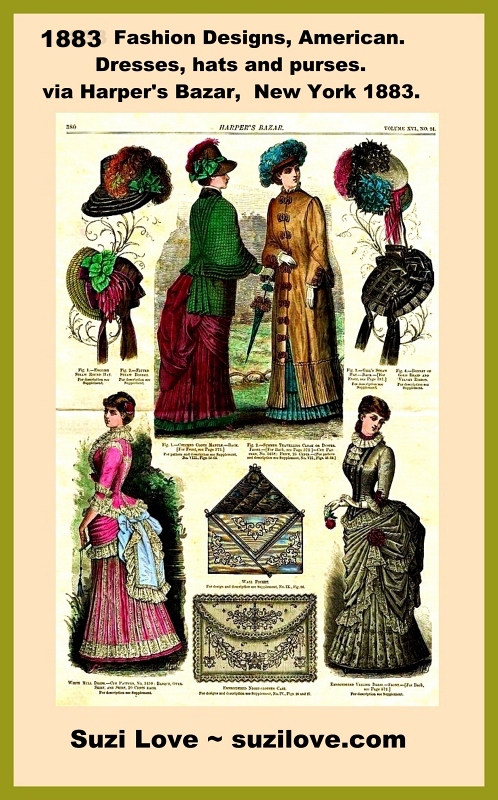


1883 Fashion Designs, American. Dresses hats and purses. Harper’s Bazar, New York City.
1805 Women’s Dresses and Fashion Accessories. Fashion plates from Fashions of London and Paris. Gorgeous Regency Era clothing came in a wide range of styles to suit every season and occasion. Ladies in Jane Austen’s times wore Empire style dresses which were usually of light fabric and floaty in style so accessories were essential to keep women warm. Accessory: item which contributes to the overall effect but is of secondary importance is the dictionary definition of an accessory, but the term has only been applied in relation to personal appearance since the 19th century. As defined by dress historians, accessories usually complete an outfit and are chosen to complement it. Accessories fall into two groups: Those worn, such as bonnets, caps and hats, boots and shoes, cravats and ties, gloves, mittens and muffs, jewellery, scarves and shawls, socks and stockings. Those that are carried, such as bags, canes, fans, parasols and umbrellas, and swords.


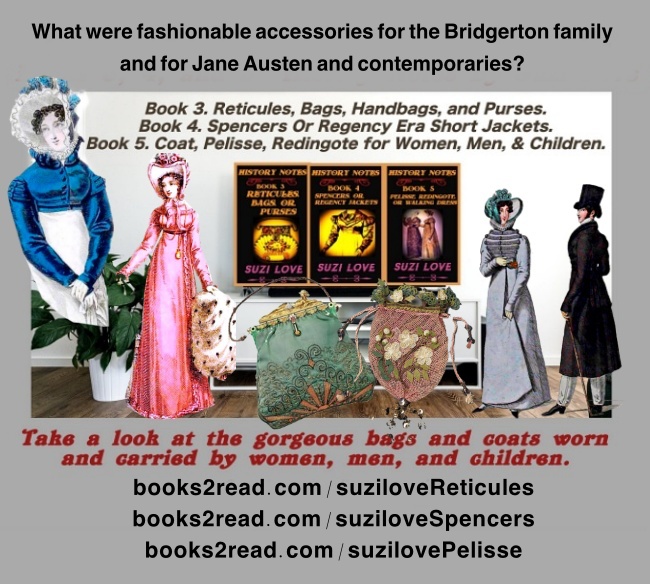
Want a glimpse into the life of a young lady in Jane Austen and the Bridgerton years? #bridgerton #RegencyEra #JaneAusten
Young Lady’s Day is Book 4 in the Regency Life Series.
This book depicts the often-frivolous life and fashions of a young lady in the early 1800’s, but also gives a glimpse into the more serious occupations a young lady may undertake. Through historic images, historical information, and funny anecdotes, it shows how a young lady fills her day, where she is permitted to go, and who she is allowed spend time with. These light-hearted looks at the longer Regency years are an easy to read overview of what people did and wore, and where they worked and played. There is plenty of information to interest history buffs, and lots of pictures to help readers and writers of historical fiction visualize the people and places from the last years of the 18th Century until Queen Victoria took the throne. https://books2read.com/suziloveYLD
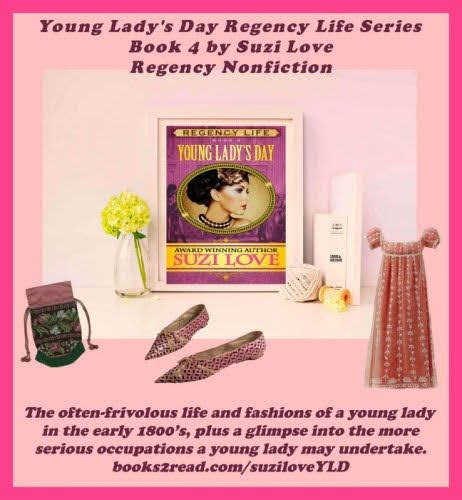

Love the life of Jane Austen and her stories? Fan of the Bridgerton series? Reader or writer of the early 1800s, or Regency Era? For information and pictures, try Regency Life Series by Suzi Love. Light-hearted series about Regency Era, or early 1800s. For writers, readers and history lovers.
Thes books use historic images, historical information, and funny anecdotes to give an overview of life through the late Georgian and the Regency years. A light-hearted look at the people, places, and fashions of the times, plus an easy to read overview of the politics and economics. There is plenty of information to interest history buffs, and lots of pictures to help readers and writers of historical fiction visualize the people and places from the last years of the 18th Century until Queen Victoria took the throne.
Try Books 1-5 Regency Life Series by Suzi Love. Regency Overview – Young Gentleman’s Day – Older Gentleman’s Day – Young Lady’s Day – Older Lady’s Day

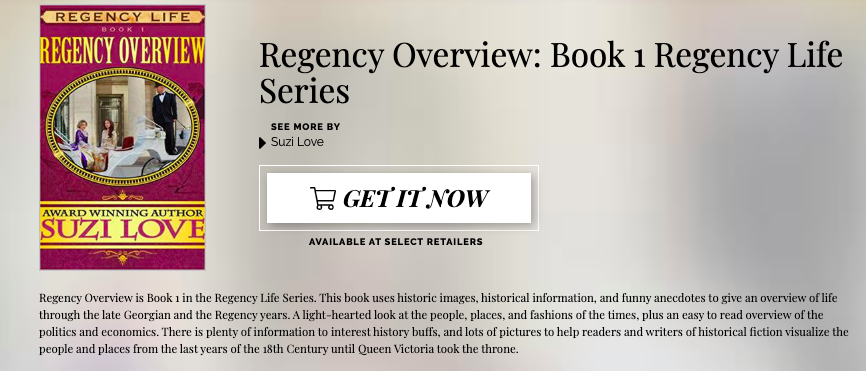
This book depicts the often-frivolous life and fashions of a young lady in the early 1800’s, but also gives a glimpse into the more serious occupations a young lady may undertake. Through historic images, historical information, and funny anecdotes, it shows how a young lady fills her day, where she is permitted to go, and who she is allowed spend time with. These light-hearted looks at the longer Regency years are an easy to read overview of what people did and wore, and where they worked and played. There is plenty of information to interest history buffs, and lots of pictures to help readers and writers of historical fiction visualize the people and places from the last years of the 18th Century until Queen Victoria took the throne. Young Lady’s Day Regency Life Series Book 4 by Suzi Love. https://books2read.com/suziloveYLD


1830 ca. Collection of Four Tiny Purses, or Reticules with drawstrings to close. via Ruby Lane Antiques. As would have been carried by ladies in Jane Austen and Bridgerton years.
Definition Of A Reticule; Bag or purse, often with a drawstring to pull closed and usually made of cloth or covered cardboard and often decorated with beading or embroidery. A reticule, or purse, or handbag, was usually carried by a woman during the Regency period to carry all their daily necessities. Earlier, women used pockets that tied at the waistline and were hidden in the folds of their skirts. Empire style, or early 1800s, high-waisted dresses made it impossible to either sewn in a pocket or to tie on a pocket, so women began carrying small, decorated bags called Reticules, or ridicules, which generally pulled closed at the top with a drawstring. These Reticules, or bags, were the forerunners of our modern day purses.

An overview of women’s fashions in the first twenty years of the 19th century. What was fashionable for women in Jane Austen’s times, or the early 1800s. Wars were being fought around the globe so women’s fashion adopted a military look in support of soldiers. In Britain, the Prince Regent ruled instead of his father, King George III, so fashions, like the lifestyle, became more extravagant and accessories went from pretty to opulent. This set includes books 12, 25, 26, 27 and 28.
What was fashionable for women in Jane Austen’s times, or 1800s, or Regency Era. High-waisted dresses were extravagantly accessorized and hats, shoes, parasols and bags were added. Set includes History Notes Books 12, 25, 26, 27 and 28.
https://books2read.com/SuziLoveFashionWomenBoxSet


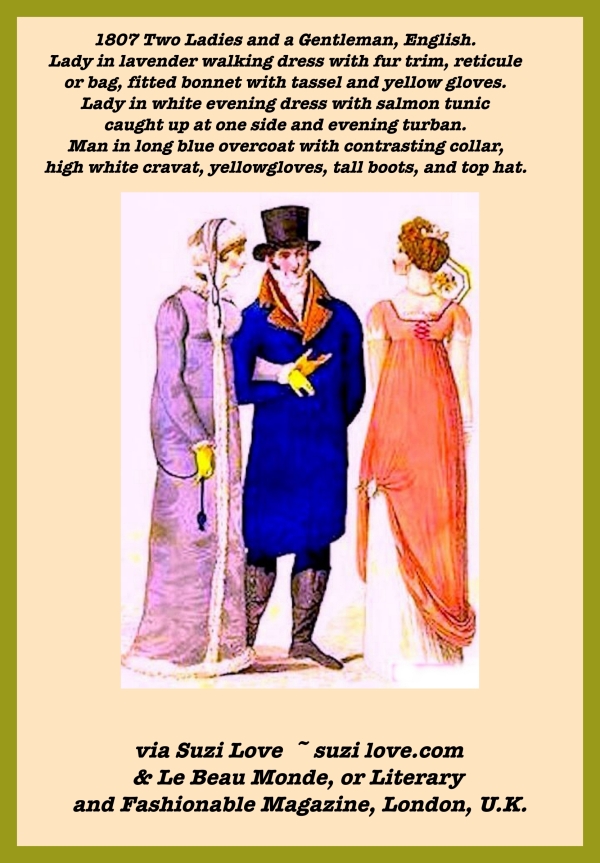
1807 Two Ladies and a Gentleman, English. Lady in lavender walking dress, or Pelisse, with fur trim, holding a blue reticule or bag, fitted lavender bonnet with tassel and yellow gloves. Lady in white evening dress with salmon tunic caught up at one side and evening turban. Man in long blue overcoat, or Redingote, with contrasting collar, high white cravat, yellow gloves, tall Hessian boots with tassels, and wearing a top hat. via Le Beau Monde, or Literary and Fashionable Magazine, London, U.K.
These are the types of outfits worn by Jane Austen and contemporaries in England and shown in their English magazines. The same designs had probably already been seen in France, because English publishers obsessively copied French fashions despite the two countries being at war for many years.