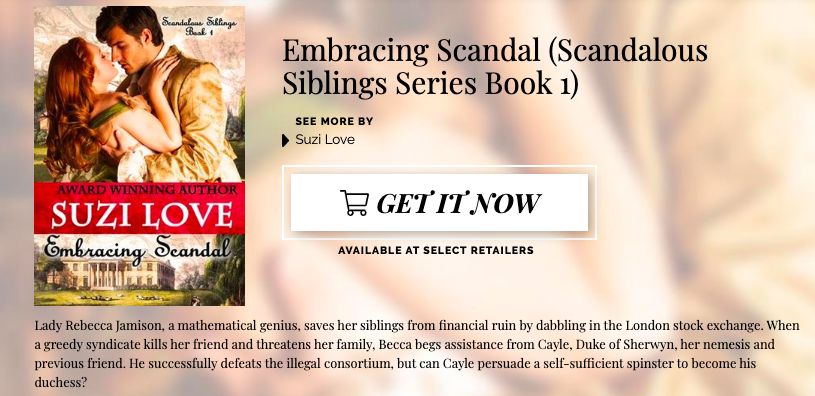
The finger prodded her chest again. Gently yet insistently. But his voice softened. “And I, the man, and the duke, choose you. You, Lady Rebecca. Do you think I can’t decide for myself, for my family, for you and me, what’s best?”
“But that’s what I’ve always done. It’s always been up to me to work out the best plan for everyone and then make it happen.” “In the past, that’s what happened.”
“But even now, it’s up to me to keep everyone safe. You said yourself that neither my family, nor the society, could go on without my making these types of decisions. I’m always the one with the clear head. In time, you’ll see that I’m right to walk away from you when this is finished.”
“No, no. This isn’t finished by a long shot, sweetheart. There has to be some consolation in my life for taking on control of Julia and my brothers, for assuming the family titles and topping up our coffers.”
“I know how hard you’re working to succeed. But it’ll never work if you have someone like me in your life.” “I don’t want someone like you, Becca. I want you.” This time his kiss was tinged with desperation. “Answer me one thing.” Her eyes widened. “Do you love me, minx? Do I still hold your heart?”
“Stop! It’s unfair to ask me that. Leave, please, just leave.” Turning away, Becca wished him gone before he glimpsed the fat tears collecting in her eyes. It was crucial that she remain strong. Even if it broke her heart to do so.As he reached the door, Becca heard Cayle mutter, “I will have you, Rebecca Jamison. I will not stop until I find a way.” She didn’t know whether it made her happy, or if it simply terrified her.
1815 White Walking Dress, English. Lady reading outside. Aqua pelisse, or coat, open to reveal a yellow lining, yellow gloves, high bonnet with feathers and blue shoes. Jane Austen and her family and friends would have worn this style of walking ensemble and as Jane Austen was very fond of reading, it’s easy to picture her looking like this. Fashion Plate via Rudolph Ackermann’s ‘The Repository of Arts’.
Nothing had prepared Lady Katharine Montgomery for the jumble of feelings overwhelming her when Alex worshipped her body, first with words and later with his hands and mouth. For years around this house, she’d been forced to appear dowdy, unintelligent, and totally self-effacing to never anger her father, or draw his wrath. Now, though, every degrading restriction was lifted from her mind, body, and life.
Her father was dead. Yesterday, she’d buried her hatred for the despicable man who’d given her life during the quarter hour it took to stand at his grave and, along with all the other hypocrites present, pretend to mourn as they buried his mortal remains. He’d cheated traders, beaten plantation workers, and horse-whipped her within an inch of her life. She and all the other mourners hoped he’d rot in hell.
Last night, she’d felt free to liberate the passionate nature she’d kept buried for six and twenty years for fear of her father’s explosive wrath. But one night with Lord Alexander St. John had changed everything. One night with a lover who was gentle and caring had her aching for more, more of Alex and more of life with him.
1815 March Brown Promenade Dress, English. High-waisted dress with decorative hem, white sleeves, white fichu, blue scarf, brown hat decorated with flowers. Jane Austen and her contemporaries would have worn this style of outdoor walking outfit and flowered hat. Fashion Plate via The Lady’s Magazine Or Entertaining Companion for the Fair Sex.
Definition Redingote: Woman’s long, fitted coat often worn open in front to show off the dress underneath. Sometimes cut away in front. Originally made with several capes and trimmed with large buttons. French word developed from English words, riding coat. reefer. Single- or double-breasted, fitted, tailored, over-all coat usually made from sturdy fabric.
Definition Fichu: A piece of lace, muslin, or other cloth worn about the neck and cleavage to preserve a lady’s modesty. From French word meaning neckerchief.
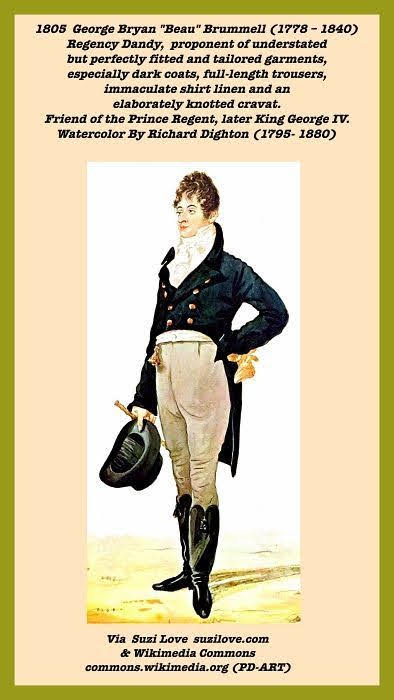
George Bryan “Beau” Brummell (June 7th 1778 – March 30th 1840) Arbiter of men’s fashion and friend of the Prince Regent, the future King George IV. Established mode of dress for men that rejected overly ornate fashions for understated but perfectly fitted and tailored clothing. Look based on dark coats, full-length trousers rather than knee breeches and stockings, with immaculate shirt linen and an elaborately knotted cravat. 1855 Engraving of Beau Brummell from an article in Harper’s New Monthly Magazine.
“Be warned, my lord,” the woman said. “I shall return. Tomorrow. Early. Very early. And if you refuse to speak with me, I’ll haunt your house until you are prepared to listen to me.”
Justin Tremayne, Viscount Hawkesbury, felt the air suck out of the room. Movements ceased, breaths held, no one spoke. Every person in the room, including the courtesans, was aware of the reason he’d spent four years debasing himself before the wealthiest members of the ton.
The reason he forced himself to get out of bed each day, to place one foot in front of the other and go through the rituals, the pretense of living a normal life. Why he arranged wild bedroom antics for women and men that he barely knew and certainly didn’t like or respect. His guilt festered like an open wound and the pain never lessened. His obsession was to locate his mother and two sisters, to bring them home, and try to make amends for his absence at the time his deranged father had evicted them.
Unable to reply, he shook his head, robbed of coherent thought, unable to believe her declaration. Unable to convince himself it wasn’t another misery-causing lie. Unable to gather the energy to conclude his night’s business. Nothing mattered above the bait she dangled before his nose, the thing he yearned for more than any other—to bring his family back to him. This tiny despot had forced him into negotiating with her.
“Bart, Thomas. I ask you to leave me to my visitor. Then I’m off to find my bed.”
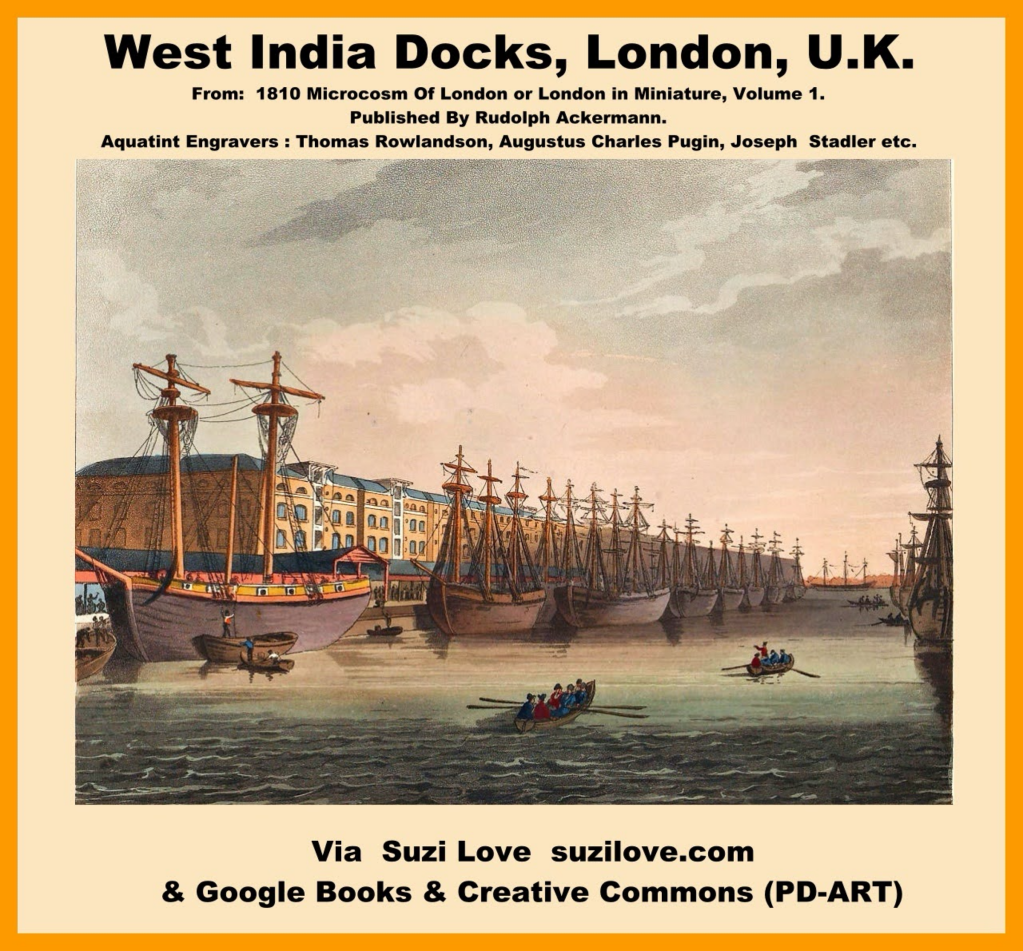
1810 January 1st. West India Docks, London. By Thomas Rowlandson and Augustus Charles Pugin. Printed in 1810 By Rudolph Ackermann in Microcosm Of London, or London In Miniature. Volume 1. Aquatint showing warehouses at quayside and several West Indiamen moored alongside. Warehouses held thousands of tons of cargo, including sugar, rum, molasses, coffee, spices and hardwood. Docks were constructed by powerful group of businessmen led by Robert Milligan, wealthy merchant and ship-owner outraged at losses suffered due to theft and delay at riverside wharves. via National Maritime Museum, Greenwich, London, U.K. ~ collections.rmg.co.uk
East and West India Docks London’s Historic Places
The East India Docks was a group of docks in Blackwall, east London, north-east of the Isle of Dogs. In 1607, the East India Company decided to build its own ships and leased a yard in Deptford. In 1614 the East India Company ordered William Burrell to begin work on a bigger yard for repair, construction and loading of out-going ships. The site selected was at Blackwall, which was further down river and had deeper water, allowing laden ships to moor closer to the dock. During the early 17th century, the site was enlarged repeatedly. Later in the 17th century, the East India Company reverted to its practice of hiring vessels, although many owners who chartered their vessel to the East India Company had them built at Deptford and Blackwall.
Before 1800, the Thames river was overcrowded with ships. They carried cargoes of tea, china and cloth in their lower parts along with casks of water, salted meat, beer, wine and rum for their crews. Brandy, wine, and tobacco were also shipped and stored in the warehouses. In 1800, the London Dock Company was formed and the planned docks in Wapping went ahead in 1801. The first was the West India Dock. In 1806, the East India Company opened their own docks to the north-east of the West India Docks after deciding that the Brunswick Dock at Blackwall, where ships were fitted out, was unsuitable for storing cargo.
The Brunswick Dock, which had originally been connected directly to the Thames to the south, became the Export Dock. To the north the company built a larger 18-acre (7.3 ha) Import Dock. Both were connected to the Thames via an eastern entrance basin. The number of ships discharged in the docks rose from 354 in 1804, to 598 in 1808, and to 641 in 1810. In 1808, the warehouses were full, as blockades prevented the re-export of goods. The dock company calculated that the almost total prevention of theft made possible by the building of the docks was saving West India merchants almost £400,000, and the Exchequer about £150,000 each year. During the 1840s and early 1850s, shipping and tonnage handled at the East and West India docks increased so much that dividends of 5 and 6 per cent were paid.
The East India Docks didn’t have many warehouses because cargoes were taken straight to their warehouses in the City. So instead of building warehouses, the company built private toll roads like Commercial Road and East India Dock Road to carry traffic to and from the docks.
The company made large profits on tea, spices, indigo, silk and Persian carpets. The tea trade alone was worth £30m a year. Spice merchants and pepper grinders set up around the dock to process goods. Although the East India docks were smaller than the West India Docks, they handled up to 250 ships at one time and East Indiamen of 1000 tons but larger ships and steam power reduced the importance of the dock.
The West India Docks were a series of three docks, quaysides, and warehouses built to import goods from, and export goods and occasionally passengers to the British West Indies. In 1802, the first dock opened on the Isle Of Dogs. When they closed for commerce in 1980, the Canary Wharf development was built around the wet docks by narrowing some of their broadest tracts.
The docks were constructed in two phases. The two northern docks were constructed between 1800 and 1802 for the West India Dock Company and were the first commercial wet docks in London. For 21 years, all vessels in the West India trade using the Port Of London had to use the West India docks by a clause in the act of Parliament that had enabled their construction.
In 1838 the East and West India companies merged. The southern dock, the South West India Dock, later known as South Dock, was constructed in the 1860s and in 1909 the Port Of London Authority took over the West India Docks,
The docks played a key role in the Second World War as a location for constructing the floating Mulberry harbours used by the Allies to support the D-Day landings in France. Following the Second World War, in which all the docks were badly damaged, the East India Docks were confined to occasional Channel Islands traffic and to the maintenance of dredger equipment.
The docks were the first London docks to close, in 1967. Today the docks have been mostly filled in. Only the entrance basin remains, as a wildlife refuge and an attractive local amenity. The area is predominantly residential with several major developments around it.
1815 Arundel Fete Dress and Baronial Helmet, English. White dress with purple bodice and hem with matching shawl and plumed headdress. Skirt of white crape over white satin, a double row of novel and elegant trimmings on the bottom, two falls of the crape, set on full, are edged with silk. Body comes high on each side of the bosom and is shaped so as to display the neck and shoulders, and both body and sleeves are formed and trimmed in the most exquisitely tasteful manner. A superb cord and tassels confines the waist and ties in front. The Baronial Helmet is striking and made of white sarsnet or satin and white lace and superbly ornamented with feathers. Jewelry set, or Grand Parure, of necklace, bracelets. ear-rings, and small French locket of pearl. White kid slippers and gloves. Full Dress for evening would most likely be a dress of silk or satin, perhaps with a transparent overlay of netting, tulle etc., embellished with taffeta, ruffles and ribbons, and with a full range of accessories including a Grand Parure of tiara and other matching jewelry. https://books2read.com/SuziLoveFashionWomen1815-1819
La Belle Assemblee: Fashion Plate via John Belle’s La Belle Assemblée or, Bell’s Court and Fashionable Magazine, London. Many of the fashion plates seen in La Belle Assemblée and The Repository of Arts were designed by Mrs. Bell who had her dressmaking showroom in Bedford Square, London, and was related to John Bell who published La Belle Assemblée. It seems that she designed for at least two fashion magazines and so there is a cross-over of designs in different magazines.
Grand Parure: A Parure is a matched set of jewelry, including a necklace, bracelet, earrings, pin etc. and a Grand Parure often includes a tiara or other headdress.