1800s Early Women’s Half Boots, British, as worn by Jane Austen and her family and the Bridgerton ladies. Walking was encouraged for women so lace-up half-boots became a popular replacement for flimsy slippers for outdoor wear. Made of nankeen, a durable, yellow-colored, natural cotton from China or from colored leather. via Victoria and Albert Museum, London, UK. collections.vam.ac.uk
In Bridgerton and Jane Austen years, people were encouraged to partake in outdoor pursuits to maintain good health so walking became a daily pastime. Fragile slippers were worn for balls and evening events but for walking sturdier shoes were needed, In the early 1800s, these were typically made of leather, had a very small heel, slightly rounded toes and were laced up on the top.
1804 London Hairstyles,Turbans and Hats. Gold, Pink, and White With Feathers. Jane Austen and her friends would have worn gorgeous hats and turbans like these. via Fashion Plate via Fashions of London and Paris, Published By Richard Phillips, St. Paul’s Church Yard, London, UK.
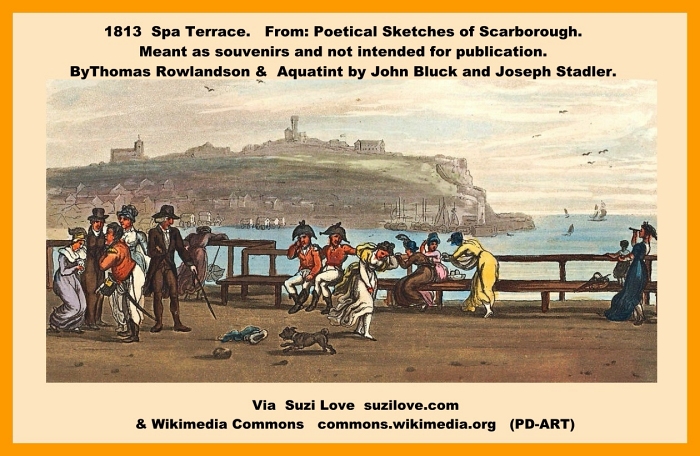
1813 Spa Terrace. From: Poetical Sketches of Scarborough. Meant as souvenirs and not intended for publication. By Thomas Rowlandson & Aquatint by John Bluck and Joseph Stadler. Via Wikimedia Commons commons.wikimedia.org (PD-ART) Spa towns were very fashionable retreats from London’s pollution for people in Jane Austen’s times.
1850–1859 ca. Silk Whalebone and Steel Corset, French. Pale green watered silk corset with black flossing and contrast stitching. via Fine Arts Museums Of San Francisco https://art.famsf.org
1820 ca. Groups of Dandies fashionably dressed. Hand Colored etching. Published By J. Le Petit, Dublin, U.K. Via British Museum, London, UK. britishmuseum.org (PD-Art)
A dandy is a man who places a lot of importance on his appearance, on having refined language living his life in a leisurely manner. A dandy didn’t have to be an aristocrat. He could also be a middle class man or a self-made man of wealth who could afford to place all his emphasis on his clothing and his leisure time.
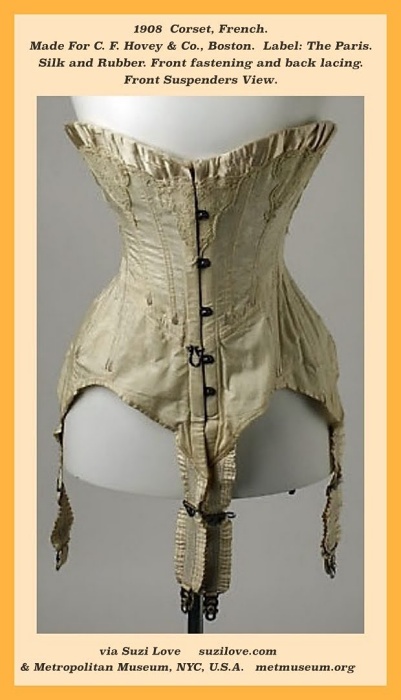
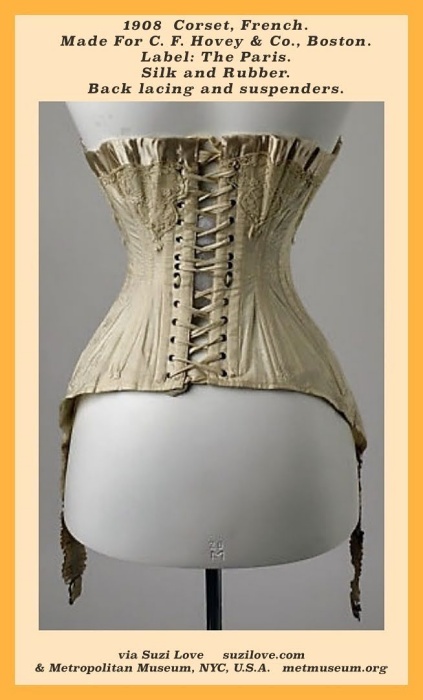
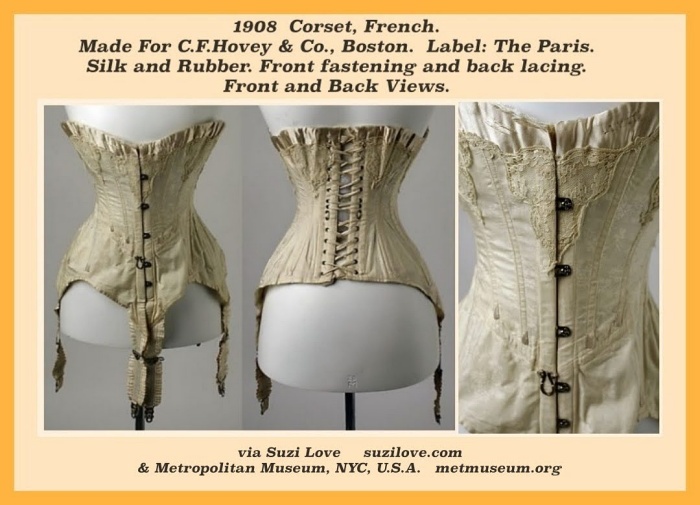
1908 Silk and Rubber Corset, French. Front fastening, front suspenders, and back lacing. Made For C. F. Hovey & Co., Boston. Label: The Paris. Marking: label “7.50, Made in France, Véritable Baleine, Brévété S.G.D.G., Best Whalebone THE PARIS, Made in France, expressly or C.F. Hovey and Co., Boston.” stamped on bone lining of corset]; “Corset de Paris” paper label via Metropolitan Museum, NYC, USA Credit Line: Gift of Mrs. Earl Rowe, 1951 Accession Number: C.I.51.15.25a, b
1908 Front Fastening View Of Corset, French. Made For C. F. Hovey & Co., Boston. Label: The Paris. Silk and Rubber. Front fastening and back lacing. via Suzi Love suzilove.com & Metropolitan Museum, NYC, U.S.A. metmuseum.org1908 Front Fastening View Of Corset, French. Made For C. F. Hovey & Co., Boston. Label: The Paris. Silk and Rubber. Front fastening and back lacing. via Suzi Love suzilove.com & Metropolitan Museum, NYC, U.S.A. metmuseum.org1908 Back Lacing Of Corset, French. Made For C. F. Hovey & Co., Boston. Label: The Paris. Silk and Rubber. Front fastening and back lacing. via Metropolitan Museum, NYC, U.S.A. metmuseum.org1908 Label For Front Fastening and Back Lacing Silk and Rubber Corset, French. Front fastening and back lacing. Made For C. F. Hovey & Co., Boston.1908 Front Suspenders and Back Lacing Silk and Rubber Corset, French. Front fastening and back lacing. Made For C. F. Hovey & Co., Boston.1908 Front Suspenders and Fastenings and Back Lacing Silk and Rubber Corset, French. Front fastening and back lacing. Made For C. F. Hovey & Co., Boston.1908 Silk and Rubber Corset, Front Fastenings and Suspenders and Back Lacing, French. #Edwardianera #Corset #HistoricalFashion #France #Boston books2read.com/SuziLoveCorsetBook21 Share on XCorsets 1900s History Notes Book 21
Corsets during early 1900s when a fashionable
silhouette became of paramount importance
and a well-fitted corset a fashion essential.
books2read.com/SuziLoveCorsetBook21
An overview of women’s fashions in the first twenty years of the 19th century. What was fashionable for women in Jane Austen’s times, or the early 1800s. Wars were being fought around the globe so women’s fashion adopted a military look in support of soldiers. In Britain, the Prince Regent ruled instead of his father, King George III, so fashions, like the lifestyle, became more extravagant and accessories went from pretty to opulent.
Reader Or Writer of Regency Era? Love Jane Austen and Bridgerton fashions? What was fashionable for women in Jane Austen’s times, or 1800s, or Regency Era. High-waisted dresses were extravagantly accessorized and hats, shoes, parasols and bags were added. Set includes History Notes Books 12, 25, 26, 27 and 28. https://books2read.com/SuziLoveFashionWomenBoxSet
Ladies clothing in the early 1800’s featured a high waist line called an Empire Line, or Empire style dress, with a waist line just under the natural bust line and much higher than the natural waist. The high-waisted, or short-bodied, Regency styles shifted focus away from the natural waist and so left the natural waist unconstricted, in direct contrast to previous and future styles. Britain took these simple European styles and progressively made them more elaborate by adding more and more complicated embroidery onto white fabrics to create the white on white look popular for many years.
The empire look of fine muslin dresses left women more exposed than in the Georgian Era when fabrics had been thicker and styles bulkier. Women, especially in England, preserved their modesty by adding lace, frills, flounces, ruches, and fabric plaits to dresses to adequately cover any parts that might inadvertently be exposed. Outer layers, such as Spencers, Redingotes or Pelisses or coats, and shawls, were also added for warmth and to brighten outfits. This Empire fashion was totally dependent on a supply of fine, translucent cotton muslin – at first imported from India, then later, less exclusive imitations often woven and printed or embroidered in Britain. Fabrics were soft and lightweight and muslins and other cotton fabrics from India and other Asian countries were in high demand.
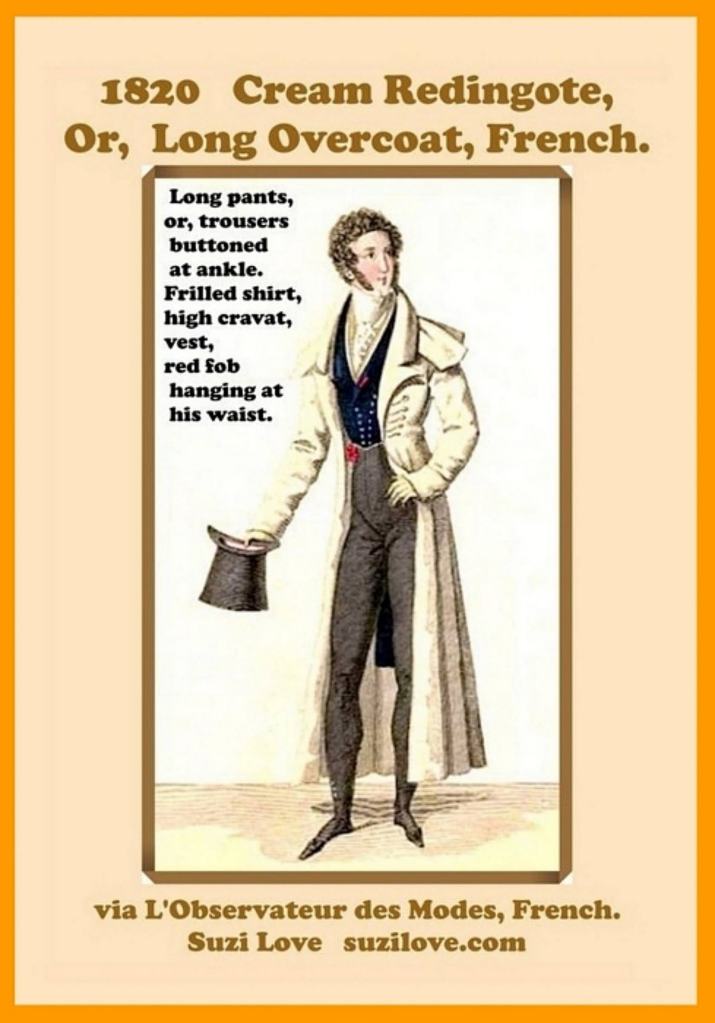
1820 Gentleman’s Cream Redingote, Or Long Overcoat, French. Long pants, or trousers, buttoned at the ankles, frilled shirt, high cravat, vest, red fob hanging at his waist. via L’Observateur des Modes, French.
Reader or Writer of Regency Era Books? Love the Bridgertons and Jane Austen? Nonfiction book, Older Gentleman’s Day, gives an overview of his daily life by Award Winning researcher and author, Suzi Love. A sometimes comical look at an older gentleman’s clothing, social life, and responsibilities in the early 1800s. Take a look at where he went, what he wore, and how he managed the family’s finances. Older Gentleman’s Day, Regency Life Series Book 3 books2read.com/suziloveOGD