1900 Friendship, or, Hoof Faberge Egg, Russia. Presented by Tzarina Alexandra to one of her friends. Red gold bowenite, diamonds, rubies and pearls.
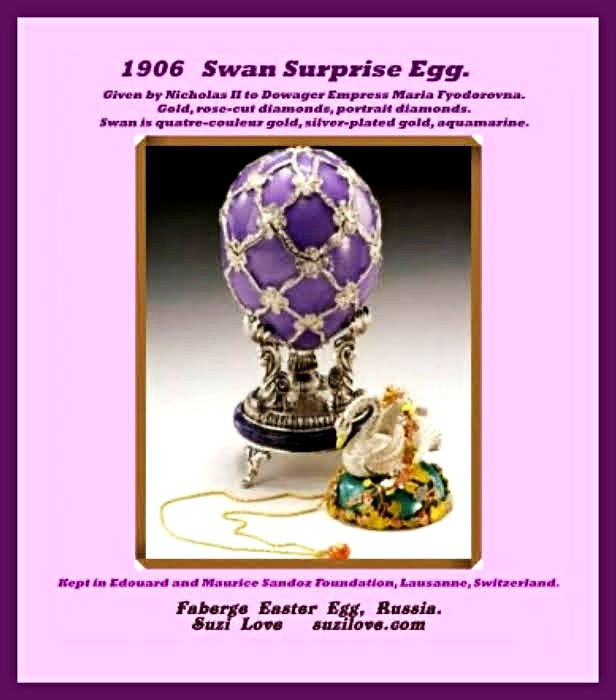
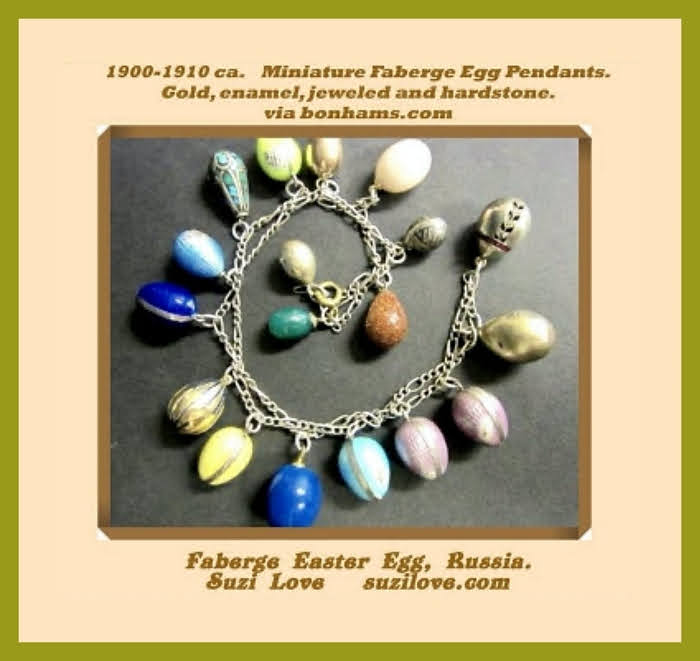
The name Faberge is associated with the Russian Imperial family for whom most of the world’s most famous eggs were created. In 1870, Faberge inherited his father’s jewelry business and quickly became known for his brilliant designs. A display of his work and the gold medal he was awarded in Moscow’s Pan-Russian Exhibition of 1882 brought him to the attention of the Russian nobility. In 1885, Faberge was commissioned by Tsar Alexander III of Russia to create an Easter egg for his wife, the Empress Maria Fedorovna. This became known as The Hen Egg, the first Imperial Faberge Egg, and is made of gold. The Empress was so happy with the gift that Alexander appointed Fabergé a ‘Goldsmith by Special Appointment to the Imperial Crown’ and the following year commissioned another egg. From then on, Faberge was given complete freedom with future Imperial designs which become even more elaborate every year. A famous Fabergé egg is one of sixty eight jeweled eggs made by Fabergé and his assistants for the Russian Tzars and private collectors between 1885 and 1917. After the Russian Revolution, the House of Faberge was nationalized by the Bolsheviks and the Faberge family fled to Switzerland where Peter Carl Faberge died in 1920. Several of the Faberge Imperial eggs are still missing.1900 Friendship, or, Hoof #Faberge #Easter Egg. Presented by Tzarina Alexandra to one of her friends. Red gold bowenite, diamonds, rubies and pearls. Faberge Easter Egg, Russia.
1916 Steel Military Surprise Faberge Easter Egg, Russia. Gift from Nicholas II to his wife Tzaritsa Alexandra Fyodorovna. Surprise is a miniature painting on an easel of the Tzarin planning with his generals in field. Faberge Easter Egg, Russia.
The name Faberge is associated with the Russian Imperial family for whom most of the world’s most famous eggs were created. In 1870, Faberge inherited his father’s jewelry business and quickly became known for his brilliant designs. A display of his work and the gold medal he was awarded in Moscow’s Pan-Russian Exhibition of 1882 brought him to the attention of the Russian nobility. In 1885, Faberge was commissioned by Tsar Alexander III of Russia to create an Easter egg for his wife, the Empress Maria Fedorovna. This became known as The Hen Egg, the first Imperial Faberge Egg, and is made of gold. The Empress was so happy with the gift that Alexander appointed Fabergé a ‘Goldsmith by Special Appointment to the Imperial Crown’ and the following year commissioned another egg. From then on, Faberge was given complete freedom with future Imperial designs which become even more elaborate every year. A famous Fabergé egg is one of sixty eight jeweled eggs made by Fabergé and his assistants for the Russian Tzars and private collectors between 1885 and 1917. After the Russian Revolution, the House of Faberge was nationalized by the Bolsheviks and the Faberge family fled to Switzerland where Peter Carl Faberge died in 1920. Several of the Faberge Imperial eggs are still missing.
What did the Bridgerton ladies and Jane Austen use to carry her personal items? Ridicule, Reticule, Or Handbag? Call them what you like: purses, bags, handbags, reticules, ridicules, clutches, or pocket replacements. They all did the same job and they changed greatly with the prevailing fashions of time. books2read.com/suziloveReticules
Definition Of A Reticule; Bag or purse, often with a drawstring to pull closed and usually made of cloth or covered cardboard and often decorated with beading or embroidery. A reticule, or purse, or handbag, was usually carried by a woman during the Regency period to carry all their daily necessities. Earlier, women used pockets that tied at the waistline and were hidden in the folds of their skirts. Empire style, or early 1800s, high-waisted dresses made it impossible to either sewn in a pocket or to tie on a pocket, so women began carrying small, decorated bags called Reticules, or ridicules, which generally pulled close at the top with a drawstring. These Reticules, or bags, were the forerunners of our modern day purses.
The term ‘ridicule’ derived from the Latin ‘ridiculum’ and first used in France during the 17th century and meant subjecting something or someone to mockery. As women’s tiny bags were mocked, or ridiculed, for being a useless fashion accessory carried outside when they were first used in the late 1700s, it’s likely this is how the name ‘ridicule’ started. The later term ‘reticule’ derived from the Latin reticulum, meaning ‘netted bag’ and was applied when bags became larger and often made from netting. In the late 1700s and early 1800s, they were also known as indispensables as they carried all the personal items a lady needed upon her person every day. They were easily made by ladies, easy to carry and became an indispensable fashion accessory.
In the early nineteenth century, reticules started to look like future handbags as they were often made from rigid card or molded mâché or card into a variety of shapes. Early bags were circular and with a drawstring but as women wanted their reticules to look individual they could be made with two halves and a hinged metal closure or with concertina sides. Materials varied from silk, cotton and string and shapes were round, hexagonal or lozenge shapes with shell shaped bags becoming very popular during the Regency and Romantic Eras.
1800s magazines were written for well bred women who could read, so they gave plenty of ideas for how ladies could make and embellish reticules for their own use and as pretty gifts. Needlework was highly encouraged as a pastime for a lady so bags were frequently embroidered or decorated with beading. By the 1820s, reticules became more like our modern handbags using soft leather gathered at the top or hard leather with a rigid fastener and metal chain for carrying.
1900 Mosaic Faberge Surprise Egg, Russia. For Tzarina Alexandra Fyodorovna The miniature frame is painted with the profiles of the five Imperial-Russian children on an opalescent pink enamel ground. Faberge Easter Egg, Russia.
1899-1903 ca. Spring Flowers Imperial Surprise Faberge Easter Egg. Gold, platinum diamonds, bowenite, white agate, demantoid, garnets, and enamel. By Mikhail Perhkin. Via Viktor Vekselberg Collection in Russia. Faberge Easter Egg, Russia. Faberge Easter Egg, Russia.
While writing about perfumes and oils, a favourite subject of mine, for my book, Scenting Scandal, I sniffed out some fascinating snippets on the history of early perfume suppliers in London. I have a nose for these things ( He He!) as in my past life I also blended oils and perfumes. One name stood out in historic London- Juan Floris.
He opened his shop at 89 Jerym St. in the elegant quarter of St. James’ London soon after his arrival from the Mediterranean in 1730. After starting as a barber and comb-maker, he missed the aromas of his Mediterranean youth and began blending oils, essences and fixatives, from Europe, into the first Floris fragrances.
‘ Purveyors of The Finest Perfumes & Toiletries to the Court of St James’ Since the Year 1730.’
In the same manner that Fortnum & Mason held Royal Warrants to supply groceries to the Royals, Floris held Royal Warrants to supply perfumes, shaving items and toiletries.
The first Royal Warrant granted to J.Floris Ltd was in 1820 as ‘Smooth Pointed Comb-makers’ to the then newly appointed King George IV. Then, the social elite followed the court until the Floris ledgers held accounts for an array of public figures, including practically every European Royal. Combs, tooth brushes and mouth washes were greatly valued by the company’s elite clientele.
These days, and at the same premises, Floris still supplies royalty and world celebrities with an array of fragrances and bathroom accessories.
The Floris archives hold letters from famous customers detailing their preferences and their thanks, including the following examples:
Winston Churchill, according to records held by Floris, purchased Special No. 127 Eau de Toilette and Stephanotis in 1934.
Marilyn Monroe was also known to have purchased from Floris on at least one occasion, having made a purchase of Rose Geranium while staying at the Beverly Hills Hotel, California in 1959.
Florence Nightingale wrote a 25 July 1863 letter thanking Mr Floris for his ‘sweet-smelling nosegay’.
Mary Shelley, whilst abroad, sent friends instructions to purchase her favourite combs and toothbrushes from Floris.
Beau Brummell in the early 19th century would discuss his current fragrances at length with Mr Floris.
1911 Orange Tree, or, Bay Tree Faberge Imperial Easter Egg. Gift to Maria from her son. Automaton nightingale emerges and sings when the correct orange is turned. Gold, jade, diamonds, vitrines, amethysts, rubies, pearls, agates, and bird has feathers. Faberge Easter Egg, Russia.
The name Faberge is associated with the Russian Imperial family for whom most of the world’s most famous eggs were created. In 1870, Faberge inherited his father’s jewelry business and quickly became known for his brilliant designs. A display of his work and the gold medal he was awarded in Moscow’s Pan-Russian Exhibition of 1882 brought him to the attention of the Russian nobility.In 1885, Faberge was commissioned by Tsar Alexander III of Russia to create an Easter egg for his wife, the Empress Maria Fedorovna. This became known as The Hen Egg, the first Imperial Faberge Egg, and is made of gold. The Empress was so happy with the gift that Alexander appointed Fabergé a ‘Goldsmith by Special Appointment to the Imperial Crown’ and the following year commissioned another egg. From then on, Faberge was given complete freedom with future Imperial designs which become even more elaborate every year. A famous Fabergé egg is one of sixty eight jeweled eggs made by Fabergé and his assistants for the Russian Tzars and private collectors between 1885 and 1917.After the Russian Revolution, the House of Faberge was nationalized by the Bolsheviks and the Faberge family fled to Switzerland where Peter Carl Faberge died in 1920. Several of the Faberge Imperial eggs are still missing.
The name Faberge is associated with the Russian Imperial family for whom most of the world’s most famous eggs were created. In 1870, Faberge inherited his father’s jewelry business and quickly became known for his brilliant designs. A display of his work and the gold medal he was awarded in Moscow’s Pan-Russian Exhibition of 1882 brought him to the attention of the Russian nobility.
In 1885, Faberge was commissioned by Tsar Alexander III of Russia to create an Easter egg for his wife, the Empress Maria Fedorovna. This became known as The Hen Egg, the first Imperial Faberge Egg, and is made of gold. The Empress was so happy with the gift that Alexander appointed Fabergé a ‘Goldsmith by Special Appointment to the Imperial Crown’ and the following year commissioned another egg. From then on, Faberge was given complete freedom with future Imperial designs which become even more elaborate every year. A famous Fabergé egg is one of sixty eight jeweled eggs made by Fabergé and his assistants for the Russian Tzars and private collectors between 1885 and 1917.
After the Russian Revolution, the House of Faberge was nationalized by the Bolsheviks and the Faberge family fled to Switzerland where Peter Carl Faberge died in 1920. Several of the Faberge Imperial eggs are still missing.
1900 Cockerel Faberge Easter Egg, or, Cuckoo Clock Egg was given by Tsar Nicholas II to Empress Maria Feodoronova. Mechanism on top rear enables its bird to come out and move. The egg is part of the Viktor Vekselberg Collection, owned by The Link of Times Foundation, and housed in the Fabergé Museum in Saint Petersburg, Russia. Faberge Easter Egg, Russia.
As some of my historical romance books are set in a house in Grosvenor Square, its history fascinates me. How about you? Do you love the history associated with Grosvenor Square? The Jamison family in Embracing Scandal and Scenting Scandal live in Grosvenor Square.
Grosvenor Square - Pronounced ˈɡrovna’, is a large garden square in the exclusive Mayfair district and the centrepiece of the Mayfair property of the Duke of Westminster and takes its name from their surname, “Grosvenor”.
In 1710, Sir Richard Grosvenor obtained a licence to develop Grosvenor Square and the surrounding streets and development started around 1721. Grosvenor Square became one of the most fashionable residential addresses in London from its construction until the Second World War, with numerous leading members of the aristocracy in residence. The early houses had five or seven bays, basement, three main stories, and an attic. Colen Campbell produced a design for a palatial east side to the square featuring thirty Corinthian columns but this was not carried out and in the end most of the houses were built to individual designs. There were mews behind all four sides. Many houses were rebuilt later and acquired an extra storey. Number 23 (later 26) was rebuilt in 1773–74 for the 11th Earl of Derby by Robert Adam and shows how grandeur of effect and sophisticated planning might be achieved on a confined site. It was demolished and rebuilt again in the 1860s.
1761 – Sir Richard Grosvenor, the 7th Baronet, was created Baron Grosvenor of Eaton in the County of Chester
1784 – Became Viscount Belgrave and Earl Grosvenor under George III.
1831- At coronation of William IV, Robert Grosvenor, the 2nd Earl Grosvenor, became Marquess of Westminster
1874 – Queen Victoria created the title Duke of Westminster and bestowed it upon Hugh Grosvenor, 3rd Marquess of Westminster.
Current title holder is Gerald Grosvenor, 6th Duke of Westminster and his seat is at Eaton Hall, Cheshire The Dukedom and Marquessate are in the Peerage of the United Kingdom The rest are in the Peerage of Great Britain. The courtesy title of the eldest son and heir to the Duke is Earl Grosvenor.
Nearly all of the older houses were demolished during the 20th century and replaced with blocks of flats in a neo-Georgian style, hotels and embassies. The central garden was originally reserved for the occupants of the houses but is now a public park managed by The Royal Parks. Grosvenor Square. Grosvenor Square has been the traditional home of the official American presence in London since John Adams established the first American mission to the Court of St. James’s in 1785. Adams lived, from 1785 to 1788, in the house which still stands on the corner of Brook and Duke Streets. During World War II, Eisenhower established a military headquarters at 20 Grosvenor Square, and during this time the square was nicknamed “Eisenhower Platz”.
The former American Embassy of 1938–1960 on the square was purchased by the Canadian government and renamed Macdonald House. In 1960, a modern USA Embassy was built on the western side of Grosvenor Square and caused controversy in the mainly Georgian and neo-Georgian area. In 2008, the United States Government chose a site for a new embassy in the Nine Elms area, south of the River Thames with with relocation completed by 2016 or 2017. In October, 2009, English Heritage granted Grade II listed status to the building which means new owners will not be allowed to change the facade.
Grosvenor Square in Literature In Little Dorrit by Charles Dickens the Barnacles are said to live at “four Mews Street Grosvenor” which “was not absolutely Grosvenor Square itself but it was very near it”. Caroline Bingley makes a comment regarding the local dance in Pride and Prejudice ”We are a long way from Grosvenor Square, are we not, Mr Darcy”. It appears in the title of several novels including The Lonely Lady of Grosvenor Square by Mrs. Henry De La Pasture (1907) and The House in Grosvenor Square by Linore Rose Burkard (2009) In Oscar Wilde’s play Lady Windermere’s Fan, the Duchess of Berwick says, “I think on the whole that Grosvenor Square would be a more healthy place to reside in. There are lots of vulgar people live in Grosvenor Square, but at any rate there are no horrid kangaroos crawling about.”