1820 Gentleman’s Cream Redingote, Or Long Overcoat, French. Long pants, or trousers, buttoned at the ankles, frilled shirt, high cravat, vest, red fob hanging at his waist. via L’Observateur des Modes, French.

1820 Gentleman’s Cream Redingote, Or Long Overcoat, French. Long pants, or trousers, buttoned at the ankles, frilled shirt, high cravat, vest, red fob hanging at his waist. via L’Observateur des Modes, French.

Reader or Writer of Regency Era Books? Love the Bridgertons and Jane Austen? Nonfiction book, Older Gentleman’s Day, gives an overview of his daily life by Award Winning researcher and author, Suzi Love. A sometimes comical look at an older gentleman’s clothing, social life, and responsibilities in the early 1800s. Take a look at where he went, what he wore, and how he managed the family’s finances. Older Gentleman’s Day, Regency Life Series Book 3 books2read.com/suziloveOGD


1811 Walking Dress, French. High-waisted lavender Redingote over a white dress, paisley shawl, white gloves, slippers, and a ruched, or gathered fabric, hat to match the high ruched neck frill. Fashion Plate via Journal des Dames et des Modes, or Costume Parisien.


1817 November Morning Dress and Evening Dress, English. Morning Dress is a round dress of Jaconot muslin with back buttons, small collar open in front to display the throat, lower part of front with bias tucks, moderately full skirt finished around bottom with small tucks and deep flounce with bright rose ribbon. Rose velvet Spenser trimmed with white satin and rose silk, finished at throat with white satin puffings. Plain long sleeves, French style Leghorn bonnet trimmed with large rows of ribbon to match Spenser and tied under the chin, stand-up lace frill around throat, swansdown muff, straw kid sandals and gloves.

Evening dress of fawn crepe over a white satin slip, cut low around the bust, confined to waist by a narrow cestus of white satin, fastened in front by a brilliant clasp. Single fall of Mecklin lace on dress, very short full sleeve finished at bottom by a rouleau of white satin and narrow lace plait. Skirt trimmed with double row of white satin Spanish puffs, very full and in bias. Hair high, parted and curled on the forehead with garland of Provence roses. Pearl earrings and necklace, spangled crape fan, white kid gloves and white satin slippers. Fashion Plate via The Mirror of Fashion in The Ladies’ Monthly Museum, England.
1817 November Muslin Morning Dress and Crepe Evening Dress, English. #RegencyFashion #JaneAusten #FashionPlate https://books2read.com/SuziLoveFashionWomen1815-1819 Share on X
1811 Green Dress French. High waist with bow under the bust, Mamaluke sleeves as “a long full sleeve partitioned into five sections, each section being drawn and seamed to fit around the arm up sleeves, white collar lining, fashionable blue bonnet tied under the chin and wearing yellow shoes. The sort of fashionable outfit worn by women in Jane Austen’s times, or 1800s, or Regency Era. Fashion Plate via Journal des Dames et des Modes, or Costume Parisien.
Mamaluke Sleeves: Long full sleeves partitioned into five sections, each section being drawn and seamed to fit around the arm up.


1798 Gentleman’s Outfit, French. Long green overcoat with yellow buttons, tan gloves, black boots topped with yellow band, gloves with three seams across the back of the hand, high white cravat, black hat, fob at his waist and holding a cane. Fashion Plate via Journal des Dames et des Modes, or Costume Parisien.


1817 March. Opera Dress, English. The sort of outfit Jane Austen and her contemporaries or the Bridgerton women would wear for an evening at the opera or theatre. Fashion Plate via Rudolph Ackermann’s ‘The Repository of Arts’.
A blue crape dress over a white satin slip; the dress trimmed round the skirt with a deep blond lace, which is headed with a light and novel trimming, composed of white floss silk and small pearl beads: this trimming is surmounted with a beautiful deep embroidery of lilies, surrounded by leaves. The body and sleeves of this dress, as our readers will perceive by our print, are extremely novel. Head-dress, toque à la Berri; it is a crown of a novel form, tastefully ornamented round the top with lilies to correspond with the trimming of the skirt, and a plume of white feathers, which droop over the face. Ear-rings, necklace, and bracelets, sapphire mixed with pearl. The hair dressed in loose light ringlets on the forehead, and disposed in full curls in the back of the neck. White kid gloves, and white satin slippers.


1814 Couple In Walking Ensembles, French. Gentleman in a brown tailcoat with a notched collar and back pockets, vest, white breeches tied under his knees, red fob at the waist, white stockings, high white shirt collar, white cravat, top hat and cane. Lady in adorable pink Redingote with capes.


Light-Hearted look at an Older Lady’s Life In Jane Austen’s Times, or early 1800s. An easy to read overview of what an older lady did, wore, and how she lived in the early 19th Century. Information for history buffs and pictures for readers and writers of historical fiction. Older Lady’s Day, Regency Life Series, Book 5, by Suzi Love. books2read.com/suziloveOLD
The older lady’s day usually started with her toilette in her bedroom, where her maid helped her dress for the day and styled her hair. After that, she would join her family downstairs for breakfast unless she preferred a tray with either tea or hot chocolate in her bedroom as she prepared for her busy day. Her day would be made up of speaking with the housekeeper and the cook about the week’s menus, assuring that the servants were all available that day and no one was ill, and checking the list of foods needed. She would also enquire if the laundry was up to date and that they had enough good linen to make up all the beds before extended family members and guests arrived. If she was in the country and hosting a weekend house party, she would assign rooms to the guests on her lists and query that all was in readiness for their arrival.


1815 May. Walking Dress, or Pelisse, or Redingote, English. Purple walking dress with wide collar, high white lace neck frill, and white trim down the vertical opening, white reticule, and a high white plumed hat. Fashion Plate via Rudolph Ackermann’s ‘The Repository of Arts’. Google Books (PD-180) suzilove.com Fashion Plate via Rudolph Ackermann’s ‘The Repository of Arts’.
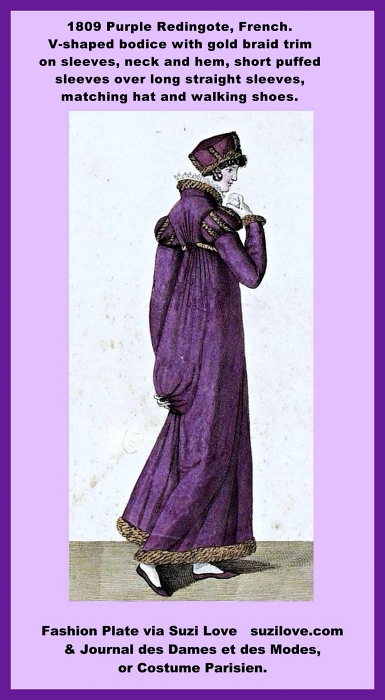
Definition: Walking Dress Or Pelisse Or Redingote Woman’s long, fitted coat often worn open in front to show off the dress underneath. Walking Dress Or Pelisse are the terms used in English fashion plates, while Redingote is seen in European fashion plates, especially the French one, Journal des Dames et des Modes, or Costume Parisien.