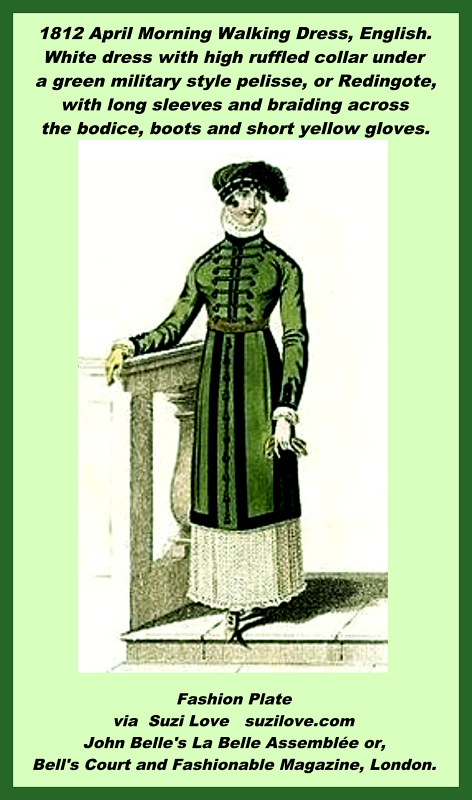
1812 April Morning Walking Dress, English, in Jane Austen style. White dress with high ruffled collar under a green military style coat, or pelisse, or Redingote, with long sleeves and braiding across the bodice, boots and short yellow gloves.
Definition Redingote, Pelisse, Walking Dress: The term, Redingote, was used more in France and other parts of Europe and Pelisse or Walking Dress was used more in England. While the terms Redingote and Pelisse are often used interchangeably, the Redingote usually features a close fitted top and flares out at the hemline with a more tailored or military look than a Pelisse. Redingotes or Pelisses were needed to cover the flimsy dresses made of lightweight fabrics of the Regency years to provide warmth and some protection from windy conditions when gowns might lift and cause modesty issues. Jane Austen and her contemporaries often walked to places and so would have needed the warmth of a Pelisse or coat in the cold British winters.
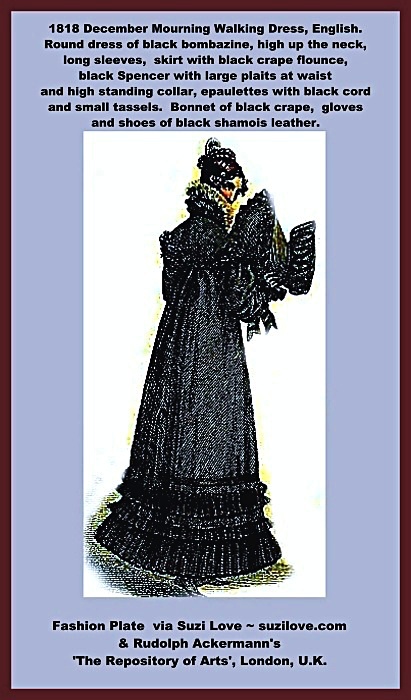
1818 December Mourning Walking Dress. Round dress of black bombazine, body tight to the shape and up to the throat but without a collar, long sleeves, with white crape weepers, skirt is finished at the bottom with a broad black crape flounce, disposed in large plaits. Over this is a very narrow flounce, which is also plaited to correspond; a little above this is a third flounce, which is quilled in the middle to correspond, and the whole is surmounted by a broad band of bias crape. The spencer worn with this dress is composed of black clothing; it is cut without a seam, and ornamented with a fullness of black crape, disposed in large plaits at the bottom of the waist: a high standing collar rounded in front, made to stand out from the neck, and edged with a light trimming of black crape: long loose sleeves, finished at the hands with black crape trimming, and surmounted by epaulettes draperied with black cord and ornamented with small tassels. Head-dress, a bonnet of black crape of a moderate size; the edge of the brim is finished with a row of large hollow plaits; the crown is trimmed to correspond. A white crape frill stands up round the throat. Gloves and shoes black shamois leather. Fashion Plate via Rudolph Ackermann’s ‘The Repository of Arts’, London, U.K.
1811 White Dress, French. Dress with scalloped hem, pink Redingote, green paisley shawl and white hat. Fashion Plate via Journal des Dames et des Modes, or Costume Parisien.
Definition Redingote Or Pelisse Or Walking Dress Or Coat: Long fitted outdoor coat worn over other garments for warmth. Often left open at the front to show off the dress underneath. French word developed from English words, riding coat. Jane Austen and her contemporaries wore long coats like these to keep warm when out and about, visiting, shopping etc. The thin muslin dresses worn in the early 1800s were little protection against European winters.
1811 January Walking Dress, or Pelisse, English. Jane Austen and her contemporaries wore long coats like these to keep warm when out and about, visiting, shopping etc. Their thin muslin dresses worn in the early 1800s were little protection against European winters.
Round high morning robe of cambric with deep full-trimmed collar. Swedish coat of velvet, trimmed with swansdown or blue fox fur. Spanish pelerine of the same, fastened in front of the throat with a mother-of-pearl brooch, clasps to correspond for the bottom of the waist. Traveller’s, or slouch, hat of velvet turned up with shell ornament, half-boots of grey cloth, laced and bound with black velvet. Chinese ridicule, or reticule, or bag, of grey satin, embellished with black medallions and tassels. Gold chain and eye-glass, or quizzing glass.. Fashion Plate via Rudolph Ackermann’s ‘The Repository’ of Arts.
Definition Redingote Or Coat Or Pelisse Or Walking Dress: Long fitted outdoor coat worn over other garments for warmth. French word developed from English words, riding coat. French fashion plates call these coats a Redingote and English plates call them a Pelisse, Or Walking Dress, or Carriage Costume. For more of these, try my book on Pelisses, History Notes Book 5 . books2read.com/suzilovePelisse
Definition Swansdown: Fine down of a swan, used for trimmings on clothing and for making powder puffs.
Definition Velvet or Velour: Silk with short, dense and smooth pile produced by pile warp raised in loops above ground weave through introduction of rods during the weaving.
Definition Ridicule, Reticule, Indispensable, or Handbag: From the late 1700s, pockets could no longer be sewn into gowns nor could separate pockets be tied around their waists and accessed by slits in the gown and petticoats, as skirts fell from just under the bust and were full and flowing. Instead, women began carrying small bags, known at first as ridicules and later as reticules, to keep necessary items on their person e.g. handkerchiefs, coins, vinaigrettes, calling cards, glasses etc. For more on reticules, try my History Notes book 3 http://books2read.com/suziloveReticules
1812 June Green Riding Dress, English. Fashion Plate via Rudolph Ackermann’s ‘The Repository of Arts’. This riding habit was probably made in two pieces. It has a vertical front decoration and is embroidered with black at the cuffs à la militaire. The small riding hat from black beaver is adorned with gold cordon and tassels and with a long ostrich feather of green in the front, or a green hat with black tassels and black feather. Black half boots, laced and fringed with green, York tan gloves, and riding crop. When this dress is worn as a carriage or walking costume, it is made as a pelisse without the riding jacket, and confined round the waist by a fancy belt of black and green. This habit was made by Mr. S. Clark, 37 Golden Square.” Riding habits and accessories were generally the only ladies’ clothing made by tailors rather than dressmakers.
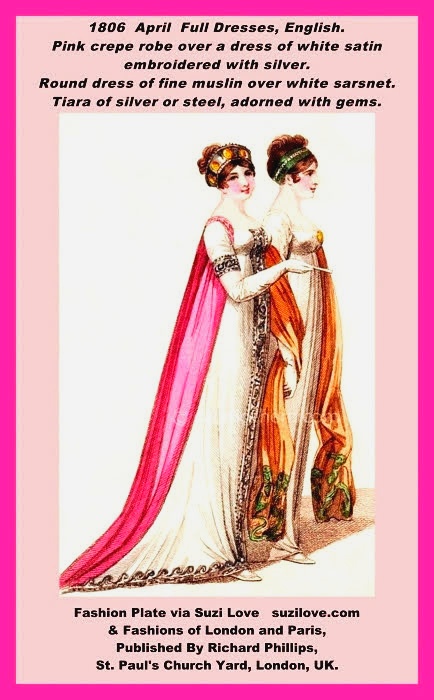
1806 April Two Ladies In Full Dress, English. Loose pink robe of undressed crepe over a dress of white satin, or sarsnet, embroidered with silver, sleeves plain and embroidered to correspond with dress. Round dress of fine muslin over white sarsnet. Broad lace let in down front and bottom. Bosom plain, trimmed with quilling of lace, ornamented with medallion or brooch. Long silk shawl, ends embroidered in colors. Tiara of silver or steel, adorned with gems. Fashion Plate via Fashions of London and Paris, Published By Richard Phillips, St. Paul’s Church Yard, London, UK.
Dress Full Dress: The most formal and complete ensemble, worn for day or night events, and includes the fullest range of accessories that could be added to the outfit to make the most impressive display.
Fabric Sarsnet: Also spelled ‘sarcenet’, is a lightweight silk that was often woven with small-scale decorative designs.
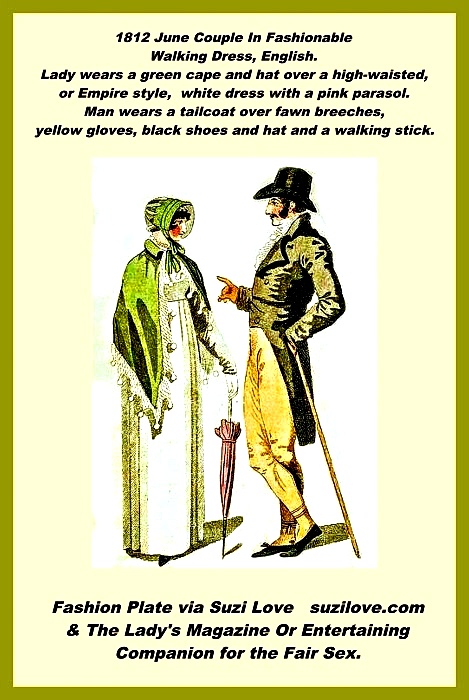
1812 June Couple In Fashionable Jane Austen style Walking Dress, English. Lady wears a green cape and hat over a high-waisted, or Empire style, white dress with a pink parasol. Man wears a tailcoat over fawn breeches, yellow gloves, black shoes and hat and a walking stick. Fashion Plate via The Lady’s Magazine Or Entertaining Companion for the Fair Sex.
By the end of the 18th century, tailored garments for both men and women were replaced by styles made for ease and comfort, resulting in the neoclassical style of the 1780s. Inspired in part by the statuary of ancient Greece and Rome, the new fashion was epitomized by light cotton gowns falling around the body in an unstructured way, held around the high waist with a simple sash and accompanied by a soft shawl draped around exposed shoulders. This style was ideal for the Indian imports like Kashmiri shawls and Bengali muslin, as used in this embroidered gown.
1800 Gentleman In Morning Dress French. Looking In Mirror, Double breasted, long coat high black boots with tan tops red cravat walking stick. Fashion Plate via Journal des Dames et des Modes, or Costume Parisien.
During the early 1800s skirted coats were replaced with short-fronted, or cutaway, tailcoats worn over fitted waistcoats and plain, white linen shirts. Knee breeches were gradually replaced by tight-fitting pantaloons and later trousers, decorative shoes were replaced with boot, such as the tan topped boots worn here, and fussy neckwear gave way to intricately tied, white linen neck cloths. A Regency Era, or early 1800s, gentleman was outfitted in more practical fabrics, such as wool, cotton and buckskin rather than the fussy brocades and silks of the late 1700s. The men in Jane Austen’s life would have worn an elegant outdoor ensemble like this for everyday excursions around the countryside.
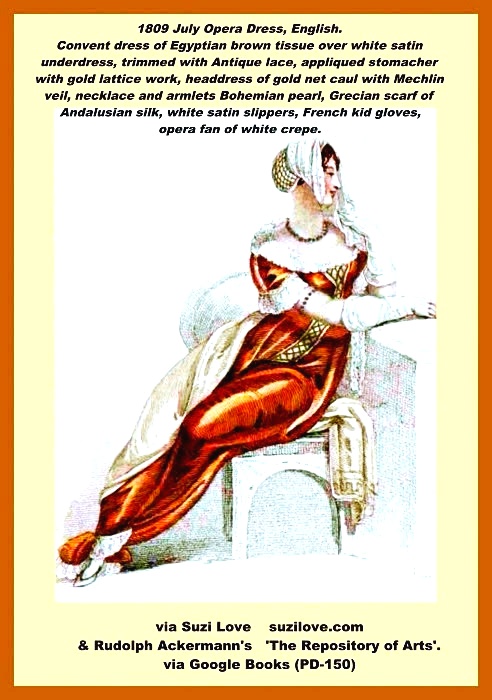
1809 July Opera Dress. I can picture aristocratic women wearing this sort of gorgeous outfit to the opera or an evening event.
Round convent robe of Egyptian brown tissue worn over white satin underdress, ornamented at feet, bosom and sleeves with broad Antique lace, out on full, and narrowing in front, white satin appliqued stomacher embellished with gold lattice work and continued in a straight line down to the hem. Headdress is a gold net caul, enclosing the hair at the back and finished in front with a Mechlin veil displaying the hair on the forehead and falling over the left shoulder. Necklace and armlets are a single row of Bohemian pearl with topaz or diamond snaps. Grecian scarf of rich Andalusian silk, contrasted with the robe and wrought at the ends in a deep Tuscan border of gold or colored silks. White satin slippers, trimmed with brown foil or gold, French kid gloves, opera fan of white crepe with a border of jessamine. Fashion Plate via Rudolph Ackermann’s ‘The Repository of Arts’.
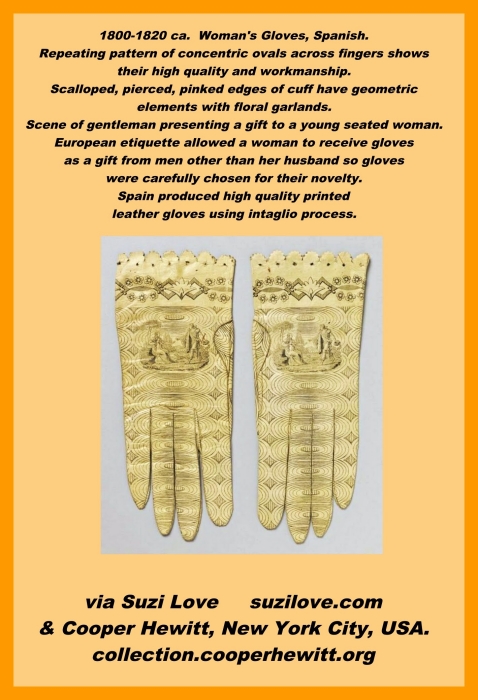
1800-1820 ca. Woman’s Gloves, Spanish. Repeating pattern of concentric ovals across fingers shows their high quality and workmanship. Scalloped, pierced, pinked edges of cuff have geometric elements with floral garlands. Scene of gentleman presenting a gift to a young seated woman. European etiquette allowed a woman to receive gloves as a gift from men other than her husband so gloves were carefully chosen for their novelty. Spain produced high quality printed leather gloves using intaglio process. via Cooper Hewitt, New York City, USA. collection.cooperhewitt.org
Now surviving in museum collections throughout Europe and North America, this style of glove must have been a brief, but very popular fad of the last years of the 18th century. As gloves were one of the few gifts a man could give to a single woman he was not engaged to marry, new designs and colours were eagerly sought after to provide variety in this staple form of present.
Printed kidskin gloves of this type were fashionable from the last decade of the 18th century until the 1820s. They were suitable for wearing with the long sleeved day dresses which women adopted in the last decade of the century. Long gloves continued to be required for court dress which retained its short sleeves. By this date many European countries were manufacturing gloves, both in leather and in woven or knitted textiles made of silk, cotton, linen or wool. Printed kidskin was used for gloves and for the backing for fans. English fan makers were printing on leather before 1720. The intaglio method of printing used a copper plate. The design was engraved with a buril or dry point into the plate, then the plate was immersed in ink and the leather placed on it in a screw press. Several different pairs of gloves could be printed at a time and if the pattern wore off with use, they could be reprinted.