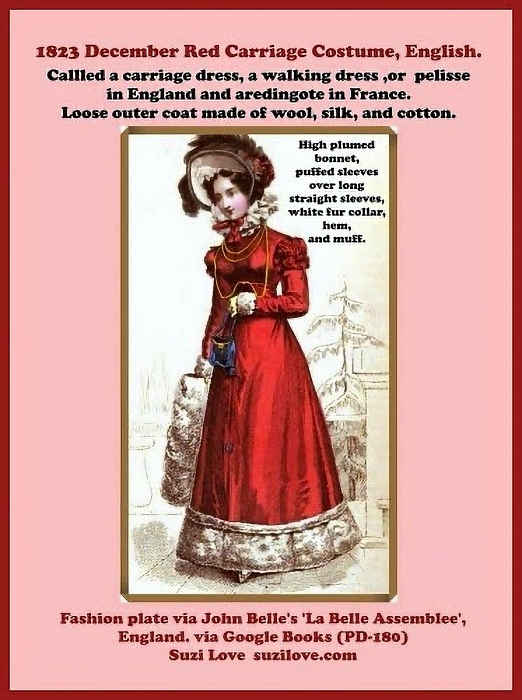
1823 December Red Carriage Costume, English. Gorgeous red dress with waistline a couple of inches below the bust, puffed short sleeves over long straight sleeves, wide white fur hem trim to match the white fur muff, white ruffle at the neck. High bonnet with a feather tied under the chin with a red bow. Fashion plate via John Belle’s ‘La Belle Assemblee’, England.
Definition Redingote Or Pelisse Or Walking Dress Or Carriage Dress Or Coat: French word developed from English words, riding coat. Long fitted outdoor coat worn over other garments for warmth. Often left open at the front to show off the dress underneath. Sometimes cut away in front. Originally made with several capes and trimmed with large buttons. French fashion plates call these coats Redingotes and they are designed for women, men and children. English fashion plates call them a Pelisse, a walking dress, Promenade dress, or Carriage dress. books2read.com/suzilovePelisse
1820 ca. Silk Spencer, British. Made of silk and willow. Short length, long sleeves, extensive decoration on shoulders, sleeves and wrists. Military style braiding on the spencer in support of all the soldiers fighting wars across the world. The sort of jacket worn by fashionable Regency ladies over their light and flowing Empire dresses. Credit Line:Catharine Breyer Van Bomel Foundation Fund, 1987 via Metropolitan Museum New York City, U.S.A. metmuseum.org
Definition Spencer: Short jackets cut to match the high waistlines of Empire dresses. They often copied military styling, such as braiding, shoulder decoration, buttons and loop fasteners, and wrist adornments. They were generally of complex construction, often with a diamond shaped piece in the back. Said to have originated in an accident to Lord Spencer while hunting when his coat tails were torn off and he wore it as a short jacket.
1820 ca. Spencer, British. Silk and willow. Front View.1820 ca. Spencer, British. Silk and willow. Back View. 1820 ca. Spencer, British. Silk and willow. Sleeve View. 1820 ca. Spencer, British. Silk and willow. Sleeve Decoration View. 1820 ca. Spencer, British. Silk and willow. Braiding View. 1820 ca. Spencer, British. Silk and willow. Wrist View.
1820 ca. Military Style Silk Spencer With Braiding In the Style of the Bridgertons and Jane Austen. #Bridgerton #JaneAusten #RegencyFashion #BritishHistory books2read.com/suziloveSpencers
HN_4_Spencers, Or Jackets. #Regency #Georgian #Victorian #Fashion History Notes Book 4 By Suzi Love.
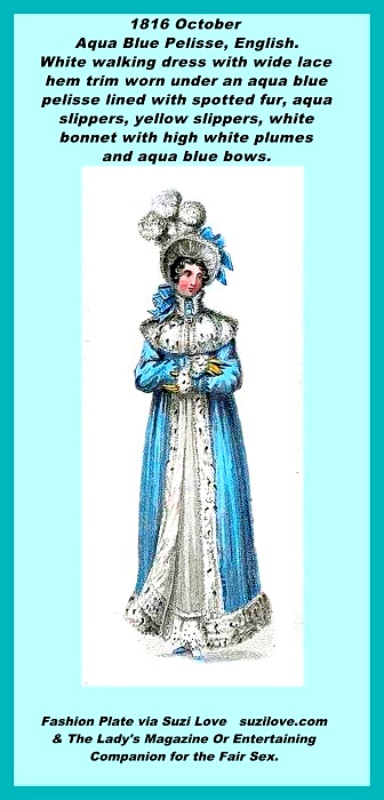
1816 October. Pelisse, English. White walking dress with wide lace hem trim worn under an aqua blue pelisse lined with spotted fur, aqua slippers, yellow slippers, white bonnet with high white plumes and aqua blue bows. Fashion Plate via Lady’s Magazine.
During the early 1800s, dress fabrics and dresses were thin, sometimes almost transparent. These lightweight white cotton dresses were fashionable in Jane Austen’s times, but they were certainly not warm when a lady was out walking or when riding in a carriage. Numerous outer layers could be added for warmth and to brighten and personalize an outfit. These might be an overdress, pelisse or redingote, hat, shawl, gloves, or large fur muff.
A typical outdoor outfit worn by the Bridgerton family, or Jane Austen and her contemporaries, when going outside consisted of an Empire style, or high-waisted, white cotton dress worn under a Pelisse, or Redingote, or coat, for warmth and with an added layer with the pretty shawl. Hats were made to match gowns and cloaks and fashionable women spent an extraordinary amount of time coordinating complete ensembles which included reticules or bags, shoes, shawls, gloves, hats, parasols, and fans. Typical Empire style dresses had low necklines and with skirts that started directly under the bust and flowed into the classical relaxed wide styles of Greece and Rome. These were worn most days and cotton, silk or taffeta were the popular fabrics.
Definition Redingote Or Pelisse Or Walking Dress Or Coat: French word developed from English words, riding coat. Long fitted outdoor coat worn over other garments for warmth. Originally made with several capes and trimmed with large buttons. For women, the coat was often cut away in the front or left open to show off the dress underneath. French fashion plates call these coats Redingotes and they were worn by men, women, and children. English fashion plates call the coats a Pelisse, a walking dress, Promenade dress, or Carriage dress.
1816 October. Pelisse, English. White walking dress with wide lace hem trim worn under an aqua blue pelisse lined with spotted fur, aqua slippers, yellow slippers, white bonnet with high white plumes and aqua blue bows. Fashion Plate via Lady’s Magazine.
1816 July Opera Dress, English. Dress of white lace worn over a rich soft white satin slip. Skirt trimmed in a style of peculiar elegance, with lace festooned at regular distances, festoons edged by plain band of byas satin and finished by pearl ornaments of a very novel and pretty shape. Lace body is cut byas and richly ornamented round the bosom with pointed lace. Plain long sleeve, very full, except towards the wrist, which is nearly tight to the arm, and elegantly finished with lace. Hair ornamented with a wreath of French roses, parted in front, and simply dressed in loose curls, which fall very low on each side. Hind hair forms a tuft at the back of the head. Necklace, ear-rings, and bracelets of pearl. White satin slippers, and white kid gloves and a blush colored French silk scarf. Fashion Plate via Rudolph Ackermann’s ‘The Repository of Arts’. https://books2read.com/SuziLoveFashionWomen1815-1819
Gorgeous Regency Era clothing came in a wide range of styles to suit every season and occasion. Ladies in the Bridgerton series and in Jane Austen’s times wore Empire style dresses which were usually made of light fabric and floaty in style. By the later 1810s, stripes were very popular and lace and frills were added to make the dress more individual.
Fashion Women 1815-1819 History Notes Book 28 What did Jane Austen wear? https://books2read.com/SuziLoveFashionWomen1815-1819
In Jane Austen’s times craftsmen created boxes and containers of precious metals, leather, silks, and decorated them with jewels. Boxes, Cases, Etui, Necessaire and everything else that was used to carry essential items for travel, sewing, medicine, writing, and toiletries. Containers were engraved to make exquisite and expensive items as well as practical carrying cases. books2read.com/suziloveBoxesCases
1825 Brown stays with center front busk, back lacing, hip shaping, breast gussets, widely spaced straps, cotton embroidered in ivory silks with hearts. via Kerry Taylor Auctions. kerrytaylorauctions.com https://books2read.com/SuziLoveCorsetBook17
The main purpose of corsets was to support and shape the breasts. Though they still slimmed the midriff, this was not the prime purpose of a corset in the 1820s. The waistline of dresses had lowered to below the bust line and nearer to the true waist so corsets were longer and were given added shaping by stitching and cording and by shaping the breasts with pleated or gathered cups.
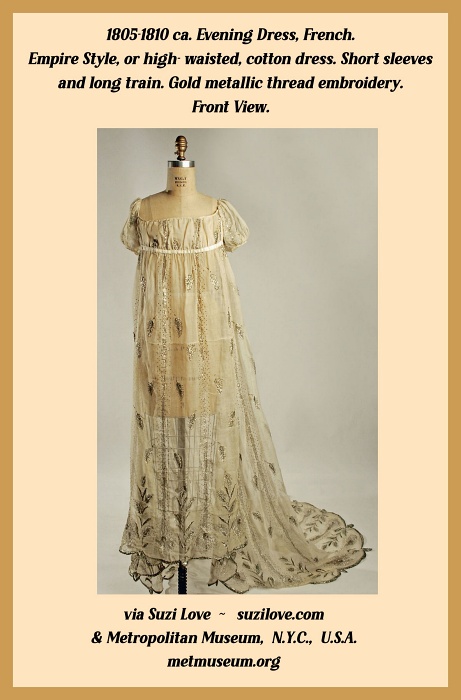
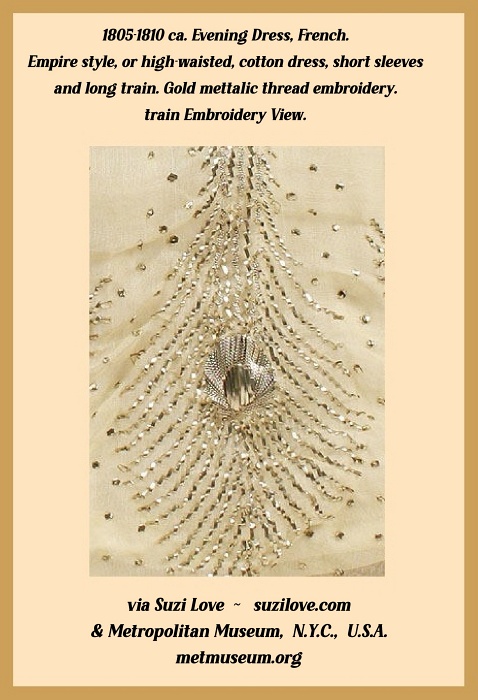
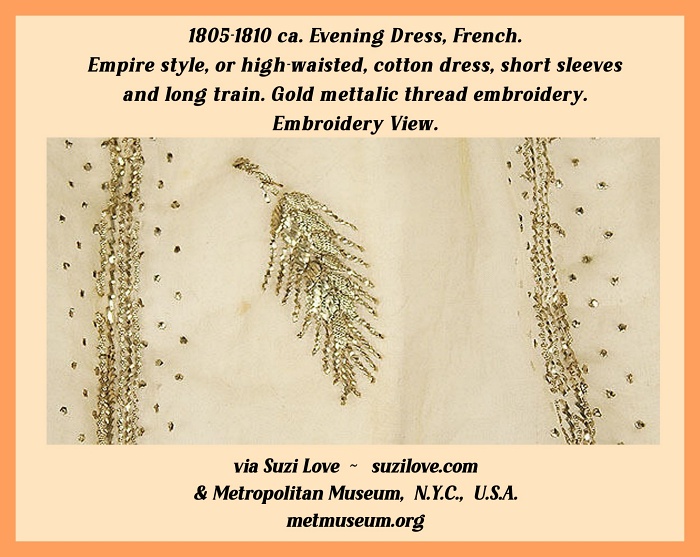
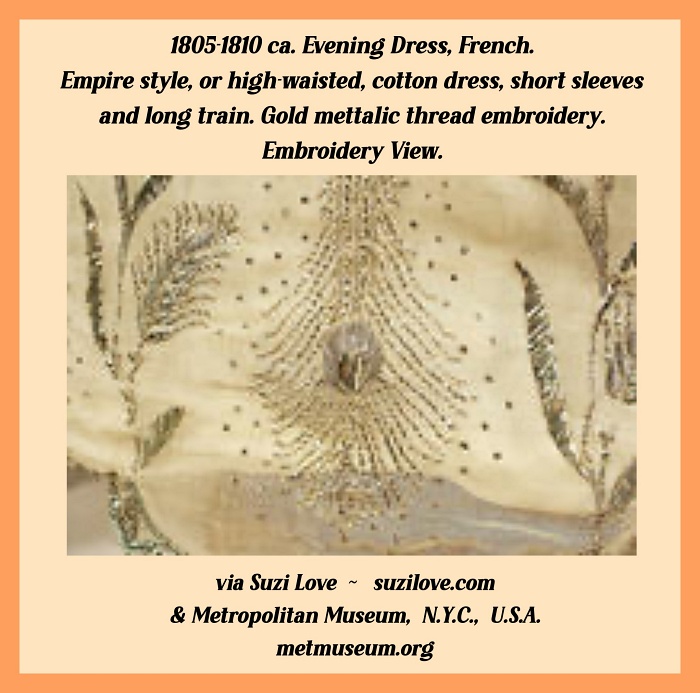
1805-1810 ca. Evening Dress, French. Empire style, or high-waisted, cotton dress, short sleeves and long train. Gold metallic thread embroidery. via Metropolitan Museum, N.Y.C., U.S.A.
1805-1810 ca. Front Evening Dress, French. Empire style, or high-waisted, cotton dress, short sleeves
and long train. Gold metallic thread embroidery. via Suzi Love ~ suzilove.com
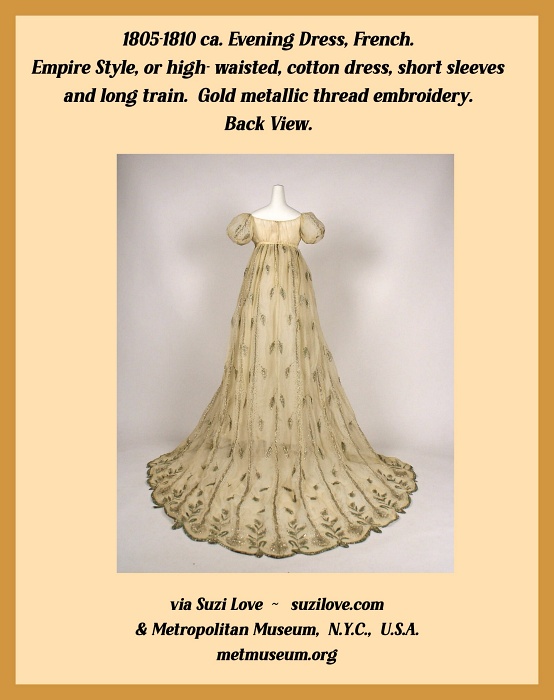
& Metropolitan Museum, N.Y.C., U.S.A. metmuseum.org1805-1810 ca. Back Evening Dress, French. Empire style, or high-waisted, cotton dress, short sleeves
and long train. Gold metallic thread embroidery. via Suzi Love ~ suzilove.com
& Metropolitan Museum, N.Y.C., U.S.A. metmuseum.org1805-1810 ca. Side Evening Dress, French. Empire style, or high-waisted, cotton dress, short sleeves
and long train. Gold metallic thread embroidery. via Suzi Love ~ suzilove.com
& Metropolitan Museum, N.Y.C., U.S.A. metmuseum.org1805-1810 ca. Train Evening Dress, French. Empire style, or high-waisted, cotton dress, short sleeves
and long train. Gold metallic thread embroidery. via Suzi Love ~ suzilove.com
& Metropolitan Museum, N.Y.C., U.S.A. metmuseum.org1805-1810 ca. Embroidery Evening Dress, French. Empire style, or high-waisted, cotton dress, short sleeves
and long train. Gold metallic thread embroidery. via Suzi Love ~ suzilove.com
& Metropolitan Museum, N.Y.C., U.S.A. metmuseum.org1805-1810 ca. Embroidery. Evening Dress, French. Empire style, or high-waisted, cotton dress, short sleeves
and long train. Gold metallic thread embroidery. via Suzi Love ~ suzilove.com
& Metropolitan Museum, N.Y.C., U.S.A. metmuseum.org1805-1810 ca. Embroidery. Evening Dress, French. Empire style, or high-waisted, cotton dress, short sleeves
and long train. Gold metallic thread embroidery. via Suzi Love ~ suzilove.com
& Metropolitan Museum, N.Y.C., U.S.A. metmuseum.org1805-1810 ca. Embroidery Evening Dress, French. Empire style, or high-waisted, cotton dress, short sleeves
and long train. Gold metallic thread embroidery. via Suzi Love ~ suzilove.com
& Metropolitan Museum, N.Y.C., U.S.A. metmuseum.org1805-1810 ca. Embroidery. Evening Dress, French. Empire style, or high-waisted, cotton dress, short sleeves
and long train. Gold metallic thread embroidery. via Suzi Love ~ suzilove.com
& Metropolitan Museum, N.Y.C., U.S.A. metmuseum.org Fashion Women 1805-1809 History Notes Book 26 What did Jane Austen and friends wear? https://books2read.com/SuziLoveFashionWomen1805-1809
1804 London Hairstyles, Gorgeous Gold Hats. via Fashion Plate via Fashions of London and Paris, Published By Richard Phillips, St. Paul’s Church Yard, London, UK. These styles of hats and hairstyles would have been worn by Jane Austen and her contemporaries as hats were an essential fashion item during the Regency years.
1804 London Hairstyles, Gorgeous Gold Hats. via Fashion Plate via Fashions of London and Paris,
Published By Richard Phillips,
St. Paul’s Church Yard, London, UK.25_D2D_Corset_1790-1810
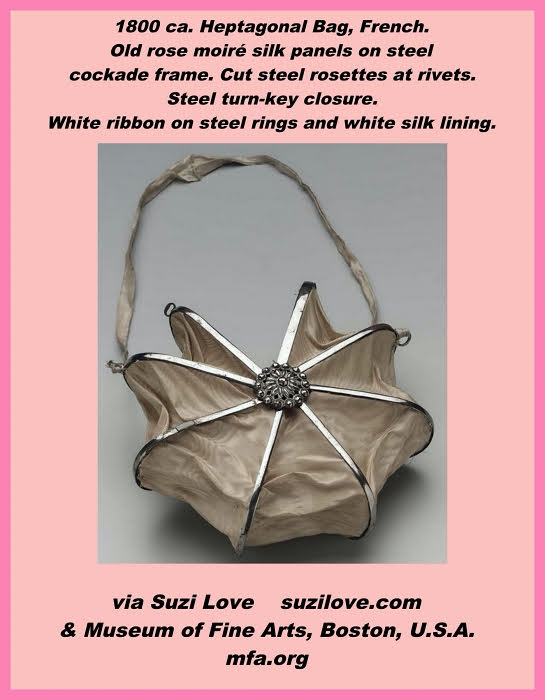
1800 ca. Heptagonal Bag, French. Old rose moiré silk panels on steel cockade frame. Cut steel rosettes at rivets. Steel turn-key closure. White ribbon on steel rings. White silk lining. Credit: The Elizabeth Day McCormick Collection via Museum of Fine Arts, Boston, U.S.A. mfa.org
Reticule Or Bag: As the silhouette of dresses became more form fitting and fabrics lighter and more transparent, pockets could no longer be hidden in the folds of skirts or underwear. Something else was needed to hold a lady’s essentials. Small purses, like men’s money pouches, were used by women to carry money for gambling, sewing necessities, and women’s daily requirements such as combs. A bag or purse, often with a drawstring to pull closed and usually made of cloth or covered cardboard and often decorated with beading or embroidery was called a reticule, or ridicule. They came in a variety of shapes, sizes, and materials. Jane Austen and her contemporaries would have purchased or hand made reticules, or bags, for each other for gifts and carried them with them whenever they went out.
1800 ca. Heptagonal Bag, French. Old rose moiré silk panels on steel cockade frame. Cut steel rosettes at rivets. Steel turn-key closure. White ribbon on steel rings. White silk lining. Credit: The Elizabeth Day McCormick Collection via Museum of Fine Arts, Boston, U.S.A. mfa.org
1800 ca. Heptagonal Bag Of Old Rose Moiré Silk Panels With A Steel Turn-Key Closure. #JaneAusten #France #Reticule books2read.com/suziloveReticules
1715-1775 ca. Flat Drawstring Bag, French. Strung glass beads, or sablé, held together by looping stitches. Polychrome Rococo design on white ground, shepherd, shepherdess, four sheep around orange tree center, border with cornucopias and flowers. Ecru silk cord drawstrings with floral bead-covered wood tassels. Blue silk lining. via Museum of Fine Arts, Boston.