1818 High-waisted Promenade Dress, English. White dress with multiple layers of lace from hem upwards. Narrow striped scarf of bright colors, large brimmed hat decorated with flowers and a pink parasol. Fashion Plate via John Belle’s La Belle Assemblée or, Bell’s Court and Fashionable Magazine, London.
Definition Empire Style Dress: High-waisted white gown defined women’s fashion during the Regency Era. ‘Empire’ is the name given to the period when Napoleon Bonaparte built his French Empire. High-waisted, loose gowns were adopted by the aristocracy as a symbol of turning away from the fussy, elaborate and expensive clothing worn in the 1700s.
1811 Evening Dress, French. Red cashmere dress over white under shirt with short puffed sleeves, carrying a white shawl, long white gloves, earrings and white evening shoes. Fashion Plate via Journal des Dames et des Modes, or Costume Parisien. Though this is a French fashion plate, the outfit is typical of the dresses worn by Jane Austen and her contemporaries. An Empire style, or high-waisted, dress with a white underdress and for warmth there is an extra layer with the shawl.
Definition Cashmere: Soft, fine wool, historically used for costly dress fabric, usually in twill weave. Originally made of yarn handspun from the wool of Cashmere goats but later from other soft wools. Used for dresses, infants’ coats.
1816 January Blue Carriage Dress, English. High neck but no collar, front is fitted but back has slight fullness and very short bodice. Puffed roll to decorate the hem, trimmed in bias cut blue satin, long sleeves finished at wrists with satin, gloves of white kid and ‘sandals’ or shoes of blue kid leather. Head-dress à la mode de Paris is an unusual cap of white lace and decorated with two rolls of ribbon. “We are indebted to the tasteful fancy of Mrs. Bean, of Albemarle Street, for both our dresses this month.” Fashion Plate via Rudolph Ackermann’s ‘The Repository of Arts’.
Jane Austen and her contemporaries would have worn this style of outdoor, or carriage ensemble with a coat over a dress. These outdoor dresses were labelled a variety of names. In England, this might also have been called a Walking Or Promenade dress, or Pelisse. In Europe, it would be called a Redingote.
Definition: Pelisse, Walking Dress, Carriage dress, Promenade Dress, Redingote. Long, fitted coat sometimes cut away in front to show off the dress underneath. Originally made for men with several capes and trimmed with large buttons, they were adapted to add an additional, and warmer, layer to the typical white muslin dresses worn in the early 1800s. Those light weight dresses were good in summer but not suited to harsh winters. Over the carriage dress, a shawl could be added as well as a muff to give a warm and comfortable outfit for traveling by carriage.
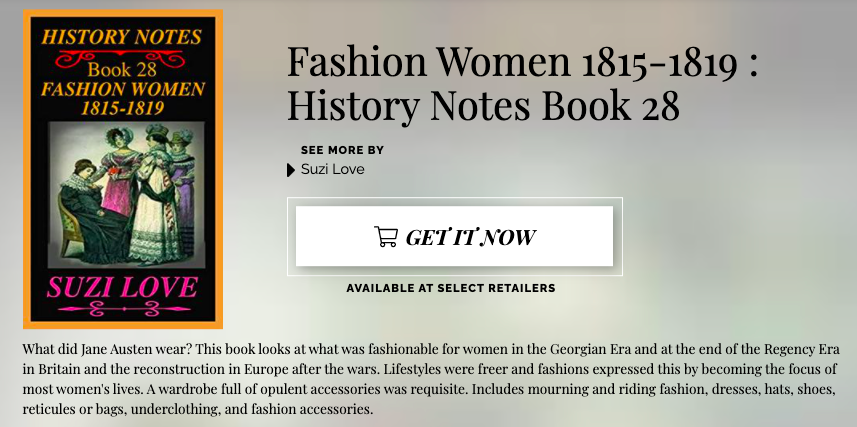
Fashion Women 1815-1819 History Notes Book 28 https://books2read.com/SuziLoveFashionWomen1815-1819
1805 Women’s Dresses and Fashion Accessories. Fashion plates from Fashions of London and Paris. Gorgeous Regency Era clothing came in a wide range of styles to suit every season and occasion. Ladies in Jane Austen’s times wore Empire style dresses which were usually of light fabric and floaty in style so accessories were essential to keep women warm. Accessory: item which contributes to the overall effect but is of secondary importance is the dictionary definition of an accessory, but the term has only been applied in relation to personal appearance since the 19th century. As defined by dress historians, accessories usually complete an outfit and are chosen to complement it. Accessories fall into two groups: Those worn, such as bonnets, caps and hats, boots and shoes, cravats and ties, gloves, mittens and muffs, jewellery, scarves and shawls, socks and stockings. Those that are carried, such as bags, canes, fans, parasols and umbrellas, and swords.
1811 Half-Mourning Dress, French. Black dress, high white neck ruffle, black hat with white trim and white shoes. Jane Austen and her family would have worn this type of outfit when mourning a relative or friend. However, as black dresses, black tunics, and black lace shawls were popular throughout the Regency years, it is often hard to decide what was definitely made for mourning and what was simply fashionable wear. Fashion Plate via Journal des Dames et des Modes, or Costume Parisien.
In November, 1810, Princess Amelia, youngest daughter of George III, died. At the end of 1810 full mourning of complete black would have been worn but by the beginning of 1811, half mourning would still have been to respect the loss of a royal family member. Half-mourning allowed touches of silver, grey, mauve and white to be added to a mostly black outfit and would be worn after the period of full mourning was ended, times depending on the relationship to the deceased person. Garments and accessories could either be trimmed with black, jet jewelry worn, black ribbons added, or a layer of black net or gauze added to a dress or hat.
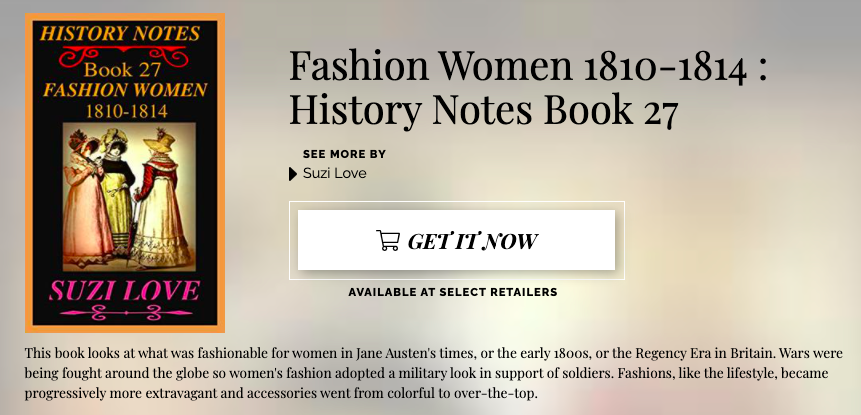
Definition Half or Slight Mourning: Allowed touches of grey and white to be added to full, or deep, mourning ensembles. Some lustre, or shine, was allowed in fabrics and accessories. After a time, mauve or deep purple could also be worn. https://books2read.com/SuziLoveFashion1810-1814
1811 Black Half-Mourning Dress With High White Neck Ruffle as worn in Jane Austen’s years. #JaneAusten #RegencyFashion #Mourning https://books2read.com/SuziLoveFashion1810-1814
1812 February Winter Walking Dress, English. Scarlet Merino wool pelisse lined with straw colored sarsnet, trimmed with light colored spotted fur attached with loops of black silk cordon and rich frog tassels, broad fur in front forming a tippet, pointed at back, narrow fur passes from top of sleeves, worn over a white dress, yellow winter hat, gray gloves, and paisley shawl. Fashion Plate via John Belle’s La Belle Assemblee.
Definition Merino Wool: Finest quality wool, originating in Spain. Just before and during the Regency, Merino sheep were exported from Spain into Britain and other parts of Europe. Napoleon supported Merino growth in France. In 1808, after French invaded Spain, King George purchased additional 2000 Merinos for royal flock but Britain too wet for thriving industry. Other countries i.e. Australia, began producing fine quality Merino.
I can picture Jane Austen and her female friends and family wearing a Pelisse, or Walking Dress, Or Redingote, like this to keep them warm when shopping or paying visits to friends. During the Regency Era, out door activities were encouraged and outside clothing needed to be more practical and with thicker fabrics, such as Merino wool. Tunics gave an additional layer to thin dresses and walking dresses, pelisses, Redingotes and half cloaks were worn and accessorized with cashmere shawls and oversized fur muffs.
1811 January Walking Dress in the English style worn by Jane Austen and her female relations and friends. Pelisse of scarlet Merino cloth, buttoned down front and up arm with small gold buttons, collar and cuffs of purple velvet, empire tippet pointed in back, Scarlet bonnet turned up with velvet, veil through front, scarlet cloth boots trimmed with velvet. Fashion Plate via John Belle’s La Belle Assemblée or, Bell’s Court and Fashionable Magazine, London.Jane Austen and her contemporaries wore long coats like these to keep warm when out and about, visiting, shopping etc. The thin muslin dresses worn in the early 1800s were little protection against European winters.
Definition Merino Wool: Finest quality wool, originating in Spain. During Napoleonic wars, Merino sheep exported to Britain and other parts of Europe. Napoleon supported Merino growth in France. In 1808, after French invaded Spain, King George purchased additional 2000 Merinos for royal flock but Britain too wet for thriving industry. Other countries i.e. Australia, began producing fine quality Merino.
Definition Velvet: Historically made with silk pile on silk backing, or cheaper backing e.g. linen. Velvets were also made from cotton or wool. Today, silk velvet is usually rayon pile on silk backing so you only see the rayon and not the silk.
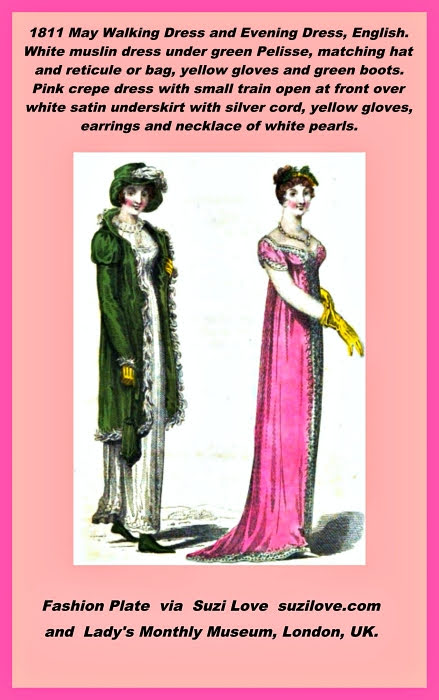
1811 May Walking Dress and Evening Dress, English. White muslin dress under green Pelisse, matching hat and reticule or bag, yellow gloves and green boots. Pink crepe dress with small train open at front over white satin underskirt with silver cord, yellow gloves, earrings and necklace of white pearls. Fashion Plate via The Lady’s Monthly Museum, London, UK.
Definition Walking Dress: Worn out shopping, walking in a city park or the country estate. Presentable and warm, more fashionable than Morning Dress but not overly accessorized.
Definition Evening Dress: Minute distinctions between ball, dinner, evening and opera gowns meant different quality of fabrics and designs.
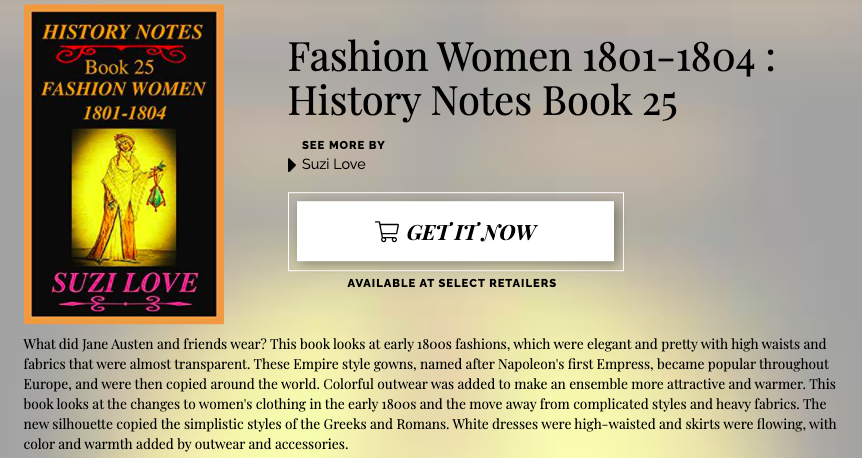
1802 Lavender Gown With Long Train and Decorative Trim, French. Short sleeved Empire style, or high-waisted, dress, long pale gloves, black straw hat with ribbon trim, necklace and fan. Fashion Plate via Journal des Dames et des Modes, or Costume Parisien. https://books2read.com/SuziLoveFashionWomen1801-1804
Definition Empire Style Dress: High-waisted white gown defined women’s fashion during the Regency Era. ‘Empire’ is the name given to the period when Napoleon Bonaparte built his French Empire. High-waisted, loose gowns were adopted by the aristocracy as a symbol of turning away from the fussy, elaborate and expensive clothing worn in the 1700s.
The type of dress worn across Europe in the early 1800s. This sort of high-waisted dress would have been worn by Jane Austen and her contemporaries in England. The Empire waist gown defined women’s fashion during the Regency Era. ‘Empire’ is the name given in France to the period when Napoleon built his French Empire. High-waisted, loose gowns were adopted by the aristocracy as a symbol of turning away from the fussy, elaborate and expensive clothing worn in the 1700s.
1802 Lavender Gown With Long Train and Decorative Trim, French. HN_25_D2D_fashwomen1801-1804 https://books2read.com/SuziLoveFashionWomen1801-1804
Want To Know More About Georgian Era Men’s Fashions? Try History Notes Book 2: Fashion Men 1700s Late. What was fashionable for men in the late 1700s? Extravagant colors and fabrics and outrageous styles. Take a look at their suits, hats, accessories and bedroom fashions.
Strictly speaking, the Georgian Era might include all the years that a ‘King George’ ruled in England, but for the purposes of this book the ‘Georgian Era’ is primarily the late 1700s when mad King George III ruled. His son became Prince Regent in the early 1800s, therefore creating the years known as the Regency, and became George IV on the death of his father.
The Georgian years officially ended with the death of King George IV in 1830.
George I ruled 1714-1727
George II ruled 1727-1760
George III ruled 1760-1820
George IV ruled 1820-1830
HN_2_D2D_Fashion Men 1700s
books2read.com/suziloveFashMen1700