1815 Typical English Dinner In Jane Austen and Bridgerton Times. Two Courses and a Desert. From- 1815 Journal of Tour of Great Britain by a French Tourist via Google Books (PD-180)
Typical food served during the early 1800s, or Regency Era. ‘Removes‘ were the dishes removed from the table during a meal, usually the soup and fish, and then replaced by other dishes. After all diners have had a chance to eat all the dishes on the table, the table is cleared and another set of dishes put on the table. This is the second course.
1814 Gentleman’s Redingote, or Overcoat, French. Back View of coat with back pleats and metal buttons worn with high topped boots, top hat, and a cane. Fashion Plate via Journal des Dames et des Modes, or Costume Parisien.
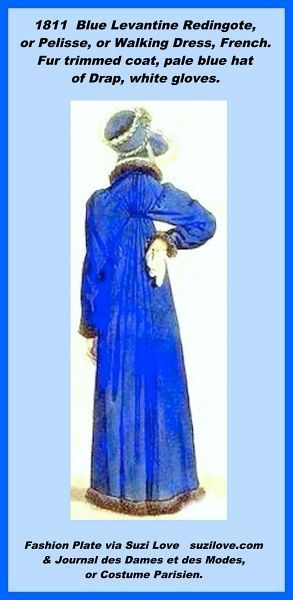
Definition Redingote Or Coat: French word developed from English words, riding coat. Long fitted outdoor coat worn over other garments for warmth. Originally made with several capes and trimmed with large buttons. For women, the coat was often cut away in the front or left open to show off the dress underneath. French fashion plates call these coats Redingotes and they were worn by men, women, and children. English fashion plates call the coats a Pelisse, a walking dress, Promenade dress, or Carriage dress.
Love After Waterloo by Suzi Love. Despite Wellington’s victory over Napoleon four days earlier, soldiers, to use the term loosely, still lingered around Waterloo. They and deserters from both sides had joined local famers in picking through the remains of bodies, uniforms, and armory to pilfer anything of value. There’d been nowhere safe to hide her and her son, Daniel, so Lady Melton’s’ brothers had packed what remained of their equipment and taken them, along with a few wounded British soldiers, to the Captain’s quarters, knowing that his orders were to protect whoever remained of French stragglers and deserters.
Anne’s twin brothers hadn’t lingered, because Wellington and what was left of his British troops were marching back towards Brussels and Brendon’s skills as a physician were urgently needed. Benjamin, an aide to Wellington, had stayed to organize the repatriation of their soldiers and the departure of their sister and nephew. Neither twin had understood her reluctance to join Captain Belling and his group and had ignored her pleas to stay with them in Europe, stating firmly that it was time that she and Daniel returned to London.
They hoped that Anne could reopen their townhouse in London and prepare for when they could join her, optimistically within a few weeks. She wasn’t quite so optimistic. Napoleon was an egotist. He wasn’t the type to accept defeat easily, and she imagined he’d already be making plans for a triumphant return in the future, despite the carnage left behind at Waterloo when he and his remaining troops retreated. Her brothers had reported that the plains had been covered with the dead and the dying, both men and horses.
1756-1762 ca. Gold and Enamel Étui, French. Probably by Jean Ducrollay, 1756-62, Paris. via Metropolitan Museum New York City, U.S.A. metmuseum.org
books2read.com/SuziLoveWritingTools
1812 Two Ladies, French. Orange sleeveless Redingote over a white dress with high neck frill and interesting sleeves. High-waisted white dress with blue pattern on the short sleeves and hem. Both with gloves, matching bonnets and shoes. Fashion Plate via Journal des Dames et des Modes, or Costume Parisien.
1788 Armchair or bergère en cabriolet. Part of a set by Jean-Baptiste-Claude Sené (French, 1748–1803). Made for Marie Antoinette, Queen of France, for her Cabinet de Toilette in Palace of Saint-Cloud, France. Carved, painted and gilded walnut; modern cotton twill embroidered in silk. Made for Marie-Antoinette’s dressing room at the château de Saint Cloud. The queen’s initials are carved on the top rail.
The Palace of St. Cloud belongs to the Duke of Orleans, is situated on the declivity of a mountain washed by the Seine. . . . The view from the house is delightful. By Harry Peckham, A Tour through Holland and Part of France
Louis XVI purchased the country residence of the duc d’Orléans a few miles west of Paris for Marie-Antoinette in 1785. Being in need of renovation, the palace was enlarged and altered for the queen, and many pieces of furniture were commissioned from Jean-Baptiste-Claude Sené. A member of an important dynasty of Parisian chairmakers, Sené had been appointed menuisier to the Crown in 1784.
A 1788 description of this set, four matching armchairs and a stool, shows that it was for one of Marie-Antoinette’s private rooms at Saint-Cloud, her Cabinet Particulier. Frame of the daybed embellished with carving of ivy and garlands of roses, ionic capitals on the short legs and Egyptian female half-figures on tapering supports. These figures express the queen’s taste for ornaments from ancient Egyptian art, well before Napoléon’s North African campaign made it fashionable. The bergère, or armchairs, has a medallion on top with Marie-Antoinette’s initials framed by myrtle branches and roses. The matching screen has classical female figures on its feet and top rail.
The 1789 inventory of Saint-Cloud records the entire suite in the queen’s Cabinet de Toilette, or dressing room. The set is upholstered in white cotton twill, embroidered with a small floral ornament in silk. Known to have worked on needlepoint projects all her life, Marie-Antoinette did the embroidery herself. The colorful floral embroidery on the light cotton ground conveys a sense of summer, the season Marie-Antoinette preferred to spend at Saint-Cloud. via Epigraph. Peckham 1788, p. 199.
1818-1820 ca. Gold Redingote, French. Gorgeous Regency Fashion French Redingote of gold silk with the same fabric used to create a trailing pattern down the bodice and front opening. Short puffed sleeves over long straight sleeves in a leg-of-mutton style. via Metropolitan Museum, New York City. metmuseum.org
1814 Gentleman’s Ensemble, French. Gentleman in brown tailcoat, white vest, high collared white shirt, knotted white cravat, white pants and white gaiters above black shoes. The style of outfit worn by the men in Jane Austen’s life. Fashion Plate via Journal des Dames et des Modes, or Costume Parisien.