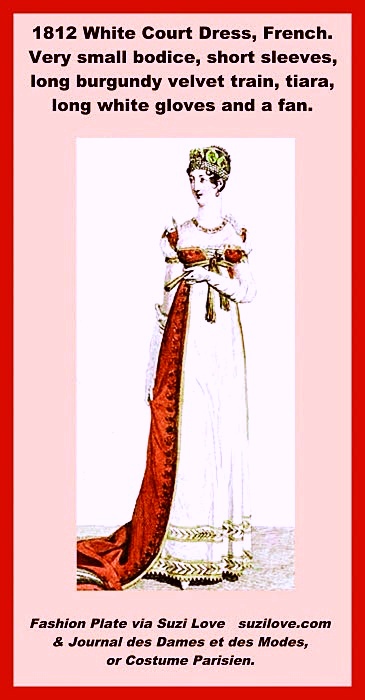
1812 White Court Dress, French. Very small bodice, short sleeves, long burgundy velvet train, tiara, long white gloves and a fan. Fashion Plate via Journal des Dames et des Modes, or Costume Parisien.
Definition Court Dress: Usually, the difference between a court dress and a ball dress was in the quality of fabrics used, how elaborate the design, and the number and quality of the accessories. Plus, in England in the early 1800s court dresses were required by Queen Charlotte to have hoops and in France and other European countries court dresses a long train, usually expensively decorated. During the Regency Era, white cotton dresses were considered suitable for many evening events, but definitely not for an evening event in a palace.
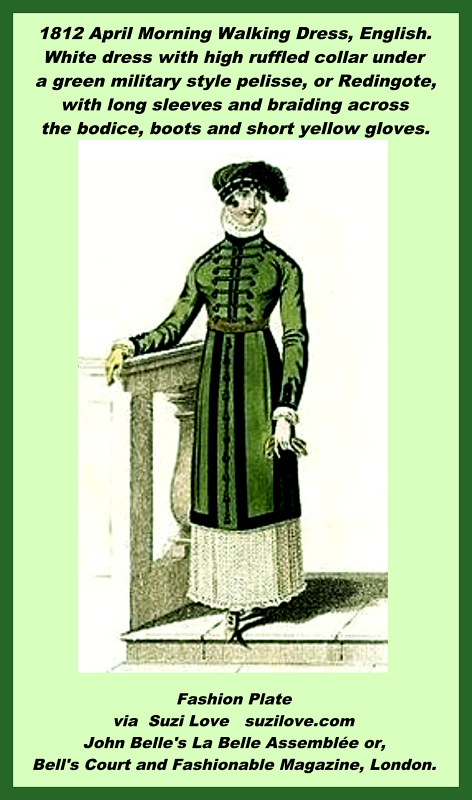
1812 April Morning Walking Dress, English, in Jane Austen style. White dress with high ruffled collar under a green military style coat, or pelisse, or Redingote, with long sleeves and braiding across the bodice, boots and short yellow gloves.
Definition Redingote, Pelisse, Walking Dress: The term, Redingote, was used more in France and other parts of Europe and Pelisse or Walking Dress was used more in England. While the terms Redingote and Pelisse are often used interchangeably, the Redingote usually features a close fitted top and flares out at the hemline with a more tailored or military look than a Pelisse. Redingotes or Pelisses were needed to cover the flimsy dresses made of lightweight fabrics of the Regency years to provide warmth and some protection from windy conditions when gowns might lift and cause modesty issues. Jane Austen and her contemporaries often walked to places and so would have needed the warmth of a Pelisse or coat in the cold British winters.
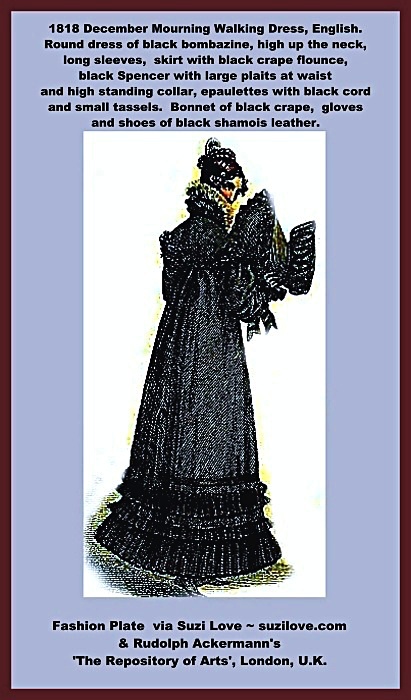
1818 December Mourning Walking Dress. Round dress of black bombazine, body tight to the shape and up to the throat but without a collar, long sleeves, with white crape weepers, skirt is finished at the bottom with a broad black crape flounce, disposed in large plaits. Over this is a very narrow flounce, which is also plaited to correspond; a little above this is a third flounce, which is quilled in the middle to correspond, and the whole is surmounted by a broad band of bias crape. The spencer worn with this dress is composed of black clothing; it is cut without a seam, and ornamented with a fullness of black crape, disposed in large plaits at the bottom of the waist: a high standing collar rounded in front, made to stand out from the neck, and edged with a light trimming of black crape: long loose sleeves, finished at the hands with black crape trimming, and surmounted by epaulettes draperied with black cord and ornamented with small tassels. Head-dress, a bonnet of black crape of a moderate size; the edge of the brim is finished with a row of large hollow plaits; the crown is trimmed to correspond. A white crape frill stands up round the throat. Gloves and shoes black shamois leather. Fashion Plate via Rudolph Ackermann’s ‘The Repository of Arts’, London, U.K.
Fashion Women 1815-1819 History Notes Book 28 What did Jane Austen wear? . D2D_HN_28_https://books2read.com/SuziLoveFashionWomen1815-1819
1811 White Dress, French. Dress with scalloped hem, pink Redingote, green paisley shawl and white hat. Fashion Plate via Journal des Dames et des Modes, or Costume Parisien.
Definition Redingote Or Pelisse Or Walking Dress Or Coat: Long fitted outdoor coat worn over other garments for warmth. Often left open at the front to show off the dress underneath. French word developed from English words, riding coat. Jane Austen and her contemporaries wore long coats like these to keep warm when out and about, visiting, shopping etc. The thin muslin dresses worn in the early 1800s were little protection against European winters.
1811 January Walking Dress, or Pelisse, English. Jane Austen and her contemporaries wore long coats like these to keep warm when out and about, visiting, shopping etc. Their thin muslin dresses worn in the early 1800s were little protection against European winters.
Round high morning robe of cambric with deep full-trimmed collar. Swedish coat of velvet, trimmed with swansdown or blue fox fur. Spanish pelerine of the same, fastened in front of the throat with a mother-of-pearl brooch, clasps to correspond for the bottom of the waist. Traveller’s, or slouch, hat of velvet turned up with shell ornament, half-boots of grey cloth, laced and bound with black velvet. Chinese ridicule, or reticule, or bag, of grey satin, embellished with black medallions and tassels. Gold chain and eye-glass, or quizzing glass.. Fashion Plate via Rudolph Ackermann’s ‘The Repository’ of Arts.
Definition Redingote Or Coat Or Pelisse Or Walking Dress: Long fitted outdoor coat worn over other garments for warmth. French word developed from English words, riding coat. French fashion plates call these coats a Redingote and English plates call them a Pelisse, Or Walking Dress, or Carriage Costume. For more of these, try my book on Pelisses, History Notes Book 5 . books2read.com/suzilovePelisse
Definition Swansdown: Fine down of a swan, used for trimmings on clothing and for making powder puffs.
Definition Velvet or Velour: Silk with short, dense and smooth pile produced by pile warp raised in loops above ground weave through introduction of rods during the weaving.
Definition Ridicule, Reticule, Indispensable, or Handbag: From the late 1700s, pockets could no longer be sewn into gowns nor could separate pockets be tied around their waists and accessed by slits in the gown and petticoats, as skirts fell from just under the bust and were full and flowing. Instead, women began carrying small bags, known at first as ridicules and later as reticules, to keep necessary items on their person e.g. handkerchiefs, coins, vinaigrettes, calling cards, glasses etc. For more on reticules, try my History Notes book 3 http://books2read.com/suziloveReticules
1812 June Green Riding Dress, English. Fashion Plate via Rudolph Ackermann’s ‘The Repository of Arts’. This riding habit was probably made in two pieces. It has a vertical front decoration and is embroidered with black at the cuffs à la militaire. The small riding hat from black beaver is adorned with gold cordon and tassels and with a long ostrich feather of green in the front, or a green hat with black tassels and black feather. Black half boots, laced and fringed with green, York tan gloves, and riding crop. When this dress is worn as a carriage or walking costume, it is made as a pelisse without the riding jacket, and confined round the waist by a fancy belt of black and green. This habit was made by Mr. S. Clark, 37 Golden Square.” Riding habits and accessories were generally the only ladies’ clothing made by tailors rather than dressmakers.
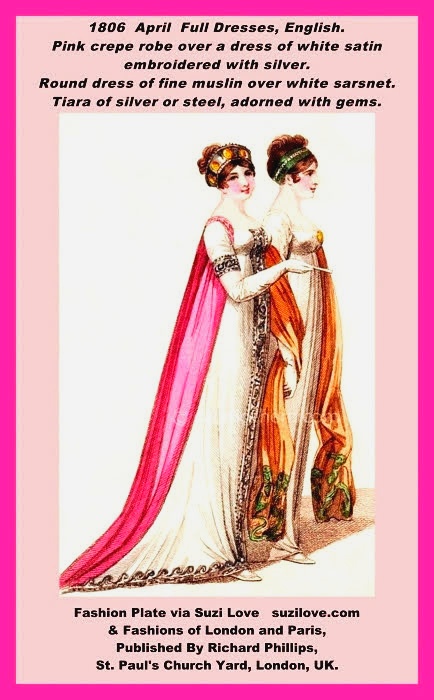
1806 April Two Ladies In Full Dress, English. Loose pink robe of undressed crepe over a dress of white satin, or sarsnet, embroidered with silver, sleeves plain and embroidered to correspond with dress. Round dress of fine muslin over white sarsnet. Broad lace let in down front and bottom. Bosom plain, trimmed with quilling of lace, ornamented with medallion or brooch. Long silk shawl, ends embroidered in colors. Tiara of silver or steel, adorned with gems. Fashion Plate via Fashions of London and Paris, Published By Richard Phillips, St. Paul’s Church Yard, London, UK.
Dress Full Dress: The most formal and complete ensemble, worn for day or night events, and includes the fullest range of accessories that could be added to the outfit to make the most impressive display.
Fabric Sarsnet: Also spelled ‘sarcenet’, is a lightweight silk that was often woven with small-scale decorative designs.
1800s White Evening Dress. Long train on the dress, gold sash, evening hair style, and carrying a fan. via The Museum of Fine Arts, Boston.
Definition Empire Style Dress: Named after the First Empire in France. Empire dresses had a low neckline and skirts started directly under the bust and flowed into the classical relaxed wide styles of Greece and Rome. This style of dress is associated with Jane Austen and her contemporaries as a high-waisted dress was worn most days. Cotton, silk or taffeta were the popular fabrics. Only the very wealthy could afford white dress in this style as the cottons were imported from India and had to be carefully cleaned, usually by a lady’s maid.
1802 Blue Riding Habit, French. Lady in a riding costume with a black fitted hat and a whip. Fashion Plate via Journal des Dames et des Modes, or Costume Parisien. Typical of the riding costumes worn by Jane Austen’s female contemporaries. The style is still in the Empire fashion of a high-waist with the skirt falling from just under the bust and worn under a matching short jacket or Spencer.
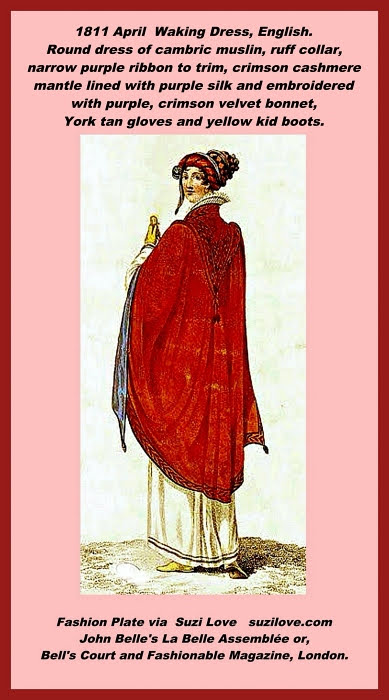
1811 April Waking Dress, English. Round dress of white cambric muslin with a ruff collar, trimmed round the bottom with narrow purple ribbon, cashmere crimson mantle confined close to the back and lined with purple silk, embroidered round the neck, cape, and sides with purple fancy border, deep cape falling from the shoulders, sloping to a narrow point, with tassels. Crimson velvet bonnet, turban front, and trimmed with purple to correspond. York tan gloves. Yellow kid boots. Fashion Plate via John Belle’s La Belle Assemblée or, Bell’s Court and Fashionable Magazine, London.