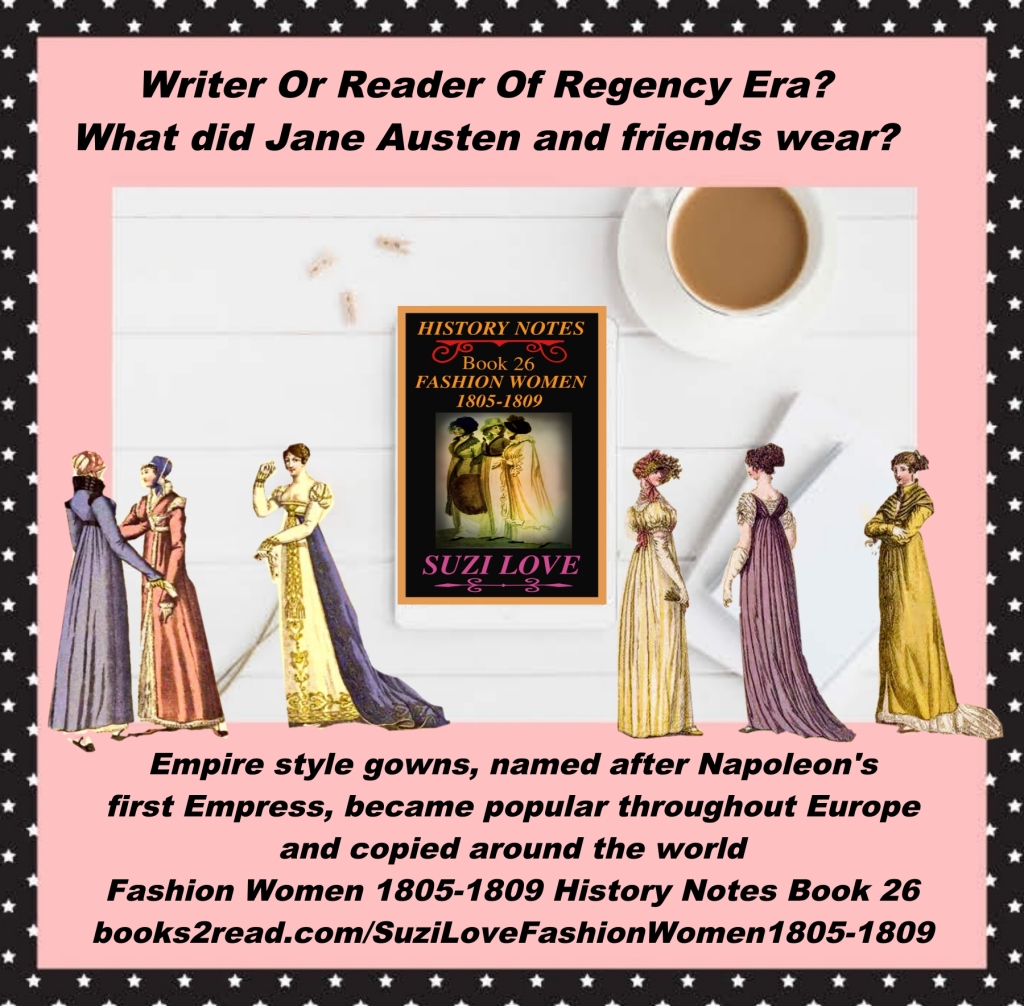
What did Jane Austen and friends wear? Early 1800s fashions were elegant and pretty with high waists and fabrics that were almost transparent. These Empire style gowns, named after Napoleon’s first Empress, became popular throughout Europe, and were then copied around the world. Colorful outwear was added to make an ensemble more attractive and warmer. History Notes Book 26 Fashion Women 1805-1809. https://books2read.com/SuziLoveFashionWomen1805-1809
What did Jane Austen and friends wear? Early 1800s fashions were elegant and pretty with high waists and fabrics that were almost transparent. These Empire style gowns, named after Napoleon’s first Empress, became popular throughout Europe, and were then copied around the world. Colorful outwear was added to make an ensemble more attractive and warmer.
https://books2read.com/SuziLoveFashionWomen1805-1809
Fashion Women 1805-1809 History Notes Book 26 What did Jane Austen and friends wear? https://books2read.com/SuziLoveFashionWomen1805-1809
What did Jane Austen and friends wear? Early 1800s fashions were elegant and pretty with high waists and fabrics that were almost transparent. These Empire style gowns, named after Napoleon’s first Empress, became popular throughout Europe, and were then copied around the world. Colorful outwear was added to make an ensemble more attractive and warmer. History Notes Book 26 Fashion Women 1805-1809. https://books2read.com/SuziLoveFashionWomen1805-1809
The Empire waist gown defined women’s fashion during the Regency Era. ‘Empire’ is the name given in France to the period when Napoleon built his French Empire. High-waisted, loose gowns were adopted by the aristocracy as a symbol of turning away from the fussy, elaborate and expensive clothing worn in the 1700s. Jean-Jaques Rousseau advocated copying peasants and returning to a simpler life and more natural fashions. Unrestricting clothing was part of the new Democracy in France and these simpler and flowing fashions were adopted all over Europe, including Britain and despite the continual wars being fought against France during the early 1800s. Not even war stopped fashions from being copied everywhere.
Fashion Women 1805-1809 History Notes Book 26
What did Jane Austen and friends wear? This book looks at early 1800s fashions, which were elegant and pretty with high waists and fabrics that were almost transparent. These Empire style gowns, named after Napoleon’s first Empress, became popular throughout Europe, and were then copied around the world. Colorful outwear was added to make an ensemble more attractive and warmer.
https://books2read.com/SuziLoveFashionWomen1805-1809HN_26_D2D_FsshionWomen1805-1809
1770 Yellow Silk Corset, Italian. Front and Back Lacing. By the 1770s, steel was being used in stays, which increased their strength, though not their flexibility. Credit Line: Gift of The Metropolitan Museum of Art, 1940 Accession Number:C.I.40.173.6a–e Metropolitan Museum, N.Y.C, U.S.A.
By the 1770s, steel was being used in stays, which increased their strength, though not their flexibility. With the tight lacing made possible by stronger stays, doctors and others voiced health concerns, such as this comment from a 1775 correspondence: “I hope Miss Sparrow will not fall into the absurd fashion of ye wasp-waisted ladies. Dr. Pringle declares he has had four of his patients martyrs to that folly (indeed wickedness), and when they were opened it was evident that their deaths were occasioned by straight lacing.” Although admonitions on the dangers of straight lacing are common in the eighteenth and nineteenth centuries, recent scholarship by Valerie Steele has called into question the reality of the many “death by tight lacing” stories of the period.
History Notes Book 15 shows how body wraps, stomachers and stays were worn during the 1700s, or Georgian Era, to create a variety of fashionable silhouettes to suit the elaborate fashions worn for court and daily life. https://books2read.com/SuziLoveCorsetBook15
1770 Yellow Corset, Italian. Front and Back Lacing. By the 1770s, steel was being used in stays, which increased their strength, though not their flexibility. via Metropolitan Museum NYC, U.S.Ametmuseum.org1770 Yellow Corset, Italian. Front and Back Lacing. By the 1770s, steel was being used in stays, which increased their strength, though not their flexibility. via Metropolitan Museum NYC, U.S.Ametmuseum.org